
How do you find the area of a sector?
Answer in short
A sector of angle θ is the fraction θ/360 of the whole circle, so its area is (θ/360) × πr², where r is the radius and θ is in degrees. Its arc is the same fraction of the circumference, (θ/360) × 2πr. The major sector is the rest of the circle: πr² minus the minor sector.
Stuck on a question? Take a photo and Lagnever AI explains it step by step. Try it for 7 days for ₹2. Get it on Google Play
What is a sector?
Draw a circle with centre O and two radii OA and OB. They cut the circular region into two pieces, each bounded by the two radii and an arc. Each piece is a sector. The smaller one (blue) is the minor sector OAPB, and ∠AOB = θ is its angle. The larger one (yellow) is the major sector OAQB, with angle 360° − θ.
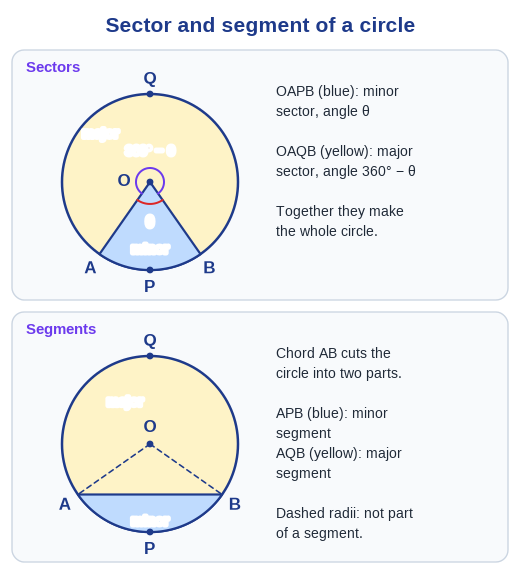
Unless a question says otherwise, “sector” means the minor sector.
How is the formula for the area found?
Use the unitary method, starting from the area of a circle.
- A full turn at the centre is 360°, and it covers the whole circle: area πr².
- So an angle of 1° at the centre covers πr²/360.
- An angle of θ covers θ times as much:
Area of a sector of angle θ = (θ/360) × πr²
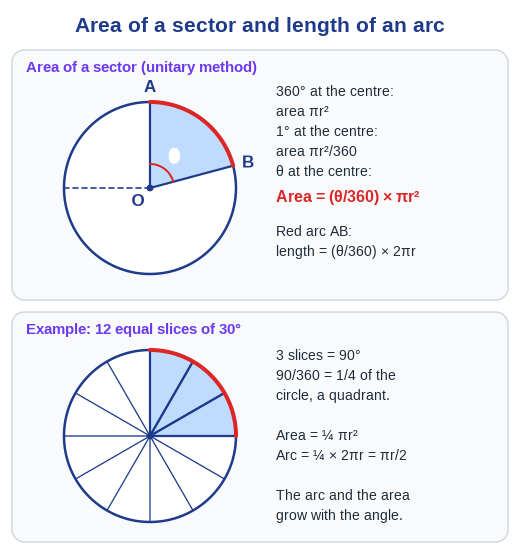
The fraction θ/360 is the share of the circle that the sector takes. A quadrant (90°) takes 90/360 = ¼, so its area is ¼πr².
How long is the arc of a sector?
The same steps work for length. The whole circle has length 2πr, so 1° of angle gives an arc of 2πr/360, and θ gives:
Length of the arc of a sector of angle θ = (θ/360) × 2πr
For example, in a circle of radius 21 cm an arc of 60° has length (1/6) × 2 × (22/7) × 21 = 22 cm, and the sector has area (1/6) × (22/7) × 441 = 231 cm².
Extra (not in the book): the perimeter of a sector is its arc plus the two radii, (θ/360) × 2πr + 2r. For the sector above it is 22 + 42 = 64 cm.
Example 1: a sector and its major sector
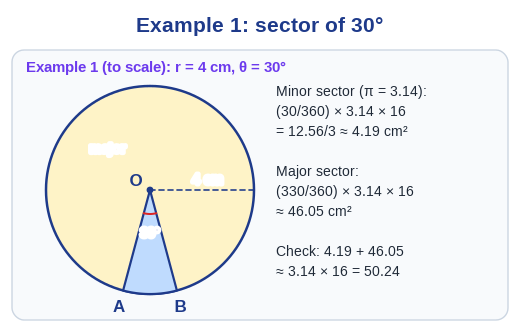
The book’s Example 1 (page 156) takes a circle of radius 4 cm and a sector of angle 30°, with π = 3.14.
- Sector = (30/360) × 3.14 × 4 × 4 = 12.56/3 ≈ 4.19 cm².
- Major sector = πr² − sector = 3.14 × 16 − 4.19 = 50.24 − 4.19 = 46.05 cm² (about 46.1 cm²).
- The other way: (330/360) × 3.14 × 16 ≈ 46.05 cm², the same answer.
Sectors in the exercise
Most of Exercise 11.1 is this one formula used in a story. The first three questions:
- Q1: radius 6 cm, angle 60°: (1/6) × (22/7) × 36 = 132/7 cm².
- Q2: circumference 22 cm, so r = 7/2 cm; the quadrant is ¼ × (22/7) × (49/4) = 77/8 cm².
- Q3: in 5 minutes the 14 cm minute hand turns 30° and sweeps (30/360) × (22/7) × 196 = 154/3 cm².
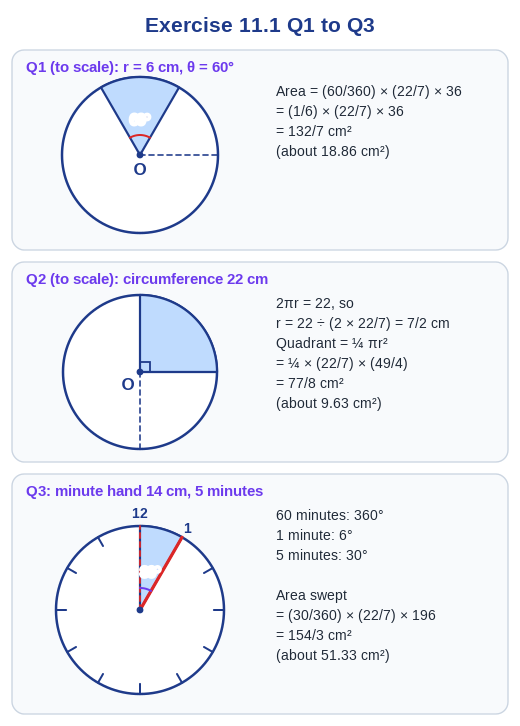
Later questions use it for a grazing horse (a quadrant), a brooch cut into 10 sectors of 36°, an umbrella with 8 sectors of 45°, two car wipers of 115° each, and a lighthouse beam of 80°.
Read next: the area of a segment, where a triangle is taken away from a sector. Every question is solved in the NCERT solutions, and the chapter notes give the full picture.
Practice
-
The area of a quadrant of a circle of radius 7 cm (π = 22/7) is:
Show answer
Answer: (b) 38.5 cm²
-
An arc of a circle of radius 21 cm makes 120° at the centre. Its length (π = 22/7) is:
Show answer
Answer: (b) 44 cm
-
A sector of a circle of radius 10 cm has angle 36°. With π = 3.14, its area is:
Show answer
Answer: (b) 31.4 cm²
-
Find the area of a sector of angle 60° in a circle of radius 6 cm, using π = 3.14.
Show answer
Answer: Area = (60/360) × 3.14 × 36 = (1/6) × 113.04 = 18.84 cm².
-
Extra: find the perimeter of a sector of angle 60° in a circle of radius 21 cm (π = 22/7).
Show answer
Answer: The perimeter is the arc plus the two radii. Arc = (60/360) × 2 × (22/7) × 21 = 22 cm. Perimeter = 22 + 21 + 21 = 64 cm.
Questions students ask
Why is the area of a sector (θ/360) × πr²?
The whole circle is a sector with 360° at the centre and area πr². Each degree at the centre gives an equal share, πr²/360, so θ degrees give θ shares: (θ/360) × πr². This is the unitary method the book uses.
What is the difference between a sector and a segment?
A sector is bounded by two radii and an arc, like a slice of pizza. A segment is bounded by a chord and an arc, like the piece cut off by one straight cut. A segment's area is the sector's area minus a triangle.
What is the angle swept by the minute hand in 5 minutes?
The minute hand turns 360° in 60 minutes, which is 6° per minute, so it sweeps 30° in 5 minutes. With a 14 cm hand the area swept is (30/360) × (22/7) × 196 = 154/3 cm².
Is the perimeter of a sector in the book?
No, the book gives only the area of a sector and the length of its arc. The perimeter (arc + 2r) is an Extra that follows from them.
Stuck on a question?
Take a photo and Lagnever AI explains it step by step. Try it for 7 days for ₹2.
Get it on Google Play Open in browser
For parents: after the trial, the plan renews monthly by UPI or card autopay. You can cancel anytime in the app.