
How do you find the area of a segment of a circle?
Answer in short
A segment is the part of a circle between a chord AB and its arc. Its area is the area of the sector OAB minus the area of triangle OAB: (θ/360) × πr² − area of △OAB. The major segment is πr² minus the minor segment. For θ = 60° the triangle is equilateral; for 90° it is right-angled.
Stuck on a question? Take a photo and Lagnever AI explains it step by step. Try it for 7 days for ₹2. Get it on Google Play
What is a segment?
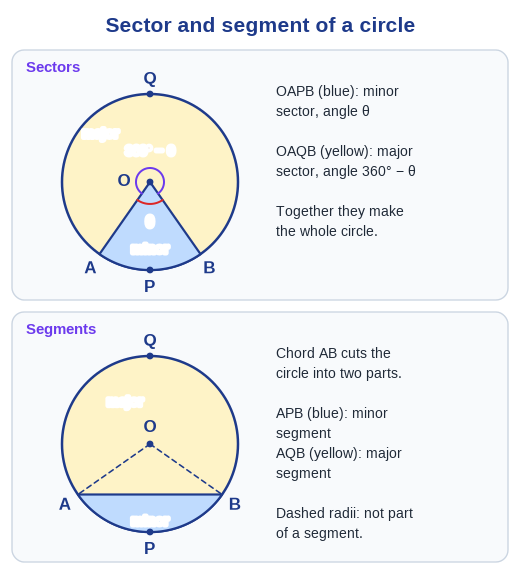
Draw a chord AB of a circle with centre O. The chord cuts the circular region into two pieces, each bounded by the chord and an arc. Each piece is a segment. The smaller one is the minor segment APB, and the larger one is the major segment AQB. Unless a question says otherwise, “segment” means the minor one.
How is the area of a segment found?
There is no new formula to learn. Join OA and OB. The sector OAPB now splits into the triangle OAB and the segment APB, so:
Area of the segment APB = area of the sector OAPB − area of △OAB = (θ/360) × πr² − area of △OAB
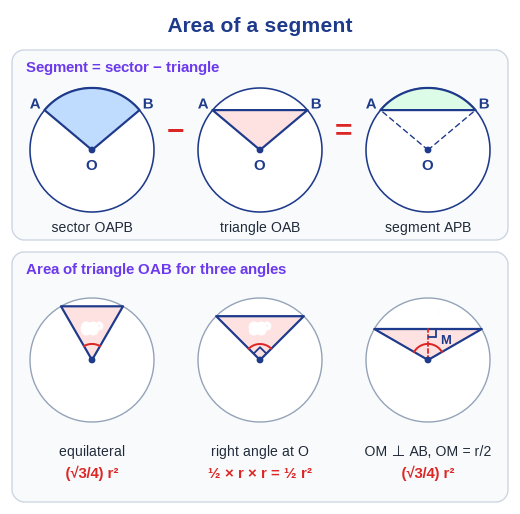
For the major segment, take the minor segment away from the whole circle: major segment = πr² − minor segment.
How do you find the area of triangle OAB?
OA = OB = r, so the triangle is isosceles. Three angles come up again and again:
- 60°: the base angles are equal and add up to 120°, so each is 60°. The triangle is equilateral with side r, and its area is (√3/4) r².
- 90°: the triangle is right-angled at O, with legs r and r. Its area is ½ r².
- 120°: draw OM ⊥ AB. Triangles OMA and OMB are congruent (RHS), so M is the midpoint of AB and ∠AOM = ∠BOM = 60°. Then OM = r cos 60° = r/2 and AM = r sin 60° = (√3/2) r, so AB = √3 r and the area is ½ × √3 r × r/2 = (√3/4) r².
Example 2: a segment of 120°
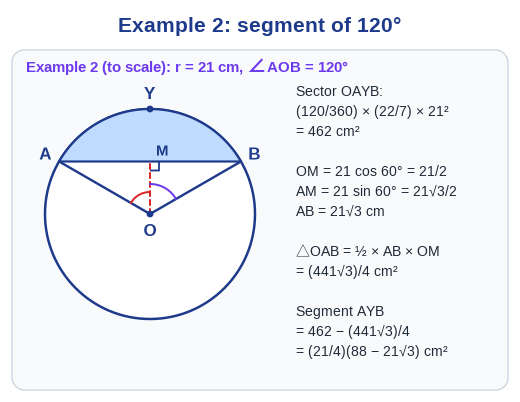
The book’s Example 2 (pages 157–158) asks for the segment AYB of a circle of radius 21 cm with ∠AOB = 120°, using π = 22/7.
- Sector: (120/360) × (22/7) × 21 × 21 = 462 cm².
- Triangle: draw OM ⊥ AB. ∠AOM = 60°, so OM = 21 × ½ = 21/2 cm and AM = 21 × (√3/2) = 21√3/2 cm. Then AB = 21√3 cm and area of △OAB = ½ × 21√3 × 21/2 = (441√3)/4 cm².
- Segment: 462 − (441√3)/4 = (21/4)(88 − 21√3) cm², which is about 271.04 cm².
Segments in the exercise
- Q4: radius 10 cm, 90°, π = 3.14: segment = 78.5 − 50 = 28.5 cm².
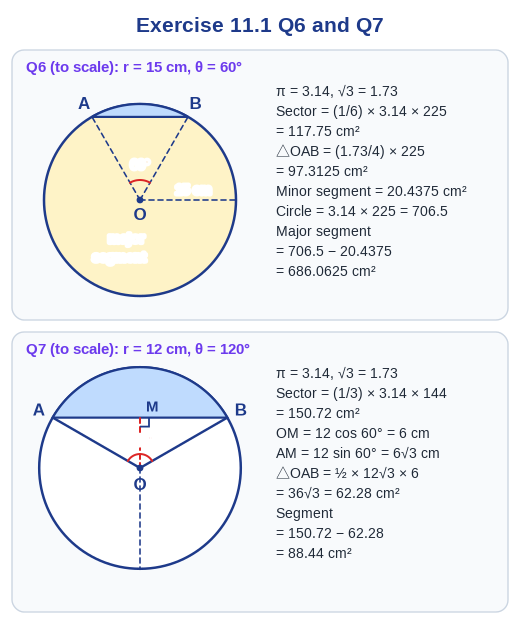
- Q6: radius 15 cm, 60°, π = 3.14, √3 = 1.73: minor segment = 117.75 − 97.3125 = 20.4375 cm², major segment = 706.5 − 20.4375 = 686.0625 cm².
- Q7: radius 12 cm, 120°: segment = 150.72 − 62.28 = 88.44 cm².
- Q13: the six designs of a table cover are six segments of 60°.
A short example of a major segment
Take a chord that makes 90° at the centre of a circle of radius 14 cm (π = 22/7). Sector = ¼ × (22/7) × 196 = 154 cm² and △OAB = ½ × 14 × 14 = 98 cm², so the minor segment is 154 − 98 = 56 cm². The whole circle is (22/7) × 196 = 616 cm², so the major segment is 616 − 56 = 560 cm². Check: major sector (462 cm²) + triangle (98 cm²) = 560 cm², the same answer.
Read the area of a sector page first if the sector formula is new. All the questions are solved in the NCERT solutions, and the chapter notes give the full picture.
Practice
-
The area of a segment equals:
Show answer
Answer: (b) sector − triangle
-
A chord of a circle of radius 10 cm makes 60° at the centre. The area of △OAB is:
Show answer
Answer: (b) 25√3 cm²
-
A chord makes 90° at the centre of a circle of radius 14 cm. The area of the minor segment (π = 22/7) is:
Show answer
Answer: (a) 56 cm²
-
A chord of a circle of radius 12 cm makes 120° at the centre. Find the area of △OAB.
Show answer
Answer: Draw OM ⊥ AB. Then ∠AOM = 60°, OM = 12 cos 60° = 6 cm and AM = 12 sin 60° = 6√3 cm, so AB = 12√3 cm. Area = ½ × 12√3 × 6 = 36√3 cm² (62.28 cm² with √3 = 1.73).
-
The minor segment of a circle of radius 15 cm has area 20.4375 cm². Find the major segment, using π = 3.14.
Show answer
Answer: Major segment = πr² − minor segment = 3.14 × 225 − 20.4375 = 706.5 − 20.4375 = 686.0625 cm².
Questions students ask
Why is the segment equal to sector minus triangle?
Join A and B to the centre O. The sector OAPB is then cut by the chord AB into two pieces: the triangle OAB (between the radii and the chord) and the segment APB (between the chord and the arc). Taking the triangle away leaves the segment.
How do I find the area of triangle OAB when the angle is 120°?
Draw OM perpendicular to AB. Since OA = OB, the triangles OMA and OMB are congruent (RHS), so M is the midpoint of AB and ∠AOM = 60°. Then OM = r cos 60° and AM = r sin 60°, and the area is ½ × AB × OM.
Is there one formula for the triangle for any angle?
Extra, not in the Class 10 book: the area of △OAB is ½ r² sin θ for any angle θ. For 60°, 90° and 120° it gives the same results as the table on this page.
Do I need to give the answer as a decimal?
Only if the question gives decimal values such as π = 3.14 or √3 = 1.73. Example 2 and Question 5 of Exercise 11.1 keep √3, so the answer is left as an expression such as 231 − 441√3/4 cm².
Stuck on a question?
Take a photo and Lagnever AI explains it step by step. Try it for 7 days for ₹2.
Get it on Google Play Open in browser
For parents: after the trial, the plan renews monthly by UPI or card autopay. You can cancel anytime in the app.