
Class 10 Maths Chapter 11: Areas Related to Circles Notes
This chapter in five lines
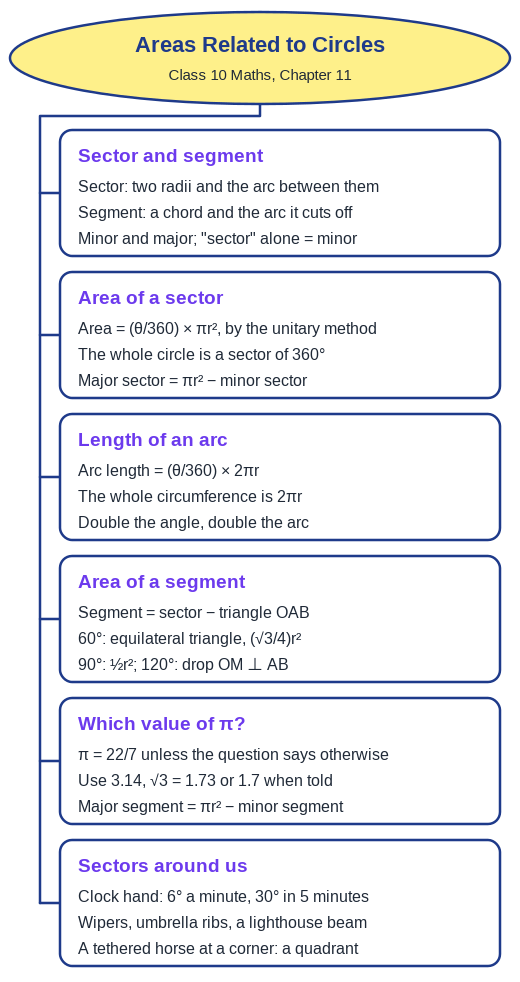
A sector is the part of a circle between two radii and their arc; a segment is the part between a chord and its arc. For a circle of radius r and an angle θ (in degrees) at the centre, the area of the sector is (θ/360) × πr², the length of its arc is (θ/360) × 2πr, and the area of the segment is the area of the sector minus the area of triangle OAB.
What is this chapter about?
You already know the two basic facts about a circle of radius r: its length, the circumference, is 2πr, and the area of the circular region is πr². This chapter asks about a part of a circle. If a pizza is cut by two straight cuts from the centre, how big is one slice? How long is its curved edge? And if a round table cover is trimmed along a straight line, how much cloth is cut away?
The chapter is short, 7 pages, with one section, two worked examples and one exercise of 14 questions.
What are a sector and a segment?
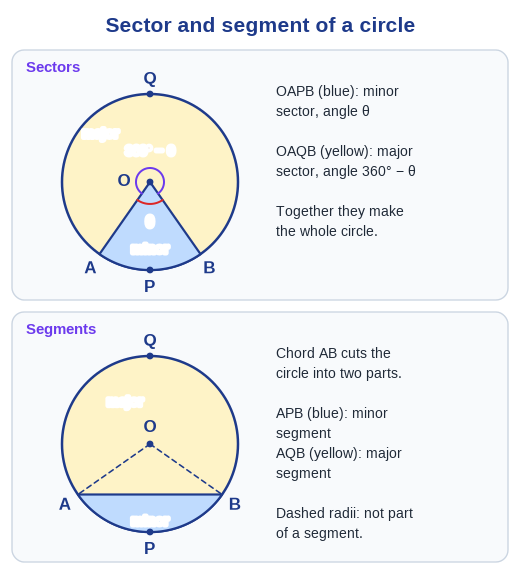
- A sector is the part of the circular region between two radii OA and OB and the arc AB. The angle AOB at the centre is the angle of the sector.
- A segment is the part of the circular region between a chord AB and the arc AB.
Two radii cut a circle into two sectors. The smaller one is the minor sector with angle θ; the larger one is the major sector with angle 360° − θ. In the same way a chord cuts the circle into a minor segment and a major segment. When a question says just “sector” or “segment”, it means the minor one.
How do you find the area of a sector?
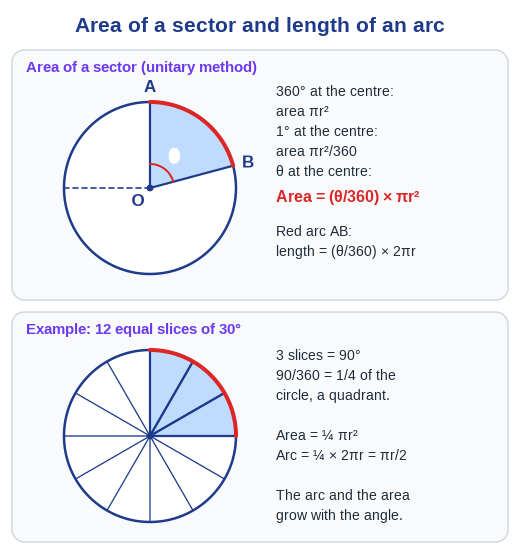
Think of the whole circle as a sector with an angle of 360° at the centre. Its area is πr². By the unitary method, an angle of 1° gives πr²/360, and an angle of θ gives θ times as much:
Area of a sector of angle θ = (θ/360) × πr²
So a sector of 90° (a quadrant) is a quarter of the circle, a sector of 60° is a sixth, and so on. The area of the major sector is what is left: πr² − area of the minor sector, which is the same as ((360 − θ)/360) × πr².
Example 1 of the book (page 156): radius 4 cm, angle 30°, π = 3.14. The sector is (30/360) × 3.14 × 16 = 12.56/3 ≈ 4.19 cm², and the major sector is about 50.24 − 4.19 = 46.05 cm². More on the area of a sector page.
How long is the arc of a sector?
The same reasoning works for length. The whole circle, with 360° at the centre, has length 2πr. So:
Length of the arc of a sector of angle θ = (θ/360) × 2πr
For a circle of radius 21 cm, an arc that makes 60° at the centre is (60/360) × 2 × (22/7) × 21 = 22 cm long (Exercise 11.1, Question 5).
How do you find the area of a segment?
Join the ends of the chord to the centre. The sector OAPB is made of two pieces: the triangle OAB and the segment APB. So:
Area of the segment APB = area of the sector OAPB − area of △OAB
and the major segment = πr² − area of the minor segment.
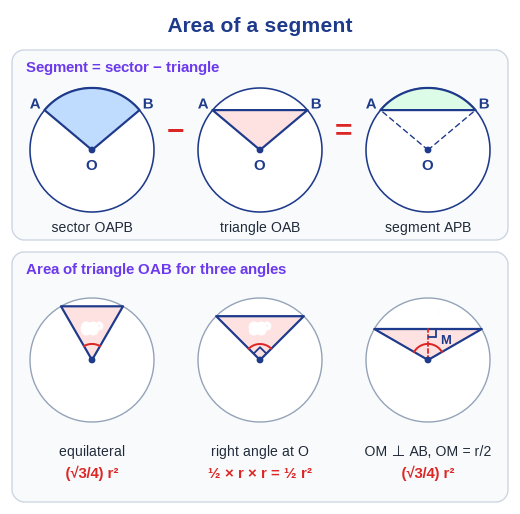
The only new work is the triangle. OA = OB = r, so △OAB is isosceles:
| Angle at the centre | Triangle OAB | Its area |
|---|---|---|
| 60° | equilateral, side r | (√3/4) r² |
| 90° | right-angled at O | ½ × r × r = ½ r² |
| 120° | drop OM ⊥ AB; OM = r cos 60° = r/2, AM = r sin 60° = (√3/2) r | ½ × AB × OM = (√3/4) r² |
Example 2 of the book (pages 157–158) does the 120° case for r = 21 cm: the sector is 462 cm², the triangle is (441√3)/4 cm², and the segment is (21/4)(88 − 21√3) cm². See the area of a segment page for the steps.
Where do sectors appear in real life?
The exercise is full of them, and they all reduce to one formula:
- A clock’s minute hand turns 360° in 60 minutes, so 6° a minute and 30° in 5 minutes.
- A horse tied at the corner of a square field grazes a quadrant, as long as the rope is shorter than the side.
- The ribs of an umbrella, the diameters of a brooch and the spokes of a wheel cut a circle into equal sectors.
- A car wiper and a lighthouse beam each sweep a sector.
Before we move on
The 120° triangle uses sin 60° = √3/2 and cos 60° = 1/2 from Chapter 8, trigonometric ratios. The current book has no section on areas of combinations of plane figures, so this chapter is only about sectors and segments. Both examples and all 14 questions of Exercise 11.1 are worked out in the NCERT solutions for Chapter 11.
Key terms
| Term | Meaning |
|---|---|
| Circumference | The length of the whole circle, 2πr for a circle of radius r. |
| Area of a circle | The area of the circular region (disc), πr². |
| Sector | The part of the circular region enclosed by two radii and the arc between them. |
| Angle of a sector | The angle between the two radii at the centre, such as ∠AOB. It is written θ and measured in degrees. |
| Arc | A part of the circle between two of its points. The arc of a sector of angle θ is the fraction θ/360 of the circumference. |
| Segment | The part of the circular region enclosed by a chord and the arc that the chord cuts off. |
| Minor and major | A chord or two radii split the circle into a smaller (minor) and a larger (major) part. A sector or segment means the minor one unless the question says otherwise. |
| Quadrant | A sector of angle 90°, one quarter of the circle. |
| Unitary method | Find the value for one unit, then multiply. Here: 360° gives πr², so 1° gives πr²/360 and θ gives θ times that. |
Topics in this chapter
Practice
-
The area of a sector of angle θ in a circle of radius r is:
Show answer
Answer: (b) (θ/360) × πr²
-
The length of the arc of a sector of angle 90° in a circle of radius 14 cm (π = 22/7) is:
Show answer
Answer: (b) 22 cm
-
The angle of the major sector that goes with a minor sector of 75° is:
Show answer
Answer: (c) 285°
-
Find the area of a sector of angle 45° in a circle of radius 14 cm. (π = 22/7)
Show answer
Answer: Area = (45/360) × (22/7) × 14 × 14 = (1/8) × 616 = 77 cm².
-
A chord subtends 90° at the centre of a circle of radius 14 cm. Find the area of the minor segment. (π = 22/7)
Show answer
Answer: Sector = ¼ × (22/7) × 196 = 154 cm². Triangle OAB is right-angled at O, so its area is ½ × 14 × 14 = 98 cm². Segment = 154 − 98 = 56 cm².
Questions students ask
What are the main topics of Class 10 Maths Chapter 11?
One section, 11.1 Areas of Sector and Segment of a Circle: what sectors and segments are, the area of a sector, the length of an arc and the area of a segment, with two worked examples and a three-point summary. The chapter runs from page 154 to page 160 of the 2026-27 book.
How many exercises does Chapter 11 have?
One. Exercise 11.1 has 14 questions: sectors, arcs and segments, the major sector and major segment, and word problems on a clock, a grazing horse, a brooch, an umbrella, car wipers, a lighthouse and a table cover. The last one is an MCQ. All are solved on the NCERT solutions page.
Are areas of combinations of plane figures in the 2026-27 book?
No. The rationalised book keeps only section 11.1 on sectors and segments, followed by the summary. There is no section on combinations of figures in this chapter.
Which value of π should I use?
The value the question gives. Exercise 11.1 says to use π = 22/7 unless stated otherwise, and Questions 4, 6, 7, 8 and 12 ask for 3.14. Using another value gives a slightly different decimal.
Stuck on a question?
Take a photo and Lagnever AI explains it step by step. Try it for 7 days for ₹2.
Get it on Google Play Open in browser
For parents: after the trial, the plan renews monthly by UPI or card autopay. You can cancel anytime in the app.