
NCERT Solutions Class 10 Maths Chapter 11: Areas Related to Circles
Answers to the two worked examples and every question of Exercise 11.1 in Chapter 11, Areas Related to Circles, from Mathematics, the Class 10 NCERT textbook. Page numbers follow the 2026-27 reprint (pages 154–160). The exercise questions are quoted from the book; the examples are restated in short and labelled by number and page. The chapter has no other in-text questions. The book’s figures are not copied: every figure here is our own drawing, computed from the data in the question, with each sector angle drawn true and each shaded area checked against its formula by script. Every answer was checked by exact calculation with the value of π (and √3) that the question asks for, and all answers match the answer key at the end of the book (one unit slip in the key is noted at Question 8). Short notes: Chapter 11 notes.
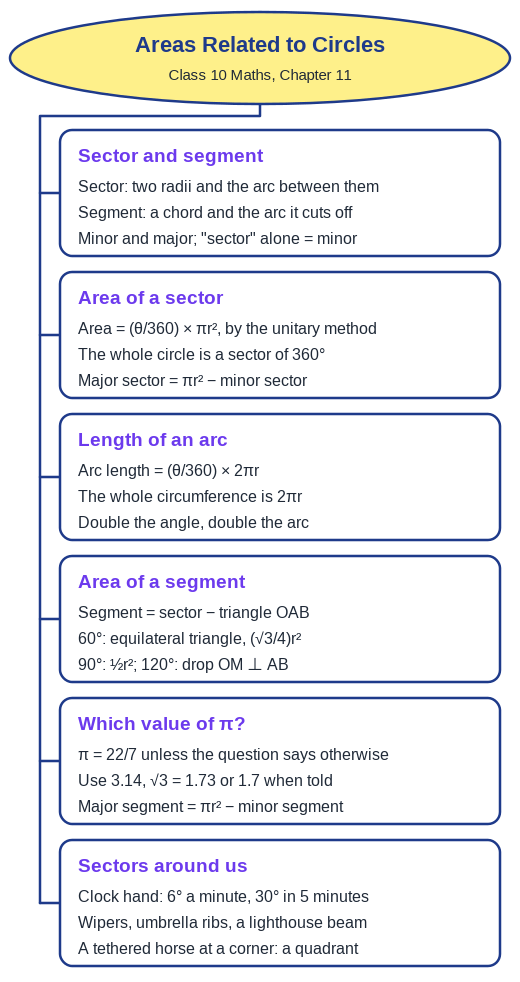
The formulas used (pages 155–156)
For a circle of radius r and an angle θ (in degrees) at the centre:
- Area of the sector = (θ/360) × πr²
- Length of its arc = (θ/360) × 2πr
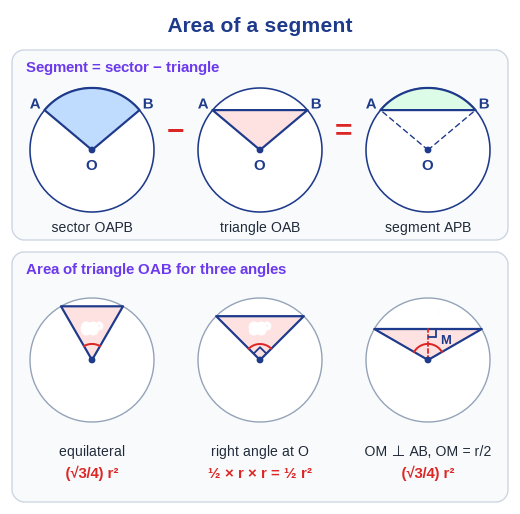
- Area of the segment = area of the sector − area of △OAB
- Major sector = πr² − minor sector; major segment = πr² − minor segment
Examples 1 and 2 (pages 156–158)
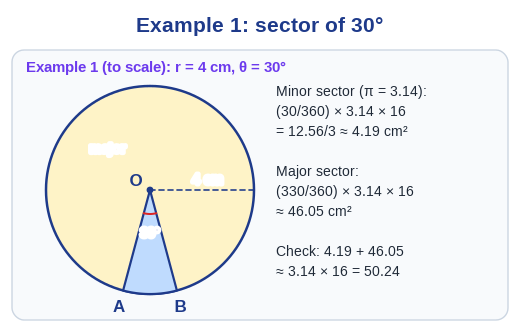
Example 1 (page 156): the area of a sector of angle 30° in a circle of radius 4 cm, and of the major sector, with π = 3.14.
Sector = (30/360) × 3.14 × 4 × 4 = 12.56/3 ≈ 4.19 cm². Major sector = πr² − sector = 3.14 × 16 − 4.19 = 50.24 − 4.19 = 46.05 cm², about 46.1 cm². Or directly: ((360 − 30)/360) × 3.14 × 16 = (330/360) × 50.24 ≈ 46.05 cm².
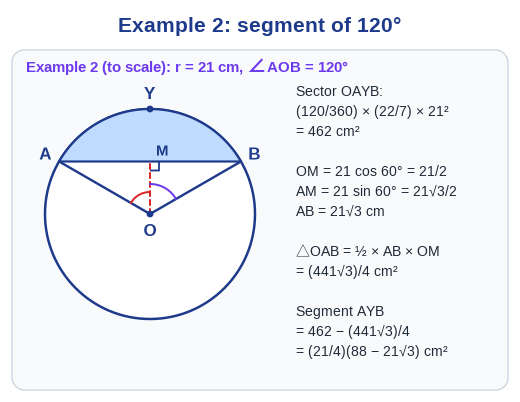
Example 2 (pages 157–158): the segment AYB of a circle of radius 21 cm with ∠AOB = 120°, π = 22/7.
Segment AYB = sector OAYB − △OAB. Sector OAYB = (120/360) × (22/7) × 21 × 21 = 462 cm². For the triangle, draw OM ⊥ AB. OA = OB, so △AMO ≅ △BMO (RHS): M is the midpoint of AB and ∠AOM = ∠BOM = 60°. In △OMA: OM/OA = cos 60° = ½, so OM = 21/2 cm; AM/OA = sin 60° = √3/2, so AM = 21√3/2 cm and AB = 21√3 cm. Area of △OAB = ½ × AB × OM = ½ × 21√3 × 21/2 = (441√3)/4 cm². So segment AYB = 462 − (441√3)/4 = (21/4)(88 − 21√3) cm² (about 271.04 cm²).
Exercise 11.1 (pages 158–159)
The book says: “Unless stated otherwise, use π = 22/7.”
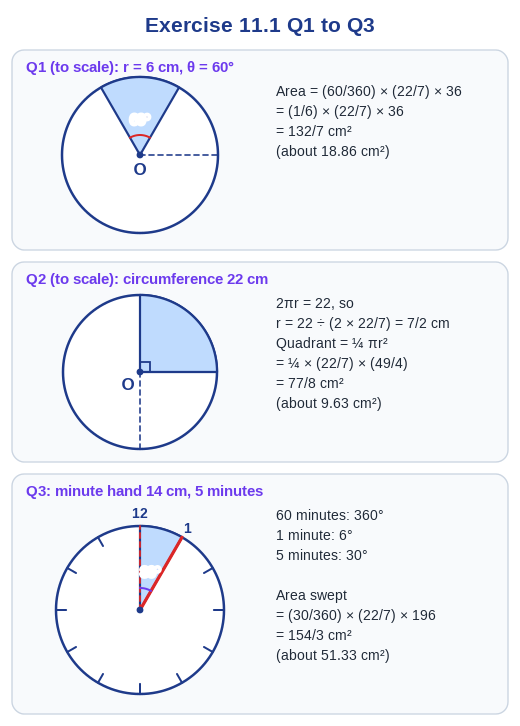
1. “Find the area of a sector of a circle with radius 6 cm if angle of the sector is 60°.”
Given: radius r = 6 cm, angle of the sector θ = 60°.
To find: area of the sector.
- Area of a sector = (θ/360) × πr².
- Area = (60/360) × (22/7) × 6 × 6.
- = (1/6) × (22/7) × 36 = 132/7.
Answer: area of the sector = 132/7 cm² (about 18.86 cm²).
2. “Find the area of a quadrant of a circle whose circumference is 22 cm.”
Given: circumference = 22 cm.
To find: area of a quadrant (a quarter of the circle, a sector of 90°).
- Circumference = 2πr, so 2 × (22/7) × r = 22.
- So r = 22 × 7 ÷ 44 = 7/2 cm.
- Area of the quadrant = ¼ × πr² = ¼ × (22/7) × (7/2) × (7/2) = 77/8.
Answer: area of the quadrant = 77/8 cm² (9.625 cm²).
3. “The length of the minute hand of a clock is 14 cm. Find the area swept by the minute hand in 5 minutes.”
Given: length of the minute hand r = 14 cm, time = 5 minutes.
To find: area swept in 5 minutes.
- The minute hand turns 360° in 60 minutes, so it turns 6° in 1 minute.
- In 5 minutes it turns 5 × 6° = 30°. So it sweeps a sector of angle 30° and radius 14 cm.
- Area = (30/360) × (22/7) × 14 × 14 = (1/12) × 616 = 154/3.
Answer: area swept = 154/3 cm² (about 51.33 cm²).
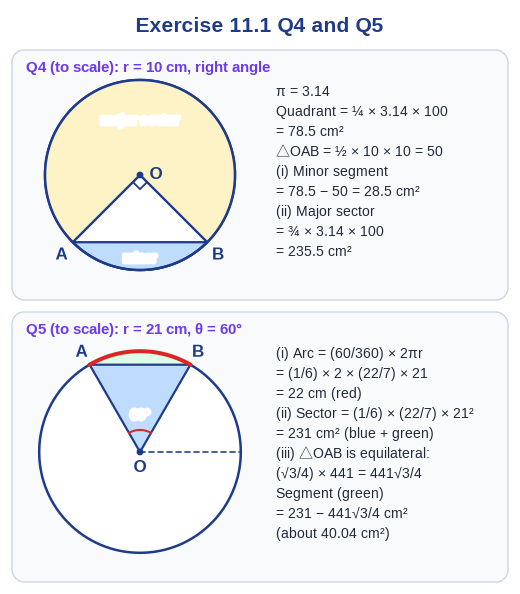
4. “A chord of a circle of radius 10 cm subtends a right angle at the centre. Find the area of the corresponding : (i) minor segment (ii) major sector. (Use π = 3.14)”
Given: r = 10 cm, chord AB with ∠AOB = 90°, π = 3.14.
To find: (i) area of the minor segment, (ii) area of the major sector.
- Minor sector OAB = (90/360) × 3.14 × 10 × 10 = 78.5 cm².
- △OAB is right-angled at O, so its area = ½ × base × height = ½ × 10 × 10 = 50 cm².
- A segment is the part between the chord and the arc. Minor segment = sector − triangle = 78.5 − 50 = 28.5 cm².
- The major sector has angle 360° − 90° = 270°. Its area = (270/360) × 3.14 × 100 = 235.5 cm². (Check: whole circle 314 − 78.5 = 235.5.)
Answer: (i) minor segment = 28.5 cm²; (ii) major sector = 235.5 cm².
5. “In a circle of radius 21 cm, an arc subtends an angle of 60° at the centre. Find: (i) the length of the arc (ii) area of the sector formed by the arc (iii) area of the segment formed by the corresponding chord”
Given: r = 21 cm, θ = 60°.
To find: (i) arc length, (ii) area of the sector, (iii) area of the segment.
- Arc length = (θ/360) × 2πr = (1/6) × 2 × (22/7) × 21 = 22 cm.
- Area of the sector = (θ/360) × πr² = (1/6) × (22/7) × 21 × 21 = (1/6) × 1386 = 231 cm².
- In △OAB, OA = OB = 21 cm, so the angles at A and B are equal. They add up to 180° − 60° = 120°, so each is 60°. So △OAB is equilateral with side 21 cm.
- Area of an equilateral triangle = (√3/4) × side² = (√3/4) × 441 = (441√3)/4 cm².
- Segment = sector − triangle = 231 − (441√3)/4.
Answer: (i) 22 cm; (ii) 231 cm²; (iii) (231 − 441√3/4) cm² (about 40.04 cm²).
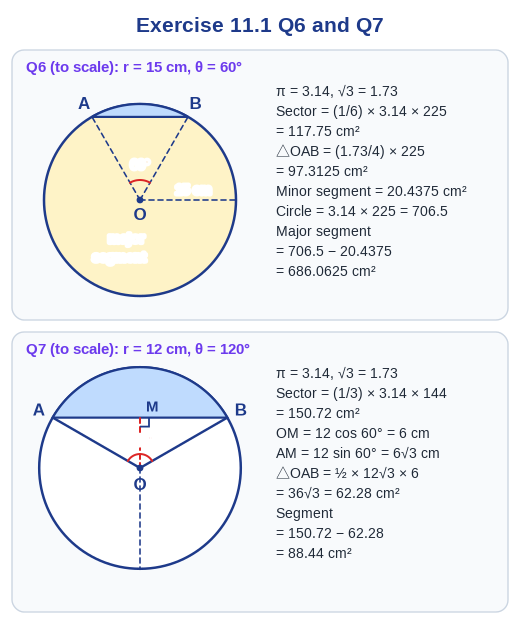
6. “A chord of a circle of radius 15 cm subtends an angle of 60° at the centre. Find the areas of the corresponding minor and major segments of the circle. (Use π = 3.14 and √3 = 1.73)”
Given: r = 15 cm, θ = 60°, π = 3.14, √3 = 1.73.
To find: areas of the minor and the major segment.
- Sector = (60/360) × 3.14 × 15 × 15 = (1/6) × 706.5 = 117.75 cm².
- △OAB is equilateral (same reason as Question 5), side 15 cm. Area = (1.73/4) × 225 = 97.3125 cm².
- Minor segment = 117.75 − 97.3125 = 20.4375 cm².
- Area of the circle = 3.14 × 225 = 706.5 cm².
- Major segment = circle − minor segment = 706.5 − 20.4375 = 686.0625 cm².
Answer: minor segment = 20.4375 cm²; major segment = 686.0625 cm².
7. “A chord of a circle of radius 12 cm subtends an angle of 120° at the centre. Find the area of the corresponding segment of the circle. (Use π = 3.14 and √3 = 1.73)”
Given: r = 12 cm, θ = 120°, π = 3.14, √3 = 1.73.
To find: area of the segment.
- Sector = (120/360) × 3.14 × 12 × 12 = (1/3) × 452.16 = 150.72 cm².
- Draw OM ⊥ AB. As in Example 2, OM cuts the 120° angle into two angles of 60°.
- In right △OMA: OM = 12 cos 60° = 6 cm and AM = 12 sin 60° = 6√3 cm. So AB = 2 × AM = 12√3 cm.
- Area of △OAB = ½ × AB × OM = ½ × 12√3 × 6 = 36√3 = 36 × 1.73 = 62.28 cm².
- Segment = 150.72 − 62.28 = 88.44 cm².
Answer: area of the segment = 88.44 cm².
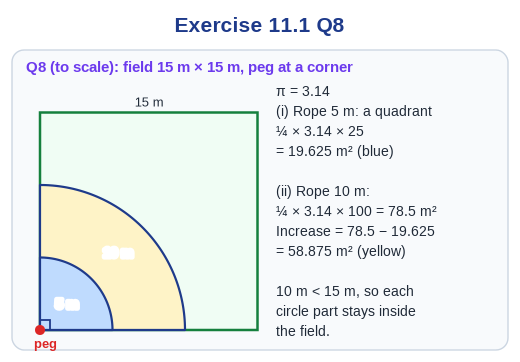
8. “A horse is tied to a peg at one corner of a square shaped grass field of side 15 m by means of a 5 m long rope (see Fig. 11.8). Find (i) the area of that part of the field in which the horse can graze. (ii) the increase in the grazing area if the rope were 10 m long instead of 5 m. (Use π = 3.14)”
Given: square field of side 15 m, rope 5 m (then 10 m), π = 3.14.
To find: (i) grazing area with the 5 m rope, (ii) increase in area with the 10 m rope.
- The corner of a square is 90°. The rope (5 m or 10 m) is shorter than the side (15 m). So the horse grazes a quadrant (a 90° sector) with the rope as radius.
- With r = 5 m: area = ¼ × 3.14 × 5 × 5 = 19.625 m².
- With r = 10 m: area = ¼ × 3.14 × 10 × 10 = 78.5 m².
- Increase = 78.5 − 19.625 = 58.875 m².
Answer: (i) 19.625 m²; (ii) increase = 58.875 m².
Note: the answer key prints 58.875 cm² for (ii). The field and rope are in metres, so the unit is m².
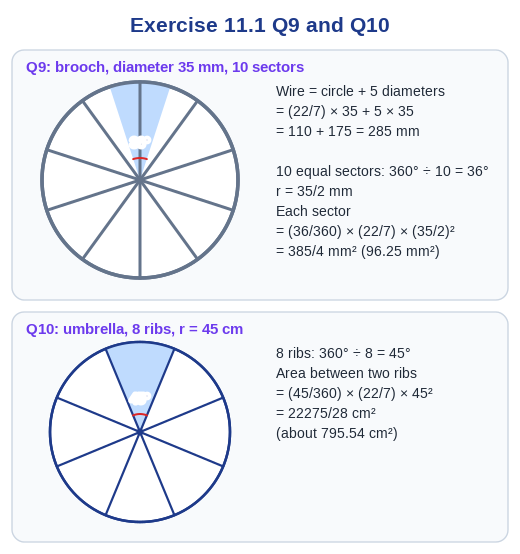
9. “A brooch is made with silver wire in the form of a circle with diameter 35 mm. The wire is also used in making 5 diameters which divide the circle into 10 equal sectors as shown in Fig. 11.9. Find : (i) the total length of the silver wire required. (ii) the area of each sector of the brooch.”
Given: diameter = 35 mm, so r = 35/2 mm; 5 diameters make 10 equal sectors.
To find: (i) total length of wire, (ii) area of each sector.
- Wire = circumference + 5 diameters.
- Circumference = π × diameter = (22/7) × 35 = 110 mm. Five diameters = 5 × 35 = 175 mm.
- Total wire = 110 + 175 = 285 mm.
- Each sector has angle 360° ÷ 10 = 36°.
- Area of one sector = (36/360) × (22/7) × (35/2) × (35/2) = (1/10) × (22/7) × (1225/4) = 385/4 mm².
Answer: (i) 285 mm; (ii) 385/4 mm² (96.25 mm²).
10. “An umbrella has 8 ribs which are equally spaced (see Fig. 11.10). Assuming umbrella to be a flat circle of radius 45 cm, find the area between the two consecutive ribs of the umbrella.”
Given: 8 equally spaced ribs, r = 45 cm.
To find: area between two consecutive ribs.
- 8 ribs cut the circle into 8 equal sectors. Each angle = 360° ÷ 8 = 45°.
- Area of one sector = (45/360) × (22/7) × 45 × 45 = (1/8) × (22/7) × 2025 = 22275/28.
Answer: area between two ribs = 22275/28 cm² (about 795.54 cm²).
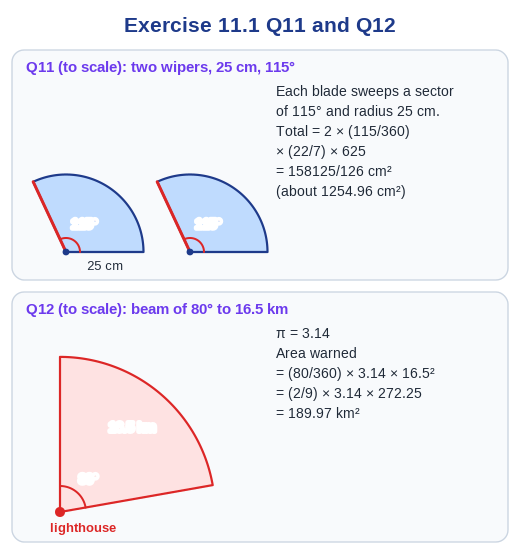
11. “A car has two wipers which do not overlap. Each wiper has a blade of length 25 cm sweeping through an angle of 115°. Find the total area cleaned at each sweep of the blades.”
Given: 2 wipers, blade length r = 25 cm, angle θ = 115°, no overlap.
To find: total area cleaned in one sweep.
- Each blade sweeps a sector of radius 25 cm and angle 115°.
- The wipers do not overlap, so the two areas simply add.
- Total = 2 × (115/360) × (22/7) × 25 × 25 = (23/36) × (22/7) × 625 = 158125/126.
Answer: total area cleaned = 158125/126 cm² (about 1254.96 cm²).
12. “To warn ships for underwater rocks, a lighthouse spreads a red coloured light over a sector of angle 80° to a distance of 16.5 km. Find the area of the sea over which the ships are warned. (Use π = 3.14)”
Given: sector of angle θ = 80°, radius r = 16.5 km, π = 3.14.
To find: area of the sea covered by the light.
- Area = (80/360) × 3.14 × 16.5 × 16.5.
- = (2/9) × 3.14 × 272.25 = 3.14 × 60.5 = 189.97.
Answer: area of the sea = 189.97 km².
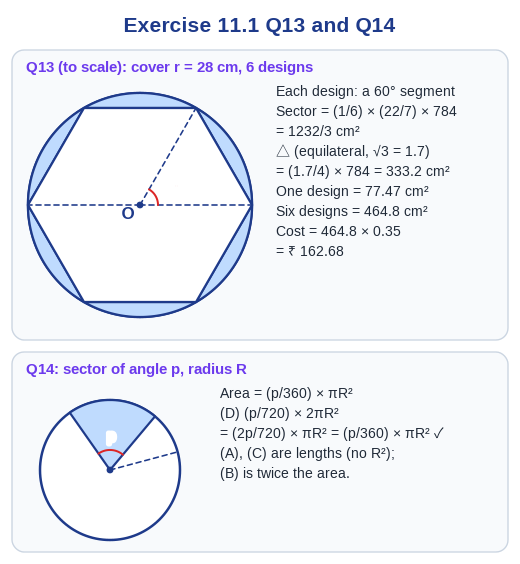
13. “A round table cover has six equal designs as shown in Fig. 11.11. If the radius of the cover is 28 cm, find the cost of making the designs at the rate of ₹ 0.35 per cm². (Use √3 = 1.7)”
Given: r = 28 cm, 6 equal designs, rate ₹ 0.35 per cm², √3 = 1.7, π = 22/7.
To find: cost of making the designs.
- The designs lie between the circle and a regular hexagon whose corners are on the circle. Each side of the hexagon is a chord that makes 360° ÷ 6 = 60° at the centre. So each design is a 60° segment.
- Sector = (60/360) × (22/7) × 28 × 28 = 1232/3 cm² (about 410.67 cm²).
- △OAB is equilateral with side 28 cm. Area = (1.7/4) × 784 = 333.2 cm².
- One design = 1232/3 − 333.2 ≈ 77.47 cm².
- Six designs = 6 × 1232/3 − 6 × 333.2 = 2464 − 1999.2 = 464.8 cm².
- Cost = 464.8 × 0.35 = ₹ 162.68.
Answer: cost of making the designs = ₹ 162.68.
14. “Tick the correct answer in the following : Area of a sector of angle p (in degrees) of a circle with radius R is (A) p/180 × 2πR (B) p/180 × πR² (C) p/360 × 2πR (D) p/720 × 2πR²”
- Area of a sector of angle p = (p/360) × πR².
- Option (D): (p/720) × 2πR² = (2p/720) × πR² = (p/360) × πR². This is the same.
- (A) and (C) have R, not R², so they are lengths ((C) is the arc length). (B) is twice the area.
Answer: (D).
Chapter summary (page 160)
The book ends with three points: the length of an arc of a sector of angle θ, (θ/360) × 2πr; the area of a sector, (θ/360) × πr²; and the area of a segment, sector minus the corresponding triangle. Each is used above and explained in the chapter notes, the area of a sector and the area of a segment pages.
Practice
-
The minute hand of a clock is 7 cm long. The area it sweeps in 15 minutes (π = 22/7) is:
Show answer
Answer: (b) 38.5 cm²
-
A circle has circumference 44 cm. The area of a quadrant of it (π = 22/7) is:
Show answer
Answer: (b) 38.5 cm²
-
An umbrella with 10 equally spaced ribs is a flat circle of radius 35 cm. The angle between two consecutive ribs is:
Show answer
Answer: (c) 36°
-
A chord of a circle of radius 14 cm makes 90° at the centre. Find the areas of the minor and the major segment. (π = 22/7)
Show answer
Answer: Sector = ¼ × (22/7) × 196 = 154 cm²; △OAB = ½ × 14 × 14 = 98 cm²; minor segment = 154 − 98 = 56 cm². Circle = (22/7) × 196 = 616 cm², so the major segment = 616 − 56 = 560 cm².
-
A cow is tied at a corner of a rectangular field 20 m by 16 m with a 14 m rope. Find the area it can graze. (π = 22/7)
Show answer
Answer: The rope is shorter than both sides, so the cow grazes a quadrant of radius 14 m: ¼ × (22/7) × 196 = 154 m².
Stuck on a question?
Take a photo and Lagnever AI explains it step by step. Try it for 7 days for ₹2.
Get it on Google Play Open in browser
For parents: after the trial, the plan renews monthly by UPI or card autopay. You can cancel anytime in the app.