
Class 10 Maths Chapter 14: Probability Notes
This chapter in five lines
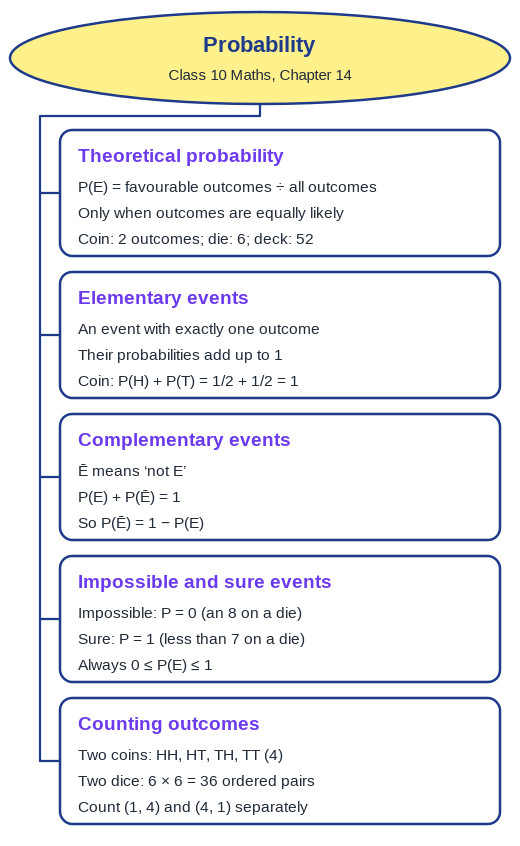
This chapter defines the theoretical (classical) probability of an event as the number of favourable outcomes divided by the number of all possible outcomes, assuming every outcome is equally likely. It shows that 0 ≤ P(E) ≤ 1, that P(E) + P(not E) = 1, and applies this to coins, dice, cards and balls.
What is this chapter about?
In Class 9 you found experimental probability: repeat an experiment many times and divide the number of times an event happened by the number of trials. That needs real trials, which are not always possible. You cannot launch many satellites just to see how often one fails.
This chapter calculates probability without trials, by thinking about the outcomes. It is the last chapter of the Class 10 Maths book, short, with 13 examples and one exercise of 25 questions.
When are outcomes equally likely?
A fair coin has no reason to land on one side more often than the other, so head and tail are equally likely. The six faces of a fair die are equally likely too. But if a bag has 4 red balls and 1 blue ball, “red” and “blue” are not equally likely, though each single ball is equally likely to be drawn.
From here on, the chapter assumes every experiment has equally likely outcomes. Words such as fair, at random and well-shuffled in a question signal this.
How is theoretical probability defined?
P(E) = number of outcomes favourable to E ÷ number of all possible outcomes
This is the theoretical or classical probability. For one throw of a die, the event “a number greater than 4” has favourable outcomes 5 and 6, so P = 2/6 = 1/3. The theoretical probability page works through coins, dice, cards and balls step by step.
An event with exactly one outcome, such as “getting a head”, is an elementary event. The probabilities of all the elementary events of an experiment always add up to 1: for a coin, 1/2 + 1/2 = 1.
What are complementary, impossible and sure events?
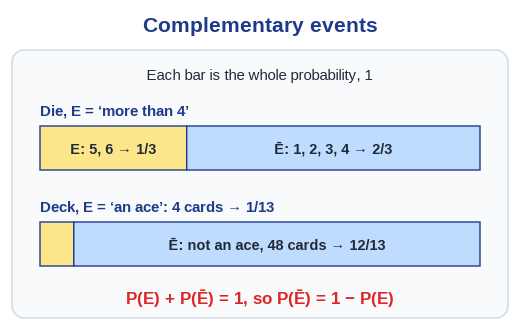
The event “not E” is written Ē and is called the complement of E. Exactly one of E and Ē happens, so
P(E) + P(Ē) = 1, that is, P(Ē) = 1 − P(E).
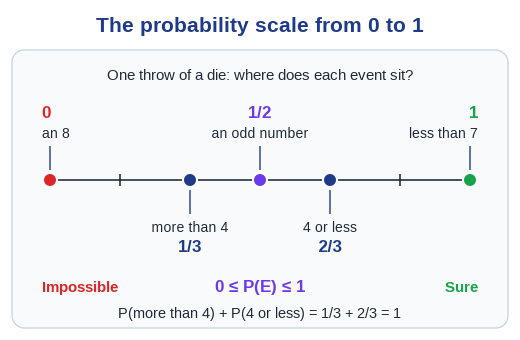
Getting an 8 on a die cannot happen: no face shows 8, so P = 0/6 = 0. This is an impossible event. Getting a number less than 7 always happens, so P = 6/6 = 1. This is a sure or certain event. Every other event lies in between, so 0 ≤ P(E) ≤ 1. The complementary, sure and impossible events page explains these with examples.
How do you count outcomes with two coins or two dice?
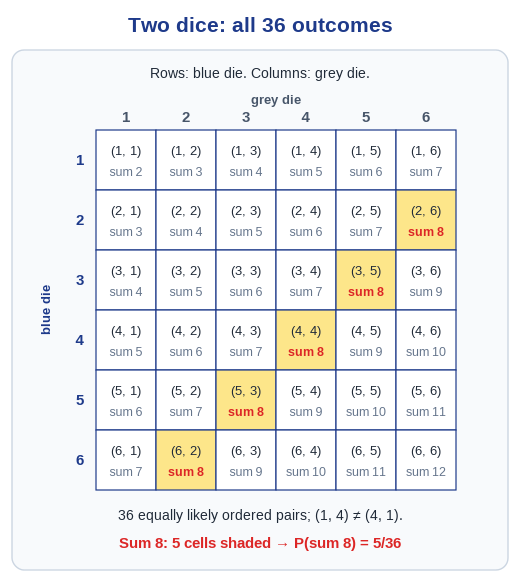
List the outcomes as ordered pairs. Two coins give HH, HT, TH and TT: four outcomes, not three. Two dice give 6 × 6 = 36 ordered pairs, from (1, 1) to (6, 6). The sum 8 comes from (2, 6), (3, 5), (4, 4), (5, 3) and (6, 2), so P(sum 8) = 5/36.
Before we move on
Always write down the full list (or the number) of possible outcomes first, then count the favourable ones. Check that your answer lies between 0 and 1. Examples 10 and 11 of the book (probability as a ratio of lengths or areas) are marked as not from the examination point of view, and so is Question 20. Every example and all 25 questions are solved in the NCERT solutions for Chapter 14.
Key terms
| Term | Meaning |
|---|---|
| Experiment and outcome | An action with a result we cannot predict for certain, such as tossing a coin. Each possible result (head or tail) is an outcome. |
| Equally likely outcomes | Outcomes that each have the same chance of happening, like the six faces of a fair die. The chapter assumes this in every question. |
| Event | A collection of outcomes of an experiment, such as 'getting an even number' when a die is thrown (outcomes 2, 4, 6). |
| Theoretical (classical) probability | P(E) = number of outcomes favourable to E ÷ number of all possible outcomes, when the outcomes are equally likely. |
| Experimental (empirical) probability | From Class 9: number of trials in which the event happened ÷ total number of trials. It is based on what actually happened. |
| Elementary event | An event with only one outcome, such as 'getting a 3' on a die. The probabilities of all the elementary events of an experiment add up to 1. |
| Complementary events | An event E and the event 'not E', written Ē. Exactly one of them happens, so P(E) + P(Ē) = 1. |
| Impossible event | An event that cannot happen, such as getting 8 on an ordinary die. Its probability is 0. |
| Sure (certain) event | An event that is certain to happen, such as getting a number less than 7 on a die. Its probability is 1. |
| Deck of cards | 52 cards in 4 suits of 13: spades and clubs are black, hearts and diamonds are red. Kings, queens and jacks are the 12 face cards. |
Topics in this chapter
Practice
-
A die is thrown once. The probability of getting a number greater than 4 is:
Show answer
Answer: (b) 1/3
-
Which of these cannot be the probability of an event?
Show answer
Answer: (c) 1.2
-
If P(E) = 0.3, then P(not E) is:
Show answer
Answer: (c) 0.7
-
One card is drawn from a well-shuffled deck of 52 cards. The probability that it is a king is:
Show answer
Answer: (b) 1/13
-
Two dice are thrown together. The number of possible outcomes is:
Show answer
Answer: (c) 36
Questions students ask
What are the main topics of Class 10 Maths Chapter 14?
One main section, 14.1 Probability — A Theoretical Approach, followed by a summary (14.2). It covers equally likely outcomes, the classical definition of probability, elementary events, complementary events, impossible and sure events, and problems with coins, dice, cards, balls and two dice. The chapter runs from page 202 to page 217.
How many exercises does Chapter 14 have?
One, Exercise 14.1, with 25 questions. Question 20 is marked as not from the examination point of view. The chapter also has 13 worked examples, of which Examples 10 and 11 carry the same mark. All are solved on the NCERT solutions page.
What is the difference between experimental and theoretical probability?
Experimental probability is found by repeating an experiment and counting how often the event happened. Theoretical probability is found without any trials, by counting outcomes, assuming they are equally likely. If an experiment is repeated a very large number of times, the experimental value is expected to come close to the theoretical one.
Why are (1, 4) and (4, 1) counted separately when two dice are thrown?
Because the two dice are different (in the book, one is blue and one grey). A 1 on the blue die with a 4 on the grey die is a different result from a 4 on the blue die with a 1 on the grey die. Counting both gives 36 equally likely outcomes.
Stuck on a question?
Take a photo and Lagnever AI explains it step by step. Try it for 7 days for ₹2.
Get it on Google Play Open in browser
For parents: after the trial, the plan renews monthly by UPI or card autopay. You can cancel anytime in the app.