
What are complementary, sure and impossible events?
Answer in short
The complement of an event E is 'not E', written Ē. Exactly one of them happens, so P(E) + P(Ē) = 1. An impossible event has no favourable outcomes, so its probability is 0; a sure event has every outcome favourable, so its probability is 1. Every probability lies between 0 and 1.
Stuck on a question? Take a photo and Lagnever AI explains it step by step. Try it for 7 days for ₹2. Get it on Google Play
The complement of an event
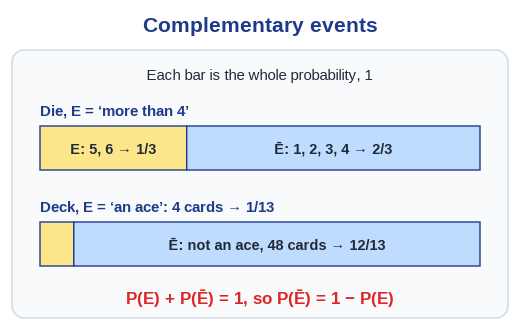
Throw a die once. Let E be “a number greater than 4” (outcomes 5, 6). The event “a number not greater than 4” is the same as “a number less than or equal to 4” (outcomes 1, 2, 3, 4). Every throw lands in exactly one of these two groups.
The event “not E” is written Ē and called the complement of E. E and Ē are complementary events. Since they share out all the outcomes between them,
P(E) + P(Ē) = 1, so P(Ē) = 1 − P(E).
For the die: P(E) = 2/6 = 1/3 and P(Ē) = 4/6 = 2/3, and 1/3 + 2/3 = 1.
Using the complement
The rule saves work in three common situations.
When only P(E) is given. In the book’s Example 5, the probability that Sangeeta wins a tennis match is 0.62. One of the two players must win, so P(Reshma wins) = 1 − 0.62 = 0.38.
When “not E” has fewer outcomes. For one card from a deck, P(ace) = 4/52 = 1/13, so P(not an ace) = 1 − 1/13 = 12/13. Counting 48 non-aces gives the same answer.
For “at least one” questions. Two coins are tossed. “At least one head” is the complement of “no head”, which is only TT. So P(at least one head) = 1 − 1/4 = 3/4. For a die thrown twice, “5 at least once” is the complement of “no 5 either time” (5 × 5 = 25 of the 36 outcomes), so it is 1 − 25/36 = 11/36.
The birthday example of the book works the same way. Ignoring leap years, the second friend’s birthday can be any of 365 days, and 364 of them differ from the first friend’s. So P(different birthdays) = 364/365 and P(same birthday) = 1 − 364/365 = 1/365.
Impossible events
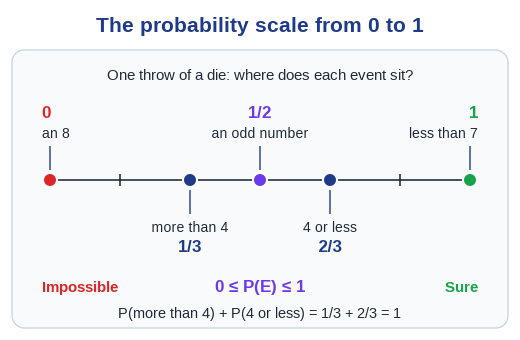
A die has faces 1 to 6. The event “getting 8” has no favourable outcome, so
P(getting 8) = 0/6 = 0.
An event that cannot happen is an impossible event, and its probability is 0. Drawing an orange candy from a bag that holds only lemon candies is another example.
Sure events
Every face of a die shows a number less than 7, so all 6 outcomes are favourable:
P(number less than 7) = 6/6 = 1.
An event that is certain to happen is a sure (or certain) event, and its probability is 1. The impossible event and the sure event are complements of each other: 0 + 1 = 1.
Why 0 ≤ P(E) ≤ 1
In the definition, the favourable outcomes are some of the possible outcomes, never more than all of them, and never fewer than none. So the numerator is at least 0 and at most the denominator:
0 ≤ P(E) ≤ 1
This gives a quick check on every answer. It also settles questions such as “which of these cannot be a probability?”: 2/3, 15% and 0.7 all lie between 0 and 1, but −1.5 does not.
Elementary events add up to 1
An elementary event has exactly one outcome. For a die, the six elementary events “1”, “2”, …, “6” each have probability 1/6, and 6 × 1/6 = 1. This is true for every experiment: the probabilities of all the elementary events add up to 1. A similar check works whenever some events split up all the outcomes with no overlap. In the book’s Example 8 (2 white, 3 blue and 4 red marbles), P(W) + P(B) + P(R) = 2/9 + 3/9 + 4/9 = 1, because every marble has exactly one of the three colours.
Read next: the method for counting outcomes on the theoretical probability page. Exercise 14.1 is solved in full in the NCERT solutions, and the chapter notes give the whole chapter.
Practice
-
If the probability of rain tomorrow is 0.35, the probability of no rain is:
Show answer
Answer: (c) 0.65
-
A bag has only blue balls. The probability of drawing a red ball is:
Show answer
Answer: (a) 0
-
Which of these is a sure event when a die is thrown once?
Show answer
Answer: (c) getting a number from 1 to 6
-
One card is drawn from a well-shuffled deck of 52. Use the complement to find P(not a heart).
Show answer
Answer: P(heart) = 13/52 = 1/4. So P(not a heart) = 1 − 1/4 = 3/4. Check by counting: 39 cards are not hearts, and 39/52 = 3/4.
-
A die is thrown twice. Find the probability that 6 comes up at least once.
Show answer
Answer: There are 36 outcomes. 'No 6 either time' has 5 × 5 = 25 outcomes, so P = 25/36. At least one 6 is its complement: 1 − 25/36 = 11/36.
Questions students ask
Why must a probability lie between 0 and 1?
In P(E) = favourable ÷ all outcomes, the number of favourable outcomes is never negative and never more than the number of all outcomes. So the fraction is at least 0 and at most 1.
When should I use P(Ē) = 1 − P(E)?
When the complement is easier to count, or when the question gives P(E) directly and asks for 'not E'. 'At least one' questions are a common case: count the outcomes where it never happens and subtract from 1.
Is an event with probability 0 the same as an impossible event?
In this chapter, yes. With a finite list of equally likely outcomes, P = 0 means no outcome is favourable, so the event cannot happen. Likewise P = 1 means every outcome is favourable.
Are 'getting a head' and 'getting a tail' complementary?
Yes, for one toss of a coin. Every toss gives exactly one of them, so P(head) + P(tail) = 1/2 + 1/2 = 1.
Stuck on a question?
Take a photo and Lagnever AI explains it step by step. Try it for 7 days for ₹2.
Get it on Google Play Open in browser
For parents: after the trial, the plan renews monthly by UPI or card autopay. You can cancel anytime in the app.