
NCERT Solutions Class 10 Maths Chapter 14: Probability
Answers to the thirteen worked examples and every question of Exercise 14.1 in Chapter 14, Probability, from Mathematics, the Class 10 NCERT textbook. Page numbers follow the 2026-27 reprint (pages 202–217). The exercise questions are quoted from the book; the examples and the short “Why?” questions inside them are restated in brief and labelled by number and page. Every probability was checked by a script that lists the sample space and counts with exact fractions, and every answer matches the answer key at the end of the book. The diagrams are our own. Short notes: Chapter 14 notes.
Examples 1 to 9 (pages 204–210)
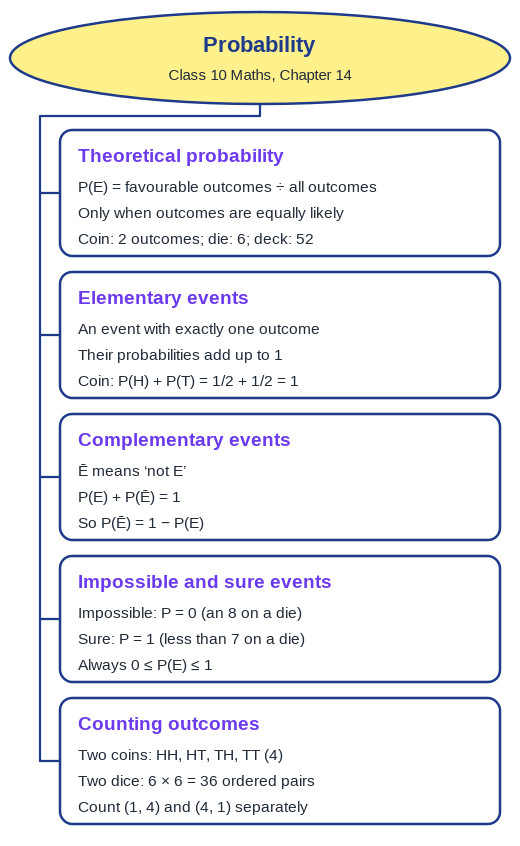
Example 1 (page 204): a coin is tossed once; find P(head) and P(tail). There are 2 equally likely outcomes, H and T, and one of them is a head. P(head) = 1/2. Why is P(tail) also 1/2? Exactly one of the 2 outcomes is a tail, so P(tail) = 1/2.
Example 2 (pages 204–205): a bag has one red, one blue and one yellow ball of the same size; one is taken out without looking. Find P(yellow), P(red), P(blue). There are 3 equally likely outcomes, and each colour has 1 ball, so each probability is 1/3. Each of these events has a single outcome, so each is an elementary event, and 1/3 + 1/3 + 1/3 = 1.
Example 3 (page 205): a die is thrown once. Find P(number greater than 4) and P(number less than or equal to 4). Outcomes 1 to 6. Greater than 4: 5 and 6, so P = 2/6 = 1/3. At most 4: 1, 2, 3, 4, so P = 4/6 = 2/3. Neither is an elementary event (they have 2 and 4 outcomes). They are complements: 1/3 + 2/3 = 1.
Page 206: the probability of getting 8, and of getting a number less than 7, in one throw of a die. No face shows 8, so P(8) = 0/6 = 0 (an impossible event). Every face is less than 7, so P = 6/6 = 1 (a sure event).
Example 4 (pages 207–208): one card from a well-shuffled deck of 52; find P(ace) and P(not an ace). Why are there 52 possible outcomes? Each of the 52 cards is equally likely to be drawn. There are 4 aces, so P(ace) = 4/52 = 1/13. Why are 48 outcomes favourable to “not an ace”? 52 − 4 = 48 cards are not aces, so P = 48/52 = 12/13. Check with the complement: 1 − 1/13 = 12/13.
Example 5 (page 208): Sangeeta wins a tennis match against Reshma with probability 0.62; find P(Reshma wins). One of the two must win, so the events are complementary: P(Reshma wins) = 1 − 0.62 = 0.38.
Example 6 (page 208): two friends, Savita and Hamida; find P(different birthdays) and P(same birthday), ignoring leap years. Hamida’s birthday can be any of 365 equally likely days. 364 of them differ from Savita’s, so P(different) = 364/365 and P(same) = 1 − 364/365 = 1/365.
Example 7 (page 209): 40 students (25 girls, 15 boys); one name card is drawn from a bag. Find P(girl) and P(boy). Why are 25 outcomes favourable to a girl, and 15 to a boy? Each girl has exactly one card, and so does each boy. P(girl) = 25/40 = 5/8 and P(boy) = 15/40 = 3/8; also 1 − 5/8 = 3/8.
Example 8 (page 209): a box has 3 blue, 2 white and 4 red marbles; one is drawn at random. Find P(white), P(blue), P(red). Why are there 9 possible outcomes? 3 + 2 + 4 = 9 marbles, each equally likely. P(W) = 2/9, P(B) = 3/9 = 1/3, P(R) = 4/9, and the three add up to 1.
Example 9 (page 210): two different coins (₹1 and ₹2) are tossed together; find P(at least one head). Outcomes: (H, H), (H, T), (T, H), (T, T). Why are three of them favourable? Each of HH, HT and TH has at least one head; only TT has none. P = 3/4. By the complement: P(no head) = 1/4, so 1 − 1/4 = 3/4.
Examples 10 to 13 (pages 210–213)
Example 10* (pages 210–211): music in a game of musical chairs stops at a random moment within 2 minutes; find the probability that it stops in the first half-minute. The outcomes are all the points from 0 to 2 on a number line, so we compare lengths: P = (1/2) ÷ 2 = 1/4. (Marked in the book as not from the examination point of view.)
Example 11* (pages 211–212): a helicopter crashed somewhere in a 9 km × 4.5 km region; a lake in it measures 3 km × 2.5 km. Find the probability that it crashed in the lake. Compare areas: total 9 × 4.5 = 40.5 km², lake 3 × 2.5 = 7.5 km². P = 7.5 ÷ 40.5 = 75/405 = 5/27. (Also not from the examination point of view.)
Example 12 (page 212): a carton of 100 shirts has 88 good, 8 with minor defects and 4 with major defects. Jimmy accepts only good shirts; Sujatha rejects only shirts with major defects. Find the probability that a shirt drawn at random is acceptable to each. Why 88 for Jimmy? Only the 88 good shirts are acceptable to him. P = 88/100 = 0.88. Why 96 for Sujatha? She accepts good shirts and shirts with minor defects, 88 + 8 = 96. P = 96/100 = 0.96.
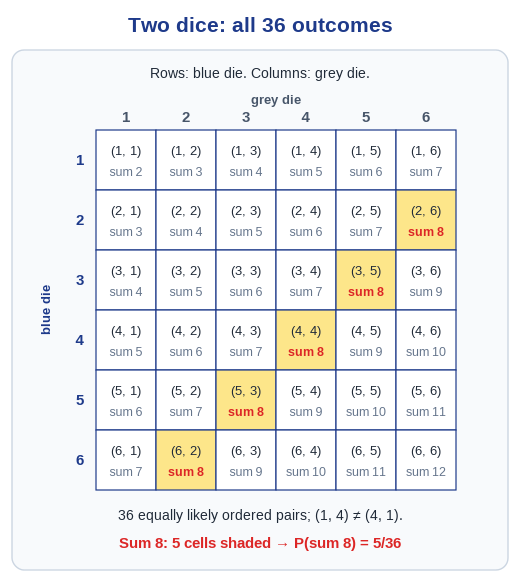
Example 13 (pages 212–213): a blue die and a grey die are thrown together. List the outcomes and find P(sum 8), P(sum 13), P(sum ≤ 12). Each of the 6 numbers on the blue die can go with each of the 6 on the grey die: 6 × 6 = 36 ordered pairs. Why is (1, 4) different from (4, 1)? In (1, 4) the blue die shows 1 and the grey die 4; in (4, 1) it is the other way round. These are two different results.
- Sum 8: (2, 6), (3, 5), (4, 4), (5, 3), (6, 2), so P = 5/36.
- Sum 13: the largest possible sum is 6 + 6 = 12, so P = 0/36 = 0 (impossible).
- Sum ≤ 12: all 36 outcomes, so P = 36/36 = 1 (sure).
Exercise 14.1 (pages 214–217)
One rule is used again and again below. If all outcomes are equally likely (each has the same chance), then
P(E) = (number of outcomes favourable to E) ÷ (total number of possible outcomes).
Also, P(not E) = 1 − P(E).
1. “Complete the following statements: (i) Probability of an event E + Probability of the event ‘not E’ = ________ . (ii) The probability of an event that cannot happen is ________ . Such an event is called ________ . (iii) The probability of an event that is certain to happen is ________ . Such an event is called ________ . (iv) The sum of the probabilities of all the elementary events of an experiment is ________ . (v) The probability of an event is greater than or equal to ________ and less than or equal to ________ .”
Answer: (i) 1. (ii) 0; an impossible event. (iii) 1; a sure (or certain) event. (iv) 1. (v) 0 and 1.
2. “Which of the following experiments have equally likely outcomes? Explain. (i) A driver attempts to start a car. The car starts or does not start. (ii) A player attempts to shoot a basketball. She/he shoots or misses the shot. (iii) A trial is made to answer a true-false question. The answer is right or wrong. (iv) A baby is born. It is a boy or a girl.”
- (i) Not equally likely. Whether a car starts depends on its condition (battery, fuel, engine). A car in working order usually starts.
- (ii) Not equally likely. It depends on the player’s skill and practice.
- (iii) Equally likely. A guessed answer to a true-false question is right or wrong with the same chance.
- (iv) Equally likely, as the book treats it. A baby is a boy or a girl with the same chance.
Answer: (iii) and (iv) have equally likely outcomes.
3. “Why is tossing a coin considered to be a fair way of deciding which team should get the ball at the beginning of a football game?”
- For a fair coin, head and tail are equally likely. Each has probability 1/2.
- Nobody can predict or control the result of a toss.
Answer: both teams have the same chance (1/2), so neither team has an advantage. That is why the toss is fair.
4. “Which of the following cannot be the probability of an event? (A) 2/3 (B) –1.5 (C) 15% (D) 0.7”
- A probability is always between 0 and 1 (both included).
- 2/3, 15% = 0.15 and 0.7 are all between 0 and 1.
- −1.5 is negative, so it cannot be a probability.
Answer: (B) −1.5.
5. “If P(E) = 0.05, what is the probability of ‘not E’?”
- P(not E) = 1 − P(E).
- = 1 − 0.05 = 0.95.
Answer: P(not E) = 0.95.
6. “A bag contains lemon flavoured candies only. Malini takes out one candy without looking into the bag. What is the probability that she takes out (i) an orange flavoured candy? (ii) a lemon flavoured candy?”
- (i) There are no orange candies in the bag. So this event cannot happen. It is an impossible event, and its probability is 0.
- (ii) Every candy is lemon flavoured. So this event is sure to happen. It is a sure event, and its probability is 1.
Answer: (i) 0; (ii) 1.
7. “It is given that in a group of 3 students, the probability of 2 students not having the same birthday is 0.992. What is the probability that the 2 students have the same birthday?”
Given: P(not the same birthday) = 0.992.
To find: P(same birthday).
- “Same birthday” and “not the same birthday” are complementary events (exactly one of them happens).
- P(same birthday) = 1 − 0.992 = 0.008.
Answer: 0.008.
8. “A bag contains 3 red balls and 5 black balls. A ball is drawn at random from the bag. What is the probability that the ball drawn is (i) red ? (ii) not red?”
Given: 3 red and 5 black balls.
To find: (i) P(red), (ii) P(not red).
- Total number of balls = 3 + 5 = 8. So there are 8 equally likely outcomes.
- (i) Favourable outcomes for red = 3. P(red) = 3/8.
- (ii) P(not red) = 1 − 3/8 = 5/8. (These are the 5 black balls.)
Answer: (i) 3/8; (ii) 5/8.
9. “A box contains 5 red marbles, 8 white marbles and 4 green marbles. One marble is taken out of the box at random. What is the probability that the marble taken out will be (i) red ? (ii) white ? (iii) not green?”
Given: 5 red, 8 white and 4 green marbles.
To find: (i) P(red), (ii) P(white), (iii) P(not green).
- Total marbles = 5 + 8 + 4 = 17.
- (i) P(red) = 5/17.
- (ii) P(white) = 8/17.
- (iii) P(green) = 4/17, so P(not green) = 1 − 4/17 = 13/17.
Answer: (i) 5/17; (ii) 8/17; (iii) 13/17.
10. “A piggy bank contains hundred 50p coins, fifty ₹ 1 coins, twenty ₹ 2 coins and ten ₹ 5 coins. If it is equally likely that one of the coins will fall out when the bank is turned upside down, what is the probability that the coin (i) will be a 50 p coin ? (ii) will not be a ₹ 5 coin?”
Given: 100 coins of 50p, 50 of ₹1, 20 of ₹2 and 10 of ₹5.
To find: (i) P(50p coin), (ii) P(not a ₹5 coin).
- Total coins = 100 + 50 + 20 + 10 = 180.
- (i) P(50p coin) = 100/180 = 5/9.
- (ii) P(₹5 coin) = 10/180 = 1/18. So P(not a ₹5 coin) = 1 − 1/18 = 17/18.
Answer: (i) 5/9; (ii) 17/18.
11. “Gopi buys a fish from a shop for his aquarium. The shopkeeper takes out one fish at random from a tank containing 5 male fish and 8 female fish (see Fig. 14.4). What is the probability that the fish taken out is a male fish?”
Given: 5 male and 8 female fish.
To find: P(male fish).
- Total fish = 5 + 8 = 13.
- Favourable outcomes (male) = 5.
- P(male) = 5/13.
Answer: 5/13.
12. “A game of chance consists of spinning an arrow which comes to rest pointing at one of the numbers 1, 2, 3, 4, 5, 6, 7, 8 (see Fig. 14.5 ), and these are equally likely outcomes. What is the probability that it will point at (i) 8 ? (ii) an odd number? (iii) a number greater than 2? (iv) a number less than 9?”
Given: 8 equally likely outcomes: 1, 2, 3, 4, 5, 6, 7, 8.
To find: the four probabilities.
- (i) Only one outcome is 8. P = 1/8.
- (ii) Odd numbers: 1, 3, 5, 7, that is 4 outcomes. P = 4/8 = 1/2.
- (iii) Greater than 2: 3, 4, 5, 6, 7, 8, that is 6 outcomes. P = 6/8 = 3/4.
- (iv) Every number is less than 9, so all 8 outcomes are favourable (a sure event). P = 8/8 = 1.
Answer: (i) 1/8; (ii) 1/2; (iii) 3/4; (iv) 1.
13. “A die is thrown once. Find the probability of getting (i) a prime number; (ii) a number lying between 2 and 6; (iii) an odd number.”
Given: a die is thrown once: 6 outcomes, 1 to 6.
To find: the three probabilities.
- (i) Prime numbers: 2, 3, 5 (1 is not a prime). P = 3/6 = 1/2.
- (ii) Between 2 and 6 means 3, 4, 5 (2 and 6 are not included). P = 3/6 = 1/2.
- (iii) Odd numbers: 1, 3, 5. P = 3/6 = 1/2.
Answer: (i) 1/2; (ii) 1/2; (iii) 1/2.
14. “One card is drawn from a well-shuffled deck of 52 cards. Find the probability of getting (i) a king of red colour (ii) a face card (iii) a red face card (iv) the jack of hearts (v) a spade (vi) the queen of diamonds”
Given: a deck of 52 cards: 4 suits (spades and clubs are black, hearts and diamonds are red), 13 cards in each suit.
To find: the six probabilities.
- Total outcomes = 52.
- (i) Red kings: king of hearts and king of diamonds, 2 cards. P = 2/52 = 1/26.
- (ii) Face cards are king, queen and jack. 3 in each of 4 suits = 12 cards. P = 12/52 = 3/13.
- (iii) Red face cards: 3 hearts + 3 diamonds = 6 cards. P = 6/52 = 3/26.
- (iv) There is only one jack of hearts. P = 1/52.
- (v) Spades: 13 cards. P = 13/52 = 1/4.
- (vi) There is only one queen of diamonds. P = 1/52.
Answer: (i) 1/26; (ii) 3/13; (iii) 3/26; (iv) 1/52; (v) 1/4; (vi) 1/52.
15. “Five cards—the ten, jack, queen, king and ace of diamonds, are well-shuffled with their face downwards. One card is then picked up at random. (i) What is the probability that the card is the queen? (ii) If the queen is drawn and put aside, what is the probability that the second card picked up is (a) an ace? (b) a queen?”
Given: 5 cards: ten, jack, queen, king and ace of diamonds.
To find: (i) P(queen); (ii) after the queen is put aside, (a) P(ace), (b) P(queen).
- (i) 5 cards, 1 queen. P(queen) = 1/5.
- (ii) After the queen is put aside, 4 cards remain: ten, jack, king, ace.
- (a) There is 1 ace in 4 cards. P(ace) = 1/4.
- (b) No queen is left. P(queen) = 0/4 = 0.
Answer: (i) 1/5; (ii) (a) 1/4, (b) 0.
16. “12 defective pens are accidentally mixed with 132 good ones. It is not possible to just look at a pen and tell whether or not it is defective. One pen is taken out at random from this lot. Determine the probability that the pen taken out is a good one.”
Given: 12 defective pens and 132 good pens.
To find: P(good pen).
- Total pens = 12 + 132 = 144.
- Favourable outcomes (good) = 132.
- P(good) = 132/144 = 11/12.
Answer: 11/12.
17. “(i) A lot of 20 bulbs contain 4 defective ones. One bulb is drawn at random from the lot. What is the probability that this bulb is defective? (ii) Suppose the bulb drawn in (i) is not defective and is not replaced. Now one bulb is drawn at random from the rest. What is the probability that this bulb is not defective ?”
Given: 20 bulbs, 4 defective (so 16 good).
To find: (i) P(defective); (ii) P(not defective) after one good bulb is removed.
- (i) P(defective) = 4/20 = 1/5.
- (ii) One good bulb is taken out and not put back. Now 19 bulbs remain: 4 defective and 16 − 1 = 15 good.
- P(not defective) = 15/19.
Answer: (i) 1/5; (ii) 15/19.
18. “A box contains 90 discs which are numbered from 1 to 90. If one disc is drawn at random from the box, find the probability that it bears (i) a two-digit number (ii) a perfect square number (iii) a number divisible by 5.”
Given: 90 discs numbered 1 to 90.
To find: P(two-digit number), P(perfect square), P(divisible by 5).
- Total outcomes = 90.
- (i) Two-digit numbers are 10 to 90. There are 90 − 9 = 81 of them. P = 81/90 = 9/10.
- (ii) Perfect squares: 1, 4, 9, 16, 25, 36, 49, 64, 81, that is 9 numbers (10² = 100 is more than 90). P = 9/90 = 1/10.
- (iii) Multiples of 5: 5, 10, …, 90. There are 90 ÷ 5 = 18 of them. P = 18/90 = 1/5.
Answer: (i) 9/10; (ii) 1/10; (iii) 1/5.
19. “A child has a die whose six faces show the letters as given below: A B C D E A The die is thrown once. What is the probability of getting (i) A? (ii) D?”
Given: 6 faces: A, B, C, D, E, A.
To find: P(A) and P(D).
- The 6 faces are equally likely.
- (i) Two faces show A. P(A) = 2/6 = 1/3.
- (ii) One face shows D. P(D) = 1/6.
Answer: (i) 1/3; (ii) 1/6.
20*. “Suppose you drop a die at random on the rectangular region shown in Fig. 14.6. What is the probability that it will land inside the circle with diameter 1m?”
(The book marks this question as not from the examination point of view.)
Given: a rectangle of 3 m by 2 m (Fig. 14.6), with a circle of diameter 1 m (so radius 1/2 m) inside it.
To find: P(the die lands inside the circle).
- Here the outcomes are points, so we compare areas.
- Area of the rectangle = 3 × 2 = 6 m².
- Area of the circle = π × (1/2)² = π/4 m².
- P = (π/4) ÷ 6 = π/24.
Answer: π/24 (about 0.13).
21. “A lot consists of 144 ball pens of which 20 are defective and the others are good. Nuri will buy a pen if it is good, but will not buy if it is defective. The shopkeeper draws one pen at random and gives it to her. What is the probability that (i) She will buy it ? (ii) She will not buy it ?”
Given: 144 pens, 20 defective.
To find: (i) P(she buys), (ii) P(she does not buy).
- Good pens = 144 − 20 = 124.
- (i) She buys only a good pen. P = 124/144 = 31/36.
- (ii) She does not buy a defective pen. P = 20/144 = 5/36.
- Check: 31/36 + 5/36 = 1.
Answer: (i) 31/36; (ii) 5/36.
22. “Refer to Example 13. (i) Complete the following table:” (The table lists the events “Sum on 2 dice” = 2, 3, …, 12, with the probabilities 1/36 for sum 2, 5/36 for sum 8 and 1/36 for sum 12 already filled in.) “(ii) A student argues that ‘there are 11 possible outcomes 2, 3, 4, 5, 6, 7, 8, 9, 10, 11 and 12. Therefore, each of them has a probability 1/11. Do you agree with this argument? Justify your answer.”
Given: two dice are thrown together: 6 × 6 = 36 equally likely ordered pairs.
To find: (i) the probability of each sum; (ii) whether each sum has probability 1/11.
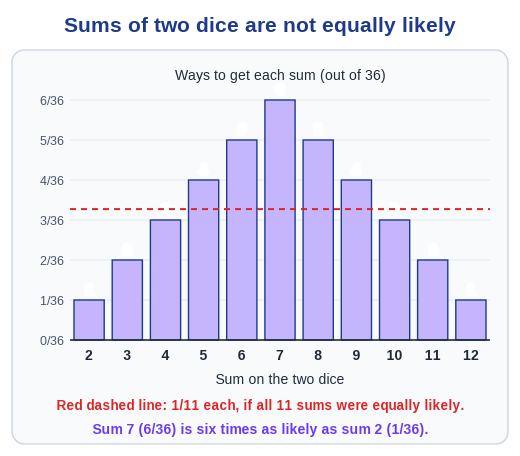
- Count the pairs for each sum. For example, sum 7 comes from (1, 6), (2, 5), (3, 4), (4, 3), (5, 2), (6, 1), that is 6 pairs.
| Sum on 2 dice | 2 | 3 | 4 | 5 | 6 | 7 | 8 | 9 | 10 | 11 | 12 |
|---|---|---|---|---|---|---|---|---|---|---|---|
| Pairs | 1 | 2 | 3 | 4 | 5 | 6 | 5 | 4 | 3 | 2 | 1 |
| Probability | 1/36 | 2/36 | 3/36 | 4/36 | 5/36 | 6/36 | 5/36 | 4/36 | 3/36 | 2/36 | 1/36 |
- Check: the pairs add up to 36, and the probabilities add up to 1.
- (ii) The formula P = favourable ÷ total works only for equally likely outcomes. The 11 sums are not equally likely: sum 2 comes only from (1, 1), but sum 7 comes from 6 pairs. So sum 7 is six times as likely as sum 2.
Answer: (i) the table above; (ii) No, we do not agree. The 11 sums are not equally likely, so each sum does not have probability 1/11.
23. “A game consists of tossing a one rupee coin 3 times and noting its outcome each time. Hanif wins if all the tosses give the same result i.e., three heads or three tails, and loses otherwise. Calculate the probability that Hanif will lose the game.”
Given: a coin is tossed 3 times. Hanif wins on HHH or TTT and loses otherwise.
To find: P(Hanif loses).
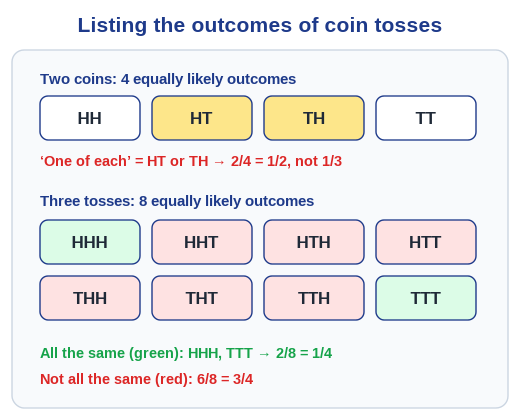
- The 8 equally likely outcomes are HHH, HHT, HTH, HTT, THH, THT, TTH, TTT. (THH means tail on the first toss, then head, then head.)
- Hanif wins on HHH and TTT: 2 outcomes. P(win) = 2/8 = 1/4.
- P(lose) = 1 − 1/4 = 3/4. (These are the other 6 outcomes.)
Answer: P(Hanif loses) = 3/4.
24. “A die is thrown twice. What is the probability that (i) 5 will not come up either time? (ii) 5 will come up at least once? [Hint : Throwing a die twice and throwing two dice simultaneously are treated as the same experiment]”
Given: a die is thrown twice: 6 × 6 = 36 equally likely outcomes.
To find: (i) P(no 5 on either throw); (ii) P(5 at least once).
- (i) Each throw must be 1, 2, 3, 4 or 6: 5 choices. So there are 5 × 5 = 25 favourable outcomes. P = 25/36.
- (ii) “5 at least once” is the complement of (i). P = 1 − 25/36 = 11/36.
- Check by counting: 6 pairs have 5 first, 6 have 5 second, and (5, 5) is in both. So 6 + 6 − 1 = 11.
Answer: (i) 25/36; (ii) 11/36.
25. “Which of the following arguments are correct and which are not correct? Give reasons for your answer. (i) If two coins are tossed simultaneously there are three possible outcomes—two heads, two tails or one of each. Therefore, for each of these outcomes, the probability is 1/3. (ii) If a die is thrown, there are two possible outcomes—an odd number or an even number. Therefore, the probability of getting an odd number is 1/2.”
- (i) The equally likely outcomes for two coins are HH, HT, TH and TT. “One of each” happens in two of them (HT and TH). So P(one of each) = 2/4 = 1/2, while P(two heads) = P(two tails) = 1/4. The three groups are not equally likely.
- (ii) Odd numbers 1, 3, 5 and even numbers 2, 4, 6 have 3 outcomes each. So “odd” and “even” are equally likely, and P(odd) = 3/6 = 1/2.
Answer: (i) not correct; (ii) correct.
Read the topic pages for the method behind these answers: theoretical probability and complementary, sure and impossible events.
Practice
-
A bag has 4 green and 6 yellow balls. One ball is drawn at random. P(green) is:
Show answer
Answer: (a) 2/5
-
A die is thrown once. The probability of getting a number that is not a multiple of 3 is:
Show answer
Answer: (c) 2/3
-
Two dice are thrown together. The probability that both show the same number is:
Show answer
Answer: (c) 1/6
-
A box has discs numbered 1 to 50. One disc is drawn at random. Find the probability that its number is divisible by 7.
Show answer
Answer: Multiples of 7 up to 50: 7, 14, 21, 28, 35, 42, 49, so 7 discs. P = 7/50.
-
Three coins are tossed together. Find the probability of getting at least two heads.
Show answer
Answer: There are 8 outcomes. At least two heads: HHH, HHT, HTH, THH, so 4. P = 4/8 = 1/2.
Stuck on a question?
Take a photo and Lagnever AI explains it step by step. Try it for 7 days for ₹2.
Get it on Google Play Open in browser
For parents: after the trial, the plan renews monthly by UPI or card autopay. You can cancel anytime in the app.