
How do you find theoretical probability?
Answer in short
Count all the possible outcomes of the experiment and the outcomes favourable to the event, then divide: P(E) = favourable outcomes ÷ all possible outcomes. This works only when every outcome is equally likely, as with a fair coin, a fair die, a well-shuffled deck or a ball drawn at random.
Stuck on a question? Take a photo and Lagnever AI explains it step by step. Try it for 7 days for ₹2. Get it on Google Play
What does “equally likely” mean?
When you toss a fair coin, there is no reason for it to land head up more often than tail up. The two outcomes are equally likely. The same holds for the six faces of a fair die, for the 52 cards of a well-shuffled deck, and for identical balls drawn from a bag without looking.
Not every experiment is like this. If a bag holds 4 red balls and 1 blue ball, you are more likely to draw red than blue, so “red” and “blue” are not equally likely. But each of the five balls is equally likely to be drawn, and that is what we count.
The definition
For an experiment whose outcomes are equally likely, the theoretical (or classical) probability of an event E is
P(E) = number of outcomes favourable to E ÷ number of all possible outcomes
The book credits this definition to Pierre Simon Laplace (1795). It needs no trials at all: we only count.
A method for every question
- Name the experiment and list (or count) all the possible outcomes.
- Check that they are equally likely.
- Count the outcomes favourable to the event.
- Divide, and simplify the fraction.
- Check that the answer lies between 0 and 1.
Coins
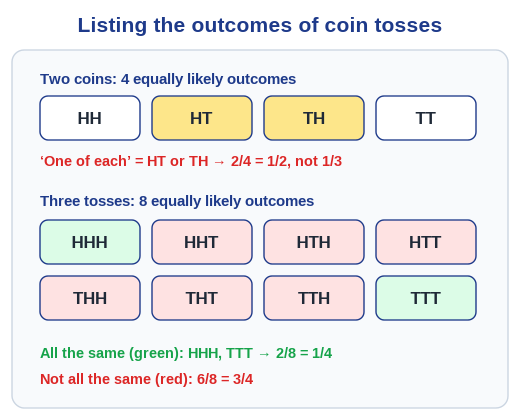
One coin: 2 outcomes, H and T. P(head) = 1/2 and P(tail) = 1/2. Each of these is an elementary event, an event with exactly one outcome, and their probabilities add up to 1.
Two coins tossed together: write ordered pairs, first coin then second. The outcomes are HH, HT, TH, TT. “At least one head” has 3 favourable outcomes (HH, HT, TH), so P = 3/4, as in the book’s Example 9.
Dice
One die: 6 outcomes. P(number greater than 4) = 2/6 = 1/3, because only 5 and 6 are favourable. P(prime number) = 3/6 = 1/2, from 2, 3 and 5.
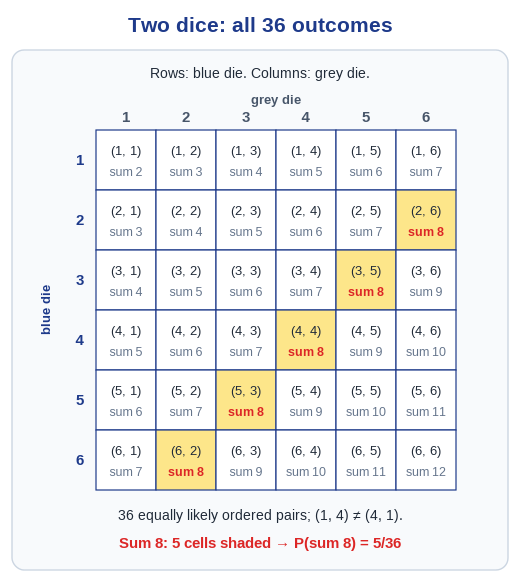
Two dice: each of the 6 numbers on the first die can go with each of the 6 on the second, giving 36 ordered pairs. The book colours the dice blue and grey so that (1, 4) and (4, 1) are clearly different outcomes. For the sum 8 there are 5 favourable pairs, so P(sum 8) = 5/36. No pair adds up to 13, and every pair adds up to 12 or less.
Cards
A deck has 52 cards in 4 suits of 13: spades and clubs (black), hearts and diamonds (red). Each suit has an ace, king, queen, jack, and 10 down to 2. Kings, queens and jacks are the face cards, 12 in all.
| Event (one card drawn) | Favourable | P |
|---|---|---|
| an ace | 4 | 4/52 = 1/13 |
| a face card | 12 | 12/52 = 3/13 |
| a red face card | 6 | 6/52 = 3/26 |
| a spade | 13 | 13/52 = 1/4 |
| the queen of diamonds | 1 | 1/52 |
Balls, marbles and names drawn at random
A box has 3 blue, 2 white and 4 red marbles. There are 9 marbles, all equally likely, so P(white) = 2/9, P(blue) = 3/9 = 1/3 and P(red) = 4/9. These three add up to 1, because every marble is one of the three colours. The same counting works for a name card drawn from a bag, a shirt picked from a carton, or a pen taken from a lot.
Lengths and areas (beyond the exam)
When the outcomes are all the points of a line or a region, they cannot be counted. The book then compares lengths or areas: the probability is the favourable length (or area) divided by the total. Its Examples 10 and 11 and Exercise 14.1 Question 20 use this idea, and all three are marked as not from the examination point of view.
Read next: complementary, sure and impossible events. Every question of Exercise 14.1 is solved in the NCERT solutions, and the chapter notes give the full picture.
Practice
-
A bag has 3 red, 5 blue and 2 green balls. One ball is drawn at random. P(blue) is:
Show answer
Answer: (c) 1/2
-
A die is thrown once. The probability of getting a multiple of 3 is:
Show answer
Answer: (b) 1/3
-
One card is drawn from a well-shuffled deck of 52. The probability that it is a black face card is:
Show answer
Answer: (a) 3/26
-
Two coins are tossed together. Find the probability of getting exactly one head.
Show answer
Answer: Outcomes: HH, HT, TH, TT, so 4 in all. Exactly one head: HT and TH, so 2. P = 2/4 = 1/2.
-
Two dice are thrown together. Find the probability that the sum is 10.
Show answer
Answer: There are 36 outcomes. Sum 10: (4, 6), (5, 5), (6, 4), so 3 outcomes. P = 3/36 = 1/12.
Questions students ask
What is the difference between theoretical and experimental probability?
Experimental probability divides the number of trials in which an event happened by the total number of trials, so it needs real trials. Theoretical probability divides favourable outcomes by all outcomes, so it needs no trials, but it assumes the outcomes are equally likely.
Who gave the classical definition of probability?
The book credits Pierre Simon Laplace, who gave this definition in 1795. It also mentions J. Cardan's early book on probability in the 16th century, and later work by James Bernoulli and A. de Moivre.
Can I write a probability as a decimal or a percentage?
Yes. 1/4, 0.25 and 25% are the same probability. The book's own examples use fractions and decimals, such as 0.62 and 0.88.
What if the outcomes are not equally likely?
Then this formula does not apply directly. Break the experiment into outcomes that are equally likely. For a bag of 4 red balls and 1 blue ball, each of the 5 balls is equally likely, so P(red) = 4/5.
Stuck on a question?
Take a photo and Lagnever AI explains it step by step. Try it for 7 days for ₹2.
Get it on Google Play Open in browser
For parents: after the trial, the plan renews monthly by UPI or card autopay. You can cancel anytime in the app.