
What is the discriminant, and what does it say about the roots?
Answer in short
For ax² + bx + c = 0, the discriminant is D = b² − 4ac. If D > 0, there are two distinct real roots. If D = 0, there are two equal real roots, each −b/2a. If D < 0, there are no real roots. When D ≥ 0, the formula x = (−b ± √D)/2a gives the roots.
Stuck on a question? Take a photo and Lagnever AI explains it step by step. Try it for 7 days for ₹2. Get it on Google Play
What is the quadratic formula?
Factorisation works well when the two numbers for splitting the middle term are easy to find. For other equations the book gives a formula. The roots of ax² + bx + c = 0 (a ≠ 0) are
x = (−b ± √(b² − 4ac)) / 2a
as long as b² − 4ac is not negative. The sign ± gives two values: use + for one root and − for the other.
Take 2x² − 7x + 3 = 0. Here a = 2, b = −7, c = 3.
b² − 4ac = (−7)² − 4 × 2 × 3 = 49 − 24 = 25
x = (7 ± √25)/4 = (7 ± 5)/4
So x = 12/4 = 3 or x = 2/4 = 1/2. Check: 18 − 21 + 3 = 0 and 1/2 − 7/2 + 3 = 0.
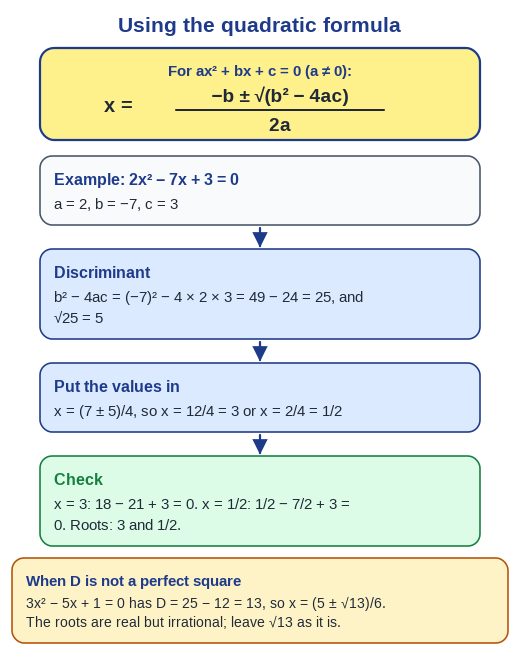
The formula also works when the answer is not a neat number. For 3x² − 5x + 1 = 0, b² − 4ac = 25 − 12 = 13, so x = (5 ± √13)/6. Leave √13 as it is.
What is the discriminant?
Everything in the formula is ordinary arithmetic except the square root. A real square root exists only for a number that is zero or positive. So the number under the root,
D = b² − 4ac,
decides whether the equation has real roots at all. It is called the discriminant of the equation.
What are the three cases?
D > 0. √D is a positive number, so (−b + √D)/2a and (−b − √D)/2a are different. The equation has two distinct real roots.
D = 0. √D = 0, so both values of the formula are −b/2a. The equation has two equal real roots. The book also calls them coincident roots.
D < 0. No real number has a negative square, so √D is not a real number. The equation has no real roots.
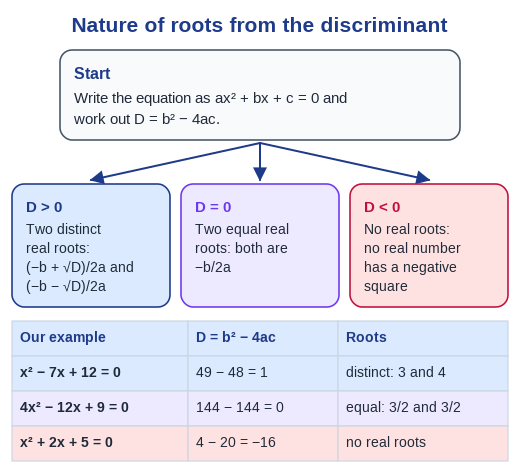
Three equations show the cases:
- x² − 7x + 12 = 0: D = 49 − 48 = 1 > 0. Roots (7 ± 1)/2, that is, 4 and 3.
- 4x² − 12x + 9 = 0: D = 144 − 144 = 0. Both roots are 12/8 = 3/2.
- x² + 2x + 5 = 0: D = 4 − 20 = −16 < 0. No real roots.
What do the three cases look like on a graph?
The roots are the x-values where the graph of y = ax² + bx + c meets the x-axis. Take x² − 4x + 3, x² − 4x + 4 and x² − 4x + 5. Only the constant term changes, and each step lifts the same parabola by 1.
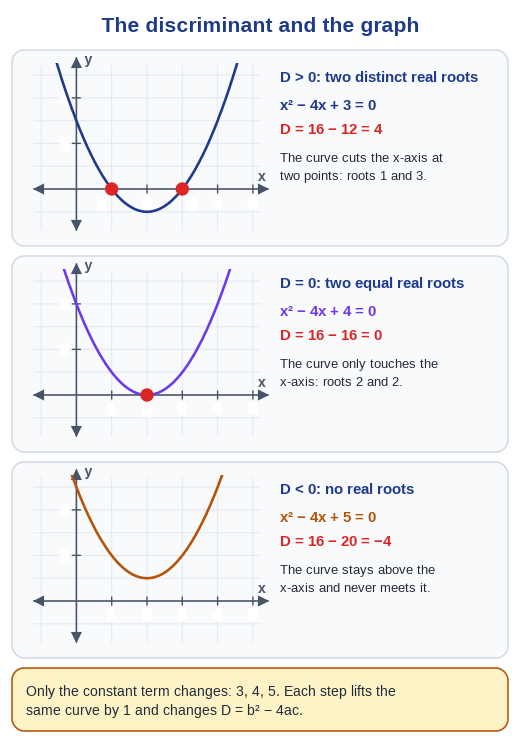
The first curve cuts the axis at 1 and 3 (D = 4). The second only touches it at 2 (D = 0). The third stays above it (D = −4). You are not asked to draw these graphs in this chapter; they are here to show why the sign of D matters.
How do you find k for equal roots?
A common question gives an equation with an unknown constant k and says the roots are equal. Equal roots mean D = 0, so write b² − 4ac = 0 and solve for k.
For x² + kx + 16 = 0: a = 1, b = k, c = 16. So k² − 64 = 0, k² = 64, and k = 8 or k = −8. Both work: x² + 8x + 16 = (x + 4)² and x² − 8x + 16 = (x − 4)².
One caution. If k is the coefficient of x², the value k = 0 must be rejected, because then the equation is not quadratic at all.
How does the discriminant decide whether a situation is possible?
Form the equation, then test D before solving.
Can a rectangle have perimeter 28 m and area 49 m²? Length + breadth = 14, so with length x, x(14 − x) = 49, that is, x² − 14x + 49 = 0. D = 196 − 196 = 0, so it is possible, with equal roots x = 7. The rectangle is a square of side 7 m.
Can a rectangle have perimeter 30 m and area 60 m²? Now x(15 − x) = 60, so x² − 15x + 60 = 0 and D = 225 − 240 = −15. No real roots: such a rectangle cannot exist.
In a real situation, check one more thing after D ≥ 0: the roots must also make sense (a positive length, a whole number of objects).
Exercise 4.3 and Examples 7 to 9 are worked out in the NCERT solutions. For the first method of the chapter, see solving by factorisation, or go back to the chapter notes.
Practice
-
The discriminant of x² − 6x + 9 = 0 is:
Show answer
Answer: (a) 0
-
The equation x² + x + 1 = 0 has:
Show answer
Answer: (a) no real roots
-
x² + kx + 16 = 0 has two equal roots when k is:
Show answer
Answer: (a) 8 or −8
-
Find the nature of the roots of 2x² + 5x − 3 = 0 and find them with the quadratic formula.
Show answer
Answer: a = 2, b = 5, c = −3. D = 25 − 4 × 2 × (−3) = 25 + 24 = 49 > 0, so there are two distinct real roots. x = (−5 ± 7)/4, so x = 2/4 = 1/2 or x = −12/4 = −3. Check: 2 × 1/4 + 5/2 − 3 = 0 and 18 − 15 − 3 = 0.
-
Can a rectangle have perimeter 30 m and area 60 m²?
Show answer
Answer: Length + breadth = 15. If the length is x, then x(15 − x) = 60, so x² − 15x + 60 = 0. D = 225 − 240 = −15 < 0, so there are no real roots. Such a rectangle is not possible.
Questions students ask
Why is b² − 4ac called the discriminant?
To discriminate means to tell things apart. The value of b² − 4ac tells apart the three cases for a quadratic equation: two distinct real roots, two equal real roots, or no real roots. The book gives this as the reason for the name.
Does the current book derive the quadratic formula?
No. In the 2026-27 reprint, Section 4.4 states the formula and goes straight to the nature of roots; the section on completing the square, from which the formula comes, is not in this edition. You are expected to know and use the formula.
Are the roots rational when D is a perfect square?
Extra, beyond the book: if a, b and c are rational numbers and D is the square of a rational number, both roots are rational, and the equation can also be solved by factorisation. If D is positive but not such a square, the roots contain a surd, as in (5 ± √13)/6.
What happens to the graph in each case?
The graph of y = ax² + bx + c is a parabola. When D > 0 it cuts the x-axis at two points, when D = 0 it only touches the axis at one point, and when D < 0 it never meets the axis. The x-values of the meeting points are the roots.
Stuck on a question?
Take a photo and Lagnever AI explains it step by step. Try it for 7 days for ₹2.
Get it on Google Play Open in browser
For parents: after the trial, the plan renews monthly by UPI or card autopay. You can cancel anytime in the app.