
How do you solve a quadratic equation by factorisation?
Answer in short
Write the equation as ax² + bx + c = 0. Split bx into two terms whose coefficients have product a × c and sum b, then group and factorise the left side into two linear factors. Put each factor equal to zero. The values of x you get are the roots; check them in the equation.
Stuck on a question? Take a photo and Lagnever AI explains it step by step. Try it for 7 days for ₹2. Get it on Google Play
What is a root, and why does factorising find it?
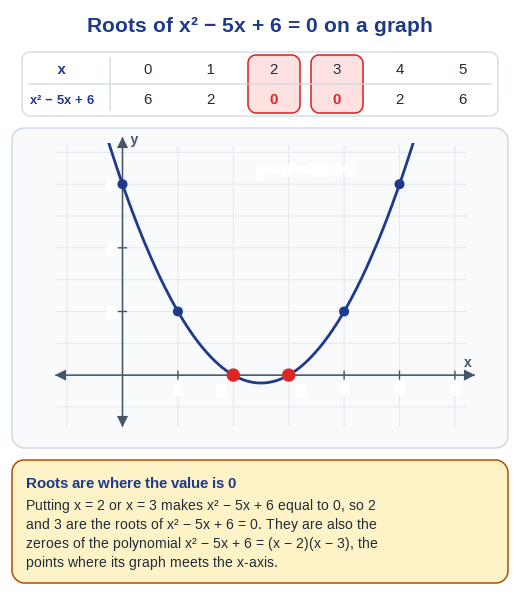
A root of a quadratic equation ax² + bx + c = 0 is a real number that makes the left side equal to zero. For x² − 5x + 6 = 0, try x = 2: 4 − 10 + 6 = 0. So 2 is a root. The roots of the equation are the same numbers as the zeroes of the polynomial x² − 5x + 6, which you studied in zeroes of a polynomial. A quadratic polynomial has at most two zeroes, so a quadratic equation has at most two roots.
Guessing roots is slow. Factorising is quicker because of one simple fact: if a product is zero, one of its factors must be zero. Since x² − 5x + 6 = (x − 2)(x − 3), the equation says (x − 2)(x − 3) = 0. So x − 2 = 0 or x − 3 = 0, and the roots are 2 and 3.
What are the steps?
- Write the equation in the standard form ax² + bx + c = 0.
- Find two numbers whose product is a × c and whose sum is b.
- Split the middle term bx using these two numbers.
- Group the four terms in pairs, take out the common factor from each pair, and write the two linear factors.
- Put each factor equal to 0 and solve.
- Check each root in the original equation.
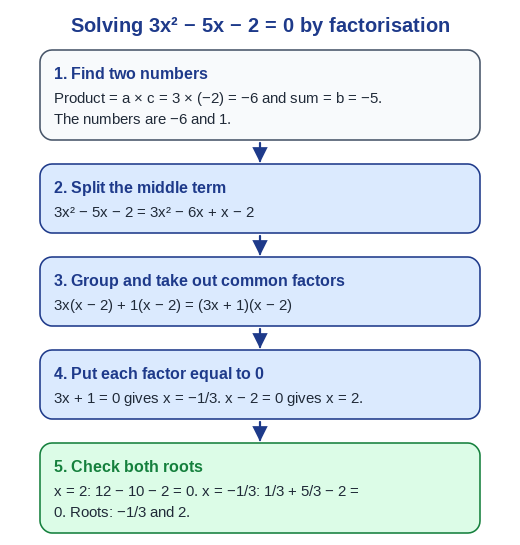
Take 3x² − 5x − 2 = 0. Here a × c = 3 × (−2) = −6 and b = −5. The numbers −6 and 1 have product −6 and sum −5.
3x² − 5x − 2 = 3x² − 6x + x − 2 = 3x(x − 2) + 1(x − 2) = (3x + 1)(x − 2)
So 3x + 1 = 0 or x − 2 = 0, and the roots are −1/3 and 2. Check x = 2: 12 − 10 − 2 = 0. Check x = −1/3: 1/3 + 5/3 − 2 = 0.
How do you find the two numbers?
The search is easier if you read the signs first.
- If a × c is positive, both numbers have the same sign, the sign of b.
- If a × c is negative, the numbers have opposite signs, and the one that is larger in size has the sign of b.
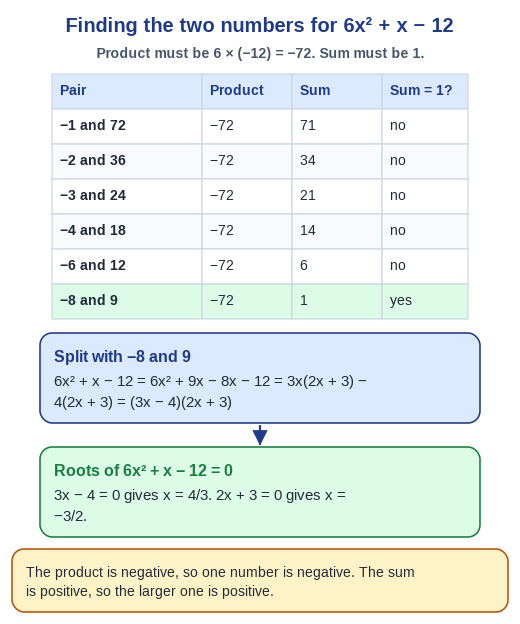
For 6x² + x − 12 = 0, a × c = −72 and b = 1. So one number is negative, and the positive one is larger. Go through the factor pairs of 72: 1 and 72, 2 and 36, 3 and 24, 4 and 18, 6 and 12, 8 and 9. Only 9 and −8 give the sum 1.
6x² + 9x − 8x − 12 = 3x(2x + 3) − 4(2x + 3) = (3x − 4)(2x + 3)
The roots are 4/3 and −3/2.
What if the two factors are the same?
Sometimes the left side is a perfect square. For 4x² − 12x + 9 = 0, a × c = 36 and b = −12, and the numbers are −6 and −6:
4x² − 6x − 6x + 9 = 2x(2x − 3) − 3(2x − 3) = (2x − 3)(2x − 3)
Both factors give x = 3/2. The equation has two equal roots, 3/2 and 3/2. Example 5 of the book is of this kind, with square roots in the coefficients: 3x² − 2√6x + 2 = (√3x − √2)², so both roots are √2/√3.
What if b or c is zero?
These are the quickest cases.
- c = 0: take x out as a common factor. 2x² − 8x = 0 becomes 2x(x − 4) = 0, so x = 0 or x = 4. Do not divide by x, or you lose the root 0.
- b = 0: use a² − b² = (a − b)(a + b). x² − 9 = 0 becomes (x − 3)(x + 3) = 0, so x = 3 or x = −3.
How is factorisation used in word problems?
Follow four moves: name the unknown, form the equation, solve it, and choose the root that fits the situation.
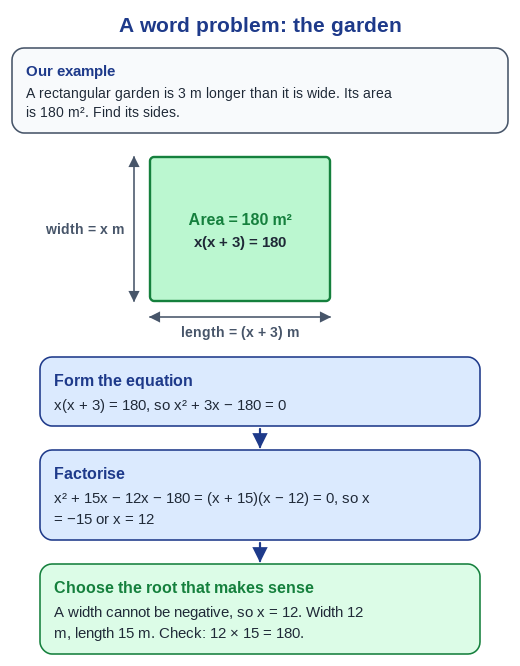
A rectangular garden is 3 m longer than it is wide, and its area is 180 m². Let the width be x m. The length is (x + 3) m, so x(x + 3) = 180, that is, x² + 3x − 180 = 0. Numbers with product −180 and sum 3 are 15 and −12:
(x + 15)(x − 12) = 0, so x = −15 or x = 12.
A width cannot be negative, so x = 12. The garden is 12 m wide and 15 m long. Check in the words: 15 is 3 more than 12, and 12 × 15 = 180.
The equation gave two roots, but the situation accepted only one. Sometimes both roots fit: if two numbers have sum 10 and product 24, then x(10 − x) = 24 gives x² − 10x + 24 = 0, (x − 4)(x − 6) = 0, and both roots describe the same pair, 4 and 6.
Every question of Exercise 4.2 is solved this way in the NCERT solutions. When the two numbers cannot be found, go to the nature of roots and the discriminant. Back to the chapter notes.
Practice
-
The roots of x² + 2x − 15 = 0 are:
Show answer
Answer: (a) 3 and −5
-
To split the middle term of 2x² − 7x + 6, the two numbers must have:
Show answer
Answer: (a) product 12 and sum −7
-
The roots of 2x² − 8x = 0 are:
Show answer
Answer: (a) 0 and 4
-
Solve 2x² − 7x + 6 = 0 by factorisation.
Show answer
Answer: Product 2 × 6 = 12 and sum −7: the numbers are −4 and −3. 2x² − 4x − 3x + 6 = 2x(x − 2) − 3(x − 2) = (2x − 3)(x − 2) = 0, so x = 3/2 or x = 2. Check: 2 × 9/4 − 21/2 + 6 = 0 and 8 − 14 + 6 = 0.
-
Two consecutive positive integers multiply to 132. Find them.
Show answer
Answer: Let them be x and x + 1. Then x(x + 1) = 132, so x² + x − 132 = 0. Numbers with product −132 and sum 1 are 12 and −11: (x + 12)(x − 11) = 0, so x = −12 or 11. x is positive, so the integers are 11 and 12. Check: 11 × 12 = 132.
Questions students ask
Why can we put each factor equal to zero?
Because a product of real numbers is zero only when at least one of the numbers is zero. If (3x + 1)(x − 2) = 0, then 3x + 1 = 0 or x − 2 = 0. This works only when the other side of the equation is 0, which is why the standard form comes first.
How do I find the two numbers quickly?
Look at the sign of a × c. If it is positive, both numbers have the sign of b. If it is negative, the numbers have opposite signs and the larger one has the sign of b. Then run through the factor pairs of a × c until the sum (or difference) is b.
What if I cannot find two such numbers?
Then the equation does not factorise with whole numbers. Work out the discriminant b² − 4ac. If it is not negative, use the quadratic formula; if it is negative, there are no real roots. The page on the nature of roots explains this.
Can the two roots be equal?
Yes. 4x² − 12x + 9 = (2x − 3)(2x − 3), so both factors give x = 3/2. The book says the root is repeated twice, once for each factor, and still counts two roots: 3/2 and 3/2.
Stuck on a question?
Take a photo and Lagnever AI explains it step by step. Try it for 7 days for ₹2.
Get it on Google Play Open in browser
For parents: after the trial, the plan renews monthly by UPI or card autopay. You can cancel anytime in the app.