
NCERT Solutions Class 10 Maths Chapter 4: Quadratic Equations
Answers to the questions inside Chapter 4, Quadratic Equations, all nine worked examples, and every question of Exercises 4.1, 4.2 and 4.3, from Mathematics, the Class 10 NCERT textbook. Page numbers follow the 2026-27 reprint (pages 38–47). The exercise questions are quoted from the book; the examples and in-chapter questions are restated in short and labelled by number and page. The book’s Fig. 4.1 and Fig. 4.2 are described in words, not redrawn, and every graph on this page is plotted from its own equation. Every root and every word-problem answer below was put back into its equation and into the words of the problem. Short notes: Chapter 4 notes.
Questions inside the chapter (pages 38–39)
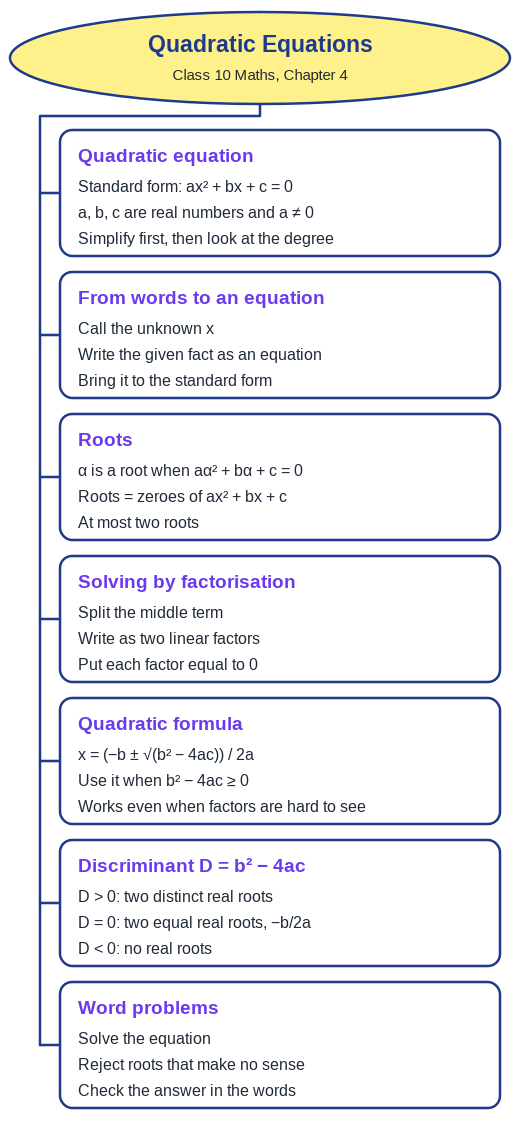
Page 38: the prayer hall with carpet area 300 m² whose length is 1 m more than twice its breadth. Let the breadth be x m. The length is (2x + 1) m, so the area is x(2x + 1) = 2x² + x. Setting this equal to 300 gives 2x² + x − 300 = 0. The breadth must satisfy this quadratic equation; it is solved in Example 6 below.
Page 39: which equations are quadratic, and what is the standard form? Any equation p(x) = 0 with p(x) of degree 2 is quadratic. So 2x² − 3x + 1 = 0, 4x − 3x² + 2 = 0 and 1 − x² + 300 = 0 are all quadratic. Written with the powers of x in descending order they read 2x² − 3x + 1 = 0, −3x² + 4x + 2 = 0 and −x² + 301 = 0. That order, ax² + bx + c = 0 with a ≠ 0, is the standard form.
Examples 1 and 2 (pages 39–41)
Example 1 (page 39): write each situation as an equation.
(i) Two children have 45 marbles in all; each loses 5, and the product of what they have left is 124. Let the first child have x marbles; the second has 45 − x, and this “why?” in the book is answered by the total of 45. After losing 5 each they have x − 5 and 40 − x.
(x − 5)(40 − x) = 124
40x − x² − 200 + 5x = 124, so −x² + 45x − 324 = 0, that is, x² − 45x + 324 = 0.
(ii) The cost of each toy (in rupees) is 55 minus the number of toys made that day, and the day’s total cost is ₹750. Let x toys be made. Each costs 55 − x, so x(55 − x) = 750.
55x − x² = 750, so x² − 55x + 750 = 0.
Both are solved in Exercise 4.2, Question 2.
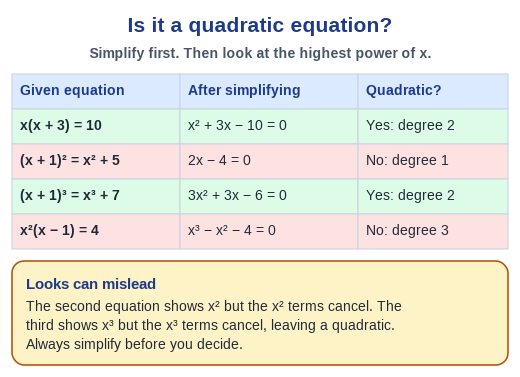
Example 2 (page 40): which of four equations are quadratic? Simplify each one first.
(i) (x − 2)² + 1 = 2x − 3: the left side is x² − 4x + 5, so x² − 6x + 8 = 0. Degree 2: quadratic.
(ii) x(x + 1) + 8 = (x + 2)(x − 2): x² + x + 8 = x² − 4, so x + 12 = 0. Degree 1: not quadratic.
(iii) x(2x + 3) = x² + 1: 2x² + 3x = x² + 1, so x² + 3x − 1 = 0. Quadratic.
(iv) (x + 2)³ = x³ − 4: x³ + 6x² + 12x + 8 = x³ − 4, so 6x² + 12x + 12 = 0, or x² + 2x + 2 = 0. Quadratic.
Page 41, Remark. (ii) looks quadratic but is not, and (iv) looks cubic but is quadratic. The lesson: simplify before you decide.
Exercise 4.1 (pages 41–42)
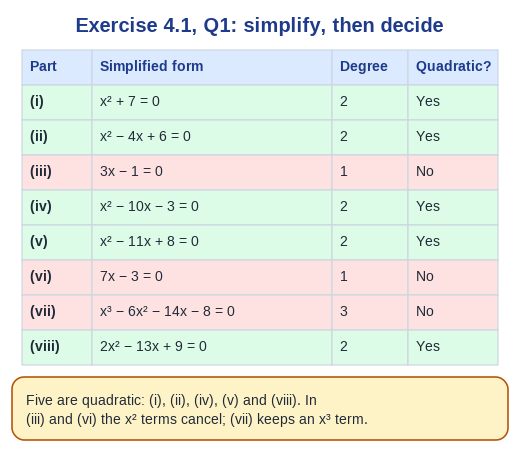
1. “Check whether the following are quadratic equations : (i) (x + 1)² = 2(x − 3) (ii) x² − 2x = (−2)(3 − x) (iii) (x − 2)(x + 1) = (x − 1)(x + 3) (iv) (x − 3)(2x + 1) = x(x + 5) (v) (2x − 1)(x − 3) = (x + 5)(x − 1) (vi) x² + 3x + 1 = (x − 2)² (vii) (x + 2)³ = 2x(x² − 1) (viii) x³ − 4x² − x + 1 = (x − 2)³”
In each part, expand both sides, bring all terms to the left and look at the degree.
(i) x² + 2x + 1 = 2x − 6, so x² + 7 = 0. This is ax² + bx + c = 0 with a = 1, b = 0, c = 7. Yes, quadratic.
(ii) x² − 2x = −6 + 2x, so x² − 4x + 6 = 0. Yes, quadratic.
(iii) Left side: x² − x − 2. Right side: x² + 2x − 3. So −3x + 1 = 0, that is, 3x − 1 = 0. The x² terms cancel. No, not quadratic.
(iv) Left side: 2x² − 5x − 3. Right side: x² + 5x. So x² − 10x − 3 = 0. Yes, quadratic.
(v) Left side: 2x² − 7x + 3. Right side: x² + 4x − 5. So x² − 11x + 8 = 0. Yes, quadratic.
(vi) x² + 3x + 1 = x² − 4x + 4, so 7x − 3 = 0. No, not quadratic.
(vii) Left side: x³ + 6x² + 12x + 8. Right side: 2x³ − 2x. So x³ − 6x² − 14x − 8 = 0, of degree 3. No, not quadratic.
(viii) Right side: x³ − 6x² + 12x − 8. So x³ − 4x² − x + 1 − x³ + 6x² − 12x + 8 = 0, that is, 2x² − 13x + 9 = 0. The x³ terms cancel. Yes, quadratic.
Answer: Quadratic: (i), (ii), (iv), (v), (viii). Not quadratic: (iii), (vi), (vii).
2. “Represent the following situations in the form of quadratic equations :”
(i) “The area of a rectangular plot is 528 m². The length of the plot (in metres) is one more than twice its breadth. We need to find the length and breadth of the plot.”
Given: Area = 528 m². Length = 2 × breadth + 1.
To find: A quadratic equation for the breadth.
- Let the breadth be x m. Then the length is (2x + 1) m.
- Area = length × breadth: x(2x + 1) = 528.
- Open the bracket: 2x² + x = 528.
Answer: 2x² + x − 528 = 0, where x is the breadth in metres.
(Not asked, but as a check: 2x² + 33x − 32x − 528 = (2x + 33)(x − 16), so x = 16. Breadth 16 m, length 33 m, and 16 × 33 = 528.)
(ii) “The product of two consecutive positive integers is 306. We need to find the integers.”
Given: Two consecutive positive integers have product 306.
To find: A quadratic equation for the integers.
- Let the smaller integer be x. The next integer is x + 1.
- Product: x(x + 1) = 306, so x² + x = 306.
Answer: x² + x − 306 = 0, where x is the smaller integer.
(Check: (x + 18)(x − 17) = 0 gives x = 17, and 17 × 18 = 306.)
(iii) “Rohan’s mother is 26 years older than him. The product of their ages (in years) 3 years from now will be 360. We would like to find Rohan’s present age.”
Given: Mother is 26 years older than Rohan. In 3 years, the product of their ages will be 360.
To find: A quadratic equation for Rohan’s present age.
- Let Rohan’s present age be x years. His mother’s age is (x + 26) years.
- In 3 years their ages will be (x + 3) and (x + 29).
- Product: (x + 3)(x + 29) = 360, so x² + 32x + 87 = 360.
Answer: x² + 32x − 273 = 0, where x is Rohan’s present age in years.
(Check: (x + 39)(x − 7) = 0 gives x = 7. In 3 years the ages are 10 and 36, and 10 × 36 = 360.)
(iv) “A train travels a distance of 480 km at a uniform speed. If the speed had been 8 km/h less, then it would have taken 3 hours more to cover the same distance. We need to find the speed of the train.”
Given: Distance = 480 km. With speed 8 km/h less, the train takes 3 hours more.
To find: A quadratic equation for the speed.
- Let the speed be u km/h. Time = distance ÷ speed = 480/u hours.
- At (u − 8) km/h, the time is 480/(u − 8) hours.
- This is 3 hours more: 480/(u − 8) − 480/u = 3.
- Multiply both sides by u(u − 8): 480u − 480(u − 8) = 3u(u − 8).
- So 3840 = 3u² − 24u. Divide by 3: 1280 = u² − 8u.
Answer: u² − 8u − 1280 = 0, where u is the speed in km/h.
(Check: (u − 40)(u + 32) = 0 gives u = 40. At 40 km/h the journey takes 12 hours; at 32 km/h it takes 15 hours, 3 more.)
All four equations match the book’s answer key.
Roots, and Examples 3 to 6 (pages 42–44)
Page 42: is 1 a root of 2x² − 3x + 1 = 0? Put x = 1: 2 × 1² − 3 × 1 + 1 = 0. The left side equals the right side, so 1 is a root, and also a zero of the polynomial 2x² − 3x + 1. (The other root is 1/2, since 2x² − 3x + 1 = (2x − 1)(x − 1).) A quadratic polynomial has at most two zeroes, so a quadratic equation has at most two roots.
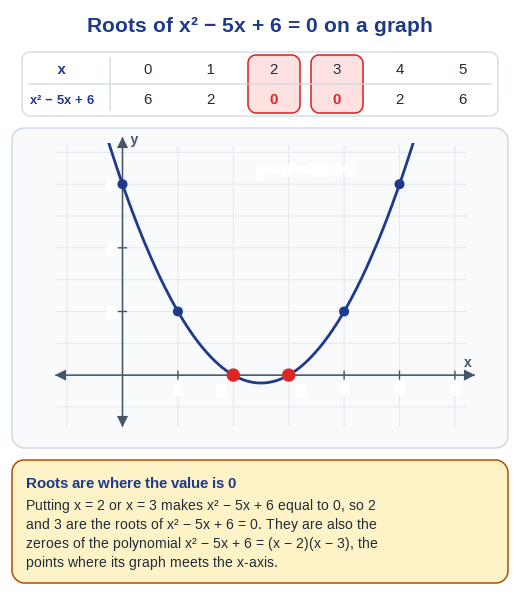
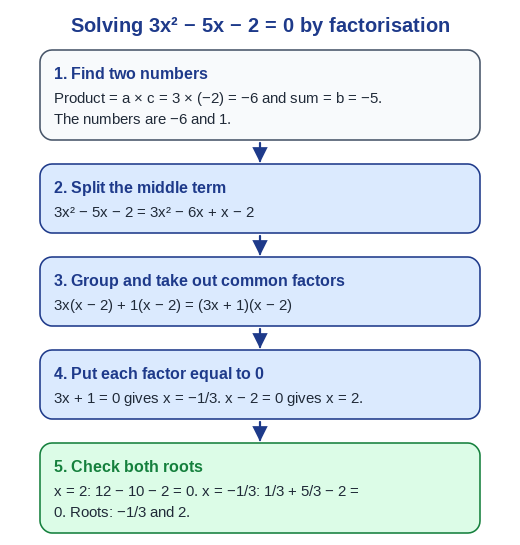
Example 3 (page 42): roots of 2x² − 5x + 3 = 0 by factorisation. Product 2 × 3 = 6 and sum −5: the numbers are −2 and −3.
2x² − 2x − 3x + 3 = 2x(x − 1) − 3(x − 1) = (2x − 3)(x − 1) = 0
Roots: 3/2 and 1. The book asks you to verify: 2 × 9/4 − 15/2 + 3 = 9/2 − 15/2 + 6/2 = 0, and 2 − 5 + 3 = 0.
Example 4 (page 43): roots of 6x² − x − 2 = 0. Product 6 × (−2) = −12 and sum −1: the numbers are 3 and −4.
6x² + 3x − 4x − 2 = 3x(2x + 1) − 2(2x + 1) = (3x − 2)(2x + 1) = 0
Roots: 2/3 and −1/2. Check: 6 × 4/9 − 2/3 − 2 = 8/3 − 2/3 − 6/3 = 0, and 6 × 1/4 + 1/2 − 2 = 0.
Example 5 (page 43): roots of 3x² − 2√6x + 2 = 0. Product 3 × 2 = 6 and sum −2√6: the numbers are −√6 and −√6. Note that 3x² = (√3x)² and √6 = √3 × √2.
3x² − √6x − √6x + 2 = √3x(√3x − √2) − √2(√3x − √2) = (√3x − √2)(√3x − √2) = 0
Both factors give √3x = √2, so x = √2/√3. The root is repeated: √2/√3 and √2/√3, which the book writes as √(2/3) and which also equals √6/3.
Example 6 (page 44): the size of the prayer hall. From page 38, 2x² + x − 300 = 0. Product 2 × (−300) = −600 and sum 1: the numbers are 25 and −24.
2x² − 24x + 25x − 300 = 2x(x − 12) + 25(x − 12) = (x − 12)(2x + 25) = 0
So x = 12 or x = −12.5. A breadth cannot be negative, so the breadth is 12 m and the length 2 × 12 + 1 = 25 m. Check: 12 × 25 = 300.
Exercise 4.2 (page 44)
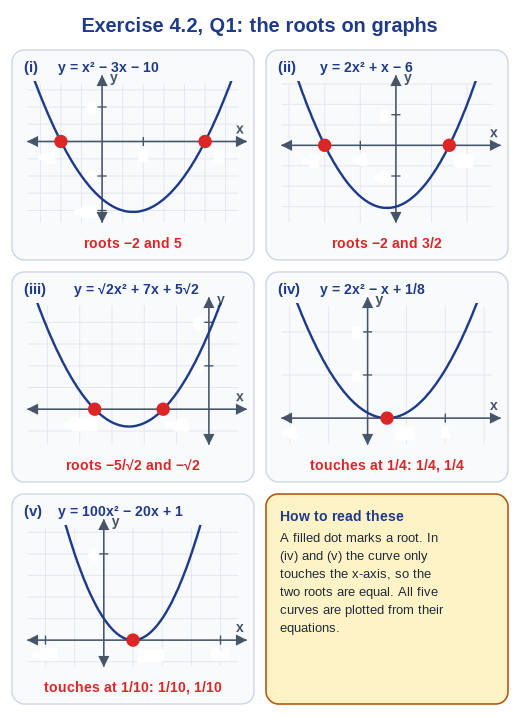
1. “Find the roots of the following quadratic equations by factorisation: (i) x² − 3x − 10 = 0 (ii) 2x² + x − 6 = 0 (iii) √2x² + 7x + 5√2 = 0 (iv) 2x² − x + 1/8 = 0 (v) 100x² − 20x + 1 = 0”
(i) Product −10 and sum −3: the numbers are −5 and 2.
x² − 5x + 2x − 10 = x(x − 5) + 2(x − 5) = (x − 5)(x + 2) = 0
Roots: 5 and −2. Check: 25 − 15 − 10 = 0 and 4 + 6 − 10 = 0.
(ii) Product 2 × (−6) = −12 and sum 1: the numbers are 4 and −3.
2x² + 4x − 3x − 6 = 2x(x + 2) − 3(x + 2) = (2x − 3)(x + 2) = 0
Roots: 3/2 and −2. Check: 2 × 9/4 + 3/2 − 6 = 0 and 8 − 2 − 6 = 0.
(iii) Product √2 × 5√2 = 10 and sum 7: the numbers are 2 and 5. Note that 2x = √2 × √2x.
√2x² + 2x + 5x + 5√2 = √2x(x + √2) + 5(x + √2) = (√2x + 5)(x + √2) = 0
Roots: −5/√2 and −√2. (−5/√2 can also be written −5√2/2.) Check x = −√2: √2 × 2 − 7√2 + 5√2 = 0. Check x = −5/√2: √2 × 25/2 − 35/√2 + 5√2 = (25 − 35 + 10)/√2 = 0.
(iv) Multiply by 8 to remove the fraction: 16x² − 8x + 1 = 0. Product 16 and sum −8: the numbers are −4 and −4.
16x² − 4x − 4x + 1 = 4x(4x − 1) − 1(4x − 1) = (4x − 1)(4x − 1) = 0
Roots: 1/4 and 1/4 (two equal roots). Check: 2 × 1/16 − 1/4 + 1/8 = 1/8 − 2/8 + 1/8 = 0.
(v) Product 100 and sum −20: the numbers are −10 and −10.
100x² − 10x − 10x + 1 = 10x(10x − 1) − 1(10x − 1) = (10x − 1)(10x − 1) = 0
Roots: 1/10 and 1/10 (two equal roots). Check: 100 × 1/100 − 2 + 1 = 0.
Answer: (i) 5, −2 (ii) 3/2, −2 (iii) −5/√2, −√2 (iv) 1/4, 1/4 (v) 1/10, 1/10
2. “Solve the problems given in Example 1.”
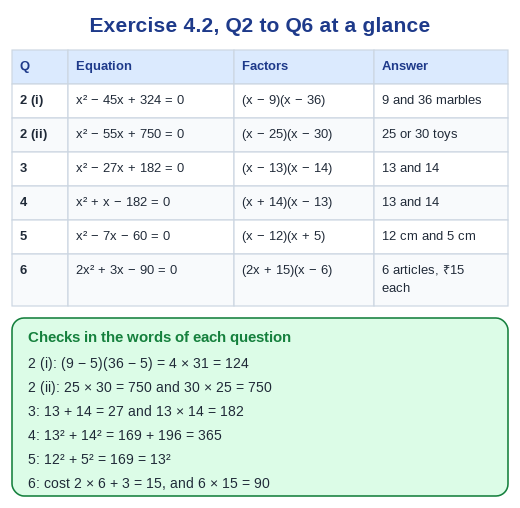
(i) The marbles: x² − 45x + 324 = 0. Product 324 and sum −45: the numbers are −36 and −9.
x² − 36x − 9x + 324 = x(x − 36) − 9(x − 36) = (x − 36)(x − 9) = 0, so x = 36 or x = 9.
If one child had 36 marbles, the other had 45 − 36 = 9; if one had 9, the other had 36. Either way, they started with 9 and 36 marbles. Check: after losing 5 each, 4 × 31 = 124.
(ii) The toys: x² − 55x + 750 = 0. Product 750 and sum −55: the numbers are −30 and −25.
x² − 30x − 25x + 750 = x(x − 30) − 25(x − 30) = (x − 30)(x − 25) = 0, so x = 30 or x = 25.
Both fit: 25 toys (each costing ₹30) or 30 toys (each costing ₹25). In both cases the total cost is ₹750.
Answer: (i) The two children started with 9 and 36 marbles. (ii) 25 toys or 30 toys were made that day.
3. “Find two numbers whose sum is 27 and product is 182.”
Given: Sum of two numbers = 27. Product = 182.
To find: The two numbers.
- Let one number be x. The other is 27 − x.
- Product: x(27 − x) = 182, so 27x − x² = 182, that is, x² − 27x + 182 = 0.
- Split the middle term: we need two numbers with product 182 and sum −27. They are −13 and −14.
- x² − 13x − 14x + 182 = x(x − 13) − 14(x − 13) = (x − 13)(x − 14) = 0.
- So x = 13 or x = 14. If x = 13, the other number is 14 (and the other way round).
- Check: 13 + 14 = 27 and 13 × 14 = 182.
Answer: The numbers are 13 and 14.
4. “Find two consecutive positive integers, sum of whose squares is 365.”
Given: Two consecutive positive integers. The sum of their squares is 365.
To find: The two integers.
- Let the integers be x and x + 1.
- x² + (x + 1)² = 365, so 2x² + 2x + 1 = 365, that is, 2x² + 2x − 364 = 0.
- Divide by 2: x² + x − 182 = 0.
- Split the middle term: product −182 and sum 1 give 14 and −13.
- x² + 14x − 13x − 182 = x(x + 14) − 13(x + 14) = (x + 14)(x − 13) = 0, so x = −14 or x = 13.
- x must be positive, so x = 13, and the next integer is 14.
- Check: 13² + 14² = 169 + 196 = 365.
Answer: The integers are 13 and 14.
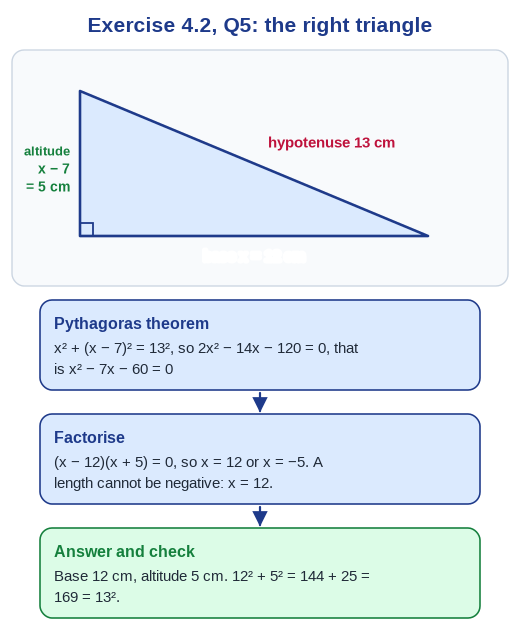
5. “The altitude of a right triangle is 7 cm less than its base. If the hypotenuse is 13 cm, find the other two sides.”
Given: A right triangle. Altitude = base − 7 cm. Hypotenuse = 13 cm.
To find: The base and the altitude.
- Let the base be x cm. Then the altitude is (x − 7) cm.
- By the Pythagoras theorem (base² + altitude² = hypotenuse²): x² + (x − 7)² = 13².
- So x² + x² − 14x + 49 = 169, that is, 2x² − 14x − 120 = 0. Divide by 2: x² − 7x − 60 = 0.
- Split the middle term: product −60 and sum −7 give −12 and 5.
- x² − 12x + 5x − 60 = x(x − 12) + 5(x − 12) = (x − 12)(x + 5) = 0, so x = 12 or x = −5.
- A length cannot be negative, so x = 12. The altitude is 12 − 7 = 5.
- Check: 12² + 5² = 144 + 25 = 169 = 13².
Answer: The base is 12 cm and the altitude is 5 cm.
6. “A cottage industry produces a certain number of pottery articles in a day. It was observed on a particular day that the cost of production of each article (in rupees) was 3 more than twice the number of articles produced on that day. If the total cost of production on that day was ₹ 90, find the number of articles produced and the cost of each article.”
Given: Cost of each article = 2 × (number of articles) + 3 rupees. Total cost = ₹90.
To find: The number of articles and the cost of each.
- Let the number of articles be x. The cost of each is ₹(2x + 3).
- Total cost: x(2x + 3) = 90, so 2x² + 3x − 90 = 0.
- Split the middle term: product 2 × (−90) = −180 and sum 3 give 15 and −12.
- 2x² + 15x − 12x − 90 = x(2x + 15) − 6(2x + 15) = (2x + 15)(x − 6) = 0, so x = −15/2 or x = 6.
- The number of articles cannot be negative or a fraction, so x = 6.
- Cost of each = 2 × 6 + 3 = 15.
- Check: 6 × 15 = 90.
Answer: 6 articles were produced, and each cost ₹15.
All answers to Exercise 4.2 match the book’s answer key.
Nature of roots, and Examples 7 to 9 (pages 44–46)
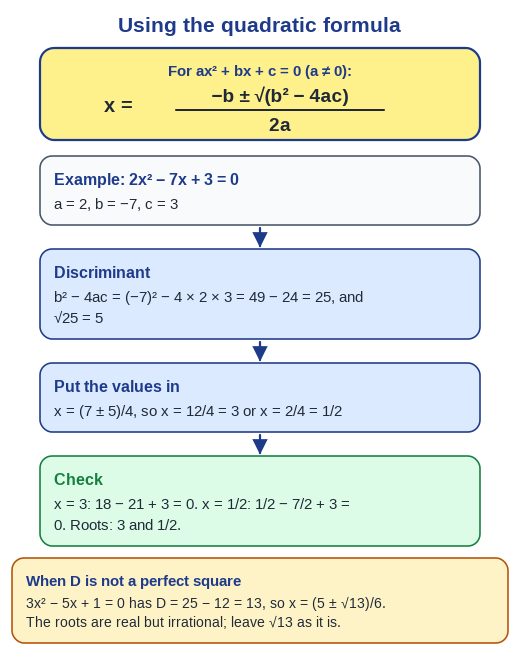
Pages 44–45: the formula and the three cases. The book states that the roots of ax² + bx + c = 0 are x = (−b ± √(b² − 4ac))/2a. This edition does not derive it. With D = b² − 4ac:
- D > 0: two distinct real roots, −b/2a + √D/2a and −b/2a − √D/2a.
- D = 0: both roots are −b/2a, so two equal real roots.
- D < 0: no real number has D as its square, so there are no real roots.
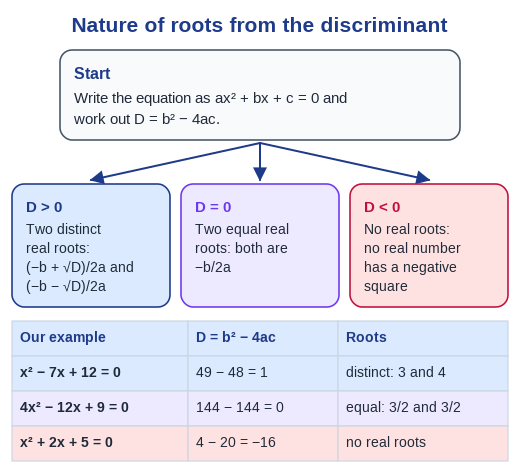
Example 7 (page 45): discriminant and nature of roots of 2x² − 4x + 3 = 0. a = 2, b = −4, c = 3.
D = (−4)² − 4 × 2 × 3 = 16 − 24 = −8 < 0
No real roots.
Example 8 (pages 45–46): a pole on the edge of a round park 13 m across, with its distances from two opposite gates A and B differing by 7 m. Is it possible, and where? Picture a circle with A and B at the two ends of a diameter and the pole P on the circle (the book’s Fig. 4.2). Let BP = x m; then AP = (x + 7) m. The book asks why angle APB is 90°: an angle in a semicircle is a right angle, and AB is a diameter. So by the Pythagoras theorem,
(x + 7)² + x² = 13², so 2x² + 14x + 49 = 169, 2x² + 14x − 120 = 0, and x² + 7x − 60 = 0.
D = 7² − 4 × 1 × (−60) = 49 + 240 = 289 > 0, so real roots exist and the pole can be placed. By the formula,
x = (−7 ± √289)/2 = (−7 ± 17)/2, so x = 5 or x = −12.
A distance cannot be negative, so x = 5. The pole stands 5 m from gate B and 12 m from gate A. Check: 12 − 5 = 7 and 5² + 12² = 169 = 13².
Example 9 (page 46): discriminant of 3x² − 2x + 1/3 = 0, the nature of its roots, and the roots. a = 3, b = −2, c = 1/3.
D = (−2)² − 4 × 3 × 1/3 = 4 − 4 = 0
Two equal real roots, each −b/2a = 2/6 = 1/3. Check: 3 × 1/9 − 2/3 + 1/3 = 0.
Exercise 4.3 (page 47)
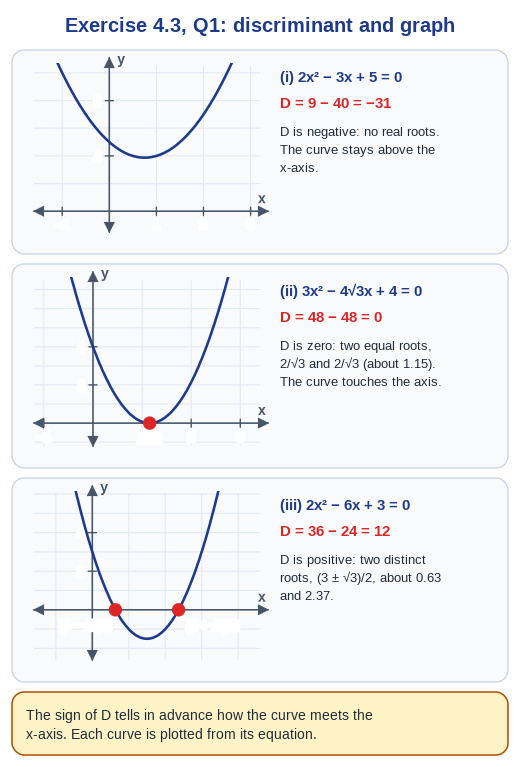
1. “Find the nature of the roots of the following quadratic equations. If the real roots exist, find them: (i) 2x² − 3x + 5 = 0 (ii) 3x² − 4√3x + 4 = 0 (iii) 2x² − 6x + 3 = 0”
(i) a = 2, b = −3, c = 5. D = (−3)² − 4 × 2 × 5 = 9 − 40 = −31 < 0. No real roots.
(ii) a = 3, b = −4√3, c = 4. D = (−4√3)² − 4 × 3 × 4 = 48 − 48 = 0. Two equal real roots, each −b/2a = 4√3/6 = 2√3/3 = 2/√3. Check: 3 × 4/3 − 4√3 × 2/√3 + 4 = 4 − 8 + 4 = 0.
(iii) a = 2, b = −6, c = 3. D = (−6)² − 4 × 2 × 3 = 36 − 24 = 12 > 0. Two distinct real roots. √12 = 2√3, so
x = (6 ± 2√3)/4 = (3 ± √3)/2
The roots are (3 + √3)/2 and (3 − √3)/2. Check with sum and product: the sum is 3 = −(−6)/2 and the product is (9 − 3)/4 = 3/2 = c/a.
Answer: (i) no real roots (ii) two equal real roots, 2/√3 and 2/√3 (iii) two distinct real roots, (3 ± √3)/2
2. “Find the values of k for each of the following quadratic equations, so that they have two equal roots. (i) 2x² + kx + 3 = 0 (ii) kx (x − 2) + 6 = 0”
Two equal roots mean D = 0.
(i) a = 2, b = k, c = 3. D = k² − 4 × 2 × 3 = k² − 24 = 0, so k² = 24 and k = ±2√6. Check with k = 2√6: 2x² + 2√6x + 3 = (√2x + √3)², a perfect square.
(ii) First write the standard form: kx² − 2kx + 6 = 0, so a = k, b = −2k, c = 6.
D = (−2k)² − 4 × k × 6 = 4k² − 24k = 4k(k − 6) = 0, so k = 0 or k = 6.
If k = 0 the equation becomes 6 = 0, which is not a quadratic equation (and is never true). So k = 6. Check: 6x² − 12x + 6 = 6(x − 1)², with equal roots 1 and 1.
Answer: (i) k = 2√6 or k = −2√6 (ii) k = 6
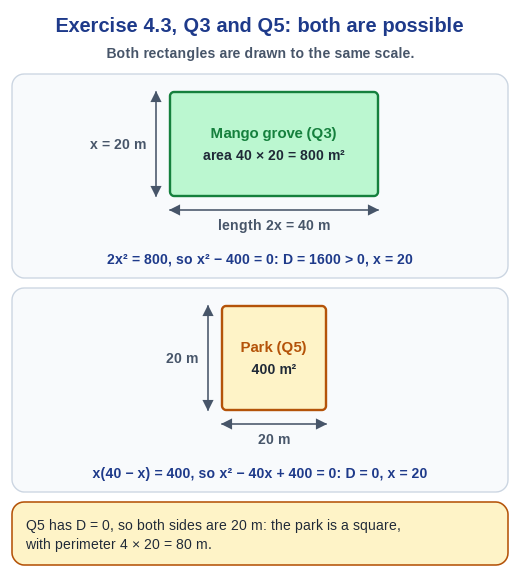
3. “Is it possible to design a rectangular mango grove whose length is twice its breadth, and the area is 800 m²? If so, find its length and breadth.”
Given: Length = 2 × breadth. Area = 800 m².
To find: Whether such a grove is possible, and if so its length and breadth.
- Let the breadth be x m. The length is 2x m.
- Area: 2x × x = 800, so 2x² − 800 = 0. Divide by 2: x² − 400 = 0. Here a = 1, b = 0, c = −400.
- Discriminant D = b² − 4ac = 0 − 4 × 1 × (−400) = 1600. D > 0, so real roots exist. The grove is possible.
- x = (0 ± √1600)/2 = ±40/2 = ±20.
- The breadth cannot be negative, so x = 20. The length is 2 × 20 = 40.
- Check: 40 × 20 = 800.
Answer: Yes, it is possible. Length 40 m, breadth 20 m.
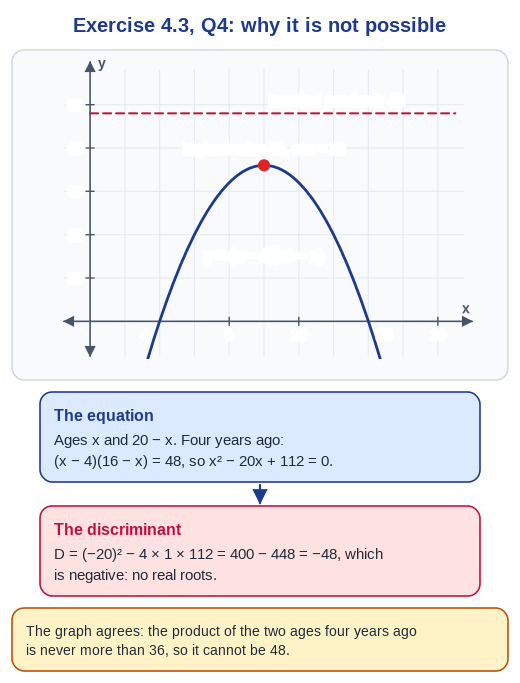
4. “Is the following situation possible? If so, determine their present ages. The sum of the ages of two friends is 20 years. Four years ago, the product of their ages in years was 48.”
Given: Sum of the present ages of two friends = 20 years. Four years ago, the product of their ages was 48.
To find: Whether this is possible, and if so their present ages.
- Let one friend’s present age be x years. The other’s is (20 − x) years.
- Four years ago their ages were (x − 4) and (16 − x).
- Product: (x − 4)(16 − x) = 48, so 16x − x² − 64 + 4x = 48, that is, −x² + 20x − 112 = 0.
- Multiply by −1: x² − 20x + 112 = 0. Here a = 1, b = −20, c = 112.
- D = (−20)² − 4 × 1 × 112 = 400 − 448 = −48. D < 0, so there are no real roots.
Answer: No, the situation is not possible.
5. “Is it possible to design a rectangular park of perimeter 80 m and area 400 m²? If so, find its length and breadth.”
Given: Perimeter = 80 m. Area = 400 m².
To find: Whether such a park is possible, and if so its length and breadth.
- Perimeter 80 m means 2(length + breadth) = 80, so length + breadth = 40 m.
- Let the length be x m. The breadth is (40 − x) m.
- Area: x(40 − x) = 400, so x² − 40x + 400 = 0. Here a = 1, b = −40, c = 400.
- D = (−40)² − 4 × 1 × 400 = 1600 − 1600 = 0. The roots are real and equal, so the park is possible.
- Each root is −b/2a = 40/2 = 20. So length = 20 m and breadth = 40 − 20 = 20 m: the park is a square.
- Check: perimeter 2(20 + 20) = 80 m and area 20 × 20 = 400 m².
Answer: Yes, it is possible. Length 20 m and breadth 20 m.
All answers to Exercise 4.3 match the book’s answer key.
Summary of the chapter (page 47)
In our own words, the five points the book closes with are: the standard form ax² + bx + c = 0 with a ≠ 0; a root α satisfies aα² + bα + c = 0, and roots are the zeroes of the polynomial; factorising into two linear factors and putting each equal to zero gives the roots; the quadratic formula gives the roots when b² − 4ac ≥ 0; and the sign of b² − 4ac separates two distinct real roots, two equal roots and no real roots. More practice with our own examples: solving by factorisation and nature of roots and the discriminant.
Practice
-
The roots of x² − 2x − 8 = 0 are:
Show answer
Answer: (a) 4 and −2
-
The discriminant of x² − 5x + 7 = 0 is −3. The equation has:
Show answer
Answer: (a) no real roots
-
For which value of k does 3x² − 6x + k = 0 have two equal roots?
Show answer
Answer: (a) 3
-
A rectangle is 5 m longer than it is wide and its area is 150 m². Find its sides.
Show answer
Answer: Let the width be x m. Then x(x + 5) = 150, so x² + 5x − 150 = 0. Numbers with product −150 and sum 5 are 15 and −10: (x + 15)(x − 10) = 0, so x = −15 or 10. A width cannot be negative, so the width is 10 m and the length 15 m. Check: 10 × 15 = 150.
-
Solve 5x² − 6x − 2 = 0 with the quadratic formula.
Show answer
Answer: a = 5, b = −6, c = −2. D = 36 + 40 = 76 > 0, and √76 = 2√19. x = (6 ± 2√19)/10 = (3 ± √19)/5. The two roots are (3 + √19)/5 and (3 − √19)/5.
-
The sides of a right triangle containing the right angle add up to 17 cm and the hypotenuse is 13 cm. Find the two sides.
Show answer
Answer: Let one side be x cm; the other is (17 − x) cm. x² + (17 − x)² = 169 gives 2x² − 34x + 120 = 0, so x² − 17x + 60 = 0 and (x − 5)(x − 12) = 0. The sides are 5 cm and 12 cm. Check: 25 + 144 = 169.
Stuck on a question?
Take a photo and Lagnever AI explains it step by step. Try it for 7 days for ₹2.
Get it on Google Play Open in browser
For parents: after the trial, the plan renews monthly by UPI or card autopay. You can cancel anytime in the app.