
Class 10 Maths Chapter 4: Quadratic Equations Notes
This chapter in five lines
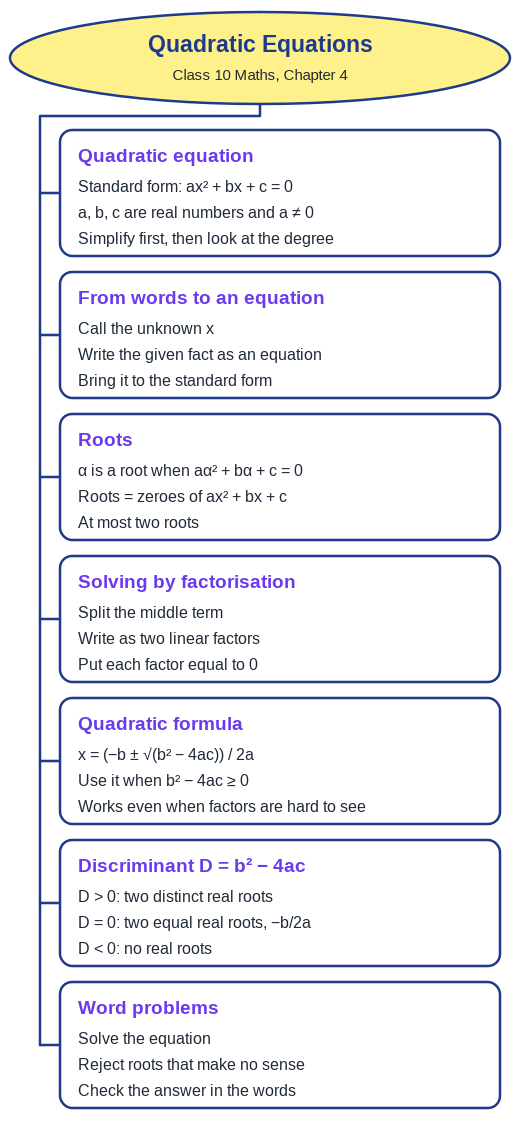
A quadratic equation in x has the form ax² + bx + c = 0, where a, b and c are real numbers and a ≠ 0. Its roots are the values of x that make it true, and there are at most two. You find them by factorising or with the quadratic formula. The discriminant b² − 4ac tells whether the roots are two distinct real numbers, two equal real numbers, or not real.
What is this chapter about?
In Chapter 2 you met the quadratic polynomial ax² + bx + c. Put it equal to zero and you get a quadratic equation. Such equations turn up whenever two unknown quantities that depend on each other are multiplied: the sides of a rectangle with a known area, two ages with a known product, a speed and a time. This 10-page chapter shows how to write such problems as equations, how to solve them, and how to tell in advance whether a solution exists.
What is a quadratic equation?
An equation in x is called quadratic when it can be written as
ax² + bx + c = 0, with real numbers a, b and c, and a ≠ 0.
This is called the standard form: the terms are in order from x² down to the constant. The condition a ≠ 0 matters, because without the x² term the equation is only linear. b or c may be zero: x² − 9 = 0 and 2x² − 8x = 0 are both quadratic.
How do you check whether an equation is quadratic?
Do not judge an equation by how it looks. Expand the brackets, bring every term to one side and simplify. Then look at the highest power of x that is left. If it is 2, the equation is quadratic.
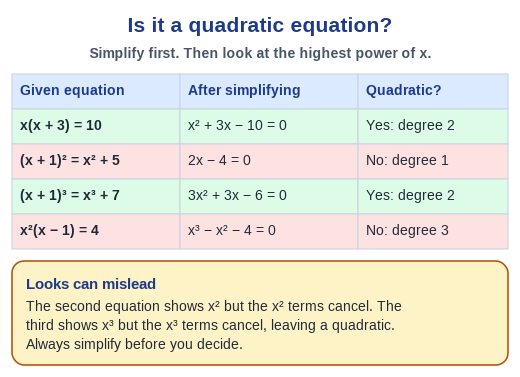
(x + 1)² = x² + 5 seems to contain x², but the x² terms cancel and only 2x − 4 = 0 remains, so it is linear. (x + 1)³ = x³ + 7 seems to be cubic, but the x³ terms cancel and 3x² + 3x − 6 = 0 remains, so it is quadratic.
How do you turn a word problem into a quadratic equation?
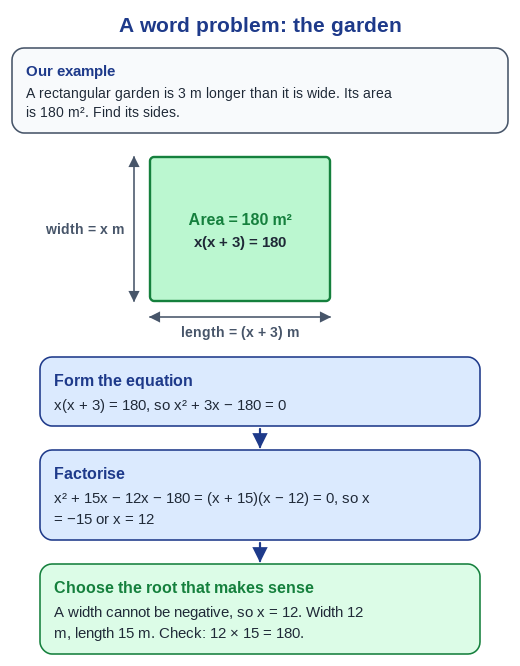
Name the unknown x, write every other quantity using x, and then turn the given fact into an equation. Suppose a rectangular garden is 3 m longer than it is wide and its area is 180 m². If the width is x m, the length is (x + 3) m, so x(x + 3) = 180. In standard form: x² + 3x − 180 = 0.
What is a root of a quadratic equation?
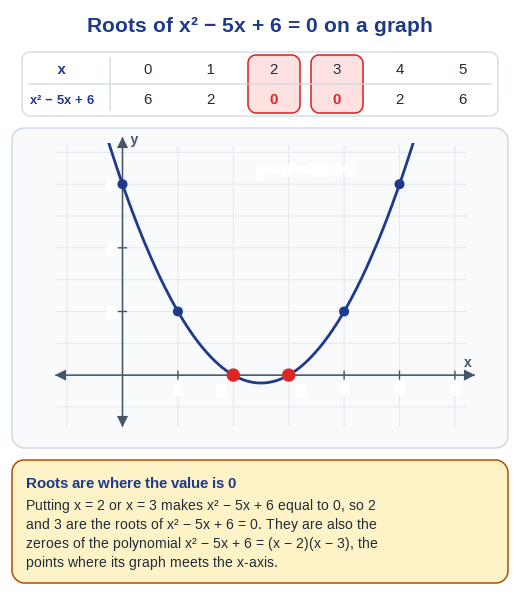
A real number α is a root of ax² + bx + c = 0 if putting x = α makes the left side zero, that is, aα² + bα + c = 0. For x² − 5x + 6 = 0, putting x = 2 gives 4 − 10 + 6 = 0, so 2 is a root; so is 3. The roots of the equation are exactly the zeroes of the polynomial x² − 5x + 6, so a quadratic equation has at most two roots.
How do you solve a quadratic equation by factorisation?
Write the left side as a product of two linear factors by splitting the middle term. A product is zero only when one of its factors is zero, so put each factor equal to 0.
For x² + 3x − 180 = 0: two numbers with product −180 and sum 3 are 15 and −12. So x² + 15x − 12x − 180 = x(x + 15) − 12(x + 15) = (x + 15)(x − 12) = 0, which gives x = −15 or x = 12. A width cannot be negative, so the garden is 12 m wide and 15 m long. Read more on solving by factorisation.
What is the quadratic formula?
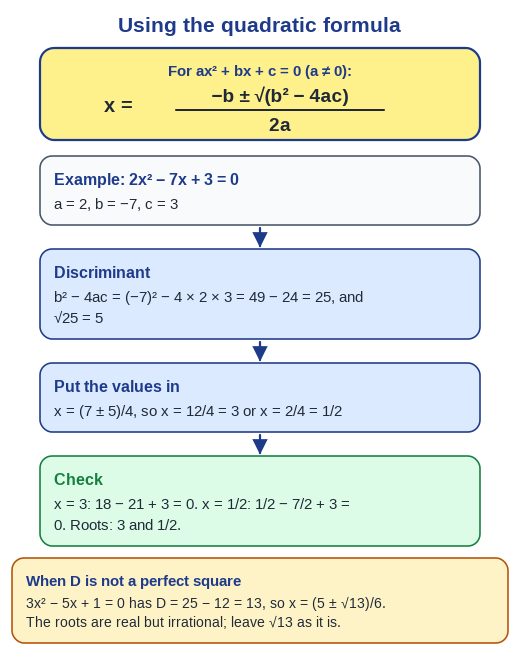
The book states that the roots of ax² + bx + c = 0 are
x = (−b ± √(b² − 4ac)) / 2a, provided b² − 4ac ≥ 0.
The sign ± means there are two values, one with + and one with −. For 2x² − 7x + 3 = 0, a = 2, b = −7 and c = 3, so b² − 4ac = 49 − 24 = 25 and x = (7 ± 5)/4. The roots are 3 and 1/2. The current book gives this formula without deriving it.
What does the discriminant tell you?
The number under the square root, D = b² − 4ac, is the discriminant. Its sign decides the nature of the roots.
- D > 0: two distinct real roots.
- D = 0: two equal real roots, each −b/2a.
- D < 0: no real roots, because no real number has a negative square.
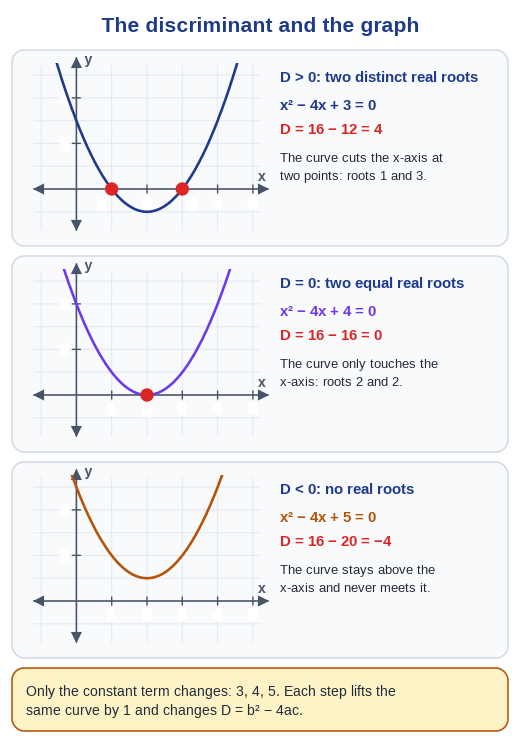
So you can answer “is this possible?” before solving anything. Read more on the nature of roots and the discriminant.
Before we move on
You need to factorise quadratic polynomials quickly; zeroes and coefficients from Chapter 2 has practice with splitting the middle term. The chapter’s introduction also has a short history note: it credits Brahmagupta and Sridharacharya with early formulas for solving such equations. All nine examples and all three exercises are answered in the NCERT solutions for Chapter 4. The previous chapter is Pair of Linear Equations in Two Variables.
Key terms
| Term | Meaning |
|---|---|
| Quadratic polynomial | A polynomial of degree 2: ax² + bx + c with a ≠ 0, such as 2x² + x − 300. |
| Quadratic equation | An equation p(x) = 0 where the polynomial p(x) has degree 2, such as x² − 5x + 6 = 0. |
| Standard form | ax² + bx + c = 0 with a ≠ 0, the terms written from the highest power of x to the lowest. |
| Root (solution) | A real number α with aα² + bα + c = 0. We also say that α satisfies the equation. |
| Zero of a polynomial | A number that makes the polynomial 0. The zeroes of ax² + bx + c are the roots of ax² + bx + c = 0. |
| Factorisation | Writing ax² + bx + c as a product of two linear factors, such as (x − 2)(x − 3). |
| Splitting the middle term | Writing bx as the sum of two terms whose product equals ax² × c, so that the expression can be grouped and factorised. |
| Quadratic formula | x = (−b ± √(b² − 4ac)) / 2a, which gives the roots of ax² + bx + c = 0 when b² − 4ac ≥ 0. |
| Discriminant | The number b² − 4ac, often written D. Its sign decides the nature of the roots. |
| Nature of roots | Whether the roots are two distinct real numbers, two equal real numbers, or not real. |
| Equal (coincident) roots | The case D = 0, when both roots are −b/2a. 4x² − 12x + 9 = 0 has roots 3/2 and 3/2. |
| No real roots | The case D < 0. No real number satisfies the equation, as with x² + 2x + 5 = 0. |
Topics in this chapter
Practice
-
Which of these is a quadratic equation?
Show answer
Answer: (a) x(x + 3) = 10
-
The roots of x² − 7x + 12 = 0 are:
Show answer
Answer: (a) 3 and 4
-
The discriminant of 2x² − 4x + 3 = 0 is:
Show answer
Answer: (a) −8
-
If b² − 4ac = 0, the equation ax² + bx + c = 0 has:
Show answer
Answer: (a) two equal real roots
-
A number x and the number 3 more than it have product 180, and x is positive. Then x is:
Show answer
Answer: (a) 12
Questions students ask
What are the main topics of Class 10 Maths Chapter 4?
The standard form ax² + bx + c = 0 and how to check whether an equation is quadratic; writing word problems as quadratic equations; roots and solving by factorisation; the quadratic formula; and the discriminant b² − 4ac, which gives the nature of the roots.
Is completing the square in the 2026-27 book?
No. The rationalised book (revised October 2022, marked Reprint 2026-27) has no section on solving by completing the square. Section 4.4 simply states the quadratic formula, without deriving it, and uses it for the nature of roots. The introduction still mentions the method only as history.
How many exercises does Chapter 4 have?
Three. Exercise 4.1 (2 questions) is about recognising and forming quadratic equations, Exercise 4.2 (6 questions) is about factorisation, and Exercise 4.3 (5 questions) is about the discriminant and the nature of roots. All 13 questions and Examples 1 to 9 are worked out on the NCERT solutions page.
When should I use the quadratic formula and when factorisation?
Use the method the question names. If the choice is yours, try factorisation first when the numbers are small. If you cannot find the two numbers to split the middle term, work out D = b² − 4ac and use the formula; it works for every quadratic equation that has real roots.
Stuck on a question?
Take a photo and Lagnever AI explains it step by step. Try it for 7 days for ₹2.
Get it on Google Play Open in browser
For parents: after the trial, the plan renews monthly by UPI or card autopay. You can cancel anytime in the app.