
NCERT Solutions Class 10 Maths Chapter 5: Arithmetic Progressions
Answers to the questions inside Chapter 5, Arithmetic Progressions, all sixteen worked examples, and every question of Exercises 5.1, 5.2 and 5.3 and of the optional Exercise 5.4, from Mathematics, the Class 10 NCERT textbook. Page numbers follow the 2026-27 reprint (pages 49–72). The exercise questions are quoted from the book; the examples and in-chapter questions are restated in short and labelled by number and page. The book’s figures are not copied: the sketches here are drawn from the numbers in each question. Every term, sum and word-problem answer below was checked by listing the terms and adding them. Throughout, a is the first term, d the common difference, aₙ the nth term, l the last term and Sₙ the sum of the first n terms. Short notes: Chapter 5 notes.
Questions inside the chapter (pages 49–53)
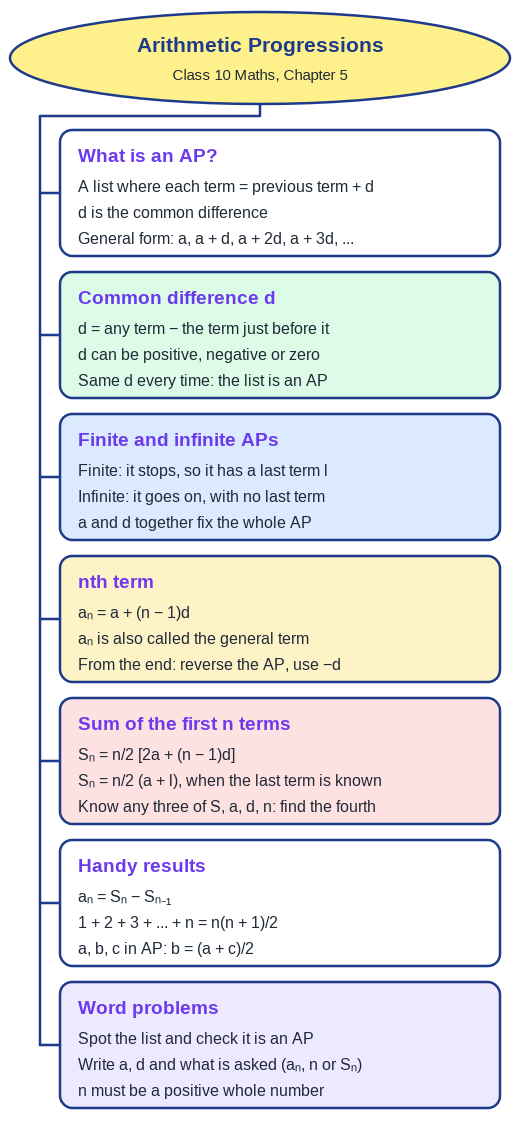
Pages 49–50: the six lists in the introduction. Which of them add a fixed number each time?
(i) Reena’s monthly salary: 8000, 8500, 9000, … Each term is 500 more than the one before: an AP, d = 500.
(ii) Ladder rungs: 45, 43, 41, …, 31. Each is 2 less: an AP, d = −2.
(iii) The savings scheme: 10000, 12500, 15625, 19531.25. Each term is 5/4 times the one before; the differences 2500 and 3125 are not equal: not an AP.
(iv) Unit squares: 1², 2², 3², … = 1, 4, 9, … The differences are 3, 5, …: not an AP.
(v) Shakila’s money box: 100, 150, 200, 250, …: an AP, d = 50.
(vi) Pairs of rabbits: 1, 1, 2, 3, 5, 8. The differences are 0, 1, 1, 2, 3: not an AP.
Page 52: why is each of the lists (a) to (e) an AP? In each, the difference between neighbours is the same.
(a) Heights 147, 148, 149, …, 157: d = 1.
(b) Temperatures −3.1, −3.0, −2.9, …, −2.5: d = 0.1.
(c) Loan balance 950, 900, 850, …, 50: 5% of ₹1000 is ₹50, so d = −50.
(d) School prizes for Classes I to XII, 200, 250, 300, …, 750: d = 50.
(e) Total savings 50, 100, 150, …, 500: d = 50.
All five stop, so they are finite APs.
Page 52: what is the least information needed to know an AP? Both the first term a and the common difference d. With a = 6 alone, the AP could be 6, 9, 12, … or 6, 3, 0, …; with d = 3 alone, it could start anywhere.
Examples 1 and 2 (pages 54–55)
Example 1 (page 54): first term and common difference of 3/2, 1/2, −1/2, −3/2, … a = 3/2. d = 1/2 − 3/2 = −1. (Any two neighbours give the same d: −1/2 − 1/2 = −1.)
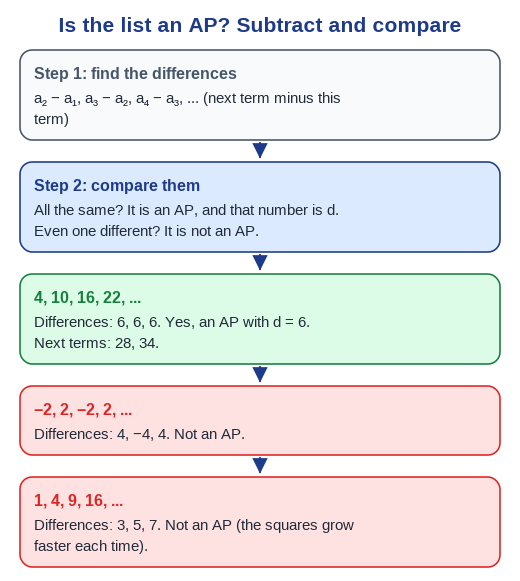
Example 2 (pages 54–55): which lists are APs? Give the next two terms of those that are.
(i) 4, 10, 16, 22, …: the differences are 6, 6, 6. AP, d = 6. Next terms: 22 + 6 = 28 and 28 + 6 = 34.
(ii) 1, −1, −3, −5, …: the differences are −2, −2, −2. AP, d = −2. Next terms: −7 and −9.
(iii) −2, 2, −2, 2, −2, …: a₂ − a₁ = 4 but a₃ − a₂ = −4. Not an AP.
(iv) 1, 1, 1, 2, 2, 2, 3, 3, 3, …: a₂ − a₁ = 0, a₃ − a₂ = 0, but a₄ − a₃ = 1. Not an AP.
Exercise 5.1 (pages 55–56)
1. “In which of the following situations, does the list of numbers involved make an arithmetic progression, and why?”
(i) “The taxi fare after each km when the fare is ₹15 for the first km and ₹8 for each additional km.”
Fares after 1, 2, 3, 4 km: 15, 15 + 8 = 23, 31, 39, … Each term is 8 more than the one before. Yes, an AP with a = 15 and d = 8.
(ii) “The amount of air present in a cylinder when a vacuum pump removes 1/4 of the air remaining in the cylinder at a time.”
Let the air at the start be V. After each stroke 3/4 of the air remains: V, 3V/4, 9V/16, 27V/64, …
a₂ − a₁ = 3V/4 − V = −V/4
a₃ − a₂ = 9V/16 − 3V/4 = −3V/16
The differences are not equal. No, not an AP.
(iii) “The cost of digging a well after every metre of digging, when it costs ₹150 for the first metre and rises by ₹50 for each subsequent metre.”
Costs: 150, 200, 250, 300, … Each term is 50 more. Yes, an AP with a = 150 and d = 50.
(iv) “The amount of money in the account every year, when ₹10000 is deposited at compound interest at 8 % per annum.”
Amounts after 1, 2, 3 years: 10000 × 1.08 = 10800, 10000 × (1.08)² = 11664, 10000 × (1.08)³ = 12597.12.
11664 − 10800 = 864, but 12597.12 − 11664 = 933.12. Each amount is 1.08 times the last, not a fixed sum more. No, not an AP.
Answer: (i) and (iii) form APs (a fixed amount is added each time); (ii) and (iv) do not.
2. “Write first four terms of the AP, when the first term a and the common difference d are given as follows: (i) a = 10, d = 10 (ii) a = −2, d = 0 (iii) a = 4, d = −3 (iv) a = −1, d = 1/2 (v) a = −1.25, d = −0.25”
Keep adding d.
(i) 10, 20, 30, 40
(ii) −2, −2, −2, −2
(iii) 4, 4 − 3, 1 − 3, −2 − 3: 4, 1, −2, −5
(iv) −1, −1 + 1/2, −1/2 + 1/2, 0 + 1/2: −1, −1/2, 0, 1/2
(v) −1.25, −1.50, −1.75, −2.00
3. “For the following APs, write the first term and the common difference: (i) 3, 1, −1, −3, … (ii) −5, −1, 3, 7, … (iii) 1/3, 5/3, 9/3, 13/3, … (iv) 0.6, 1.7, 2.8, 3.9, …”
(i) a = 3, d = 1 − 3 = −2
(ii) a = −5, d = −1 − (−5) = 4
(iii) a = 1/3, d = 5/3 − 1/3 = 4/3
(iv) a = 0.6, d = 1.7 − 0.6 = 1.1
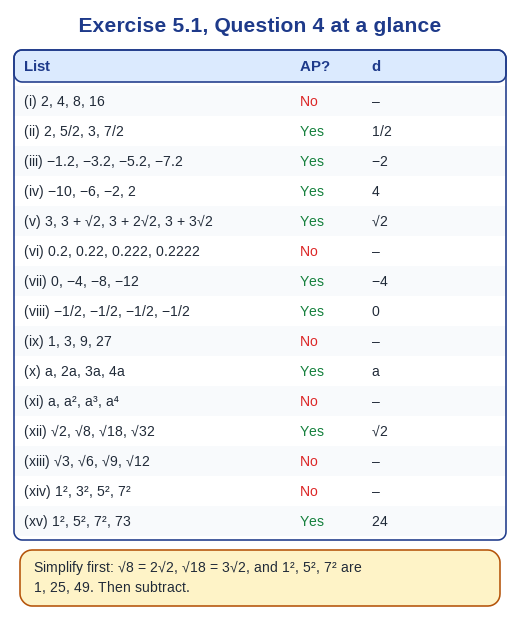
4. “Which of the following are APs ? If they form an AP, find the common difference d and write three more terms. (i) 2, 4, 8, 16, … (ii) 2, 5/2, 3, 7/2, … (iii) −1.2, −3.2, −5.2, −7.2, … (iv) −10, −6, −2, 2, … (v) 3, 3 + √2, 3 + 2√2, 3 + 3√2, … (vi) 0.2, 0.22, 0.222, 0.2222, … (vii) 0, −4, −8, −12, … (viii) −1/2, −1/2, −1/2, −1/2, … (ix) 1, 3, 9, 27, … (x) a, 2a, 3a, 4a, … (xi) a, a², a³, a⁴, … (xii) √2, √8, √18, √32, … (xiii) √3, √6, √9, √12, … (xiv) 1², 3², 5², 7², … (xv) 1², 5², 7², 73, …”
(i) 4 − 2 = 2 but 8 − 4 = 4. Not an AP.
(ii) 5/2 − 2 = 1/2, 3 − 5/2 = 1/2, 7/2 − 3 = 1/2. AP, d = 1/2. Next three terms: 4, 9/2, 5.
(iii) −3.2 − (−1.2) = −2, and the same for the others. AP, d = −2. Next: −9.2, −11.2, −13.2.
(iv) −6 − (−10) = 4, −2 − (−6) = 4, 2 − (−2) = 4. AP, d = 4. Next: 6, 10, 14.
(v) Each term is √2 more than the one before. AP, d = √2. Next: 3 + 4√2, 3 + 5√2, 3 + 6√2.
(vi) 0.22 − 0.2 = 0.02 but 0.222 − 0.22 = 0.002. Not an AP.
(vii) −4 − 0 = −4, −8 − (−4) = −4, −12 − (−8) = −4. AP, d = −4. Next: −16, −20, −24.
(viii) Every difference is 0. AP, d = 0. Next: −1/2, −1/2, −1/2.
(ix) 3 − 1 = 2 but 9 − 3 = 6. Not an AP.
(x) 2a − a = a, 3a − 2a = a, 4a − 3a = a. AP, d = a. Next: 5a, 6a, 7a.
(xi) a² − a = a(a − 1) but a³ − a² = a²(a − 1). These are not equal in general. Not an AP. (Only for a = 0 or a = 1 are all the terms equal.)
(xii) Simplify first: √8 = 2√2, √18 = 3√2, √32 = 4√2. The list is √2, 2√2, 3√2, 4√2, … AP, d = √2. Next: 5√2, 6√2, 7√2, that is √50, √72, √98.
(xiii) The list is √3, √6, 3, 2√3, … √6 − √3 is about 0.72, but 3 − √6 is about 0.55. Not an AP.
(xiv) The list is 1, 9, 25, 49, … The differences are 8, 16, 24. Not an AP.
(xv) The list is 1, 25, 49, 73, … The differences are 24, 24, 24. AP, d = 24. Next: 97, 121, 145.
Questions inside section 5.3 (pages 56–57)
Page 56: why are 8000, 8500, 9000, 9500, 10000, … in AP? Each year’s salary is the previous year’s plus the same ₹500, so every difference is 500.
Page 57: Reena’s salary in the 6th, 15th and 25th years. Here a = 8000 and d = 500.
6th year: 8000 + 5 × 500 = ₹10500
15th year: 8000 + 14 × 500 = ₹15000
25th year: 8000 + 24 × 500 = ₹20000
Examples 3 to 10 (pages 58–61)
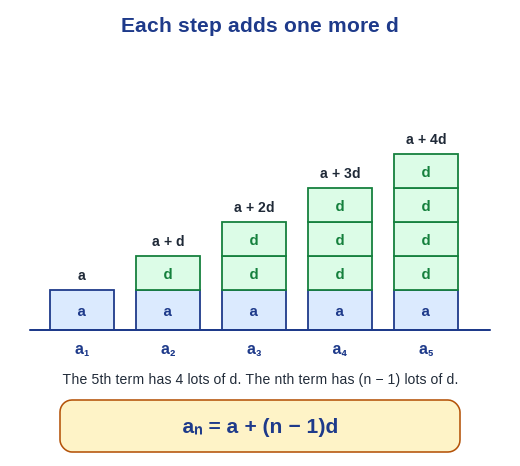
Example 3 (page 58): the 10th term of 2, 7, 12, … a = 2, d = 5, n = 10. a₁₀ = 2 + 9 × 5 = 47.
Example 4 (page 58): which term of 21, 18, 15, … is −81? Is any term 0? a = 21, d = −3.
−81 = 21 + (n − 1)(−3), so (n − 1)(−3) = −102, n − 1 = 34 and n = 35. The 35th term is −81.
For 0: 21 + (n − 1)(−3) = 0 gives n − 1 = 7, so n = 8. Yes, the 8th term is 0. Check: 21, 18, 15, 12, 9, 6, 3, 0.
Example 5 (page 58): the AP whose 3rd term is 5 and 7th term is 9. a + 2d = 5 and a + 6d = 9. Subtracting, 4d = 4, so d = 1 and a = 3. The AP is 3, 4, 5, 6, 7, …
Example 6 (page 59): is 301 a term of 5, 11, 17, 23, …? The differences are all 6, so it is an AP with a = 5 and d = 6. If 301 = 5 + (n − 1) × 6, then 6n − 1 = 301 and n = 302/6 = 151/3. Why must n be a positive integer? Because n is the position of a term in the list: there is a 1st term and a 2nd term, but no “50⅓th” term. So 301 is not a term.
Example 7 (page 59): how many two-digit numbers are divisible by 3? They are 12, 15, 18, …, 99: an AP with a = 12, d = 3. 99 = 12 + (n − 1) × 3 gives n − 1 = 29, so n = 30.
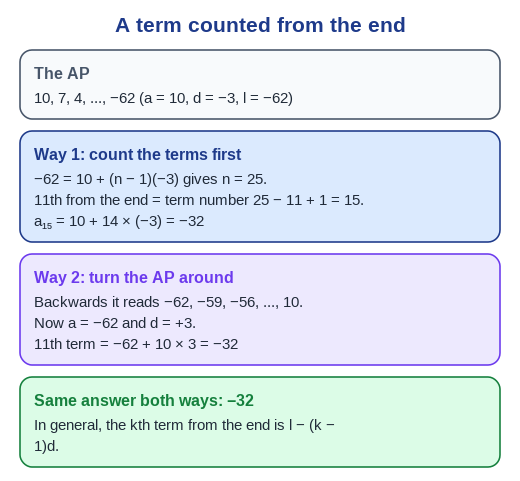
Example 8 (pages 59–60): the 11th term from the end of 10, 7, 4, …, −62. a = 10, d = −3, l = −62. −62 = 10 + (n − 1)(−3) gives n − 1 = 24, so there are 25 terms. The 11th from the end is the 15th term: a₁₅ = 10 + 14 × (−3) = −32.
Why the 15th and not the 14th? The last term is the 25th, the 2nd from the end is the 24th, and so on: the kth from the end is term number 25 − k + 1. For k = 11 that is 15. After the 15th term there are exactly 10 more terms.
Why is d = 3 in the reversed AP? Read backwards, each term is the one that came before it in the original list, so the step changes sign: −62, −59, −56, … Its 11th term is −62 + 10 × 3 = −32, the same answer.
Example 9 (pages 60–61): ₹1000 at 8% simple interest per year. Do the yearly interests form an AP? Find the interest after 30 years. Interest = P × R × T/100. After 1, 2, 3 years it is 1000 × 8 × 1/100 = ₹80, then ₹160, then ₹240. The differences are all 80, so they form an AP with a = 80 and d = 80. a₃₀ = 80 + 29 × 80 = ₹2400. (Compare Exercise 5.1 Q1 (iv): compound interest does not give an AP.)
Example 10 (page 61): rose plants 23, 21, 19, …, 5 in the rows of a flower bed. How many rows? Why is it an AP? Each row has 2 fewer plants than the row before, so d = −2. With a = 23 and aₙ = 5: 5 = 23 + (n − 1)(−2), so (n − 1)(−2) = −18, n − 1 = 9 and n = 10 rows.
Exercise 5.2 (pages 61–63)
1. “Fill in the blanks in the following table, given that a is the first term, d the common difference and aₙ the nth term of the AP:”
The table gives: (i) a = 7, d = 3, n = 8, aₙ = … (ii) a = −18, d = …, n = 10, aₙ = 0 (iii) a = …, d = −3, n = 18, aₙ = −5 (iv) a = −18.9, d = 2.5, n = …, aₙ = 3.6 (v) a = 3.5, d = 0, n = 105, aₙ = …
Use aₙ = a + (n − 1)d each time. Put in the three values you know and solve for the fourth.
(i) aₙ = 7 + (8 − 1) × 3 = 7 + 21 = 28
(ii) 0 = −18 + (10 − 1)d, so 9d = 18 and d = 2
(iii) −5 = a + (18 − 1)(−3) = a − 51, so a = 46
(iv) 3.6 = −18.9 + (n − 1) × 2.5, so (n − 1) × 2.5 = 22.5, n − 1 = 9 and n = 10
(v) aₙ = 3.5 + 104 × 0 = 3.5
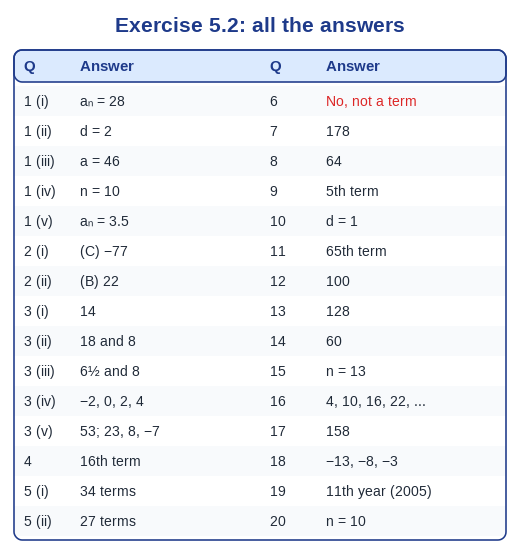
Answer: (i) aₙ = 28 (ii) d = 2 (iii) a = 46 (iv) n = 10 (v) aₙ = 3.5
2. “Choose the correct choice in the following and justify : (i) 30th term of the AP: 10, 7, 4, … , is (A) 97 (B) 77 (C) −77 (D) −87 (ii) 11th term of the AP: −3, −1/2, 2, …, is (A) 28 (B) 22 (C) −38 (D) −48½”
(i) a = 10, d = 7 − 10 = −3. a₃₀ = 10 + 29 × (−3) = 10 − 87 = −77.
(ii) a = −3, d = −1/2 − (−3) = 5/2. a₁₁ = −3 + 10 × 5/2 = −3 + 25 = 22.
Answer: (i) (C) −77 (ii) (B) 22
3. “In the following APs, find the missing terms in the boxes : (i) 2, ☐, 26 (ii) ☐, 13, ☐, 3 (iii) 5, ☐, ☐, 9½ (iv) −4, ☐, ☐, ☐, ☐, 6 (v) ☐, 38, ☐, ☐, ☐, −22”
First find d from the two terms you know. Then add d again and again.
(i) a = 2 and a₃ = 26: 2 + 2d = 26, so d = 12. The missing term is 2 + 12 = 14.
(ii) a₂ = 13 and a₄ = 3: a₄ − a₂ = 2d = −10, so d = −5. Then a₁ = 13 + 5 = 18 and a₃ = 13 − 5 = 8. The AP is 18, 13, 8, 3.
(iii) a = 5 and a₄ = 9½: 3d = 4½, so d = 1½. The missing terms are 6½ and 8.
(iv) a = −4 and a₆ = 6: 5d = 10, so d = 2. The missing terms are −2, 0, 2, 4.
(v) a₂ = 38 and a₆ = −22: 4d = −60, so d = −15. Then a₁ = 38 + 15 = 53, and a₃, a₄, a₅ are 23, 8, −7. The AP is 53, 38, 23, 8, −7, −22.
Answer: (i) 14 (ii) 18, 8 (iii) 6½, 8 (iv) −2, 0, 2, 4 (v) 53, 23, 8, −7
4. “Which term of the AP : 3, 8, 13, 18, … ,is 78?”
Given: a = 3, d = 8 − 3 = 5, aₙ = 78.
To find: n.
- Use aₙ = a + (n − 1)d.
- 78 = 3 + (n − 1) × 5
- (n − 1) × 5 = 75, so n − 1 = 15.
- n = 16.
Answer: 78 is the 16th term.
5. “Find the number of terms in each of the following APs : (i) 7, 13, 19, … , 205 (ii) 18, 15½, 13, … , −47”
Given: (i) a = 7, d = 6, last term 205. (ii) a = 18, d = 15½ − 18 = −5/2, last term −47.
To find: the number of terms n in each.
(i)
- 205 = 7 + (n − 1) × 6
- (n − 1) × 6 = 198, so n − 1 = 33.
- n = 34.
(ii)
- −47 = 18 + (n − 1)(−5/2)
- (n − 1)(−5/2) = −65
- n − 1 = 65 × 2/5 = 26, so n = 27.
Answer: (i) 34 terms (ii) 27 terms
6. “Check whether −150 is a term of the AP : 11, 8, 5, 2 …”
Given: a = 11, d = 8 − 11 = −3.
To find: whether some term aₙ equals −150.
- Suppose −150 = 11 + (n − 1)(−3).
- Then (n − 1) × 3 = 161, so n − 1 = 161/3 and n = 164/3.
- n is the position of a term, so it must be a positive whole number. 164/3 is not a whole number.
Answer: No, −150 is not a term of this AP. (The terms near it are −148 and −151.)
7. “Find the 31st term of an AP whose 11th term is 38 and the 16th term is 73.”
Given: a₁₁ = 38, a₁₆ = 73.
To find: a₃₁.
- a₁₁ = a + 10d = 38 … (1)
- a₁₆ = a + 15d = 73 … (2)
- Subtract (1) from (2): 5d = 35, so d = 7.
- From (1): a = 38 − 70 = −32.
- a₃₁ = a + 30d = −32 + 30 × 7 = −32 + 210 = 178.
Answer: a₃₁ = 178
8. “An AP consists of 50 terms of which 3rd term is 12 and the last term is 106. Find the 29th term.”
Given: n = 50, a₃ = 12, last term a₅₀ = 106.
To find: a₂₉.
- a₃ = a + 2d = 12 … (1)
- The last term is the 50th: a + 49d = 106 … (2)
- Subtract (1) from (2): 47d = 94, so d = 2.
- From (1): a = 12 − 4 = 8.
- a₂₉ = a + 28d = 8 + 28 × 2 = 64.
Answer: a₂₉ = 64
9. “If the 3rd and the 9th terms of an AP are 4 and −8 respectively, which term of this AP is zero?”
Given: a₃ = 4, a₉ = −8.
To find: n such that aₙ = 0.
- a + 2d = 4 … (1) and a + 8d = −8 … (2)
- Subtract (1) from (2): 6d = −12, so d = −2.
- From (1): a = 4 + 4 = 8.
- Put aₙ = 0: 8 + (n − 1)(−2) = 0, so n − 1 = 4 and n = 5.
Check: the AP is 8, 6, 4, 2, 0, …
Answer: The 5th term is zero.
10. “The 17th term of an AP exceeds its 10th term by 7. Find the common difference.”
Given: a₁₇ − a₁₀ = 7.
To find: d.
- (a + 16d) − (a + 9d) = 7
- The a’s cancel: 7d = 7.
- d = 1.
Answer: d = 1
11. “Which term of the AP : 3, 15, 27, 39, … will be 132 more than its 54th term?”
Given: a = 3, d = 15 − 3 = 12.
To find: the term that is 132 more than a₅₄.
- a₅₄ = 3 + 53 × 12 = 3 + 636 = 639.
- The term we want is 639 + 132 = 771.
- 771 = 3 + (n − 1) × 12, so (n − 1) × 12 = 768.
- n − 1 = 64, so n = 65.
Shorter way: 132 ÷ 12 = 11, so we need 11 more steps of d after the 54th term: 54 + 11 = 65.
Answer: The 65th term.
12. “Two APs have the same common difference. The difference between their 100th terms is 100, what is the difference between their 1000th terms?”
Given: two APs with first terms a and b and the same common difference d. Their 100th terms differ by 100.
To find: the difference between their 1000th terms.
- Difference of 100th terms: (a + 99d) − (b + 99d) = a − b. So a − b = 100.
- Difference of 1000th terms: (a + 999d) − (b + 999d) = a − b.
- So this is also 100.
The d-parts always cancel, so every pair of matching terms differs by the same amount a − b.
Answer: The difference is 100.
13. “How many three-digit numbers are divisible by 7?”
Given: three-digit numbers run from 100 to 999.
To find: how many of them are multiples of 7.
- The first one is 105 (7 × 15). The last one is 994 (7 × 142).
- They form the AP 105, 112, 119, …, 994 with a = 105 and d = 7.
- 994 = 105 + (n − 1) × 7, so (n − 1) × 7 = 889.
- n − 1 = 127, so n = 128.
Answer: 128 three-digit numbers are divisible by 7.
14. “How many multiples of 4 lie between 10 and 250?”
Given: numbers between 10 and 250.
To find: how many of them are multiples of 4.
- The first multiple of 4 after 10 is 12. The last one before 250 is 248.
- They form the AP 12, 16, 20, …, 248 with a = 12 and d = 4.
- 248 = 12 + (n − 1) × 4, so (n − 1) × 4 = 236.
- n − 1 = 59, so n = 60.
Answer: 60 multiples of 4.
15. “For what value of n, are the nth terms of two APs: 63, 65, 67, … and 3, 10, 17, … equal?”
Given: first AP a = 63, d = 2; second AP a = 3, d = 7.
To find: n for which their nth terms are equal.
- nth term of the first AP: 63 + (n − 1) × 2.
- nth term of the second AP: 3 + (n − 1) × 7.
- Make them equal: 63 + 2(n − 1) = 3 + 7(n − 1).
- 60 = 5(n − 1), so n − 1 = 12 and n = 13.
Check: 63 + 12 × 2 = 87 and 3 + 12 × 7 = 87.
Answer: n = 13
16. “Determine the AP whose third term is 16 and the 7th term exceeds the 5th term by 12.”
Given: a₃ = 16 and a₇ − a₅ = 12.
To find: the AP.
- a₇ − a₅ = (a + 6d) − (a + 4d) = 2d = 12, so d = 6.
- a₃ = a + 2d = 16, so a = 16 − 12 = 4.
- Keep adding 6: 4, 10, 16, 22, …
Answer: The AP is 4, 10, 16, 22, …
17. “Find the 20th term from the last term of the AP : 3, 8, 13, …, 253.”
Given: a = 3, d = 5, last term l = 253.
To find: the 20th term counted from the end.
- Read the AP backwards. It starts at 253 and goes down by 5 each time, so its common difference is −5.
- 20th term of this reversed AP = 253 + 19 × (−5) = 253 − 95 = 158.
Check the other way: 253 = 3 + (n − 1) × 5 gives n = 51 terms. The 20th from the end is term number 51 − 20 + 1 = 32, and a₃₂ = 3 + 31 × 5 = 158.
Answer: The 20th term from the last is 158.
18. “The sum of the 4th and 8th terms of an AP is 24 and the sum of the 6th and 10th terms is 44. Find the first three terms of the AP.”
Given: a₄ + a₈ = 24 and a₆ + a₁₀ = 44.
To find: the first three terms.
- (a + 3d) + (a + 7d) = 24, so 2a + 10d = 24, that is a + 5d = 12 … (1)
- (a + 5d) + (a + 9d) = 44, so 2a + 14d = 44, that is a + 7d = 22 … (2)
- Subtract (1) from (2): 2d = 10, so d = 5.
- From (1): a = 12 − 25 = −13.
- The first three terms are −13, −13 + 5 = −8 and −8 + 5 = −3.
Check: a₄ + a₈ = 2 + 22 = 24 and a₆ + a₁₀ = 12 + 32 = 44.
Answer: −13, −8, −3
19. “Subba Rao started work in 1995 at an annual salary of ₹5000 and received an increment of ₹200 each year. In which year did his income reach ₹7000?”
Given: salaries 5000, 5200, 5400, … (an increment is a yearly rise), so a = 5000 and d = 200.
To find: the year in which the salary becomes ₹7000.
- 7000 = 5000 + (n − 1) × 200
- (n − 1) × 200 = 2000, so n − 1 = 10 and n = 11.
- The 1st year is 1995, so the 11th year is 1995 + 10 = 2005.
Answer: In the 11th year of work, that is, in 2005.
20. “Ramkali saved ₹5 in the first week of a year and then increased her weekly savings by ₹1.75. If in the nth week, her weekly savings become ₹20.75, find n.”
Given: a = 5, d = 1.75, aₙ = 20.75.
To find: n.
- 20.75 = 5 + (n − 1) × 1.75
- (n − 1) × 1.75 = 15.75
- n − 1 = 15.75 ÷ 1.75 = 9, so n = 10.
Answer: n = 10 (the 10th week).
Questions inside section 5.4 (pages 63–65)
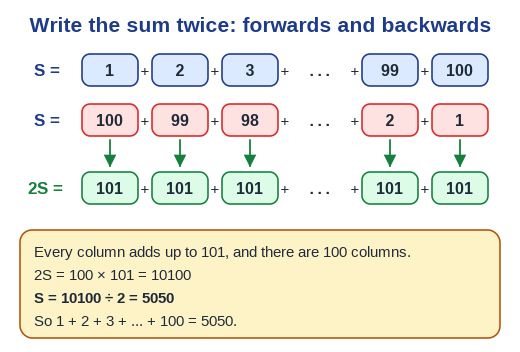
Page 63: how did Gauss add 1 to 100 so fast? He wrote the sum forwards and backwards and added the two lines. Each of the 100 columns gives 101, so 2S = 100 × 101 and S = 5050.
Pages 63–65: the money in the box of Shakila’s daughter on her 21st birthday. The amounts 100, 150, 200, … form an AP with a = 100, d = 50 and n = 21.
S = 21/2 [2 × 100 + (21 − 1) × 50] = 21/2 × [200 + 1000] = 21/2 × 1200 = ₹12600
Examples 11 to 16 (pages 65–68)
Example 11 (page 65): the sum of the first 22 terms of 8, 3, −2, … a = 8, d = −5, n = 22. S = 22/2 [16 + 21 × (−5)] = 11 × (16 − 105) = 11 × (−89) = −979.
Example 12 (pages 65–66): S₁₄ = 1050 and a = 10. Find the 20th term. 1050 = 14/2 [20 + 13d] = 140 + 91d, so 91d = 910 and d = 10. a₂₀ = 10 + 19 × 10 = 200.
Example 13 (page 66): how many terms of 24, 21, 18, … add up to 78? a = 24, d = −3. 78 = n/2 [48 + (n − 1)(−3)] = n/2 (51 − 3n), so 3n² − 51n + 156 = 0, n² − 17n + 52 = 0 and (n − 4)(n − 13) = 0. n = 4 or 13. Both are right: 24 + 21 + 18 + 15 = 78, and the 5th to 13th terms (12, 9, 6, 3, 0, −3, −6, −9, −12) add up to 0.
Example 14 (pages 66–67): the sum of (i) the first 1000 positive integers, (ii) the first n positive integers. (i) a = 1, l = 1000: S = 1000/2 × (1 + 1000) = 500 × 1001 = 500500. (ii) a = 1, l = n: Sₙ = n(n + 1)/2.
Example 15 (page 67): the sum of the first 24 terms of the list with aₙ = 3 + 2n. a₁ = 5, a₂ = 7, a₃ = 9: an AP with a = 5, d = 2. S₂₄ = 24/2 [10 + 23 × 2] = 12 × 56 = 672.
Example 16 (pages 67–68): TV sets, 600 in the 3rd year and 700 in the 7th year, rising by a fixed number each year. a + 2d = 600 and a + 6d = 700. Subtracting, 4d = 100, so d = 25 and a = 550.
(i) Production in the 1st year: 550 sets.
(ii) In the 10th year: a₁₀ = 550 + 9 × 25 = 775 sets.
(iii) In the first 7 years: S₇ = 7/2 [1100 + 6 × 25] = 7/2 × 1250 = 4375 sets.
Exercise 5.3 (pages 68–70)
1. “Find the sum of the following APs: (i) 2, 7, 12, …, to 10 terms. (ii) −37, −33, −29, …, to 12 terms. (iii) 0.6, 1.7, 2.8, …, to 100 terms. (iv) 1/15, 1/12, 1/10, …, to 11 terms.”
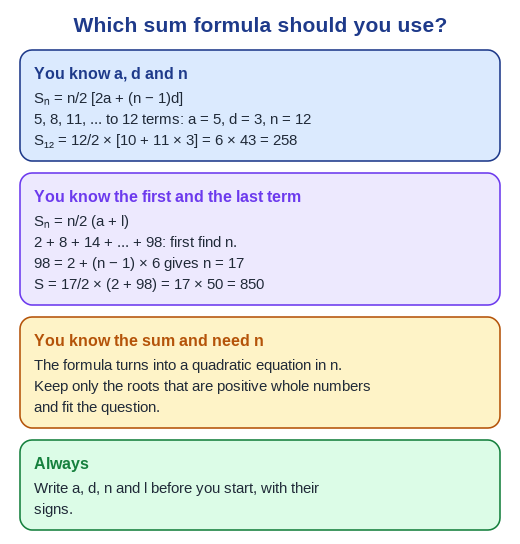
Use Sₙ = n/2 [2a + (n − 1)d].
(i) a = 2, d = 5, n = 10. S₁₀ = 10/2 [4 + 9 × 5] = 5 × 49 = 245
(ii) a = −37, d = 4, n = 12. S₁₂ = 12/2 [−74 + 11 × 4] = 6 × (−30) = −180
(iii) a = 0.6, d = 1.1, n = 100. S₁₀₀ = 100/2 [1.2 + 99 × 1.1] = 50 × 110.1 = 5505
(iv) a = 1/15, d = 1/12 − 1/15 = 5/60 − 4/60 = 1/60, n = 11. S₁₁ = 11/2 [2/15 + 10/60] = 11/2 × [8/60 + 10/60] = 11/2 × 3/10 = 33/20
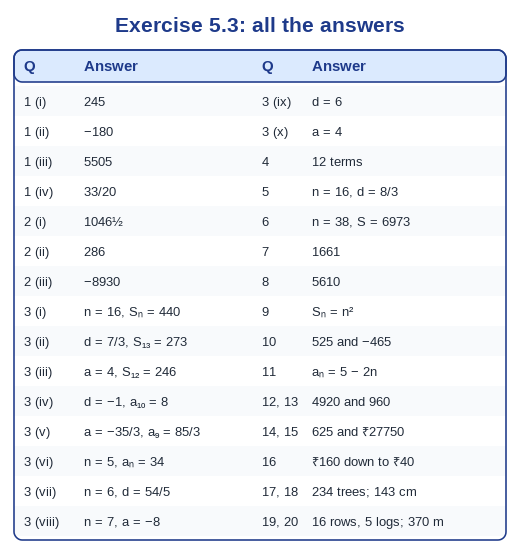
Answer: (i) 245 (ii) −180 (iii) 5505 (iv) 33/20
2. “Find the sums given below : (i) 7 + 10½ + 14 + … + 84 (ii) 34 + 32 + 30 + … + 10 (iii) −5 + (−8) + (−11) + … + (−230)”
Here the last term l is known. First find n from the last term, then use Sₙ = n/2 (a + l).
(i) a = 7, d = 3½ = 7/2, l = 84. 84 = 7 + (n − 1) × 7/2, so n − 1 = 77 × 2/7 = 22 and n = 23. S = 23/2 × (7 + 84) = 23 × 91/2 = 2093/2 = 1046½
(ii) a = 34, d = −2, l = 10. 10 = 34 + (n − 1)(−2), so n − 1 = 12 and n = 13. S = 13/2 × (34 + 10) = 13 × 22 = 286
(iii) a = −5, d = −3, l = −230. −230 = −5 + (n − 1)(−3), so n − 1 = 75 and n = 76. S = 76/2 × (−5 − 230) = 38 × (−235) = −8930
Answer: (i) 1046½ (ii) 286 (iii) −8930
3. “In an AP: (i) given a = 5, d = 3, aₙ = 50, find n and Sₙ. (ii) given a = 7, a₁₃ = 35, find d and S₁₃. (iii) given a₁₂ = 37, d = 3, find a and S₁₂. (iv) given a₃ = 15, S₁₀ = 125, find d and a₁₀. (v) given d = 5, S₉ = 75, find a and a₉. (vi) given a = 2, d = 8, Sₙ = 90, find n and aₙ. (vii) given a = 8, aₙ = 62, Sₙ = 210, find n and d. (viii) given aₙ = 4, d = 2, Sₙ = −14, find n and a. (ix) given a = 3, n = 8, S = 192, find d. (x) given l = 28, S = 144, and there are total 9 terms. Find a.”
In each part, use aₙ = a + (n − 1)d and Sₙ = n/2 [2a + (n − 1)d] or Sₙ = n/2 (a + aₙ).
(i) 50 = 5 + (n − 1) × 3, so n − 1 = 15 and n = 16. Sₙ = 16/2 × (5 + 50) = 8 × 55 = 440.
(ii) 35 = 7 + 12d, so 12d = 28 and d = 7/3. S₁₃ = 13/2 × (7 + 35) = 13 × 21 = 273.
(iii) 37 = a + 11 × 3, so a = 4. S₁₂ = 12/2 × (4 + 37) = 6 × 41 = 246.
(iv) a + 2d = 15 … (1). S₁₀ = 10/2 [2a + 9d] = 125, so 2a + 9d = 25 … (2). From (1), a = 15 − 2d. Put this in (2): 30 − 4d + 9d = 25, so 5d = −5 and d = −1. Then a = 17 and a₁₀ = 17 + 9 × (−1) = 8.
(v) S₉ = 9/2 [2a + 8 × 5] = 75, so 9(a + 20) = 75, a + 20 = 25/3 and a = −35/3. a₉ = −35/3 + 8 × 5 = −35/3 + 120/3 = 85/3.
(vi) 90 = n/2 [4 + (n − 1) × 8] = n(4n − 2). So 4n² − 2n − 90 = 0, that is 2n² − n − 45 = 0, and (2n + 9)(n − 5) = 0. n cannot be −9/2 (a number of terms is a positive whole number), so n = 5. aₙ = 2 + 4 × 8 = 34.
(vii) 210 = n/2 × (8 + 62) = 35n, so n = 6. Then 62 = 8 + 5d, so d = 54/5.
(viii) aₙ = a + (n − 1) × 2 = 4, so a = 6 − 2n. Sₙ = n/2 × (a + aₙ) = n/2 × (10 − 2n) = n(5 − n) = −14. So n² − 5n − 14 = 0 and (n − 7)(n + 2) = 0. n cannot be −2, so n = 7 and a = 6 − 14 = −8.
(ix) 192 = 8/2 [6 + 7d], so 6 + 7d = 48, 7d = 42 and d = 6.
(x) 144 = 9/2 × (a + 28), so a + 28 = 32 and a = 4.
Answer: (i) n = 16, Sₙ = 440 (ii) d = 7/3, S₁₃ = 273 (iii) a = 4, S₁₂ = 246 (iv) d = −1, a₁₀ = 8 (v) a = −35/3, a₉ = 85/3 (vi) n = 5, aₙ = 34 (vii) n = 6, d = 54/5 (viii) n = 7, a = −8 (ix) d = 6 (x) a = 4
4. “How many terms of the AP : 9, 17, 25, … must be taken to give a sum of 636?”
Given: a = 9, d = 17 − 9 = 8, Sₙ = 636.
To find: n.
- Sₙ = n/2 [2a + (n − 1)d], so 636 = n/2 [18 + (n − 1) × 8].
- 636 = n/2 (8n + 10) = n(4n + 5).
- So 4n² + 5n − 636 = 0.
- Discriminant = 5² + 4 × 4 × 636 = 25 + 10176 = 10201 = 101².
- n = (−5 + 101)/8 = 12, or n = (−5 − 101)/8 = −53/4.
- A number of terms must be a positive whole number, so n = 12.
Check: a₁₂ = 9 + 11 × 8 = 97, and 12/2 × (9 + 97) = 6 × 106 = 636.
Answer: 12 terms
5. “The first term of an AP is 5, the last term is 45 and the sum is 400. Find the number of terms and the common difference.”
Given: a = 5, l = 45, Sₙ = 400.
To find: n and d.
- Sₙ = n/2 (a + l), so 400 = n/2 × (5 + 45) = 25n.
- n = 400 ÷ 25 = 16.
- The last term is the 16th: 45 = 5 + 15d, so 15d = 40.
- d = 40/15 = 8/3.
Answer: n = 16, d = 8/3
6. “The first and the last terms of an AP are 17 and 350 respectively. If the common difference is 9, how many terms are there and what is their sum?”
Given: a = 17, l = 350, d = 9.
To find: n and Sₙ.
- 350 = 17 + (n − 1) × 9, so (n − 1) × 9 = 333.
- n − 1 = 37, so n = 38.
- S₃₈ = 38/2 × (17 + 350) = 19 × 367 = 6973.
Answer: 38 terms; sum = 6973
7. “Find the sum of first 22 terms of an AP in which d = 7 and 22nd term is 149.”
Given: d = 7, a₂₂ = 149, n = 22.
To find: S₂₂.
- a₂₂ = a + 21d, so a + 21 × 7 = 149.
- a = 149 − 147 = 2.
- S₂₂ = 22/2 × (a + a₂₂) = 11 × (2 + 149) = 11 × 151 = 1661.
Answer: S₂₂ = 1661
8. “Find the sum of first 51 terms of an AP whose second and third terms are 14 and 18 respectively.”
Given: a₂ = 14, a₃ = 18, n = 51.
To find: S₅₁.
- d = a₃ − a₂ = 18 − 14 = 4.
- a = a₂ − d = 14 − 4 = 10.
- S₅₁ = 51/2 [2 × 10 + 50 × 4] = 51/2 × 220 = 51 × 110 = 5610.
Answer: S₅₁ = 5610
9. “If the sum of first 7 terms of an AP is 49 and that of 17 terms is 289, find the sum of first n terms.”
Given: S₇ = 49, S₁₇ = 289.
To find: Sₙ.
- S₇ = 7/2 [2a + 6d] = 49, so 2a + 6d = 14, that is a + 3d = 7 … (1)
- S₁₇ = 17/2 [2a + 16d] = 289, so 2a + 16d = 34, that is a + 8d = 17 … (2)
- Subtract (1) from (2): 5d = 10, so d = 2.
- From (1): a = 7 − 6 = 1.
- Sₙ = n/2 [2 × 1 + (n − 1) × 2] = n/2 × 2n = n².
Check: 7² = 49 and 17² = 289.
Answer: Sₙ = n²
10. “Show that a₁, a₂, …, aₙ, … form an AP where aₙ is defined as below : (i) aₙ = 3 + 4n (ii) aₙ = 9 − 5n Also find the sum of the first 15 terms in each case.”
Given: (i) aₙ = 3 + 4n (ii) aₙ = 9 − 5n.
To prove: each list is an AP. To find: S₁₅ in each case.
(i)
- aₙ₊₁ − aₙ = [3 + 4(n + 1)] − [3 + 4n] = 4, the same for every n.
- A constant difference means the terms form an AP, with d = 4 and a = a₁ = 3 + 4 = 7. (The list is 7, 11, 15, …)
- S₁₅ = 15/2 [2 × 7 + 14 × 4] = 15/2 × 70 = 525.
(ii)
- aₙ₊₁ − aₙ = [9 − 5(n + 1)] − [9 − 5n] = −5, the same for every n.
- So the terms form an AP, with d = −5 and a = a₁ = 9 − 5 = 4. (The list is 4, −1, −6, …)
- S₁₅ = 15/2 [2 × 4 + 14 × (−5)] = 15/2 × (−62) = −465.
Answer: Both are APs. (i) S₁₅ = 525 (ii) S₁₅ = −465
11. “If the sum of the first n terms of an AP is 4n − n², what is the first term (that is S₁)? What is the sum of first two terms? What is the second term? Similarly, find the 3rd, the 10th and the nth terms.”
Given: Sₙ = 4n − n².
To find: S₁, S₂, a₂, a₃, a₁₀ and aₙ.
Key idea: the nth term = (sum of first n terms) − (sum of first n − 1 terms), that is aₙ = Sₙ − Sₙ₋₁.
- First term: S₁ = 4 × 1 − 1² = 3.
- Sum of the first two terms: S₂ = 8 − 4 = 4.
- Second term: a₂ = S₂ − S₁ = 4 − 3 = 1.
- Third term: S₃ = 12 − 9 = 3, so a₃ = S₃ − S₂ = 3 − 4 = −1.
- Tenth term: S₁₀ = 40 − 100 = −60 and S₉ = 36 − 81 = −45, so a₁₀ = −60 − (−45) = −15.
- nth term: aₙ = (4n − n²) − [4(n − 1) − (n − 1)²] = 4n − n² − 4n + 4 + n² − 2n + 1 = 5 − 2n.
Check: 5 − 2 × 10 = −15. The AP is 3, 1, −1, −3, … with d = −2.
Answer: S₁ = 3, S₂ = 4, a₂ = 1, a₃ = −1, a₁₀ = −15, aₙ = 5 − 2n
12. “Find the sum of the first 40 positive integers divisible by 6.”
Given: the numbers are 6, 12, 18, …, so a = 6, d = 6, n = 40.
To find: S₄₀.
- S₄₀ = 40/2 [2 × 6 + 39 × 6]
- = 20 × (12 + 234) = 20 × 246 = 4920.
Answer: 4920
13. “Find the sum of the first 15 multiples of 8.”
Given: the multiples are 8, 16, 24, …, so a = 8, d = 8, n = 15.
To find: S₁₅.
- S₁₅ = 15/2 [2 × 8 + 14 × 8]
- = 15/2 × 128 = 15 × 64 = 960.
Answer: 960
14. “Find the sum of the odd numbers between 0 and 50.”
Given: the odd numbers are 1, 3, 5, …, 49, so a = 1, d = 2, l = 49.
To find: their sum.
- 49 = 1 + (n − 1) × 2, so n − 1 = 24 and n = 25.
- S₂₅ = 25/2 × (1 + 49) = 25 × 25 = 625.
Answer: 625
15. “A contract on construction job specifies a penalty for delay of completion beyond a certain date as follows: ₹200 for the first day, ₹250 for the second day, ₹300 for the third day, etc., the penalty for each succeeding day being ₹50 more than for the preceding day. How much money the contractor has to pay as penalty, if he has delayed the work by 30 days?”
Given: daily penalties (a penalty is money paid for the delay) 200, 250, 300, …, so a = 200, d = 50, n = 30.
To find: the total penalty S₃₀.
- S₃₀ = 30/2 [2 × 200 + 29 × 50]
- = 15 × (400 + 1450) = 15 × 1850 = 27750.
Answer: The contractor pays ₹27750.
16. “A sum of ₹700 is to be used to give seven cash prizes to students of a school for their overall academic performance. If each prize is ₹20 less than its preceding prize, find the value of each of the prizes.”
Given: 7 prizes in AP with d = −20 and total S₇ = 700.
To find: the value of each prize.
- Let the first (largest) prize be ₹a.
- S₇ = 7/2 [2a + 6 × (−20)] = 7(a − 60).
- 7(a − 60) = 700, so a − 60 = 100 and a = 160.
- Subtract 20 each time to get the other prizes.
Check: 160 + 140 + 120 + 100 + 80 + 60 + 40 = 700.
Answer: The prizes are ₹160, ₹140, ₹120, ₹100, ₹80, ₹60 and ₹40.
17. “In a school, students thought of planting trees in and around the school to reduce air pollution. It was decided that the number of trees, that each section of each class will plant, will be the same as the class, in which they are studying, e.g., a section of Class I will plant 1 tree, a section of Class II will plant 2 trees and so on till Class XII. There are three sections of each class. How many trees will be planted by the students?”
Given: each section plants as many trees as its class number; 3 sections per class; Classes I to XII.
To find: the total number of trees.
- Class I plants 3 × 1 = 3 trees, Class II plants 3 × 2 = 6, Class III plants 9, …, Class XII plants 3 × 12 = 36.
- So the numbers are 3, 6, 9, …, 36: an AP with a = 3, l = 36, n = 12.
- S₁₂ = 12/2 × (3 + 36) = 6 × 39 = 234.
Answer: 234 trees will be planted.
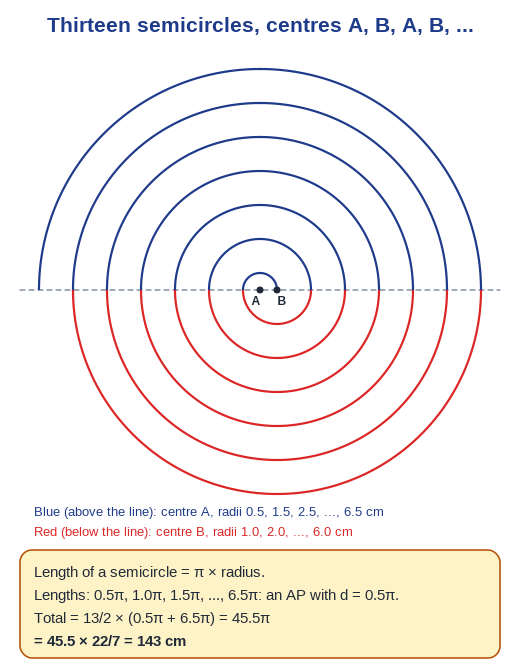
18. “A spiral is made up of successive semicircles, with centres alternately at A and B, starting with centre at A, of radii 0.5 cm, 1.0 cm, 1.5 cm, 2.0 cm, … as shown in Fig. 5.4. What is the total length of such a spiral made up of thirteen consecutive semicircles? (Take π = 22/7)”
Given: 13 semicircles with radii 0.5 cm, 1.0 cm, 1.5 cm, …; π = 22/7.
To find: the total length of the spiral.
- The length of a semicircle of radius r is half the circumference: ½ × 2πr = πr.
- So the lengths are l₁ = 0.5π, l₂ = 1.0π, l₃ = 1.5π, …, l₁₃ = 6.5π (in cm).
- These form an AP with a = 0.5π, d = 0.5π and n = 13.
- S₁₃ = 13/2 × (0.5π + 6.5π) = 13/2 × 7π = 45.5π.
- 45.5π = 45.5 × 22/7 = 6.5 × 22 = 143.
Answer: The spiral is 143 cm long.
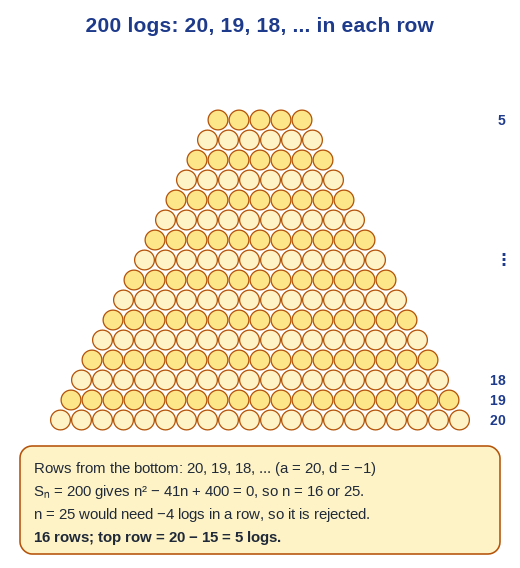
19. “200 logs are stacked in the following manner: 20 logs in the bottom row, 19 in the next row, 18 in the row next to it and so on (see Fig. 5.5). In how many rows are the 200 logs placed and how many logs are in the top row?”
Given: rows from the bottom have 20, 19, 18, … logs, so a = 20, d = −1, Sₙ = 200.
To find: the number of rows n and the logs in the top row.
- 200 = n/2 [40 + (n − 1)(−1)] = n/2 (41 − n).
- 400 = 41n − n², so n² − 41n + 400 = 0.
- (n − 16)(n − 25) = 0, so n = 16 or n = 25.
- For n = 25, the 25th row would have a₂₅ = 20 − 24 = −4 logs. A row cannot have a negative number of logs, so n = 25 is rejected.
- So n = 16. Top row: a₁₆ = 20 − 15 = 5.
Check: 16/2 × (20 + 5) = 8 × 25 = 200.
Answer: 16 rows, with 5 logs in the top row.
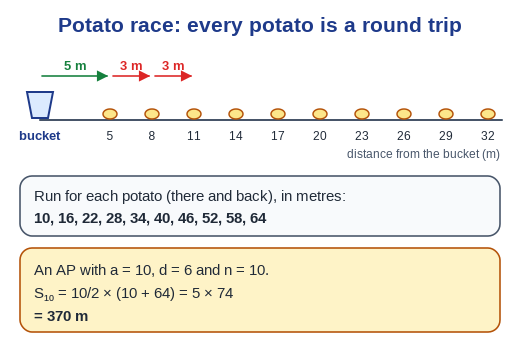
20. “In a potato race, a bucket is placed at the starting point, which is 5 m from the first potato, and the other potatoes are placed 3 m apart in a straight line. There are ten potatoes in the line (see Fig. 5.6). A competitor starts from the bucket, picks up the nearest potato, runs back with it, drops it in the bucket, runs back to pick up the next potato, runs to the bucket to drop it in, and she continues in the same way until all the potatoes are in the bucket. What is the total distance the competitor has to run?”
Given: the first potato is 5 m from the bucket; the others are 3 m apart; 10 potatoes.
To find: the total distance run.
- The potatoes are 5 m, 8 m, 11 m, … from the bucket.
- For each potato she runs there and back, so she runs twice its distance: 10 m, 16 m, 22 m, …
- These form an AP with a = 10, d = 6 and n = 10.
- S₁₀ = 10/2 [2 × 10 + 9 × 6] = 5 × (20 + 54) = 5 × 74 = 370.
Answer: She runs 370 m in all.
Exercise 5.4 (Optional) (page 71)
The book marks this exercise as optional and notes that it is not from the examination point of view. It is solved here for practice.
1. “Which term of the AP : 121, 117, 113, …, is its first negative term?”
Given: a = 121, d = 117 − 121 = −4.
To find: the first n for which aₙ < 0.
- aₙ = 121 + (n − 1)(−4) = 125 − 4n.
- aₙ < 0 means 125 − 4n < 0, that is 4n > 125, so n > 31.25.
- n is a whole number, so the smallest n above 31.25 is 32.
Check: a₃₁ = 125 − 124 = 1 (still positive) and a₃₂ = 125 − 128 = −3 (negative).
Answer: The 32nd term is the first negative term.
2. “The sum of the third and the seventh terms of an AP is 6 and their product is 8. Find the sum of first sixteen terms of the AP.”
Given: a₃ + a₇ = 6 and a₃ × a₇ = 8.
To find: S₁₆.
- a₃ + a₇ = (a + 2d) + (a + 6d) = 2a + 8d = 6, so a + 4d = 3 and a = 3 − 4d.
- Then a₃ = a + 2d = 3 − 2d and a₇ = a + 6d = 3 + 2d.
- Product: (3 − 2d)(3 + 2d) = 9 − 4d² = 8, so 4d² = 1 and d = 1/2 or d = −1/2.
- If d = 1/2: a = 3 − 2 = 1, and S₁₆ = 16/2 [2 × 1 + 15 × 1/2] = 8 × 19/2 = 76.
- If d = −1/2: a = 3 + 2 = 5, and S₁₆ = 16/2 [2 × 5 + 15 × (−1/2)] = 8 × 5/2 = 20.
Both APs fit the question: in one a₃ = 2 and a₇ = 4, in the other a₃ = 4 and a₇ = 2.
Answer: S₁₆ = 76 or S₁₆ = 20
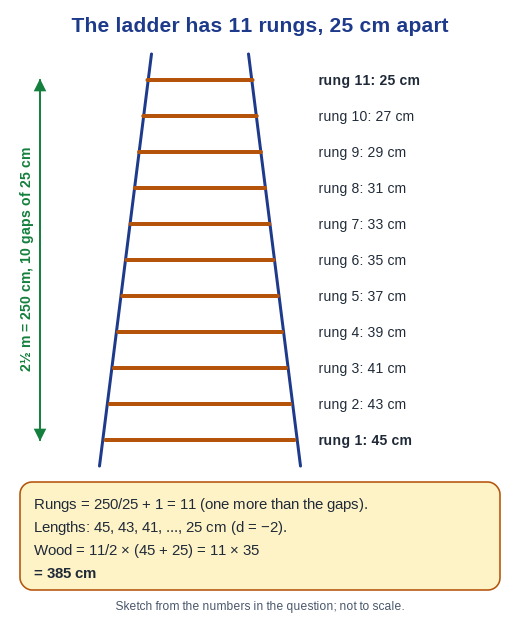
3. “A ladder has rungs 25 cm apart. (see Fig. 5.7). The rungs decrease uniformly in length from 45 cm at the bottom to 25 cm at the top. If the top and the bottom rungs are 2½ m apart, what is the length of the wood required for the rungs?”
Given: gap between rungs = 25 cm; bottom rung 45 cm; top rung 25 cm; top to bottom = 2½ m = 250 cm.
To find: the total length of all the rungs.
- Number of gaps = 250 ÷ 25 = 10, so the number of rungs = 10 + 1 = 11.
- The lengths decrease uniformly (by the same amount each time), so they form an AP with a = 45, l = 25, n = 11.
- S₁₁ = 11/2 × (45 + 25) = 11 × 35 = 385.
(Here d = (25 − 45)/10 = −2 cm, so the rungs are 45, 43, 41, …, 25 cm.)
Answer: 385 cm of wood is needed.
4. “The houses of a row are numbered consecutively from 1 to 49. Show that there is a value of x such that the sum of the numbers of the houses preceding the house numbered x is equal to the sum of the numbers of the houses following it. Find this value of x.”
Given: houses numbered 1, 2, 3, …, 49.
To find: x such that (sum of house numbers before x) = (sum of house numbers after x).
- Sum of the first n natural numbers: Sₙ = n(n + 1)/2.
- Houses before x: 1 + 2 + … + (x − 1) = Sₓ₋₁ = (x − 1)x/2.
- Houses after x: S₄₉ − Sₓ = 49 × 50/2 − x(x + 1)/2 = 1225 − x(x + 1)/2.
- Make them equal: (x − 1)x/2 = 1225 − x(x + 1)/2.
- Multiply by 2: x² − x = 2450 − x² − x, so 2x² = 2450 and x² = 1225.
- x is positive, so x = 35.
Since 35 is a whole number from 1 to 49, such a house exists.
Check: 1 + 2 + … + 34 = 34 × 35/2 = 595, and 36 + 37 + … + 49 = 1225 − 630 = 595.
Answer: x = 35
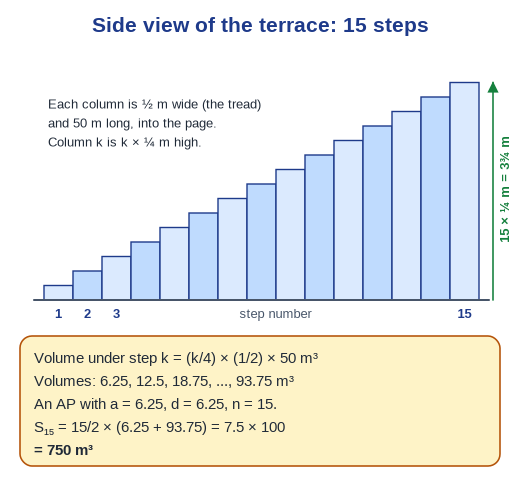
5. “A small terrace at a football ground comprises of 15 steps each of which is 50 m long and built of solid concrete. Each step has a rise of 1/4 m and a tread of 1/2 m. (see Fig. 5.8). Calculate the total volume of concrete required to build the terrace.”
Given: 15 steps; each step is 50 m long, has a rise (height) of 1/4 m and a tread (depth) of 1/2 m.
To find: the total volume of concrete.
- Look at the terrace from the side. The concrete under the 1st step is 1/4 m high, under the 2nd step 2/4 m high, under the 3rd step 3/4 m high, and so on. Each block is 1/2 m deep and 50 m long.
- Volume under step 1 = 1/4 × 1/2 × 50 = 6.25 m³.
- Volume under step 2 = 2/4 × 1/2 × 50 = 12.5 m³; under step 3 = 18.75 m³.
- These form an AP with a = 6.25, d = 6.25 and n = 15.
- S₁₅ = 15/2 [2 × 6.25 + 14 × 6.25] = 15/2 × 100 = 750.
Answer: 750 m³ of concrete.
The note at the end of the chapter (page 72)
If a, b, c are in AP, what is b? The common difference gives b − a = c − b, so 2b = a + c and b = (a + c)/2. b is called the arithmetic mean of a and c. For example, in 2, 14, 26 (Exercise 5.2 Q3 (i)), 14 = (2 + 26)/2.
More help: the nth term of an AP and the sum of the first n terms.
Practice
-
The 12th term of the AP 5, 8, 11, ... is:
Show answer
Answer: (b) 38
-
The sum of the first 12 terms of the AP 5, 8, 11, ... is:
Show answer
Answer: (a) 258
-
Which term of the AP 40, 37, 34, ... is 16?
Show answer
Answer: (c) 9th
-
Find the sum of the first 14 terms of the AP 40, 37, 34, ...
Show answer
Answer: a = 40, d = −3, n = 14. S₁₄ = 14/2 [80 + 13 × (−3)] = 7 × (80 − 39) = 7 × 41 = 287. Check with the last term: a₁₄ = 40 − 39 = 1, and 7 × (40 + 1) = 287.
-
The first term of an AP is −5 and the common difference is 3. Find the 10th term and the sum of the first 10 terms.
Show answer
Answer: a₁₀ = −5 + 9 × 3 = 22. S₁₀ = 10/2 × (a + a₁₀) = 5 × (−5 + 22) = 5 × 17 = 85.
Stuck on a question?
Take a photo and Lagnever AI explains it step by step. Try it for 7 days for ₹2.
Get it on Google Play Open in browser
For parents: after the trial, the plan renews monthly by UPI or card autopay. You can cancel anytime in the app.