
Class 10 Maths Chapter 5: Arithmetic Progressions Notes
This chapter in five lines
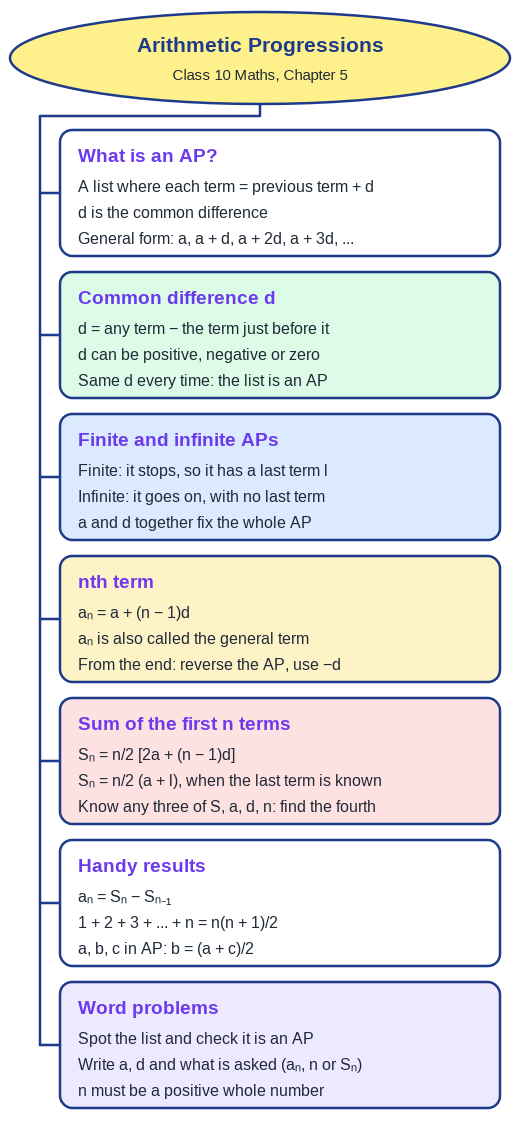
An arithmetic progression (AP) is a list of numbers in which every term after the first is made by adding the same fixed number, the common difference d, to the term before it. With first term a, the nth term is aₙ = a + (n − 1)d, and the sum of the first n terms is Sₙ = n/2 [2a + (n − 1)d], which is also n/2 (a + l) when l is the last term.
What is this chapter about?
Many lists of numbers follow a pattern. In some, each number is the one before it plus a fixed amount: a salary that rises by ₹500 every year, a savings box that gets ₹50 more on each birthday, a ladder whose rungs get 2 cm shorter towards the top. This chapter studies exactly this pattern, the arithmetic progression. It then gives two short formulas: one for any term of the list and one for the total of its first n terms.
What is an arithmetic progression?
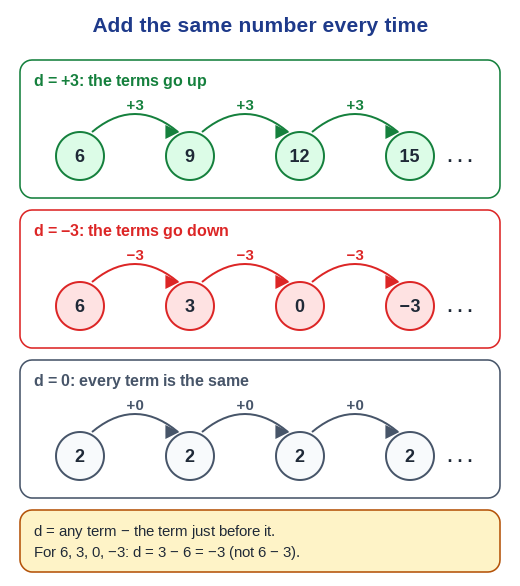
Each number in a list is called a term. An arithmetic progression (AP) is a list in which every term, except the first, is obtained by adding one fixed number to the term before it. That fixed number is the common difference, written d.
- 6, 9, 12, 15, … is an AP with d = 3.
- 6, 3, 0, −3, … is an AP with d = −3.
- 2, 2, 2, 2, … is an AP with d = 0.
So d can be positive, negative or zero. To find it, subtract any term from the term that follows it: for 6, 3, 0, −3, …, d = 3 − 6 = −3. Subtract in this order even when the later term is smaller.
What do a and d tell you?
The first term is written a (or a₁). Once a and d are known, the whole AP is fixed:
a, a + d, a + 2d, a + 3d, …
This is the general form of an AP. Neither a alone nor d alone is enough; you need both. An AP that stops is a finite AP and has a last term, often written l. An AP that never stops is an infinite AP and has no last term.
How do you check whether a list is an AP?
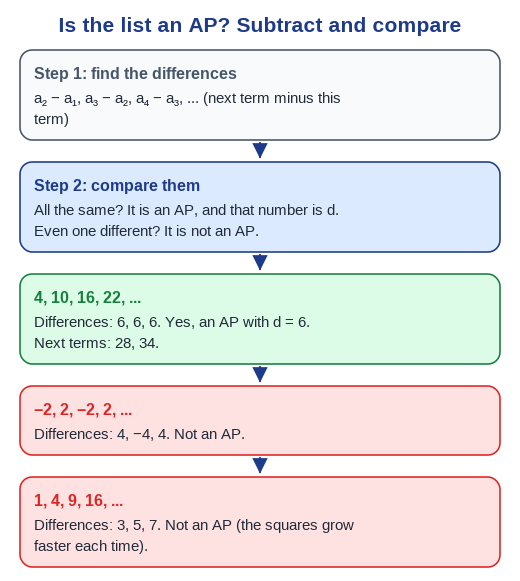
Work out a₂ − a₁, a₃ − a₂, a₄ − a₃ and so on. If every difference is the same, the list is an AP and that value is d. If even one is different, it is not an AP. For 1, 4, 9, 16, … the differences are 3, 5, 7, so it is not an AP. Once you know a list is an AP, a single subtraction gives d.
What is the nth term of an AP?
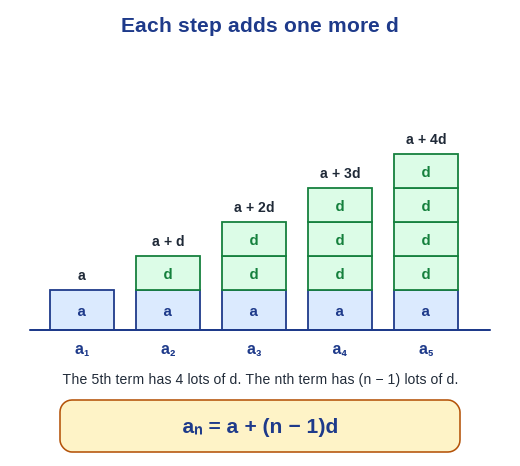
To reach the 2nd term you add d once, to reach the 3rd you add it twice, and to reach the nth you add it (n − 1) times. So
aₙ = a + (n − 1)d
aₙ is also called the general term. For 2, 7, 12, … the 10th term is 2 + 9 × 5 = 47. The same formula, solved for n, tells you the position of a given term, or whether a number is a term at all. Read more on the nth term of an AP.
How do you add the first n terms?
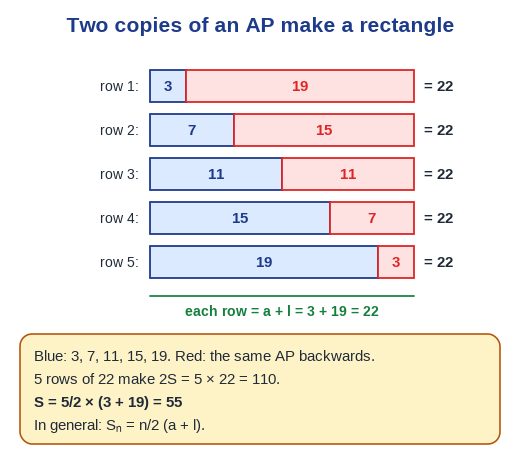
Write the sum forwards, write it again backwards, and add the two lines. Every column gives the same total, 2a + (n − 1)d, and there are n columns. Halving gives
Sₙ = n/2 [2a + (n − 1)d]
Since the last of these terms is l = a + (n − 1)d, the same result can be written Sₙ = n/2 (a + l), which is handy when the first and last terms are given. For 8, 3, −2, … the sum of the first 22 terms is 11 × (16 − 105) = −979. Read more on the sum of the first n terms.
What else should you remember?
- The nth term is the difference of two sums: aₙ = Sₙ − Sₙ₋₁.
- The sum of the first n positive integers is n(n + 1)/2, so 1 + 2 + … + 100 = 5050.
- If a, b, c are in AP, then b = (a + c)/2, the arithmetic mean of a and c (the book’s note to the reader).
- In a word problem, n is a count of terms: years, rows, weeks. It must be a positive whole number, so a fraction or a negative root is rejected.
Before we move on
Some questions give two facts about an AP and lead to two equations in a and d; the page on substitution and elimination from Chapter 3 shows how to solve such a pair. Questions that ask “how many terms give this sum?” lead to a quadratic equation in n, as in Chapter 4. Every example and every question of Exercises 5.1 to 5.3, and the optional Exercise 5.4, is worked out in the NCERT solutions for Chapter 5.
Key terms
| Term | Meaning |
|---|---|
| Term | Each number in a list. In 6, 9, 12, 15, ... the first term is 6 and the third term is 12. |
| Arithmetic progression (AP) | A list of numbers in which each term, except the first, is the term before it plus a fixed number. |
| Common difference (d) | The fixed number added each time. d = any term minus the term just before it. It can be positive, negative or zero. |
| First term (a) | The term the AP starts with, also written a₁. |
| General form of an AP | a, a + d, a + 2d, a + 3d, ... Knowing a and d gives the whole AP. |
| Finite AP | An AP that stops, such as 147, 148, ..., 157. It has a last term. |
| Infinite AP | An AP that goes on without end, such as 1, 2, 3, 4, ... It has no last term. |
| nth term (aₙ) | The term in position n: aₙ = a + (n − 1)d. It is also called the general term. |
| Last term (l) | The final term of a finite AP. If the AP has n terms, l = aₙ. |
| Sum of the first n terms (Sₙ) | a₁ + a₂ + ... + aₙ. Sₙ = n/2 [2a + (n − 1)d] = n/2 (a + l). |
| Arithmetic mean | If a, b, c are in AP, then b = (a + c)/2, and b is called the arithmetic mean of a and c. |
Topics in this chapter
Practice
-
The common difference of the AP 7, 4, 1, −2, ... is:
Show answer
Answer: (b) −3
-
The 10th term of the AP 5, 8, 11, ... is:
Show answer
Answer: (b) 32
-
Which list is an AP?
Show answer
Answer: (c) 2, 5, 8, 11, ...
-
The sum of the first 10 terms of the AP 3, 7, 11, ... is:
Show answer
Answer: (a) 210
-
The sum 1 + 2 + 3 + ... + 50 is:
Show answer
Answer: (b) 1275
Questions students ask
What are the main topics of Class 10 Maths Chapter 5?
What an arithmetic progression is, its first term and common difference, how to test whether a list is an AP, the nth term aₙ = a + (n − 1)d, the sum of the first n terms Sₙ = n/2 [2a + (n − 1)d] = n/2 (a + l), and word problems that use these two results.
How many exercises does Chapter 5 have?
Four. Exercise 5.1 (4 questions) is about recognising APs, Exercise 5.2 (20 questions) uses the nth term, and Exercise 5.3 (20 questions) uses the sum. Exercise 5.4 (5 questions) is marked optional; the book says it is not from the examination point of view.
Can the common difference of an AP be zero or negative?
Yes. With d = 0 every term is the same, as in 3, 3, 3, 3, ... With a negative d the terms get smaller, as in 100, 70, 40, 10, ... where d = −30. The list is still an AP because the same number is added each time.
Why are there sometimes two values of n for the same sum?
The sum formula gives a quadratic equation in n. When an AP has both positive and negative terms, some of them cancel, so two different numbers of terms can give the same sum. In the book's Example 13, the first 4 terms and the first 13 terms of 24, 21, 18, ... both add up to 78.
Stuck on a question?
Take a photo and Lagnever AI explains it step by step. Try it for 7 days for ₹2.
Get it on Google Play Open in browser
For parents: after the trial, the plan renews monthly by UPI or card autopay. You can cancel anytime in the app.