
How do you find the nth term of an AP?
Answer in short
The nth term of an AP with first term a and common difference d is aₙ = a + (n − 1)d. Put in n to get any term directly. Put in a term's value and solve for n to find its position. If n is not a positive whole number, that value is not a term.
Stuck on a question? Take a photo and Lagnever AI explains it step by step. Try it for 7 days for ₹2. Get it on Google Play
Why do we need a formula for the nth term?
Suppose a shop assistant starts at ₹12,000 a month and gets a raise of ₹600 every year. The monthly salary in successive years is 12000, 12600, 13200, … To know the salary in the 20th year you could keep adding 600, but that is nineteen additions. A formula does it in one line. (The book makes the same point with Reena’s salary of ₹8000 and a yearly rise of ₹500.)
How is the formula built?
Let the AP have first term a and common difference d.
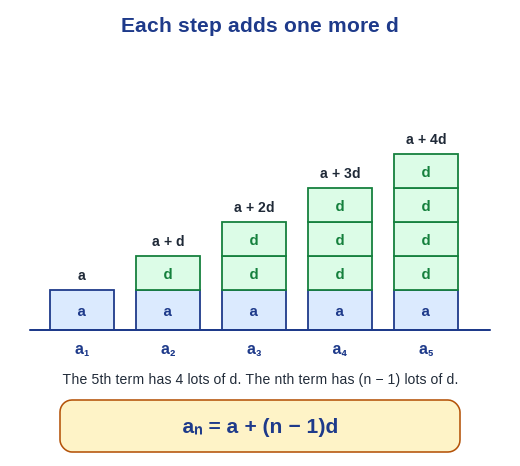
- 1st term: a
- 2nd term: a + d
- 3rd term: a + 2d
- 4th term: a + 3d
The number multiplying d is always one less than the position of the term. So the term in position n is
aₙ = a + (n − 1)d
This is the nth term or general term of the AP. If the AP is finite and has m terms, aₘ is its last term, also written l.
For the shop assistant, a = 12000, d = 600 and n = 20, so a₂₀ = 12000 + 19 × 600 = ₹23,400.
How do you find a particular term?
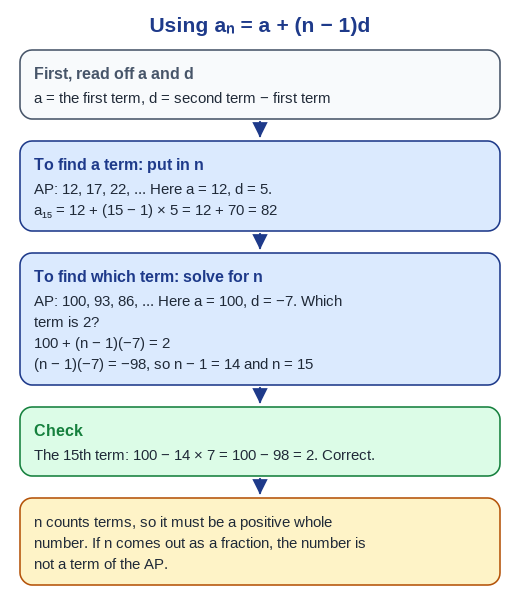
Read a and d from the list, then put in n. For the AP 12, 17, 22, …, a = 12 and d = 17 − 12 = 5.
a₁₅ = 12 + (15 − 1) × 5 = 12 + 70 = 82
Be careful with a falling AP. For 100, 93, 86, …, d = 93 − 100 = −7, so a₁₁ = 100 + 10 × (−7) = 30.
How do you find which term a number is?
Now the term is known and n is not. Put the value equal to a + (n − 1)d and solve. Which term of 100, 93, 86, … is 2?
100 + (n − 1)(−7) = 2
(n − 1)(−7) = −98
n − 1 = 14, so n = 15
So 2 is the 15th term.
How do you know whether a number is a term at all?
Solve for n in the same way and look at the answer. Since n is a position in the list, it must be a positive whole number. Is 100 a term of 4, 10, 16, …? Here 4 + (n − 1) × 6 = 100 gives n − 1 = 16, so n = 17: yes, the 17th term. Is 101 a term? Then n − 1 = 97/6, which is not a whole number, so 101 is not in the list.
The same idea counts numbers. The three-digit multiples of 9 are 108, 117, …, 999, an AP with d = 9. From 999 = 108 + (n − 1) × 9, n − 1 = 99, so there are 100 of them.
How do you find a term counted from the end?
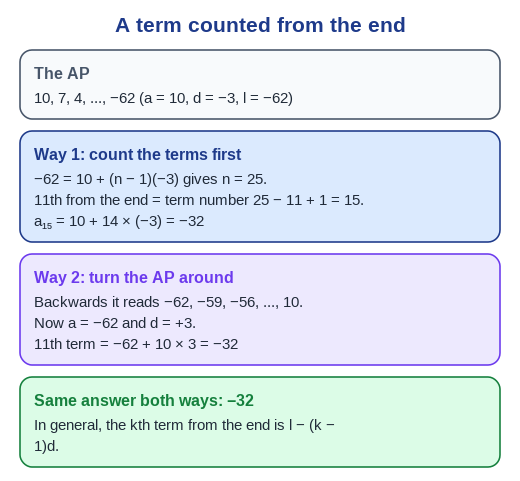
Take the finite AP 10, 7, 4, …, −62 and ask for the 11th term from the end. There are two ways.
- Find how many terms there are: −62 = 10 + (n − 1)(−3) gives n = 25. The 11th from the end is term number 25 − 11 + 1 = 15, and a₁₅ = 10 + 14 × (−3) = −32.
- Reverse the AP. Read backwards it starts at −62 and goes up by 3, so its 11th term is −62 + 10 × 3 = −32.
Both give −32. In general the kth term from the end is l − (k − 1)d.
What if two terms are given instead of a and d?
Each known term gives one equation. If the 3rd term is 5 and the 7th term is 9, then a + 2d = 5 and a + 6d = 9. Subtracting the first from the second gives 4d = 4, so d = 1 and a = 3. The AP is 3, 4, 5, 6, 7, … This is a pair of linear equations, solved as in Chapter 3.
A useful shortcut follows from the formula: the difference between the mth and the nth terms is (m − n)d. If the 17th term exceeds the 10th by 7, then 7d = 7 and d = 1, without knowing a.
How do you use it in a word problem?
Pick out the list, check that it is an AP, and name a, d and what is asked. Say a hall has 18 chairs in the first row, 21 in the second, 24 in the third, and so on, with 60 chairs in the last row. How many rows are there? Here a = 18, d = 3 and aₙ = 60:
18 + (n − 1) × 3 = 60, so n − 1 = 14 and n = 15
The hall has 15 rows. Check: 18 + 14 × 3 = 60.
Exercise 5.2 practises all of this, and every question is solved in the NCERT solutions. Read next: the sum of the first n terms and the chapter notes.
Practice
-
The 20th term of the AP 7, 11, 15, ... is:
Show answer
Answer: (b) 83
-
Which term of the AP 40, 37, 34, ... is 1?
Show answer
Answer: (c) 14th
-
How many two-digit numbers are divisible by 5?
Show answer
Answer: (d) 18
-
The 4th term of an AP is 11 and the 9th term is 26. Find the AP.
Show answer
Answer: a + 3d = 11 and a + 8d = 26. Subtracting, 5d = 15, so d = 3 and a = 11 − 9 = 2. The AP is 2, 5, 8, 11, ... Check: the 9th term is 2 + 8 × 3 = 26.
-
Is 50 a term of the AP 2, 5, 8, 11, ...? If yes, which one?
Show answer
Answer: Put 2 + (n − 1) × 3 = 50. Then (n − 1) × 3 = 48, n − 1 = 16 and n = 17. Since 17 is a positive whole number, 50 is the 17th term.
Questions students ask
What is the formula for the nth term of an AP?
aₙ = a + (n − 1)d, where a is the first term, d is the common difference and n is the position of the term. For the AP 2, 7, 12, ... the 10th term is 2 + 9 × 5 = 47. The nth term is also called the general term.
How do I check whether a number is a term of an AP?
Put the number equal to a + (n − 1)d and solve for n. If n comes out as a positive whole number, the number is that term. If n is a fraction or negative, it is not a term. For 5, 11, 17, 23, ... the number 301 gives n = 151/3, so 301 is not a term.
How do I find a term counted from the end of an AP?
Either find the total number of terms n and take term number n − k + 1, or reverse the AP: start from the last term l and use −d as the common difference. Both give l − (k − 1)d for the kth term from the end.
What do I do when two terms of an AP are given?
Write each one with the formula, for example a + 2d = 5 and a + 6d = 9. That is a pair of linear equations in a and d. Subtract to get d, substitute to get a, and then write the AP or any term that is asked.
Stuck on a question?
Take a photo and Lagnever AI explains it step by step. Try it for 7 days for ₹2.
Get it on Google Play Open in browser
For parents: after the trial, the plan renews monthly by UPI or card autopay. You can cancel anytime in the app.