
How do you find the sum of the first n terms of an AP?
Answer in short
The sum of the first n terms of an AP with first term a and common difference d is Sₙ = n/2 [2a + (n − 1)d]. If the last term l is known, the same sum is Sₙ = n/2 (a + l). Any three of S, a, d and n give the fourth.
Stuck on a question? Take a photo and Lagnever AI explains it step by step. Try it for 7 days for ₹2. Get it on Google Play
Why do we need a formula for the sum?
Think of a savings box that gets ₹100 on a child’s first birthday, ₹150 on the second, ₹200 on the third, and so on. To know the total on the 21st birthday you would have to write 21 numbers and add them. That is slow, and one slip spoils the answer. Because the amounts form an AP, there is a quicker way.
How did Gauss add 1 to 100?
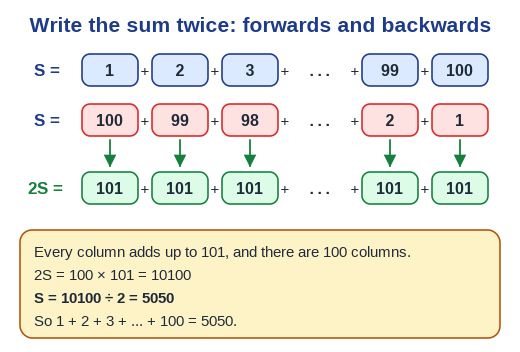
The book tells the story of Gauss, who as a ten-year-old was asked to add the whole numbers from 1 to 100. He wrote the sum once forwards and once backwards:
S = 1 + 2 + 3 + … + 99 + 100
S = 100 + 99 + 98 + … + 2 + 1
Adding the two lines column by column gives 101 every time, and there are 100 columns. So 2S = 100 × 101 and S = 5050.
How does the same idea give the formula?
Use the trick on a general AP. Let S be the sum of the first n terms.
S = a + (a + d) + (a + 2d) + … + [a + (n − 1)d]
S = [a + (n − 1)d] + [a + (n − 2)d] + … + (a + d) + a
Add the lines term by term. In each column the d-parts add up to (n − 1)d, so every column equals 2a + (n − 1)d. There are n columns:
2S = n[2a + (n − 1)d]
Sₙ = n/2 [2a + (n − 1)d]
What is the second form of the formula?
The bracket can be split as a + [a + (n − 1)d], which is the first term plus the nth term. If the AP stops there, the nth term is the last term l, so
Sₙ = n/2 (a + l)
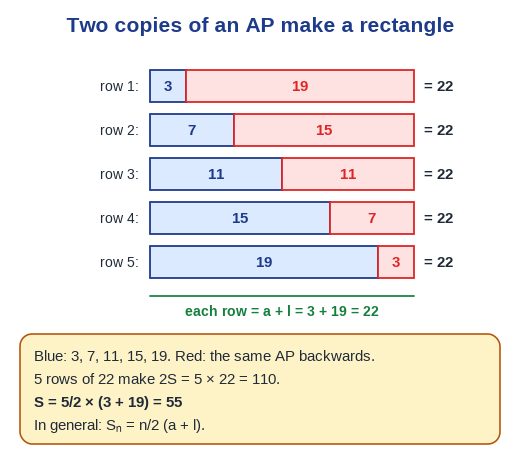
In words: the sum is the number of terms times the average of the first and last terms. A picture shows why. Put the AP 3, 7, 11, 15, 19 next to a copy of itself written backwards. Every row is 3 + 19 = 22 long, and there are 5 rows, so twice the sum is 110 and the sum is 55.
Which form should you use?
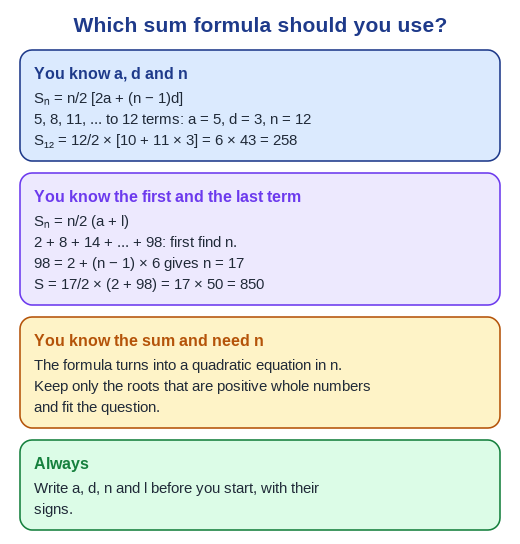
- You know a, d and n: use Sₙ = n/2 [2a + (n − 1)d]. For 5, 8, 11, … to 12 terms, S₁₂ = 6 × [10 + 33] = 258.
- You know the first and the last term: use Sₙ = n/2 (a + l). If n is not given, find it first from l = a + (n − 1)d. For 2 + 8 + 14 + … + 98: 98 = 2 + (n − 1) × 6 gives n = 17, and S = 17/2 × 100 = 850.
For the savings box, a = 100, d = 50 and n = 21, so S = 21/2 [200 + 20 × 50] = 21/2 × 1200 = ₹12,600, as the book finds.
How do you find a, d or n from a given sum?
The formula has four quantities: S, a, d and n. Given three, solve for the fourth.
Finding d: the first term is 10 and the sum of the first 8 terms is 220. Then 220 = 8/2 [20 + 7d] = 80 + 28d, so 28d = 140 and d = 5.
Finding n: how many terms of 24, 21, 18, … add up to 78? Here 78 = n/2 [48 + (n − 1)(−3)], which simplifies to n² − 17n + 52 = 0, so (n − 4)(n − 13) = 0 and n = 4 or 13. Both are acceptable (the book’s Example 13): the 5th to the 13th terms add up to zero, so the total is 78 both times.
When n comes from a quadratic equation, test each root against the question. A fraction or a negative number can never be a number of terms.
What other results follow?
- aₙ = Sₙ − Sₙ₋₁. The first n terms minus the first (n − 1) terms leaves only the nth term. If Sₙ = n², then a₅ = 25 − 16 = 9.
- 1 + 2 + 3 + … + n = n(n + 1)/2. Here a = 1 and l = n. The first 1000 positive integers add up to 500 × 1001 = 500500.
Exercise 5.3 practises these, and every question is solved in the NCERT solutions. Read next: the nth term of an AP and the chapter notes.
Practice
-
The sum of the first 20 terms of the AP 7, 11, 15, ... is:
Show answer
Answer: (a) 900
-
The sum 2 + 4 + 6 + ... + 40 is:
Show answer
Answer: (c) 420
-
If Sₙ = n² for an AP, then its 5th term is:
Show answer
Answer: (d) 9
-
How many terms of the AP 1, 3, 5, ... must be added to get 144?
Show answer
Answer: a = 1, d = 2. Sₙ = n/2 [2 + (n − 1) × 2] = n/2 × 2n = n². So n² = 144 and n = 12 (n = −12 is rejected). 12 terms are needed.
-
A child saves ₹50 in the first month and ₹10 more each month than the month before. How much is saved in 12 months?
Show answer
Answer: The savings are 50, 60, 70, ..., an AP with a = 50, d = 10, n = 12. S₁₂ = 12/2 [100 + 11 × 10] = 6 × 210 = ₹1260. Check with the last term: a₁₂ = 160 and 6 × (50 + 160) = 1260.
Questions students ask
What is the formula for the sum of the first n terms of an AP?
Sₙ = n/2 [2a + (n − 1)d], where a is the first term and d the common difference. When the last term l is known, it is shorter to use Sₙ = n/2 (a + l). Both are the same formula, because l = a + (n − 1)d.
How was the sum formula found?
By writing the sum forwards and backwards and adding the two lines term by term. Each of the n columns adds up to 2a + (n − 1)d, so twice the sum is n[2a + (n − 1)d]. The book links this to the way Gauss added 1 to 100 as a boy.
How do I find the nth term if only Sₙ is given?
Use aₙ = Sₙ − Sₙ₋₁. The first term is S₁. For example, if Sₙ = 4n − n², then a₁ = S₁ = 3 and a₂ = S₂ − S₁ = 4 − 3 = 1.
Why does finding n from a sum give two answers sometimes?
The formula becomes a quadratic equation in n, which can have two roots. Keep only positive whole numbers. Sometimes both fit, as when positive and negative terms cancel; sometimes one must be rejected because it would mean a negative number of logs, rows or the like.
Stuck on a question?
Take a photo and Lagnever AI explains it step by step. Try it for 7 days for ₹2.
Get it on Google Play Open in browser
For parents: after the trial, the plan renews monthly by UPI or card autopay. You can cancel anytime in the app.