
What is the distance formula?
Answer in short
The distance formula gives the distance between two points from their coordinates. For P(x₁, y₁) and Q(x₂, y₂), PQ = √[(x₂ − x₁)² + (y₂ − y₁)²]. It is the Pythagoras theorem applied to the right triangle whose legs are the difference of the x-coordinates and the difference of the y-coordinates.
Stuck on a question? Take a photo and Lagnever AI explains it step by step. Try it for 7 days for ₹2. Get it on Google Play
Why do we need a formula?
The book starts with two towns. Town B is 36 km east and 15 km north of town A. How far is B from A, without measuring? The trip east and the trip north are at right angles, so the straight distance is the hypotenuse of a right triangle.
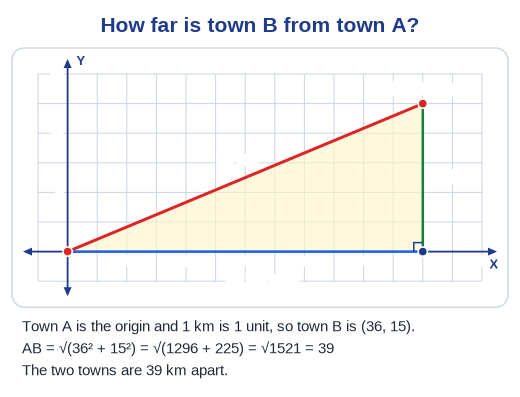
By the Pythagoras theorem, AB = √(36² + 15²) = √1521 = 39 km. The distance formula does exactly this for any two points.
What are the easy cases?
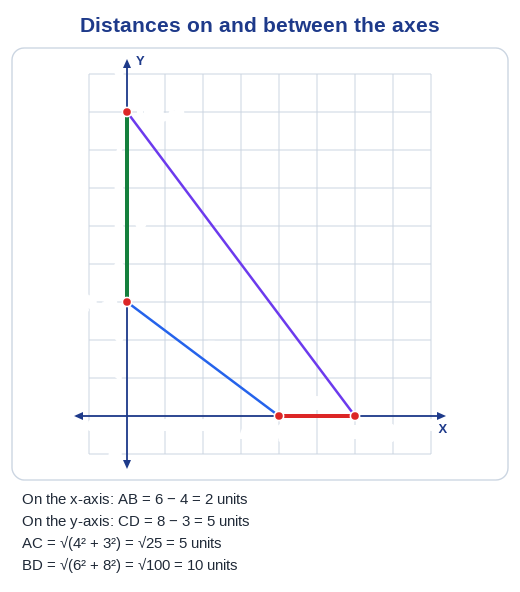
- Both points on the x-axis. For A(4, 0) and B(6, 0), AB = 6 − 4 = 2 units.
- Both points on the y-axis. For C(0, 3) and D(0, 8), CD = 8 − 3 = 5 units.
- One point on each axis. For A(4, 0) and C(0, 3), OA = 4 and OC = 3, so AC = √(4² + 3²) = 5 units. In the same way BD = √(6² + 8²) = 10 units.
How is the formula proved?
Take any two points P(x₁, y₁) and Q(x₂, y₂). Draw PR and QS perpendicular to the x-axis, and draw PT perpendicular to QS.
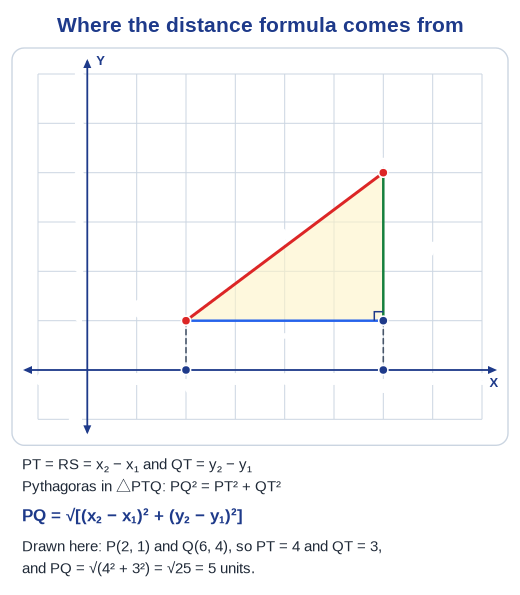
- OR = x₁ and OS = x₂, so RS = x₂ − x₁. PT is opposite to RS in the rectangle PRST, so PT = x₂ − x₁.
- SQ = y₂ and ST = PR = y₁, so QT = y₂ − y₁.
- △PTQ is right-angled at T. By the Pythagoras theorem, PQ² = PT² + QT² = (x₂ − x₁)² + (y₂ − y₁)².
- Distance is not negative, so we take the positive square root:
PQ = √[(x₂ − x₁)² + (y₂ − y₁)²]
Two remarks follow. First, the distance of P(x, y) from the origin O(0, 0) is OP = √(x² + y²). Second, PQ can also be written as √[(x₁ − x₂)² + (y₁ − y₂)²], because a number and its negative have the same square.
Does it work when the points are in different quadrants?
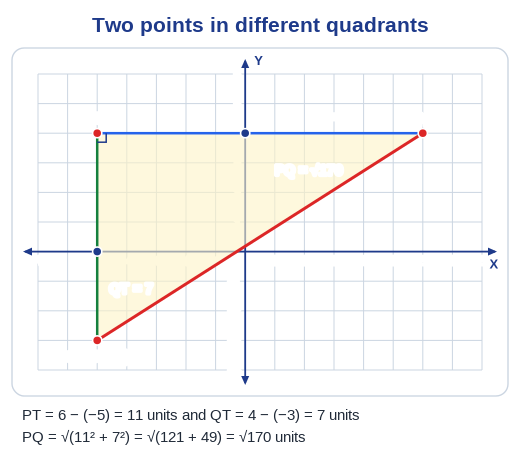
Yes. Take P(6, 4) and Q(−5, −3). The horizontal side is 6 − (−5) = 11 units and the vertical side is 4 − (−3) = 7 units, so PQ = √(11² + 7²) = √170 units. The formula takes care of the signs by itself.
How do you test for collinear points?
Find the three distances. If the two smaller ones add up to the largest, the points are collinear. If the sum of any two is more than the third, they form a triangle.
For A(3, 1), B(6, 4) and C(8, 6): AB = √18 = 3√2, BC = √8 = 2√2 and AC = √50 = 5√2. Since 3√2 + 2√2 = 5√2, the points are collinear (Example 3).
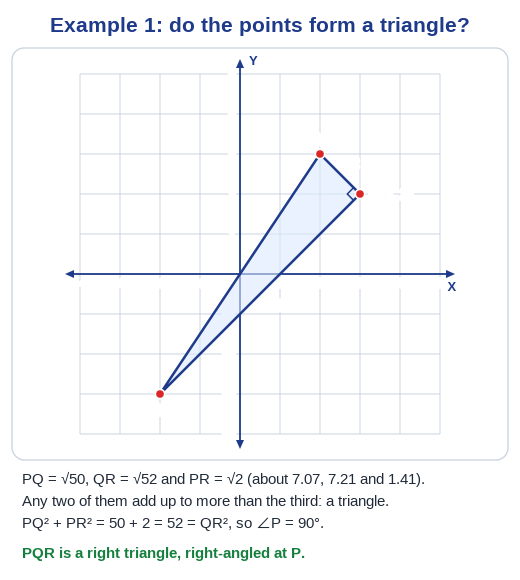
For P(3, 2), Q(−2, −3) and R(2, 3): PQ = √50, QR = √52 and PR = √2. No two add up to the third, so PQR is a triangle. Also PQ² + PR² = 50 + 2 = 52 = QR², so by the converse of the Pythagoras theorem ∠P = 90° (Example 1).
How do you name a quadrilateral?
Find the four sides and the two diagonals, then compare.
| What you find | The figure |
|---|---|
| Four equal sides, equal diagonals | Square |
| Four equal sides, unequal diagonals | Rhombus |
| Opposite sides equal, equal diagonals | Rectangle |
| Opposite sides equal, unequal diagonals | Parallelogram |
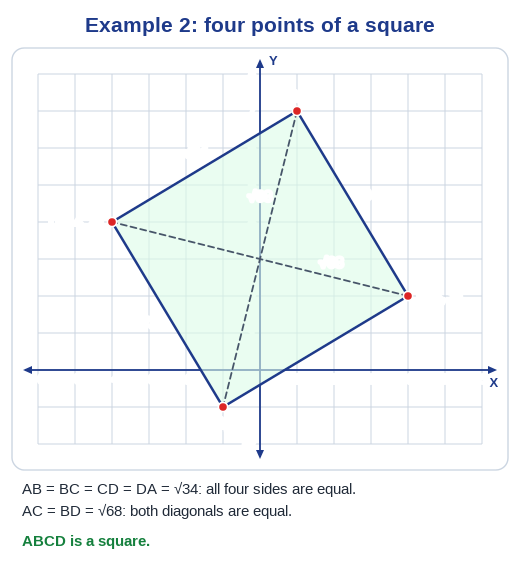
Extra: this table is not printed in the chapter. It collects properties of quadrilaterals from earlier classes, which the chapter applies in Example 2 and in Exercise 7.1. For A(1, 7), B(4, 2), C(−1, −1) and D(−4, 4), each side is √34 and each diagonal is √68, so ABCD is a square.
Always check first that no three of the points are collinear. If three are, no quadrilateral is formed at all.
How do you find equidistant points?
Write the two distances, square them, and put them equal.
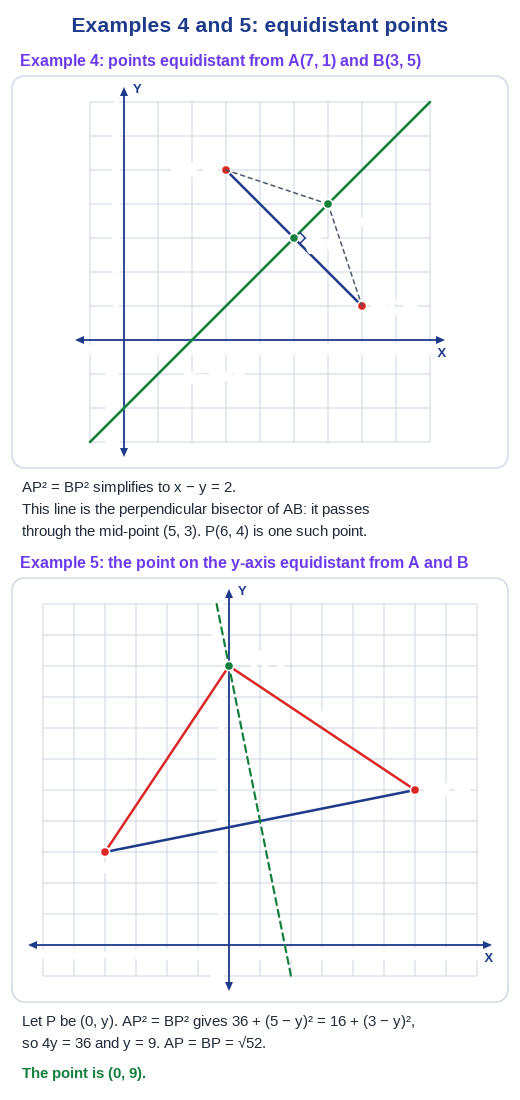
A relation between x and y. Let P(x, y) be equidistant from A(7, 1) and B(3, 5). Then (x − 7)² + (y − 1)² = (x − 3)² + (y − 5)². Expanding and cancelling x² and y² leaves x − y = 2 (Example 4). This is a line: the perpendicular bisector of AB.
A point on an axis. A point on the y-axis is (0, y). If it is equidistant from A(6, 5) and B(−4, 3), then 36 + (5 − y)² = 16 + (3 − y)², which gives y = 9. The point is (0, 9) (Example 5).
Read next: the section formula. All ten questions of Exercise 7.1 are solved in the NCERT solutions, and the chapter notes give the full picture.
Practice
-
The distance between (−1, −1) and (2, 3) is:
Show answer
Answer: (c) 5 units
-
The distance between (3, −1) and (−1, 2) is:
Show answer
Answer: (a) 5 units
-
The points (0, 0), (3, 4) and (6, 0) form:
Show answer
Answer: (c) an isosceles triangle
-
Find the values of y for which the distance between A(1, 2) and B(4, y) is 5 units.
Show answer
Answer: AB² = (4 − 1)² + (y − 2)² = 25, so (y − 2)² = 16 and y − 2 = ±4. So y = 6 or y = −2.
-
Find the point on the x-axis which is equidistant from (1, 4) and (5, 2).
Show answer
Answer: Let the point be P(x, 0). PA² = PB² gives (x − 1)² + 16 = (x − 5)² + 4, so x² − 2x + 17 = x² − 10x + 29, 8x = 12 and x = 3/2. The point is (3/2, 0). Check: both squared distances are 65/4.
Questions students ask
Why do we take only the positive square root in the distance formula?
A distance is a length, and a length cannot be negative. So of the two square roots of (x₂ − x₁)² + (y₂ − y₁)², only the positive one is taken.
Does it matter which point is taken as (x₁, y₁)?
No. Swapping the points changes x₂ − x₁ into x₁ − x₂, which only changes the sign. The square is the same, so PQ = √[(x₁ − x₂)² + (y₁ − y₂)²] gives the same distance.
How do I prove that four points form a square?
Find the four sides and the two diagonals. If all four sides are equal and both diagonals are equal, the figure is a square. Another way is to show four equal sides and one right angle, using the converse of the Pythagoras theorem. Example 2 of the chapter shows both ways.
What does the equation of equidistant points represent?
All points equidistant from two points A and B lie on the perpendicular bisector of AB. So the relation you get, such as x − y = 2 in Example 4, is the equation of that line.
Stuck on a question?
Take a photo and Lagnever AI explains it step by step. Try it for 7 days for ₹2.
Get it on Google Play Open in browser
For parents: after the trial, the plan renews monthly by UPI or card autopay. You can cancel anytime in the app.