
What is the section formula?
Answer in short
The section formula gives the point dividing a segment in a given ratio. If P divides the join of A(x₁, y₁) and B(x₂, y₂) internally in m₁ : m₂, then P is ((m₁x₂ + m₂x₁)/(m₁ + m₂), (m₁y₂ + m₂y₁)/(m₁ + m₂)). For the ratio 1 : 1 it gives the mid-point.
Stuck on a question? Take a photo and Lagnever AI explains it step by step. Try it for 7 days for ₹2. Get it on Google Play
What problem does the section formula solve?
Recall the two towns of the chapter: with town A as the origin and 1 km as one unit, town B is (36, 15). A telephone company wants a relay tower P on AB, twice as far from B as from A. So P divides AB in the ratio 1 : 2. Where exactly is P?
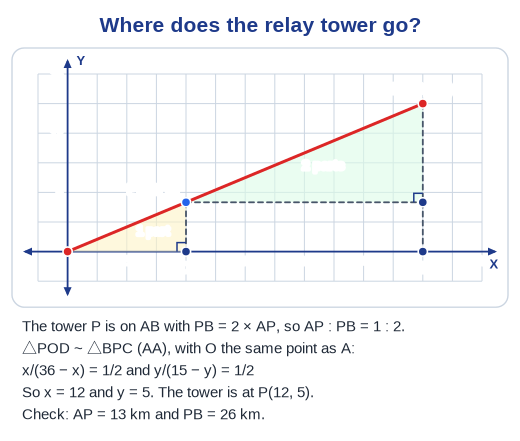
Let P be (x, y). Draw PD and BE perpendicular to the x-axis, and PC perpendicular to BE. The right triangles POD and BPC have equal angles, so they are similar by the AA criterion. Their sides are in the ratio OP : PB = 1 : 2:
- OD/PC = 1/2, that is x/(36 − x) = 1/2, so 2x = 36 − x and x = 12.
- PD/BC = 1/2, that is y/(15 − y) = 1/2, so 2y = 15 − y and y = 5.
The tower stands at P(12, 5). Check with distances: AP = √(144 + 25) = 13 km and PB = √(576 + 100) = 26 km, and 13 : 26 = 1 : 2.
How is the formula derived?
Now take any two points A(x₁, y₁) and B(x₂, y₂), and let P(x, y) divide AB internally in the ratio m₁ : m₂, so that PA/PB = m₁/m₂. Draw AR, PS and BT perpendicular to the x-axis, and draw AQ and PC parallel to the x-axis.
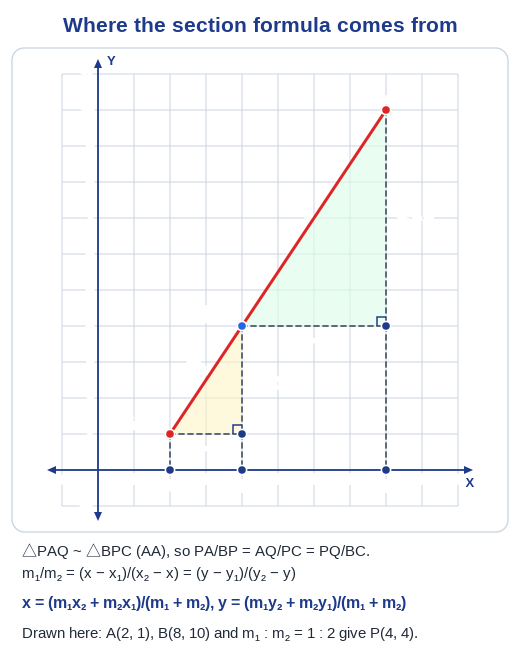
- △PAQ ~ △BPC by the AA criterion. So PA/BP = AQ/PC = PQ/BC.
- AQ = RS = x − x₁ and PC = ST = x₂ − x.
- PQ = PS − QS = y − y₁ and BC = BT − CT = y₂ − y.
- So m₁/m₂ = (x − x₁)/(x₂ − x) = (y − y₁)/(y₂ − y).
- From m₁/m₂ = (x − x₁)/(x₂ − x): m₁x₂ − m₁x = m₂x − m₂x₁, so x(m₁ + m₂) = m₁x₂ + m₂x₁.
- The y-coordinates work in the same way.
Section formula: the point dividing the join of A(x₁, y₁) and B(x₂, y₂) internally in the ratio m₁ : m₂ is
((m₁x₂ + m₂x₁)/(m₁ + m₂), (m₁y₂ + m₂y₁)/(m₁ + m₂))
In our drawing A is (2, 1), B is (8, 10) and the ratio is 1 : 2. The formula gives x = (1 × 8 + 2 × 2)/3 = 4 and y = (1 × 10 + 2 × 1)/3 = 4, the point P(4, 4) on the grid.
What are the k : 1 form and the mid-point formula?
Ratio k : 1. Dividing m₁ and m₂ by m₂ turns the ratio into k : 1, where k = m₁/m₂. The point is then
((kx₂ + x₁)/(k + 1), (ky₂ + y₁)/(k + 1))
Mid-point. The mid-point divides the segment in the ratio 1 : 1, so its coordinates are
((x₁ + x₂)/2, (y₁ + y₂)/2)
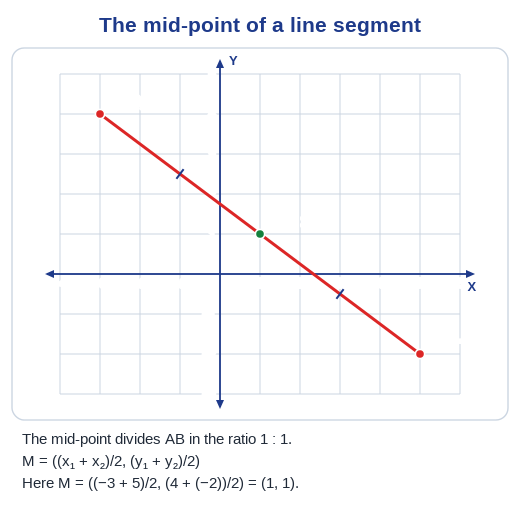
For A(−3, 4) and B(5, −2), the mid-point is ((−3 + 5)/2, (4 − 2)/2) = (1, 1).
How do you find a point of division?
Example 6 of the book. Divide the join of (4, −3) and (8, 5) internally in the ratio 3 : 1.
x = (3 × 8 + 1 × 4)/(3 + 1) = 28/4 = 7 and y = (3 × 5 + 1 × (−3))/(3 + 1) = 12/4 = 3. The point is (7, 3).
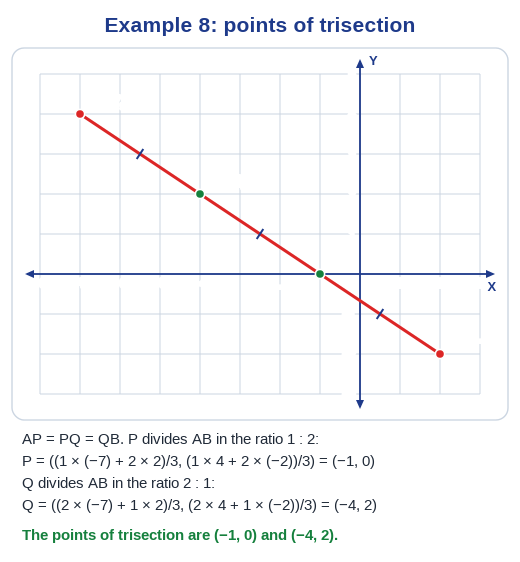
Points of trisection (Example 8). For A(2, −2) and B(−7, 4), the point P nearer to A divides AB in the ratio 1 : 2, and the point Q nearer to B divides it in the ratio 2 : 1.
- P = ((1 × (−7) + 2 × 2)/3, (1 × 4 + 2 × (−2))/3) = (−1, 0)
- Q = ((2 × (−7) + 1 × 2)/3, (2 × 4 + 1 × (−2))/3) = (−4, 2)
Q is also the mid-point of PB, which is a quick check: ((−1 − 7)/2, (0 + 4)/2) = (−4, 2).
How do you find the ratio?
Example 7. In what ratio does (−4, 6) divide the join of A(−6, 10) and B(3, −8)? Let the ratio be k : 1. Then −4 = (3k − 6)/(k + 1), so −4k − 4 = 3k − 6 and k = 2/7. The ratio is 2 : 7. Check with y: (−8 × 2 + 10 × 7)/(2 + 7) = 54/9 = 6.
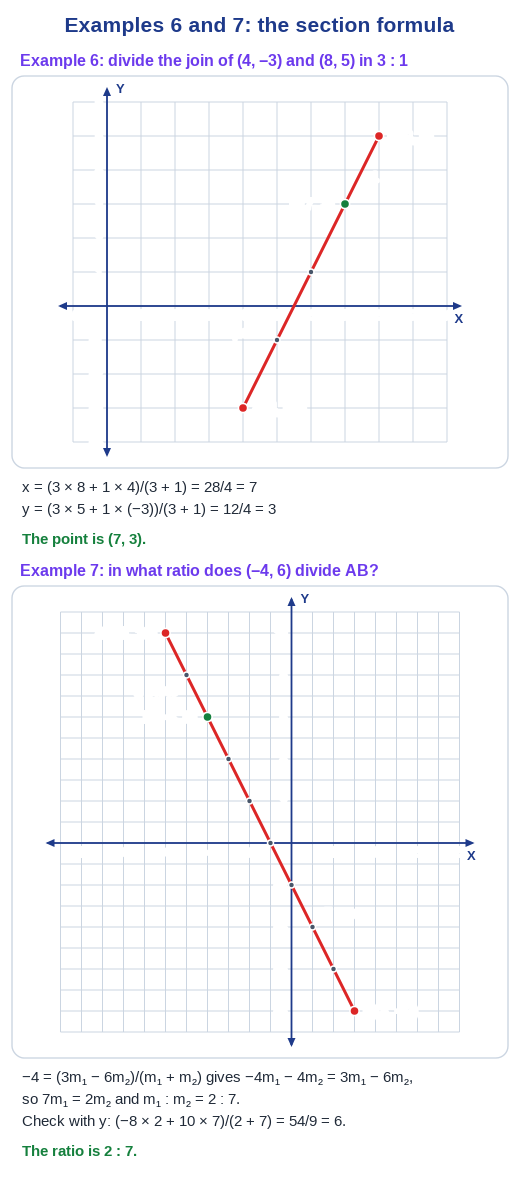
Where an axis cuts a segment (Example 9). For (5, −6) and (−1, −4), a point dividing the join in the ratio k : 1 is ((−k + 5)/(k + 1), (−4k − 6)/(k + 1)). On the y-axis the x-coordinate is 0, so k = 5. The ratio is 5 : 1 and the point is (0, −26/6) = (0, −13/3).
How does it help with parallelograms?
The diagonals of a parallelogram bisect each other, so the two diagonals have the same mid-point. In Example 10, A(6, 1), B(8, 2), C(9, 4) and D(p, 3) are the vertices in order. The mid-point of AC is (15/2, 5/2) and the mid-point of BD is ((8 + p)/2, 5/2). So 15 = 8 + p and p = 7.
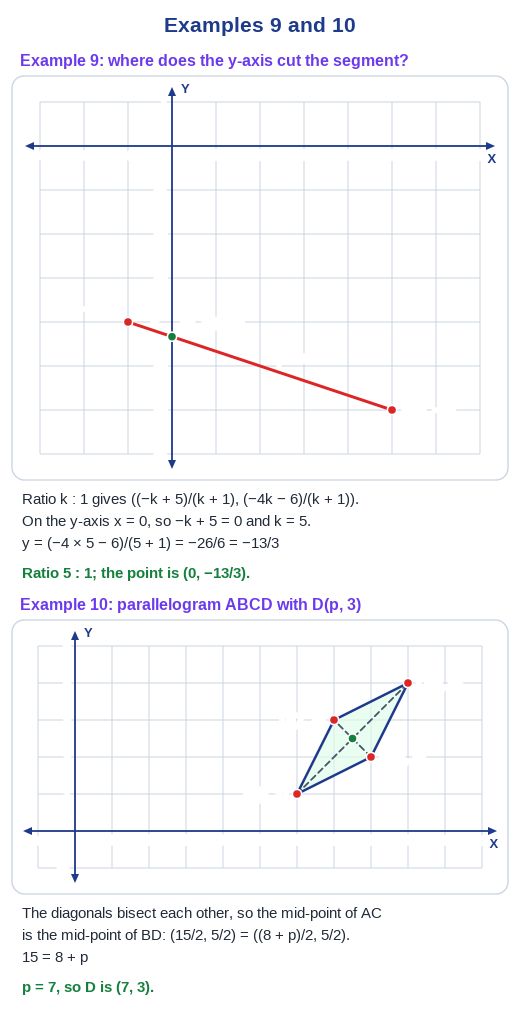
The same idea finds the other end of a diameter of a circle, because the centre is the mid-point of the diameter (Exercise 7.2, Question 7).
Read next: Exercise 7.2 in the NCERT solutions, the distance formula and the chapter notes.
Practice
-
The point that divides the join of (−2, 3) and (4, 0) internally in the ratio 1 : 2 is:
Show answer
Answer: (b) (0, 2)
-
The mid-point of the join of (−2, 5) and (4, −1) is:
Show answer
Answer: (a) (1, 2)
-
The point (3, 2) divides the join of (1, −2) and (6, 8) in the ratio:
Show answer
Answer: (c) 2 : 3
-
Find the ratio in which the y-axis divides the join of (−3, 2) and (5, 6), and the point of division.
Show answer
Answer: Let the ratio be k : 1. The x-coordinate is (5k − 3)/(k + 1), and on the y-axis it is 0, so k = 3/5. The ratio is 3 : 5. Then y = (3 × 6 + 5 × 2)/(3 + 5) = 28/8 = 7/2. The point is (0, 7/2).
-
(1, 1), (2, 5), (5, 7) and (x, y) are the vertices of a parallelogram taken in order. Find x and y.
Show answer
Answer: The diagonals bisect each other. Mid-point of AC = ((1 + 5)/2, (1 + 7)/2) = (3, 4). Mid-point of BD = ((2 + x)/2, (5 + y)/2). So 2 + x = 6 and 5 + y = 8, giving x = 4 and y = 3.
Questions students ask
What does 'divides internally' mean?
The point P lies on the segment AB, between A and B. If P is on the line AB but outside the segment, it divides AB externally. The chapter deals only with internal division; a note at the end says external division comes in higher classes.
Why is the ratio often taken as k : 1?
The ratio m₁ : m₂ is the same as (m₁/m₂) : 1. Writing it as k : 1 leaves only one unknown, so one equation is enough to find it. If k = 2/7, the ratio is 2 : 7.
How is the mid-point formula related to the section formula?
The mid-point divides the segment in the ratio 1 : 1. Putting m₁ = m₂ = 1 in the section formula gives ((x₁ + x₂)/2, (y₁ + y₂)/2), the average of the coordinates of the two ends.
Can I find the ratio using distances instead?
Yes, if you already know that the three points are collinear. Then the ratio is PA : PB, found with the distance formula. The book notes this after Example 7. The section formula is usually quicker.
Stuck on a question?
Take a photo and Lagnever AI explains it step by step. Try it for 7 days for ₹2.
Get it on Google Play Open in browser
For parents: after the trial, the plan renews monthly by UPI or card autopay. You can cancel anytime in the app.