
NCERT Solutions Class 10 Maths Chapter 7: Coordinate Geometry
Answers to the questions inside Chapter 7, Coordinate Geometry, all ten worked examples, and every question of Exercises 7.1 and 7.2, from Mathematics, the Class 10 NCERT textbook. Page numbers follow the 2026-27 reprint (pages 99–112). The exercise questions are quoted from the book; the examples and in-chapter questions are restated in short and labelled by number and page. The book’s figures are not copied: every figure on this page is our own drawing on a true grid, with each point plotted from its coordinates. Every answer was checked by exact calculation and agrees with the answer key at the back of the book. Short notes: Chapter 7 notes.
Questions inside the chapter: Sections 7.1 and 7.2 (pages 99–102)
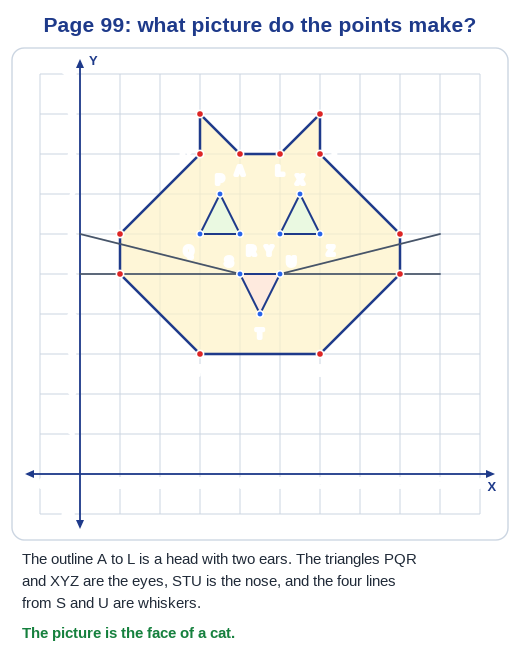
Page 99: plot the given points A to L, the triangles PQR, XYZ and STU, and the four extra lines. What picture do you get? The face of a cat. The twelve points A to L, joined in order, make the head with two pointed ears. The triangles PQR and XYZ are the eyes, the triangle STU is the nose, and the lines from S to (0, 5) and (0, 6) and from U to (9, 5) and (9, 6) are the whiskers.
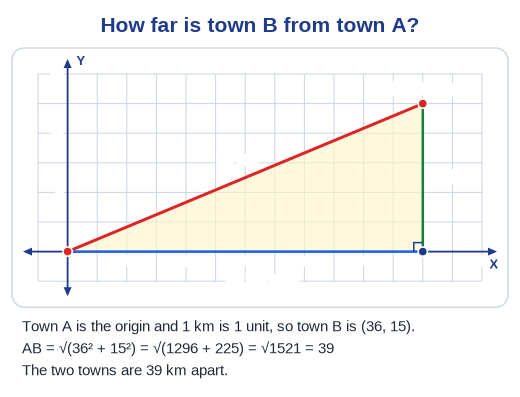
Page 100: town B is 36 km east and 15 km north of town A. How far is it from A? The two legs are at right angles, so AB = √(36² + 15²) = √(1296 + 225) = √1521 = 39 km. (Exercise 7.1, Question 2 asks this again.)
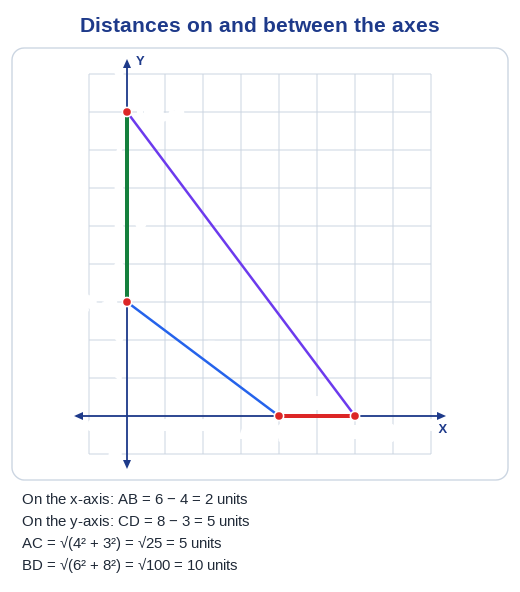
Page 100: for A(4, 0), B(6, 0), C(0, 3) and D(0, 8), find AB, CD, AC and BD. AB = 6 − 4 = 2 units and CD = 8 − 3 = 5 units. AC = √(4² + 3²) = 5 units, and BD = √(6² + 8²) = √100 = 10 units.
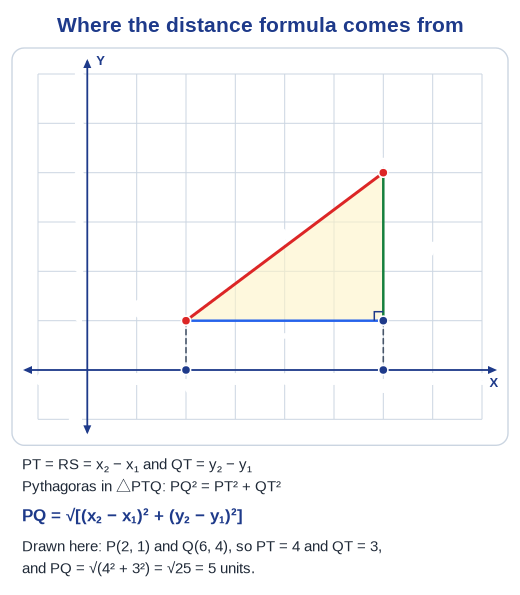
Pages 100–101: find the distance between P(4, 6) and Q(6, 8). Draw PR and QS perpendicular to the x-axis and PT perpendicular to QS. Then PT = RS = 6 − 4 = 2 and QT = 8 − 6 = 2. So PQ² = 2² + 2² = 8 and PQ = 2√2 units.
Page 101: for P(6, 4) and Q(−5, −3), PT = 11 units and QT = 7 units. Why? T is the point (−5, 4): it is on the vertical line through Q and on the horizontal line through P. PT runs from x = −5 to x = 6, so PT = 6 − (−5) = 11 units. QT runs from y = −3 to y = 4, so QT = 4 − (−3) = 7 units. Then PQ = √(11² + 7²) = √170 units.
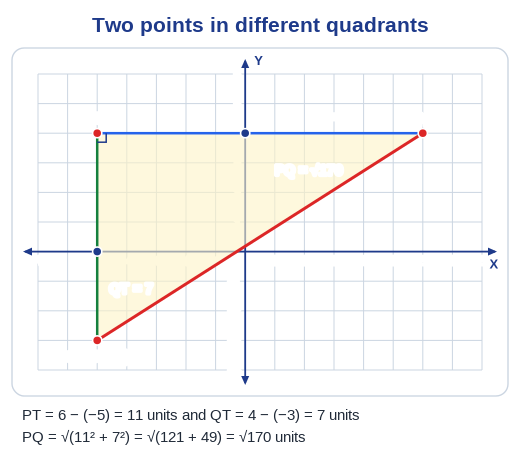
Page 102, Remark 2: PQ can also be written as √[(x₁ − x₂)² + (y₁ − y₂)²]. Why? Because x₁ − x₂ = −(x₂ − x₁), and a number and its negative have the same square. So (x₁ − x₂)² = (x₂ − x₁)², and the same holds for the y-terms.
Examples 1 to 5 (pages 102–105)
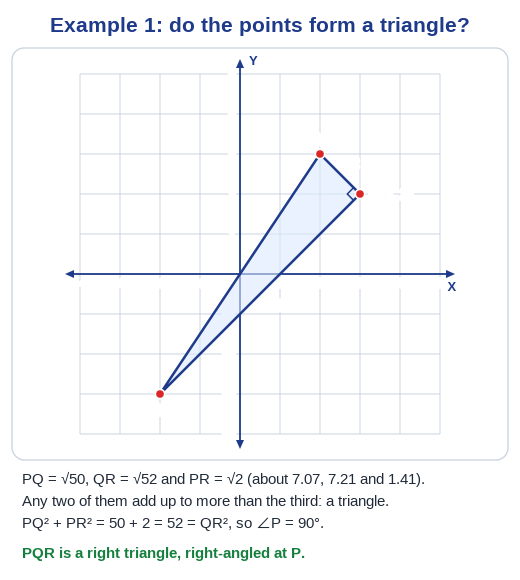
Example 1 (page 102): do the points (3, 2), (−2, −3) and (2, 3) form a triangle? If so, what type?
Let P(3, 2), Q(−2, −3) and R(2, 3).
- PQ = √[(3 + 2)² + (2 + 3)²] = √(25 + 25) = √50, about 7.07.
- QR = √[(−2 − 2)² + (−3 − 3)²] = √(16 + 36) = √52, about 7.21.
- PR = √[(3 − 2)² + (2 − 3)²] = √(1 + 1) = √2, about 1.41.
- The sum of any two of these is greater than the third, so the points form a triangle.
- PQ² + PR² = 50 + 2 = 52 = QR². By the converse of the Pythagoras theorem, ∠P = 90°. PQR is a right triangle.
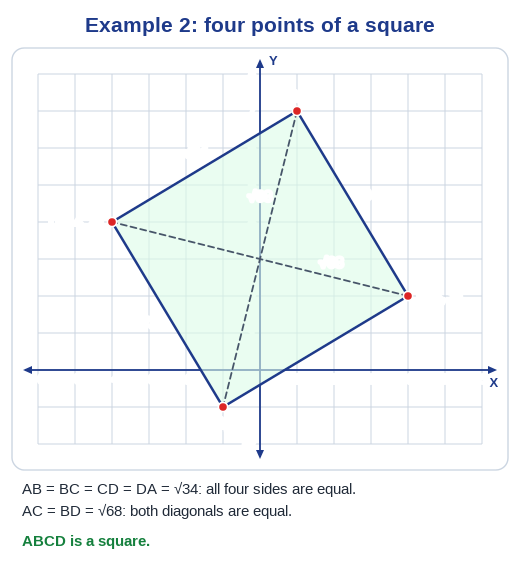
Example 2 (page 103): show that (1, 7), (4, 2), (−1, −1) and (−4, 4) are the vertices of a square.
Let A(1, 7), B(4, 2), C(−1, −1) and D(−4, 4).
- AB = √[(1 − 4)² + (7 − 2)²] = √(9 + 25) = √34.
- BC = √[(4 + 1)² + (2 + 1)²] = √(25 + 9) = √34.
- CD = √[(−1 + 4)² + (−1 − 4)²] = √(9 + 25) = √34.
- DA = √[(1 + 4)² + (7 − 4)²] = √(25 + 9) = √34.
- AC = √[(1 + 1)² + (7 + 1)²] = √(4 + 64) = √68 and BD = √[(4 + 4)² + (2 − 4)²] = √(64 + 4) = √68.
- All four sides are equal and both diagonals are equal, so ABCD is a square.
Another way: AD² + DC² = 34 + 34 = 68 = AC², so ∠D = 90°. A quadrilateral with four equal sides and one right angle is a square.
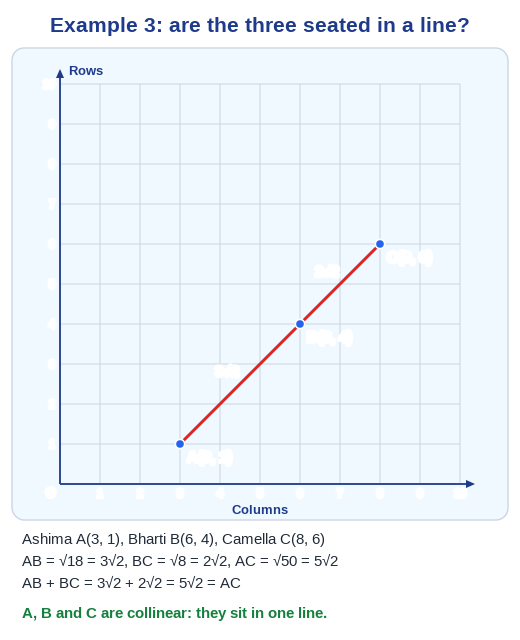
Example 3 (page 103): Ashima, Bharti and Camella sit at A(3, 1), B(6, 4) and C(8, 6). Are they seated in a line?
- AB = √[(6 − 3)² + (4 − 1)²] = √18 = 3√2.
- BC = √[(8 − 6)² + (6 − 4)²] = √8 = 2√2.
- AC = √[(8 − 3)² + (6 − 1)²] = √50 = 5√2.
- AB + BC = 3√2 + 2√2 = 5√2 = AC. So A, B and C are collinear: yes, they are seated in a line.
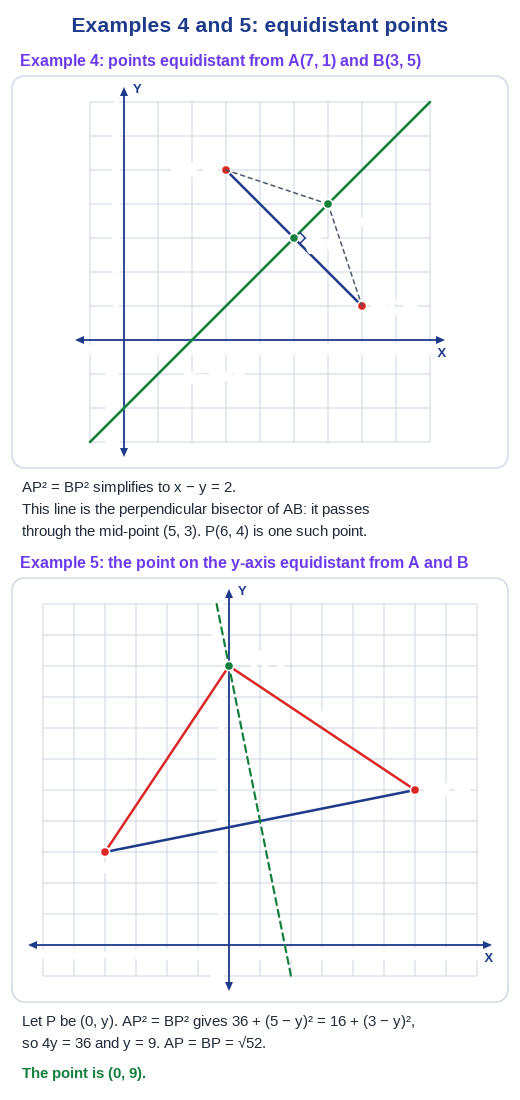
Example 4 (page 104): find a relation between x and y if (x, y) is equidistant from (7, 1) and (3, 5).
Let P(x, y), A(7, 1) and B(3, 5). AP = BP, so AP² = BP².
- (x − 7)² + (y − 1)² = (x − 3)² + (y − 5)².
- x² − 14x + 49 + y² − 2y + 1 = x² − 6x + 9 + y² − 10y + 25.
- −14x − 2y + 50 = −6x − 10y + 34, so 8x − 8y = 16.
- x − y = 2.
The graph of x − y = 2 is a line, the perpendicular bisector of AB.
Example 5 (page 104): find the point on the y-axis equidistant from A(6, 5) and B(−4, 3).
A point on the y-axis is P(0, y).
- (6 − 0)² + (5 − y)² = (−4 − 0)² + (3 − y)².
- 36 + 25 − 10y + y² = 16 + 9 − 6y + y².
- 61 − 10y = 25 − 6y, so 4y = 36 and y = 9.
- The point is (0, 9). Check: AP = √(36 + 16) = √52 and BP = √(16 + 36) = √52.
Exercise 7.1 (pages 105–106)
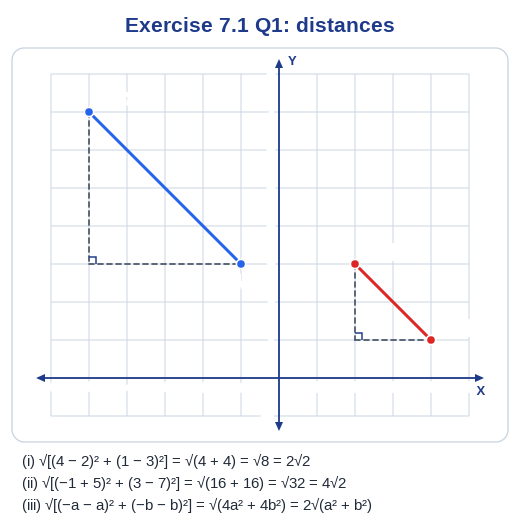
1. “Find the distance between the following pairs of points : (i) (2, 3), (4, 1) (ii) (−5, 7), (−1, 3) (iii) (a, b), (−a, −b)”
We use the distance formula: the distance between (x₁, y₁) and (x₂, y₂) is √[(x₂ − x₁)² + (y₂ − y₁)²].
(i) Distance = √[(4 − 2)² + (1 − 3)²] = √(4 + 4) = √8 = 2√2.
Answer: 2√2 units.
(ii) Distance = √[(−1 + 5)² + (3 − 7)²] = √(16 + 16) = √32 = 4√2.
Answer: 4√2 units.
(iii) Distance = √[(−a − a)² + (−b − b)²] = √(4a² + 4b²) = 2√(a² + b²).
Answer: 2√(a² + b²) units.
2. “Find the distance between the points (0, 0) and (36, 15). Can you now find the distance between the two towns A and B discussed in Section 7.2.”
- Distance = √[(36 − 0)² + (15 − 0)²] = √(1296 + 225) = √1521 = 39 units.
- For the towns, take town A as the origin and 1 km as one unit. Town B is 36 km east and 15 km north of A, so B is (36, 15).
- So the distance between the towns is the same 39, now in km. (The figure is with the page 100 question above.)
Answer: 39 units; yes, the towns A and B are 39 km apart.
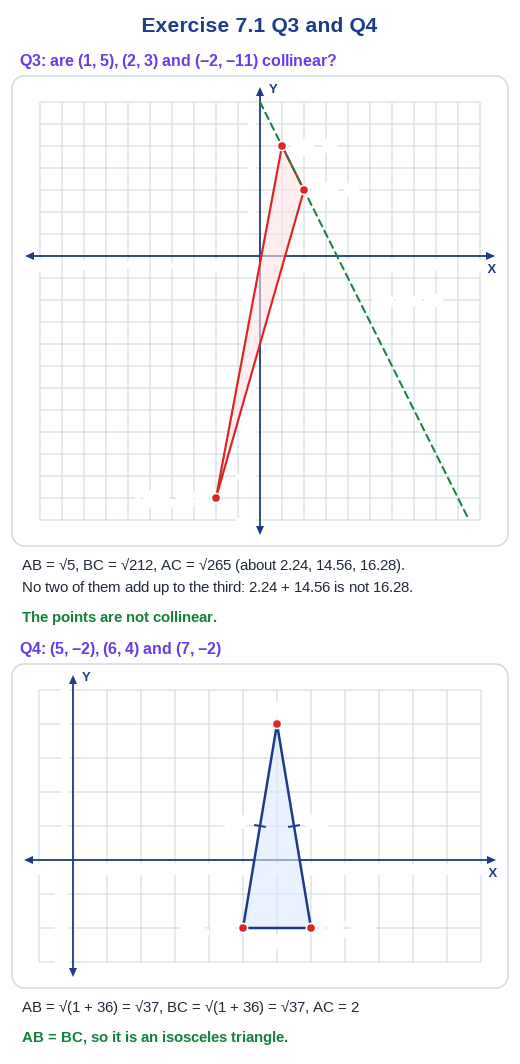
3. “Determine if the points (1, 5), (2, 3) and (−2, −11) are collinear.”
Given: A(1, 5), B(2, 3) and C(−2, −11).
To find: whether they are collinear (lie on one straight line).
Three points are collinear when the two smaller distances add up to the largest one.
- AB = √[(2 − 1)² + (3 − 5)²] = √(1 + 4) = √5, about 2.24.
- BC = √[(−2 − 2)² + (−11 − 3)²] = √(16 + 196) = √212, about 14.56.
- AC = √[(−2 − 1)² + (−11 − 5)²] = √(9 + 256) = √265, about 16.28.
- The largest is AC. AB + BC is about 16.80, which is not 16.28.
Answer: The points are not collinear.
4. “Check whether (5, −2), (6, 4) and (7, −2) are the vertices of an isosceles triangle.”
Given: A(5, −2), B(6, 4) and C(7, −2).
To find: whether triangle ABC is isosceles (has two equal sides).
- AB = √[(6 − 5)² + (4 + 2)²] = √(1 + 36) = √37.
- BC = √[(7 − 6)² + (−2 − 4)²] = √(1 + 36) = √37.
- AC = √[(7 − 5)² + (−2 + 2)²] = √4 = 2.
- AB + BC is greater than AC, so the points do form a triangle. Also AB = BC.
Answer: Yes, they are the vertices of an isosceles triangle (AB = BC = √37).
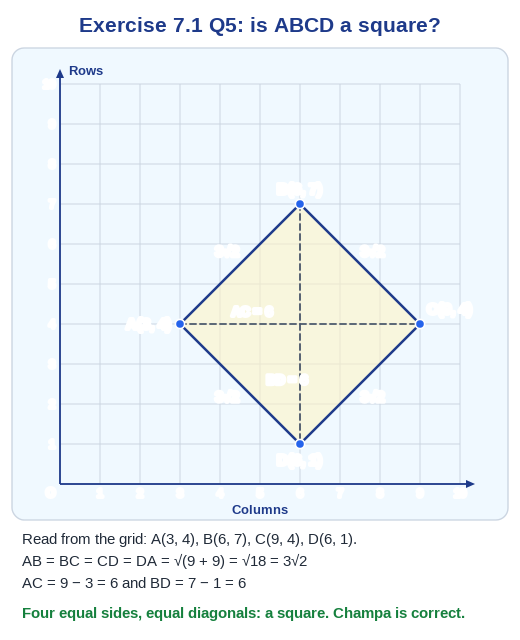
5. “In a classroom, 4 friends are seated at the points A, B, C and D as shown in Fig. 7.8. Champa and Chameli walk into the class and after observing for a few minutes Champa asks Chameli, ‘Don’t you think ABCD is a square?’ Chameli disagrees. Using distance formula, find which of them is correct.” (Fig. 7.8 is a grid of columns and rows numbered 0 to 10. Reading it, the friends sit at A(3, 4), B(6, 7), C(9, 4) and D(6, 1).)
Given: A(3, 4), B(6, 7), C(9, 4) and D(6, 1).
To find: whether ABCD is a square.
A quadrilateral is a square when all four sides are equal and both diagonals are equal.
- AB = √[(6 − 3)² + (7 − 4)²] = √(9 + 9) = √18 = 3√2.
- BC = √[(9 − 6)² + (4 − 7)²] = √18 = 3√2.
- CD = √[(6 − 9)² + (1 − 4)²] = √18 = 3√2.
- DA = √[(3 − 6)² + (4 − 1)²] = √18 = 3√2.
- AC = √[(9 − 3)² + (4 − 4)²] = 6 and BD = √[(6 − 6)² + (1 − 7)²] = 6.
All four sides are equal and both diagonals are equal, so ABCD is a square.
Answer: Champa is correct.
6. “Name the type of quadrilateral formed, if any, by the following points, and give reasons for your answer: (i) (−1, −2), (1, 0), (−1, 2), (−3, 0) (ii) (−3, 5), (3, 1), (0, 3), (−1, −4) (iii) (4, 5), (7, 6), (4, 3), (1, 2)”
To find: the type of quadrilateral, with reasons.
Call the points A, B, C and D in the order given. Find the four sides and the two diagonals (AC and BD).
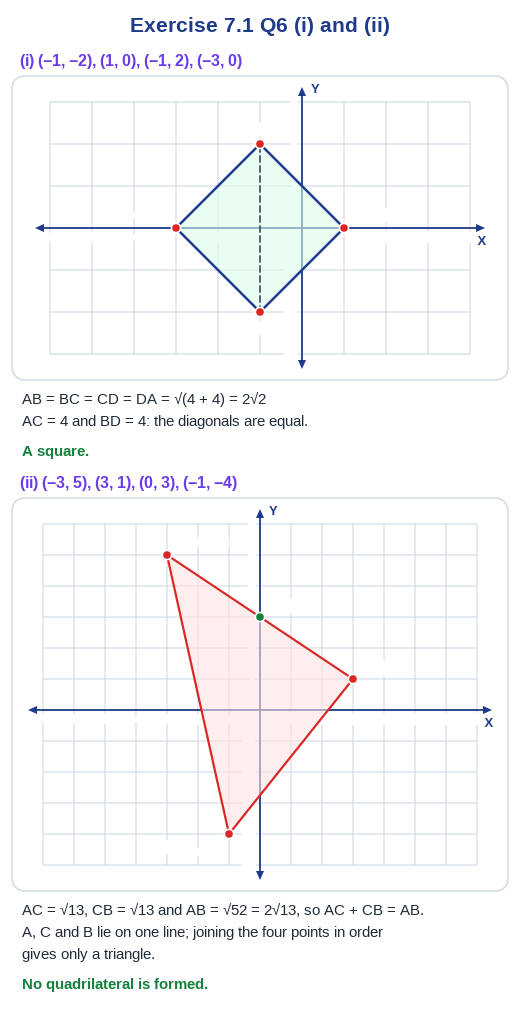
(i) A(−1, −2), B(1, 0), C(−1, 2), D(−3, 0).
- AB = √[(1 + 1)² + (0 + 2)²] = √8 = 2√2.
- BC = √[(−1 − 1)² + (2 − 0)²] = √8 = 2√2.
- CD = √[(−3 + 1)² + (0 − 2)²] = √8 = 2√2.
- DA = √[(−1 + 3)² + (−2 − 0)²] = √8 = 2√2.
- Diagonals: AC = √[0² + (2 + 2)²] = 4 and BD = √[(−3 − 1)² + 0²] = 4.
Answer: All four sides are equal and the diagonals are equal, so it is a square.
(ii) A(−3, 5), B(3, 1), C(0, 3), D(−1, −4).
- AB = √[(3 + 3)² + (1 − 5)²] = √52 = 2√13.
- BC = √[(0 − 3)² + (3 − 1)²] = √13.
- AC = √[(0 + 3)² + (3 − 5)²] = √13.
- So AC + CB = √13 + √13 = 2√13 = AB. This means A, C and B lie on one straight line (C is the mid-point of AB).
Answer: Three of the four points are on one line, so no quadrilateral is formed.
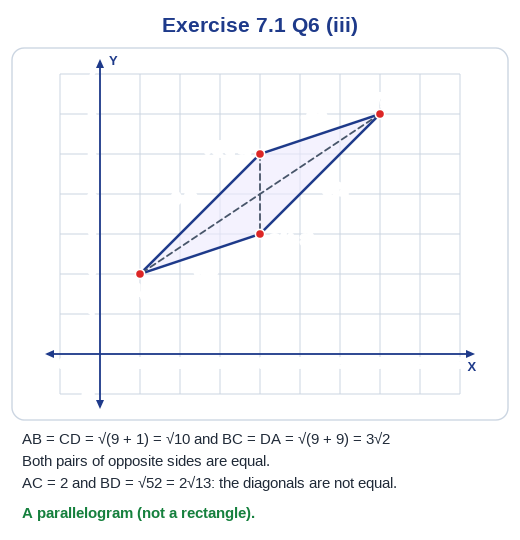
(iii) A(4, 5), B(7, 6), C(4, 3), D(1, 2).
- AB = √[(7 − 4)² + (6 − 5)²] = √10.
- BC = √[(4 − 7)² + (3 − 6)²] = √18 = 3√2.
- CD = √[(1 − 4)² + (2 − 3)²] = √10.
- DA = √[(4 − 1)² + (5 − 2)²] = √18 = 3√2.
- So AB = CD and BC = DA: both pairs of opposite sides are equal.
- Diagonals: AC = √[0² + (3 − 5)²] = 2 and BD = √[(1 − 7)² + (2 − 6)²] = √52 = 2√13. They are not equal, so it is not a rectangle.
Answer: Opposite sides are equal, so it is a parallelogram.
7. “Find the point on the x-axis which is equidistant from (2, −5) and (−2, 9).”
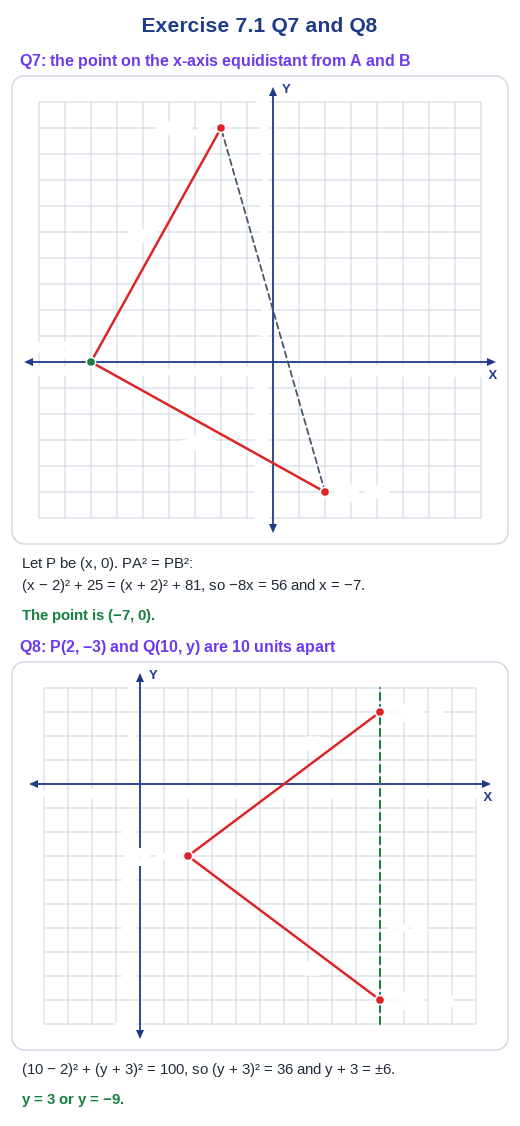
Given: A(2, −5) and B(−2, 9).
To find: the point P on the x-axis with PA = PB.
- Every point on the x-axis has y-coordinate 0. So let P be (x, 0).
- PA = PB, so PA² = PB² (squaring removes the square roots).
- (x − 2)² + (0 + 5)² = (x + 2)² + (0 − 9)².
- x² − 4x + 4 + 25 = x² + 4x + 4 + 81.
- −4x + 29 = 4x + 85, so −8x = 56 and x = −7.
- Check: PA² = 9² + 5² = 106 and PB² = 5² + 9² = 106. Equal.
Answer: The point is (−7, 0).
8. “Find the values of y for which the distance between the points P(2, −3) and Q(10, y) is 10 units.”
Given: P(2, −3), Q(10, y) and PQ = 10 units.
To find: y.
- PQ² = (10 − 2)² + (y + 3)² = 10².
- 64 + (y + 3)² = 100, so (y + 3)² = 36.
- A number whose square is 36 is 6 or −6. So y + 3 = 6 or y + 3 = −6.
Answer: y = 3 or y = −9.
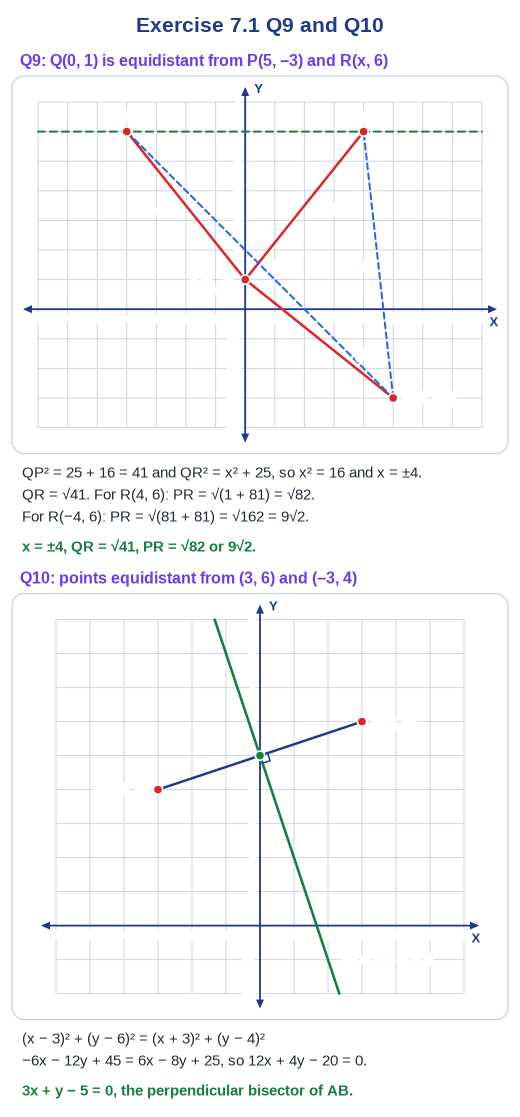
9. “If Q(0, 1) is equidistant from P(5, −3) and R(x, 6), find the values of x. Also find the distances QR and PR.”
Given: Q(0, 1), P(5, −3), R(x, 6) and QP = QR.
To find: x, QR and PR.
- QP² = (5 − 0)² + (−3 − 1)² = 25 + 16 = 41.
- QR² = (x − 0)² + (6 − 1)² = x² + 25.
- QP = QR, so x² + 25 = 41. Then x² = 16, so x = 4 or x = −4.
- QR = QP = √41 units in both cases.
- If x = 4, R is (4, 6) and PR = √[(4 − 5)² + (6 + 3)²] = √(1 + 81) = √82 units.
- If x = −4, R is (−4, 6) and PR = √[(−4 − 5)² + (6 + 3)²] = √(81 + 81) = √162 = 9√2 units.
Answer: x = ±4, QR = √41 units, and PR = √82 units (when x = 4) or 9√2 units (when x = −4).
10. “Find a relation between x and y such that the point (x, y) is equidistant from the point (3, 6) and (−3, 4).”
Given: P(x, y) is equidistant from A(3, 6) and B(−3, 4), that is, PA = PB.
To find: an equation connecting x and y.
- PA² = PB², so (x − 3)² + (y − 6)² = (x + 3)² + (y − 4)².
- x² − 6x + 9 + y² − 12y + 36 = x² + 6x + 9 + y² − 8y + 16.
- x² and y² cancel: −6x − 12y + 45 = 6x − 8y + 25.
- So 12x + 4y − 20 = 0. Divide by 4: 3x + y − 5 = 0.
Answer: 3x + y − 5 = 0 (or 3x + y = 5).
This line is the perpendicular bisector of the join of (3, 6) and (−3, 4); it passes through their mid-point (0, 5).
Questions inside the chapter: Section 7.3 (pages 106–107)
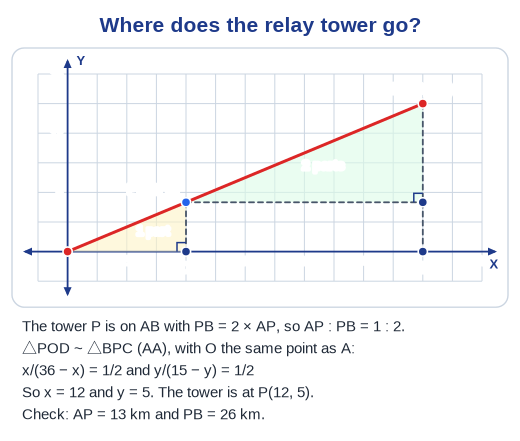
Page 106: the relay tower P is on AB with A at the origin and B(36, 15), and it is twice as far from B as from A. Find P, and check that OP : PB = 1 : 2. Let P be (x, y). Draw PD and BE perpendicular to the x-axis and PC perpendicular to BE. △POD ~ △BPC (AA), so OD/PC = OP/PB = 1/2 and PD/BC = 1/2. That is x/(36 − x) = 1/2 and y/(15 − y) = 1/2, which give x = 12 and y = 5. So P is (12, 5).
Check: OP = √(12² + 5²) = √169 = 13 and PB = √[(36 − 12)² + (15 − 5)²] = √(576 + 100) = √676 = 26. So OP : PB = 13 : 26 = 1 : 2.
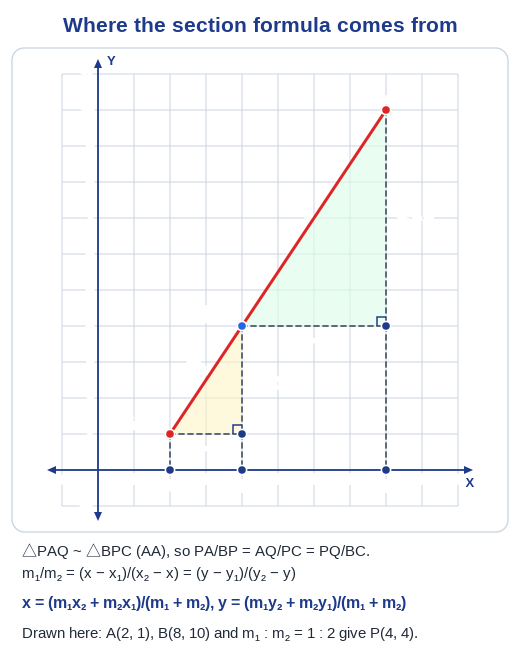
Page 107: how does the section formula follow from Fig. 7.10? With AR, PS and BT perpendicular to the x-axis and AQ and PC parallel to it, △PAQ ~ △BPC (AA). So m₁/m₂ = PA/BP = AQ/PC = PQ/BC, that is m₁/m₂ = (x − x₁)/(x₂ − x) = (y − y₁)/(y₂ − y). Solving the first equality for x gives x = (m₁x₂ + m₂x₁)/(m₁ + m₂), and the second gives y = (m₁y₂ + m₂y₁)/(m₁ + m₂).
Examples 6 to 10 (pages 108–110)
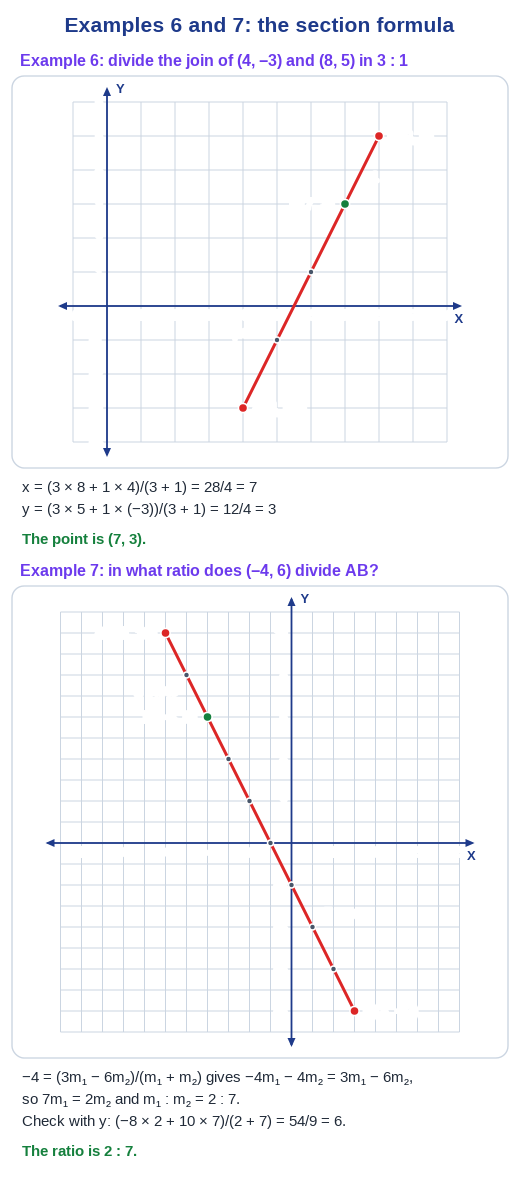
Example 6 (page 108): find the point that divides the join of (4, −3) and (8, 5) internally in the ratio 3 : 1.
x = (3 × 8 + 1 × 4)/(3 + 1) = 28/4 = 7 and y = (3 × 5 + 1 × (−3))/(3 + 1) = 12/4 = 3. The point is (7, 3).
Example 7 (pages 108–109): in what ratio does (−4, 6) divide the join of A(−6, 10) and B(3, −8)?
Let the ratio be m₁ : m₂.
- −4 = (3m₁ − 6m₂)/(m₁ + m₂), so −4m₁ − 4m₂ = 3m₁ − 6m₂.
- 7m₁ = 2m₂, so m₁ : m₂ = 2 : 7.
- The book asks you to verify the y-coordinate: (−8 × 2 + 10 × 7)/(2 + 7) = (−16 + 70)/9 = 54/9 = 6. It agrees.
With the ratio k : 1 instead: −4 = (3k − 6)/(k + 1) gives −4k − 4 = 3k − 6, so 7k = 2 and k = 2/7, the same ratio 2 : 7.
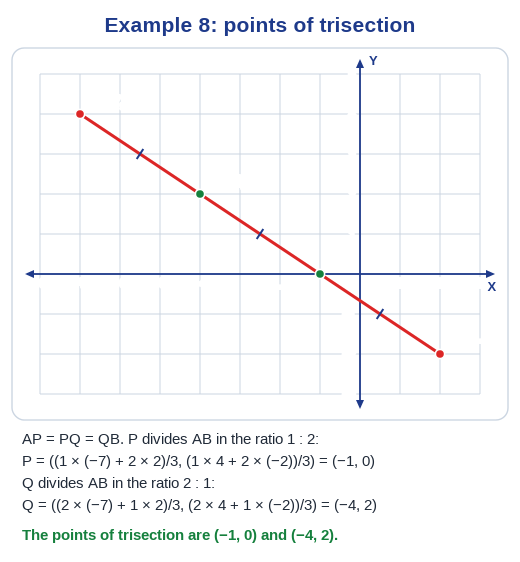
Example 8 (pages 109–110): find the points of trisection of the join of A(2, −2) and B(−7, 4).
Let P and Q be the points with AP = PQ = QB.
- P divides AB in the ratio 1 : 2. P = ((1 × (−7) + 2 × 2)/3, (1 × 4 + 2 × (−2))/3) = (−3/3, 0/3) = (−1, 0).
- Q divides AB in the ratio 2 : 1. Q = ((2 × (−7) + 1 × 2)/3, (2 × 4 + 1 × (−2))/3) = (−12/3, 6/3) = (−4, 2).
- The book’s note: Q is also the mid-point of PB, and ((−1 − 7)/2, (0 + 4)/2) = (−4, 2). It agrees.
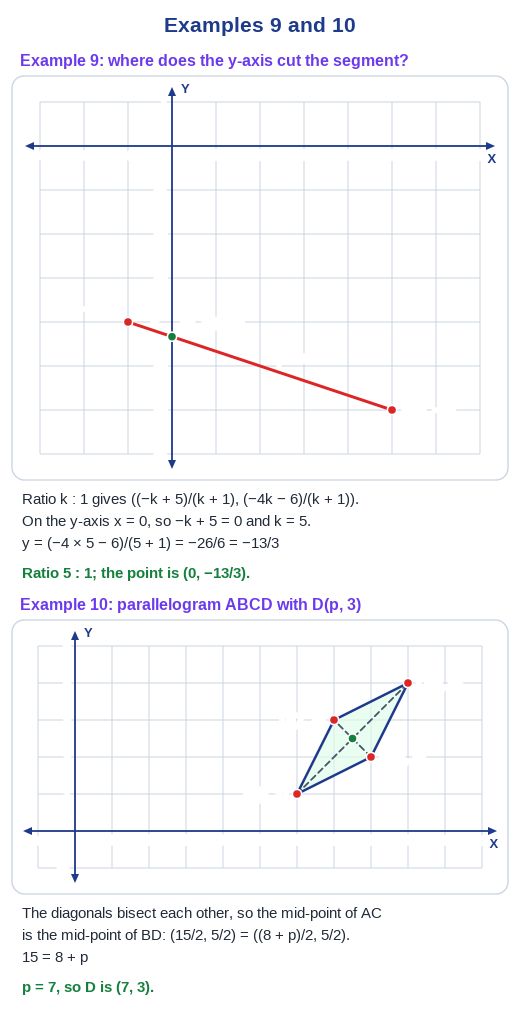
Example 9 (page 110): in what ratio does the y-axis divide the join of (5, −6) and (−1, −4)? Find the point of intersection.
- Let the ratio be k : 1. The point is ((−k + 5)/(k + 1), (−4k − 6)/(k + 1)).
- On the y-axis the x-coordinate is 0, so −k + 5 = 0 and k = 5. The ratio is 5 : 1.
- y = (−4 × 5 − 6)/(5 + 1) = −26/6 = −13/3. The point is (0, −13/3).
Example 10 (page 110): A(6, 1), B(8, 2), C(9, 4) and D(p, 3) are the vertices of a parallelogram in order. Find p.
- The diagonals of a parallelogram bisect each other, so the mid-point of AC is the mid-point of BD.
- Mid-point of AC = ((6 + 9)/2, (1 + 4)/2) = (15/2, 5/2).
- Mid-point of BD = ((8 + p)/2, (2 + 3)/2) = ((8 + p)/2, 5/2).
- So 15/2 = (8 + p)/2 and p = 7.
Exercise 7.2 (page 111)
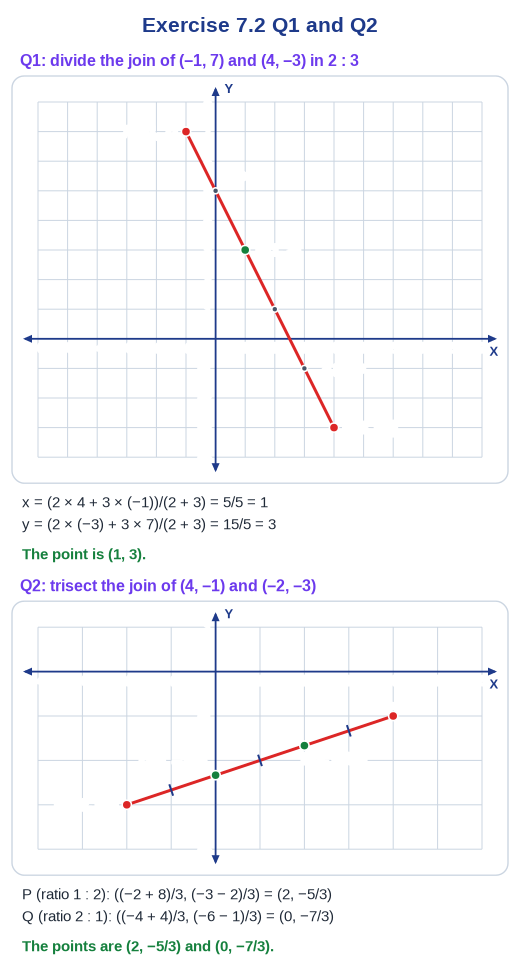
1. “Find the coordinates of the point which divides the join of (−1, 7) and (4, −3) in the ratio 2 : 3.”
Given: (x₁, y₁) = (−1, 7), (x₂, y₂) = (4, −3), and the ratio m₁ : m₂ = 2 : 3.
To find: the point P(x, y) that divides the join in this ratio.
Section formula: x = (m₁x₂ + m₂x₁)/(m₁ + m₂) and y = (m₁y₂ + m₂y₁)/(m₁ + m₂).
- x = (2 × 4 + 3 × (−1))/(2 + 3) = (8 − 3)/5 = 1.
- y = (2 × (−3) + 3 × 7)/(2 + 3) = (−6 + 21)/5 = 3.
Answer: The point is (1, 3).
2. “Find the coordinates of the points of trisection of the line segment joining (4, −1) and (−2, −3).”
Given: A(4, −1) and B(−2, −3).
To find: the points of trisection P and Q. These are the two points that cut AB into three equal parts, so AP = PQ = QB.
- AP is one part and PB is two parts, so P divides AB in the ratio 1 : 2. P = ((1 × (−2) + 2 × 4)/3, (1 × (−3) + 2 × (−1))/3) = (6/3, −5/3) = (2, −5/3).
- AQ is two parts and QB is one part, so Q divides AB in the ratio 2 : 1. Q = ((2 × (−2) + 1 × 4)/3, (2 × (−3) + 1 × (−1))/3) = (0/3, −7/3) = (0, −7/3).
Answer: The points of trisection are (2, −5/3) and (0, −7/3).
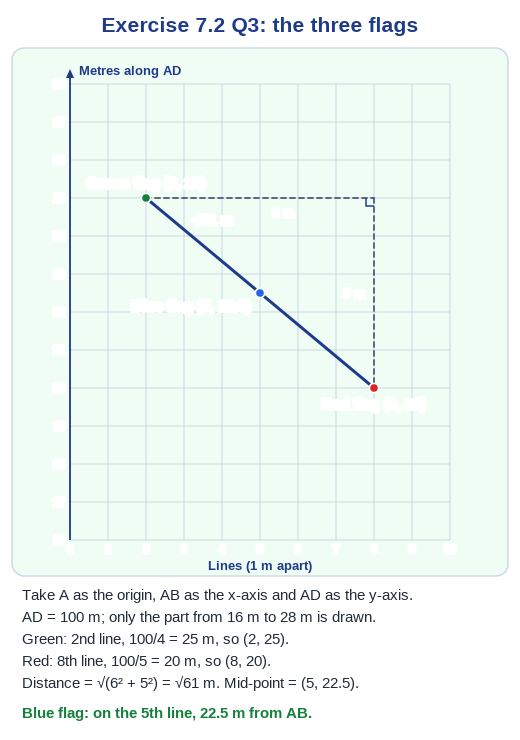
3. “To conduct Sports Day activities, in your rectangular shaped school ground ABCD, lines have been drawn with chalk powder at a distance of 1m each. 100 flower pots have been placed at a distance of 1m from each other along AD, as shown in Fig. 7.12. Niharika runs 1/4 th the distance AD on the 2nd line and posts a green flag. Preet runs 1/5 th the distance AD on the eighth line and posts a red flag. What is the distance between both the flags? If Rashmi has to post a blue flag exactly halfway between the line segment joining the two flags, where should she post her flag?” (In Fig. 7.12, A is the bottom-left corner of the ground. The chalk lines run parallel to AD and are numbered 1 to 10 along AB, and the pots stand along AD.)
Given: AD = 100 m (100 pots, 1 m apart). The green flag is on the 2nd line at 1/4 of AD; the red flag is on the 8th line at 1/5 of AD.
To find: the distance between the flags, and the place for the blue flag halfway between them.
Take A as the origin, AB as the x-axis and AD as the y-axis, with 1 m as one unit.
- Niharika is on the 2nd line (x = 2) and runs 1/4 × 100 = 25 m. The green flag is at G(2, 25).
- Preet is on the 8th line (x = 8) and runs 1/5 × 100 = 20 m. The red flag is at R(8, 20).
- GR = √[(8 − 2)² + (20 − 25)²] = √(36 + 25) = √61 m (about 7.81 m).
- The blue flag goes at the mid-point of GR: ((2 + 8)/2, (25 + 20)/2) = (5, 22.5).
Answer: The flags are √61 m apart. Rashmi should post the blue flag on the 5th line, 22.5 m from AB (measured along the line, in the direction of AD).
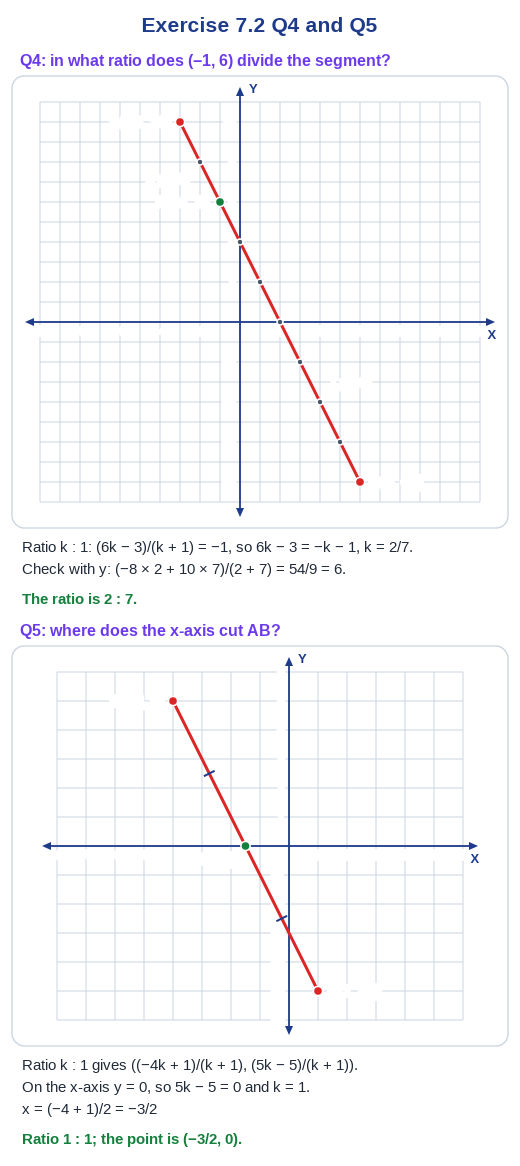
4. “Find the ratio in which the line segment joining the points (−3, 10) and (6, −8) is divided by (−1, 6).”
Given: A(−3, 10), B(6, −8) and the point P(−1, 6) on AB.
To find: the ratio AP : PB.
- Let the ratio be k : 1. By the section formula, the x-coordinate of P is (6k − 3)/(k + 1).
- So (6k − 3)/(k + 1) = −1, which gives 6k − 3 = −k − 1.
- 7k = 2, so k = 2/7. The ratio is 2/7 : 1 = 2 : 7.
- Check with y: (2 × (−8) + 7 × 10)/(2 + 7) = 54/9 = 6. It agrees.
Answer: The ratio is 2 : 7.
5. “Find the ratio in which the line segment joining A(1, −5) and B(−4, 5) is divided by the x-axis. Also find the coordinates of the point of division.”
Given: A(1, −5) and B(−4, 5).
To find: the ratio in which the x-axis divides AB, and the point of division.
- Let the ratio be k : 1. The point is ((−4k + 1)/(k + 1), (5k − 5)/(k + 1)).
- A point on the x-axis has y-coordinate 0. So 5k − 5 = 0, and k = 1.
- x = (−4 × 1 + 1)/(1 + 1) = −3/2.
Answer: The ratio is 1 : 1, and the point of division is (−3/2, 0).
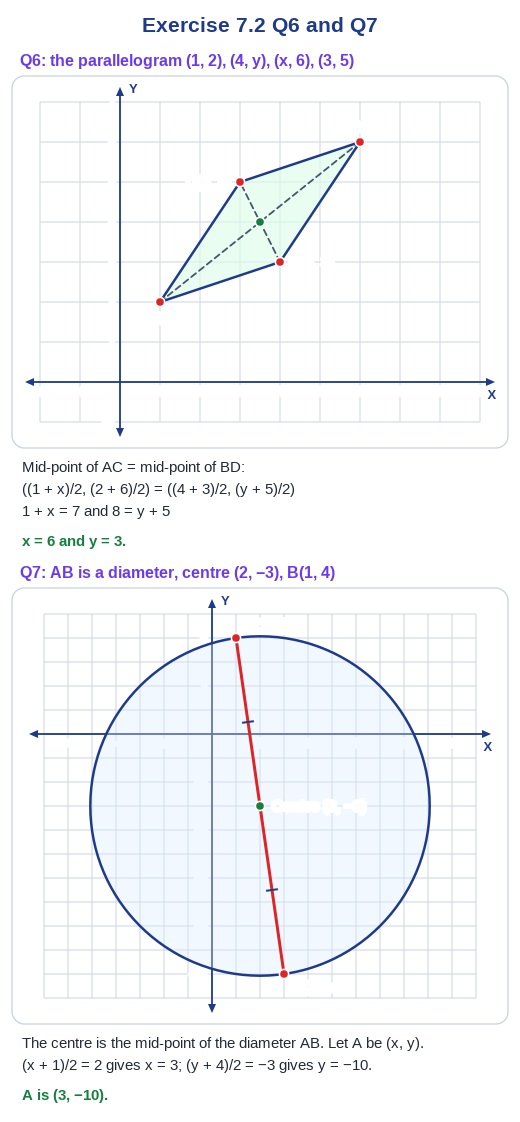
6. “If (1, 2), (4, y), (x, 6) and (3, 5) are the vertices of a parallelogram taken in order, find x and y.”
Given: A(1, 2), B(4, y), C(x, 6) and D(3, 5) form a parallelogram ABCD.
To find: x and y.
The diagonals of a parallelogram bisect each other, so AC and BD have the same mid-point.
- Mid-point of AC = ((1 + x)/2, (2 + 6)/2) = ((1 + x)/2, 4).
- Mid-point of BD = ((4 + 3)/2, (y + 5)/2) = (7/2, (y + 5)/2).
- Compare x-coordinates: (1 + x)/2 = 7/2, so 1 + x = 7 and x = 6.
- Compare y-coordinates: (y + 5)/2 = 4, so y + 5 = 8 and y = 3.
Answer: x = 6 and y = 3.
7. “Find the coordinates of a point A, where AB is the diameter of a circle whose centre is (2, −3) and B is (1, 4).”
Given: centre O(2, −3), B(1, 4), and AB is a diameter.
To find: A.
The centre of a circle is the mid-point of every diameter. Let A be (x, y).
- (x + 1)/2 = 2, so x + 1 = 4 and x = 3.
- (y + 4)/2 = −3, so y + 4 = −6 and y = −10.
Answer: A is (3, −10).
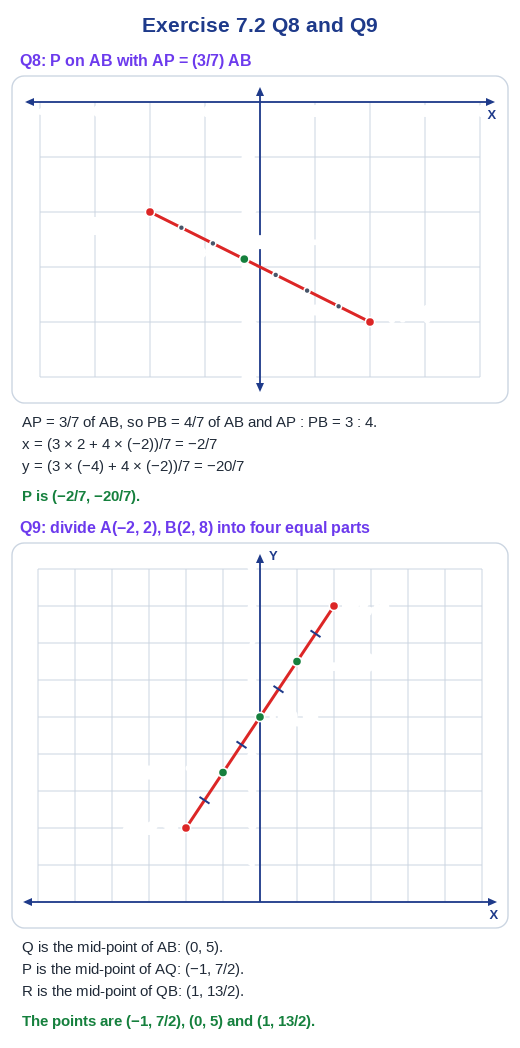
8. “If A and B are (−2, −2) and (2, −4), respectively, find the coordinates of P such that AP = 3/7 AB and P lies on the line segment AB.”
Given: A(−2, −2), B(2, −4), P on AB with AP = 3/7 AB.
To find: P.
- AP = 3/7 of AB, so PB = AB − AP = 4/7 of AB.
- So AP : PB = 3 : 4. P divides AB in the ratio 3 : 4.
- x = (3 × 2 + 4 × (−2))/(3 + 4) = (6 − 8)/7 = −2/7.
- y = (3 × (−4) + 4 × (−2))/(3 + 4) = (−12 − 8)/7 = −20/7.
Answer: P is (−2/7, −20/7).
9. “Find the coordinates of the points which divide the line segment joining A(−2, 2) and B(2, 8) into four equal parts.”
Given: A(−2, 2) and B(2, 8).
To find: the points P, Q and R with AP = PQ = QR = RB.
- Q is the mid-point of AB: ((−2 + 2)/2, (2 + 8)/2) = (0, 5).
- P is the mid-point of AQ: ((−2 + 0)/2, (2 + 5)/2) = (−1, 7/2).
- R is the mid-point of QB: ((0 + 2)/2, (5 + 8)/2) = (1, 13/2).
Answer: The points are (−1, 7/2), (0, 5) and (1, 13/2).
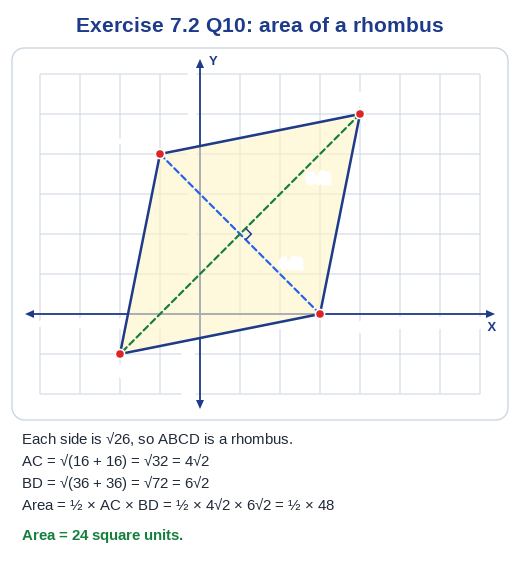
10. “Find the area of a rhombus if its vertices are (3, 0), (4, 5), (−1, 4) and (−2, −1) taken in order. [Hint : Area of a rhombus = 1/2 (product of its diagonals)]”
Given: the rhombus ABCD with A(3, 0), B(4, 5), C(−1, 4) and D(−2, −1).
To find: its area.
- The diagonals are AC and BD. AC = √[(−1 − 3)² + (4 − 0)²] = √(16 + 16) = √32 = 4√2.
- BD = √[(−2 − 4)² + (−1 − 5)²] = √(36 + 36) = √72 = 6√2.
- Area = 1/2 × AC × BD = 1/2 × 4√2 × 6√2 = 1/2 × 48 = 24.
Answer: The area is 24 square units.
A note on what the chapter leaves out
The chapter ends with a summary (Section 7.4) and a note to the reader: when P lies on the line AB but outside the segment, it divides AB externally, and that formula is studied in higher classes. The current book has no section on the area of a triangle in this chapter. For more on the two formulas, see the distance formula and section formula pages.
Practice
-
The distance between (2, 3) and (7, 8) is:
Show answer
Answer: (b) 5√2 units
-
The mid-point of the join of (4, 1) and (0, 7) is:
Show answer
Answer: (a) (2, 4)
-
The point dividing the join of (2, 3) and (7, 8) internally in the ratio 2 : 3 is:
Show answer
Answer: (d) (4, 5)
-
Find the point that divides the join of (2, 5) and (8, −1) internally in the ratio 1 : 2.
Show answer
Answer: x = (1 × 8 + 2 × 2)/(1 + 2) = 12/3 = 4 and y = (1 × (−1) + 2 × 5)/(1 + 2) = 9/3 = 3. The point is (4, 3).
-
The centre of a circle is (2, 4) and one end of a diameter is (4, 1). Find the other end.
Show answer
Answer: Let the other end be (x, y). The centre is the mid-point of the diameter, so (4 + x)/2 = 2 and (1 + y)/2 = 4. So x = 0 and y = 7. The other end is (0, 7).
Stuck on a question?
Take a photo and Lagnever AI explains it step by step. Try it for 7 days for ₹2.
Get it on Google Play Open in browser
For parents: after the trial, the plan renews monthly by UPI or card autopay. You can cancel anytime in the app.