
Class 10 Maths Chapter 7: Coordinate Geometry Notes
This chapter in five lines
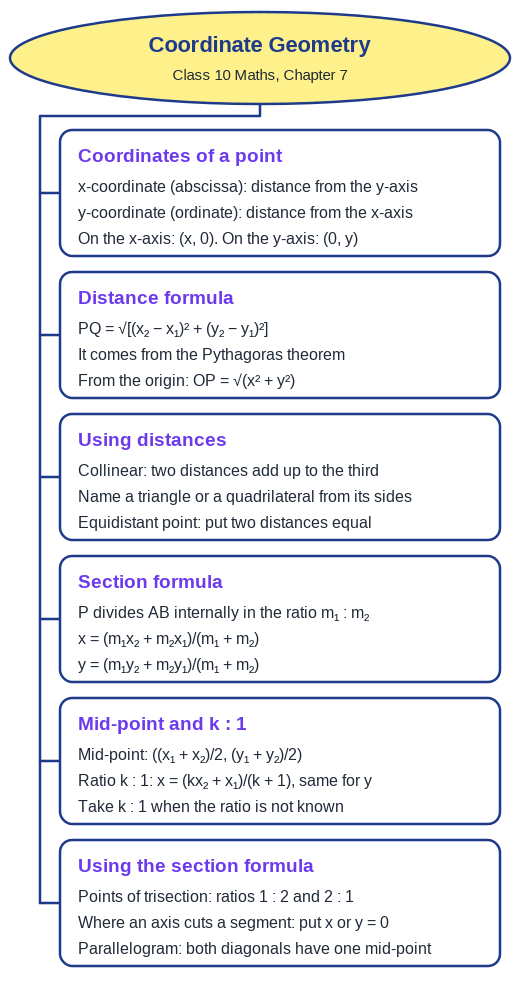
Coordinate geometry studies figures with the help of coordinates and algebra. This chapter gives two formulas. The distance formula finds the distance between P(x₁, y₁) and Q(x₂, y₂) as √[(x₂ − x₁)² + (y₂ − y₁)²]. The section formula finds the point that divides the join of two points internally in a given ratio; the mid-point formula is its special case for the ratio 1 : 1.
What is this chapter about?
In Class 9 you learnt to locate a point on a plane with a pair of coordinate axes. This 14-page chapter uses those coordinates to answer two questions with algebra alone, without measuring anything:
- How far apart are two points whose coordinates are known?
- Which point divides the line segment joining two points in a given ratio?
The answers are the distance formula and the section formula. The book points out that coordinate geometry lets us study geometry with algebra, and algebra with geometry, and that it is used in fields such as physics, engineering, navigation, seismology and art.
What should you recall about coordinates?
The distance of a point from the y-axis is its x-coordinate, or abscissa. Its distance from the x-axis is its y-coordinate, or ordinate. Every point on the x-axis looks like (x, 0), and every point on the y-axis looks like (0, y).
Two graphs from earlier chapters are also worth remembering. A linear equation ax + by + c = 0 gives a straight line (see the graphical method), and y = ax² + bx + c gives a parabola (see Polynomials).
How do you find the distance between two points?
If both points lie on the x-axis, subtract their x-coordinates. For A(4, 0) and B(6, 0), AB = 6 − 4 = 2 units. If both lie on the y-axis, subtract their y-coordinates. For a point on each axis, the two axes and the segment form a right triangle, so the Pythagoras theorem gives the distance.
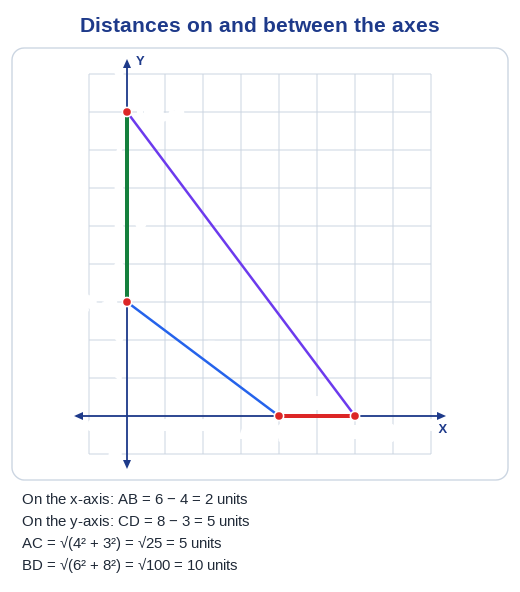
The same idea works for any two points. Draw a horizontal line through one point and a vertical line through the other. They meet at a right angle, and the two points are the ends of the hypotenuse.
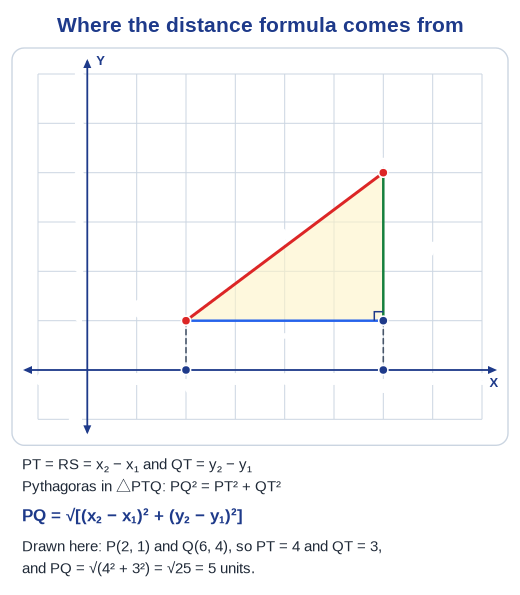
Distance formula: the distance between P(x₁, y₁) and Q(x₂, y₂) is
PQ = √[(x₂ − x₁)² + (y₂ − y₁)²]
The distance of P(x, y) from the origin is OP = √(x² + y²). The proof and more examples are on the distance formula page.
What can distances tell you?
Once you can find distances, you can test many things without drawing:
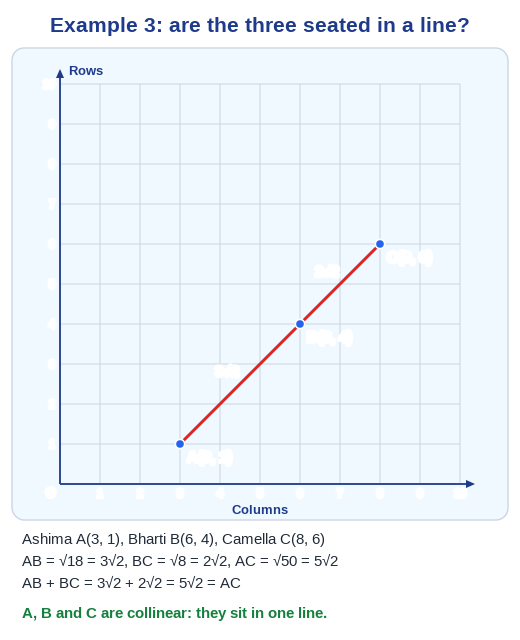
- Collinear or not. Three points lie on one line when the two smaller distances add up to the largest. In Example 3 of the book, three students sit at A(3, 1), B(6, 4) and C(8, 6). Here AB = 3√2, BC = 2√2 and AC = 5√2, so AB + BC = AC and they sit in a line.
- The type of triangle. Two equal sides make it isosceles. If the square of one side equals the sum of the squares of the other two, it is right-angled.
- The type of quadrilateral. Four equal sides and equal diagonals make a square. Opposite sides equal but diagonals unequal make a parallelogram that is not a rectangle.
- Equidistant points. Put PA² = PB² and simplify to find a point at the same distance from A and B.
What is the section formula?
Suppose town B is 36 km east and 15 km north of town A, and a relay tower P must stand on AB so that it is twice as far from B as from A. Then P divides AB in the ratio 1 : 2. With A as the origin, B is (36, 15), and similar triangles give P(12, 5).
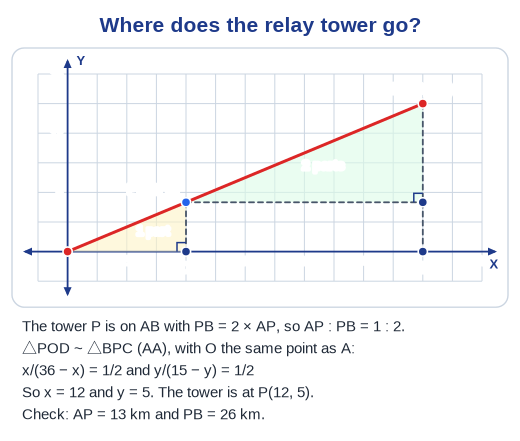
The same reasoning with any two points gives the general result.
Section formula: the point P(x, y) that divides the line segment joining A(x₁, y₁) and B(x₂, y₂) internally in the ratio m₁ : m₂ is
x = (m₁x₂ + m₂x₁)/(m₁ + m₂), y = (m₁y₂ + m₂y₁)/(m₁ + m₂)
Here PA : PB = m₁ : m₂. Notice the cross pattern: m₁ goes with the coordinates of B, and m₂ with the coordinates of A.
Two special forms are used all the time:
- Mid-point (ratio 1 : 1): ((x₁ + x₂)/2, (y₁ + y₂)/2).
- Ratio k : 1: ((kx₂ + x₁)/(k + 1), (ky₂ + y₁)/(k + 1)). This form has only one unknown, so it is handy when the ratio itself has to be found.
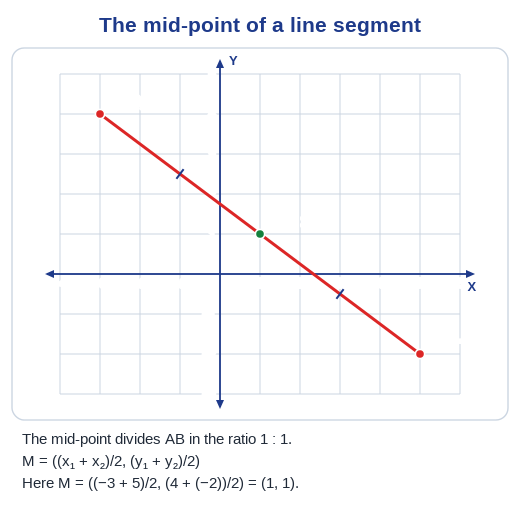
The derivation and worked examples are on the section formula page.
How is the section formula used?
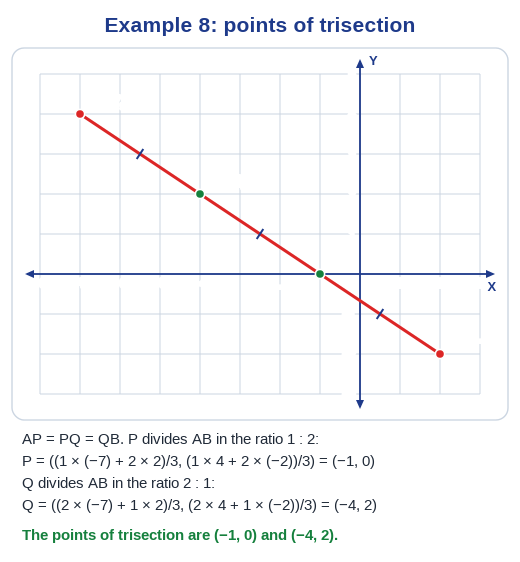
- To find a point that divides a segment in a given ratio, such as the points of trisection (ratios 1 : 2 and 2 : 1).
- To find a ratio. Take the ratio as k : 1, write the point, and compare it with the given point. To find where an axis cuts a segment, put x = 0 (for the y-axis) or y = 0 (for the x-axis).
- With parallelograms. The diagonals bisect each other, so the mid-point of one diagonal is the mid-point of the other. This gives a missing vertex.
- With circles. The centre is the mid-point of every diameter.
Before we move on
The distance formula rests on the Pythagoras theorem, which Class 8 met as the Baudhayana-Pythagoras theorem. The section formula rests on the AA criterion for similarity from Chapter 6. The current book has no section on the area of a triangle in this chapter, and it leaves external division to higher classes. Every example and both exercises are worked out in the NCERT solutions for Chapter 7.
Key terms
| Term | Meaning |
|---|---|
| Coordinate axes | Two perpendicular number lines, the x-axis and the y-axis, used to fix the position of a point on a plane. |
| x-coordinate (abscissa) | The distance of a point from the y-axis. |
| y-coordinate (ordinate) | The distance of a point from the x-axis. |
| Origin | The point O(0, 0), where the two axes meet. |
| Distance formula | The distance between P(x₁, y₁) and Q(x₂, y₂) is PQ = √[(x₂ − x₁)² + (y₂ − y₁)²]. |
| Collinear points | Points that lie on one straight line. For three such points, the two shorter distances add up to the longest one. |
| Equidistant | At the same distance. A point equidistant from A and B lies on the perpendicular bisector of AB. |
| Internal division | A point P on the segment AB, between A and B, divides AB internally in the ratio PA : PB. |
| Section formula | The point dividing the join of A(x₁, y₁) and B(x₂, y₂) internally in the ratio m₁ : m₂ is ((m₁x₂ + m₂x₁)/(m₁ + m₂), (m₁y₂ + m₂y₁)/(m₁ + m₂)). |
| Mid-point formula | The mid-point of the join of (x₁, y₁) and (x₂, y₂) is ((x₁ + x₂)/2, (y₁ + y₂)/2). |
| Points of trisection | The two points that divide a line segment into three equal parts. They divide it in the ratios 1 : 2 and 2 : 1. |
Topics in this chapter
Practice
-
The distance between the points (1, 2) and (4, 6) is:
Show answer
Answer: (b) 5 units
-
The distance of the point (−6, 8) from the origin is:
Show answer
Answer: (c) 10 units
-
The mid-point of the line segment joining (2, −3) and (6, 5) is:
Show answer
Answer: (a) (4, 1)
-
The point that divides the join of (1, 1) and (7, 4) internally in the ratio 2 : 1 is:
Show answer
Answer: (c) (5, 3)
-
A point on the y-axis always has the form:
Show answer
Answer: (b) (0, y)
Questions students ask
What are the main topics of Class 10 Maths Chapter 7?
Two formulas and their uses: the distance formula (Section 7.2) and the section formula with its special case, the mid-point formula (Section 7.3). Exercise 7.1 has 10 questions on distances and Exercise 7.2 has 10 questions on the section formula.
Is the area of a triangle from coordinates in the 2026-27 book?
No. The rationalised book (marked Reprint 2026-27) has only four sections in this chapter: Introduction, Distance Formula, Section Formula and Summary, with Exercises 7.1 and 7.2. It has no section or exercise on the area of a triangle. Question 10 of Exercise 7.2 asks for the area of a rhombus, and that is found from its diagonals.
Is external division in the Class 10 syllabus?
No. The chapter deals only with internal division, where P lies between A and B. A note at the end of the chapter says that the formula for a point outside the segment (external division) is studied in higher classes.
How do I show that three points are collinear using the distance formula?
Find the three distances between the points. If the two smaller distances add up exactly to the largest one, the points lie on one line. If the sum of any two is greater than the third, the points form a triangle.
Stuck on a question?
Take a photo and Lagnever AI explains it step by step. Try it for 7 days for ₹2.
Get it on Google Play Open in browser
For parents: after the trial, the plan renews monthly by UPI or card autopay. You can cancel anytime in the app.