
What is Ohm’s law, and what does resistance depend on?
Answer in short
Ohm’s law says that the potential difference across a metal wire is directly proportional to the current through it, if its temperature stays the same: V = IR. The resistance R grows with the length of the wire, falls as the wire gets thicker, and depends on the material: R = ρl/A.
Stuck on a question? Take a photo and Lagnever AI explains it step by step. Try it for 7 days for ₹2. Get it on Google Play
How is Ohm’s law found?
In Activity 11.1 a nichrome wire XY, about 0.5 m long, is joined to a cell through an ammeter and a plug key, with a voltmeter connected across X and Y. You note the current I and the potential difference V, then repeat with two, three and four cells of 1.5 V. Each time both readings go up, but the ratio V/I stays nearly the same. Plotted on a graph, V against I gives a straight line through the origin.
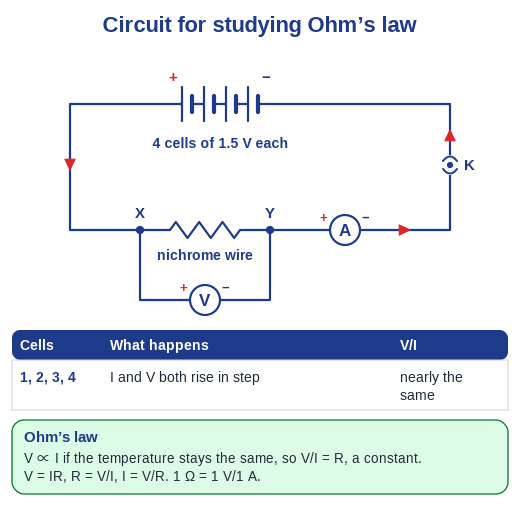
Georg Simon Ohm stated this in 1827. Ohm’s law: the potential difference V across the ends of a metallic wire is directly proportional to the current I flowing through it, provided its temperature remains the same:
V ∝ I, so V/I = R, or V = IR.
The constant R is the resistance of the wire at that temperature. Rearranged, R = V/I and I = V/R.
What does the V–I graph tell us?
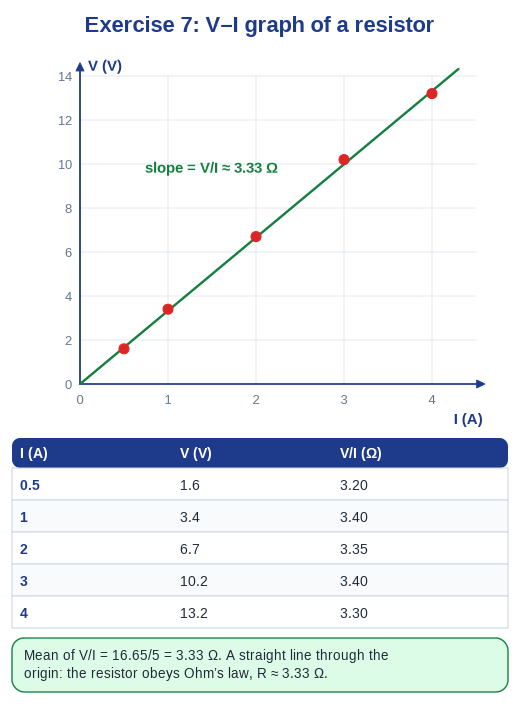
The slope of a V–I graph is V/I, which is the resistance. Exercise 7 of the chapter gives real readings for a resistor: as I goes 0.5, 1.0, 2.0, 3.0 and 4.0 A, V goes 1.6, 3.4, 6.7, 10.2 and 13.2 V. The points lie close to a straight line through the origin, and V/I averages 3.33 Ω.
What is the unit of resistance?
The SI unit of resistance is the ohm, written Ω. A conductor has a resistance of 1 Ω if a potential difference of 1 V across it drives a current of 1 A: 1 Ω = 1 V/1 A.
From I = V/R, the current through a resistor is inversely proportional to its resistance: double the resistance and the current halves. Two examples from the chapter:
- Example 11.3: on a 220 V supply, a bulb filament of 1200 Ω draws I = 220/1200 = 0.18 A, while a heater coil of 100 Ω draws 2.2 A. The same source gives very different currents.
- Example 11.4: a heater draws 4 A at 60 V, so R = 60/4 = 15 Ω. At 120 V it draws 120/15 = 8 A.
To change the current without changing the source, we use a variable resistance, usually a rheostat.
Why do different things carry different currents?
In Activity 11.2 the gap XY in a circuit of four 1.5 V cells and an ammeter is filled in turn by a nichrome wire, a torch bulb and a 10 W bulb. The ammeter reading is different each time. Electrons moving in a conductor are held back by the attraction of the atoms among which they move, so every conductor opposes the current a little. A component of a given size with low resistance is a good conductor; one with an appreciable resistance is a resistor; a poor conductor has higher resistance, and an insulator of the same size has even more.
What does the resistance of a wire depend on?
Activity 11.3 compares four wires joined to the same cell: a nichrome wire of length l, one of length 2l, a thicker nichrome wire of length l, and a copper wire of the same size as the first. The results:
- doubling the length halves the current, so R ∝ l;
- a thicker wire (larger area of cross-section A) carries more current, so R ∝ 1/A;
- a wire of a different material gives a different current.
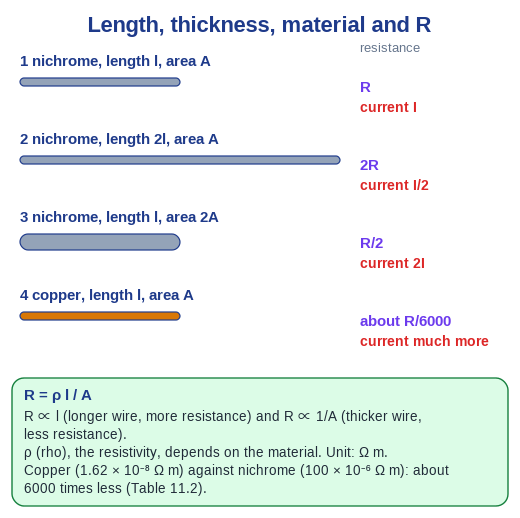
Combining these, R = ρ l/A, where ρ (rho) is the electrical resistivity of the material. Its SI unit is the ohm metre (Ω m). It is a property of the material, though, like resistance, it changes with temperature.
What does Table 11.2 show?
Table 11.2 lists resistivities at 20 °C. Metals have very low values: silver 1.60 × 10⁻⁸, copper 1.62 × 10⁻⁸, aluminium 2.63 × 10⁻⁸ and tungsten 5.20 × 10⁻⁸ Ω m. Alloys are much higher: manganin 44 × 10⁻⁶, constantan 49 × 10⁻⁶ and nichrome 100 × 10⁻⁶ Ω m. Insulators like glass, rubber and ebonite lie between about 10¹⁰ and 10¹⁷ Ω m. You need not memorise these values, only use them.
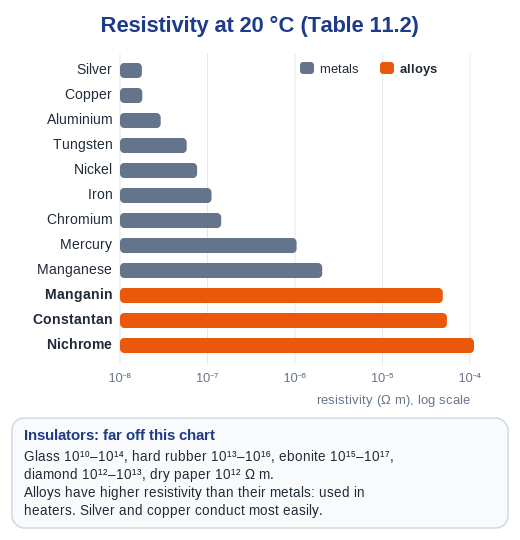
So alloys, which also do not oxidise easily when hot, are used in electric irons and toasters; tungsten for bulb filaments; and copper and aluminium for transmission lines.
In Example 11.5, a metal wire 1 m long and 0.3 mm in diameter has a resistance of 26 Ω. Then ρ = RA/l = Rπd²/(4l) = 26 × 3.14 × (3 × 10⁻⁴)² / 4 = 1.84 × 10⁻⁶ Ω m, which Table 11.2 shows is manganese.
Next, see how resistors combine in resistors in series and parallel. All numericals are in the NCERT solutions for Chapter 11. Go back to the Chapter 11 notes.
Practice
-
A heater draws 4 A at 60 V. Its resistance is:
Show answer
Answer: (b) 15 Ω
-
The potential difference across a resistor is halved. The current through it:
Show answer
Answer: (c) halves
-
Which material in Table 11.2 conducts electricity most easily?
Show answer
Answer: (b) silver
-
A wire of resistance 4 Ω is replaced by one of the same material with half the length and twice the area. What is the new resistance?
Show answer
Answer: R = ρl/A. Halving l halves R, and doubling A halves it again: 4 × ½ × ½ = 1 Ω. This is Example 11.6 of the chapter.
-
Why is a voltmeter joined across the wire, but an ammeter joined in line with it?
Show answer
Answer: The voltmeter measures the potential difference between the two ends of the wire, so it must be connected to both ends, in parallel. The ammeter measures the current through the wire, so the same current must pass through it: it goes in series.
Questions students ask
Does every conductor obey Ohm’s law?
The chapter states the law for a metallic wire whose temperature stays the same. If the wire heats up, its resistance changes, because resistance and resistivity vary with temperature. That is why the key is taken out after each reading in the activities.
What is the difference between resistance and resistivity?
Resistance R belongs to a particular piece of wire and depends on its length and thickness as well as its material. Resistivity ρ belongs to the material alone: every copper wire at 20 °C has the same ρ, 1.62 × 10⁻⁸ Ω m.
Why are heating coils made of alloys like nichrome?
Alloys have a much higher resistivity than pure metals and do not oxidise (burn) easily at high temperatures, so a coil of an alloy gets very hot and lasts long.
What does a rheostat do?
It is a variable resistance. Changing its resistance changes the current in the circuit without changing the cell or battery.
Stuck on a question?
Take a photo and Lagnever AI explains it step by step. Try it for 7 days for ₹2.
Get it on Google Play Open in browser
For parents: after the trial, the plan renews monthly by UPI or card autopay. You can cancel anytime in the app.