
How do resistors combine in series and in parallel?
Answer in short
In series the resistors are joined end to end: the same current flows through each, the voltages add, and Rs = R1 + R2 + R3. In parallel they are joined between the same two points: each gets the same voltage, the currents add, and 1/Rp = 1/R1 + 1/R2 + 1/R3.
Stuck on a question? Take a photo and Lagnever AI explains it step by step. Try it for 7 days for ₹2. Get it on Google Play
What are the two ways of joining resistors?
Electrical gadgets often use several resistors together. There are two basic ways to join them. In series, the resistors are joined end to end in one line, so a single path runs through all of them (Figure 11.6 of the chapter). In parallel, they are all joined between the same two points X and Y, so the current has several paths (Figure 11.7). Ohm’s law, V = IR, applied to each resistor and to the whole combination, gives the rules for both.
What happens to the current in series?
In Activity 11.4, three resistors (for example 1 Ω, 2 Ω and 3 Ω) are joined in series with a 6 V battery, an ammeter and a plug key. Moving the ammeter to any position between the resistors gives the same reading. In a series combination, the same current flows through every part of the circuit.
What happens to the voltage in series?
In Activity 11.5, a voltmeter measures the potential difference V across the whole combination XY and then V1, V2 and V3 across each resistor in turn. The total equals the sum of the parts:
V = V1 + V2 + V3.
Applying Ohm’s law, V1 = IR1, V2 = IR2, V3 = IR3 and V = IRs, where Rs is the single resistor that could replace all three. Then IRs = IR1 + IR2 + IR3, so
Rs = R1 + R2 + R3.
The series resistance is the sum of the individual resistances and is greater than any one of them.
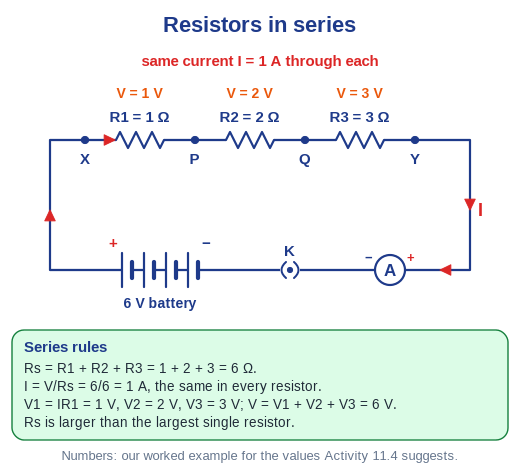
With the values suggested for Activity 11.4 (our worked example): Rs = 1 + 2 + 3 = 6 Ω, so I = 6/6 = 1 A, and the three voltages are 1 V, 2 V and 3 V, adding up to 6 V.
Example 11.7: a 20 Ω lamp and a 4 Ω conductor in series on 6 V. Rs = 24 Ω, I = 6/24 = 0.25 A, the lamp has 5 V across it and the conductor 1 V. A single 24 Ω resistor would draw the same 0.25 A from the battery.
What happens in parallel?
In Activity 11.6, three resistors R1, R2 and R3 are joined in parallel between X and Y, with a battery, a plug key and an ammeter, and a voltmeter across XY. The voltmeter shows that each resistor has the same potential difference V, the full voltage across XY. Placing the ammeter in each branch in turn gives currents I1, I2 and I3, and these add up to the total current:
I = I1 + I2 + I3.
With I = V/Rp for the whole combination and I1 = V/R1, I2 = V/R2, I3 = V/R3 for the branches:
1/Rp = 1/R1 + 1/R2 + 1/R3.
The reciprocal of the equivalent resistance is the sum of the reciprocals, and Rp is less than the smallest resistor.
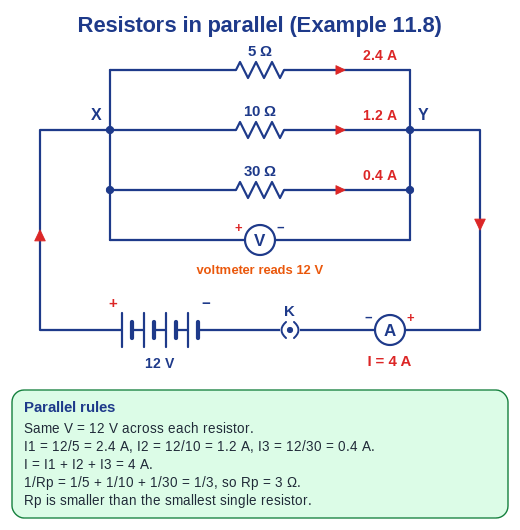
Example 11.8: 5 Ω, 10 Ω and 30 Ω in parallel on 12 V. I1 = 12/5 = 2.4 A, I2 = 12/10 = 1.2 A, I3 = 12/30 = 0.4 A; I = 4 A. And 1/Rp = 1/5 + 1/10 + 1/30 = 1/3, so Rp = 3 Ω (check: 12 V/3 Ω = 4 A).
How do we solve a mixed circuit?
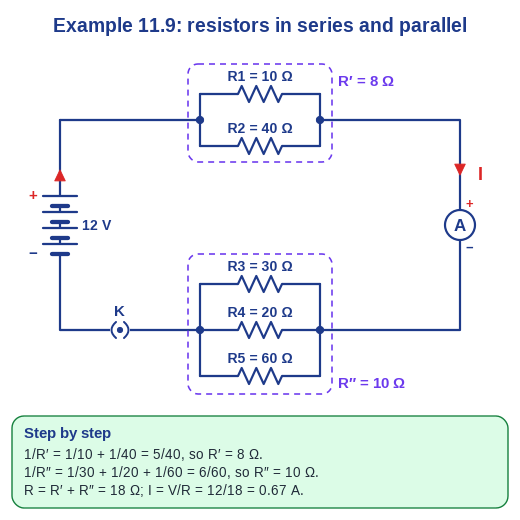
Replace each parallel group by one equivalent resistor, then add the groups in series. In Example 11.9, R1 = 10 Ω and R2 = 40 Ω are in parallel, and R3 = 30 Ω, R4 = 20 Ω and R5 = 60 Ω are in another parallel group, the two groups in series with a 12 V battery. 1/R′ = 1/10 + 1/40 = 5/40, so R′ = 8 Ω; 1/R″ = 1/30 + 1/20 + 1/60 = 6/60, so R″ = 10 Ω. The total is R = 18 Ω and I = 12/18 = 0.67 A.
Why do homes use parallel circuits?
A series circuit has the same current everywhere, so it cannot run a bulb and a heater together: they need very different currents (Example 11.3 gives 0.18 A and 2.2 A on the same supply). And if one component fails, the whole circuit breaks. Decorative “fairy lights” joined in series show this: when one bulb fuses, all go dark, and each must be tested to find it. A parallel circuit divides the current among the devices, gives each the full voltage, lowers the total resistance, and lets each device draw the current it needs and work on its own.
Read how current produces heat in heating effect and electric power. The Questions boxes and exercises on combinations are solved in the NCERT solutions for Chapter 11. Go back to the Chapter 11 notes.
Practice
-
Resistors of 2 Ω, 3 Ω and 5 Ω are in series with a 5 V battery. The current is:
Show answer
Answer: (a) 0.5 A
-
Resistors of 6 Ω and 3 Ω are in parallel. The equivalent resistance is:
Show answer
Answer: (c) 2 Ω
-
In a parallel circuit, which quantity is the same for every branch?
Show answer
Answer: (c) potential difference
-
A 20 Ω lamp and a 4 Ω conductor are in series with a 6 V battery. Find the current and the voltage across each.
Show answer
Answer: Rs = 20 + 4 = 24 Ω, so I = 6/24 = 0.25 A. V1 = 20 × 0.25 = 5 V across the lamp and V2 = 4 × 0.25 = 1 V across the conductor; 5 + 1 = 6 V. This is Example 11.7.
-
Why is a string of decorative lights joined in series hard to repair?
Show answer
Answer: In series one path carries the current through every bulb. If one bulb fuses, the circuit breaks and all of them go out, so each bulb has to be tested to find the dead one.
Questions students ask
Why is the equivalent resistance in parallel smaller than each resistor?
Each new branch is an extra path for the current. With the same voltage, more paths let more total current flow, and a larger current at the same voltage means a smaller resistance (R = V/I).
How do I solve a circuit with both series and parallel parts?
Replace each parallel group by its equivalent resistor using 1/Rp, then add the groups that are in series. Example 11.9 does this: 10 Ω and 40 Ω in parallel give 8 Ω, 30, 20 and 60 Ω in parallel give 10 Ω, and 8 + 10 = 18 Ω.
Why are household appliances not joined in series?
A bulb and a heater need very different currents, but a series circuit forces one current through both. Also, if one device fails or is switched off, the circuit breaks and nothing else works.
Stuck on a question?
Take a photo and Lagnever AI explains it step by step. Try it for 7 days for ₹2.
Get it on Google Play Open in browser
For parents: after the trial, the plan renews monthly by UPI or card autopay. You can cancel anytime in the app.