
NCERT Solutions Class 10 Science Chapter 11: Electricity
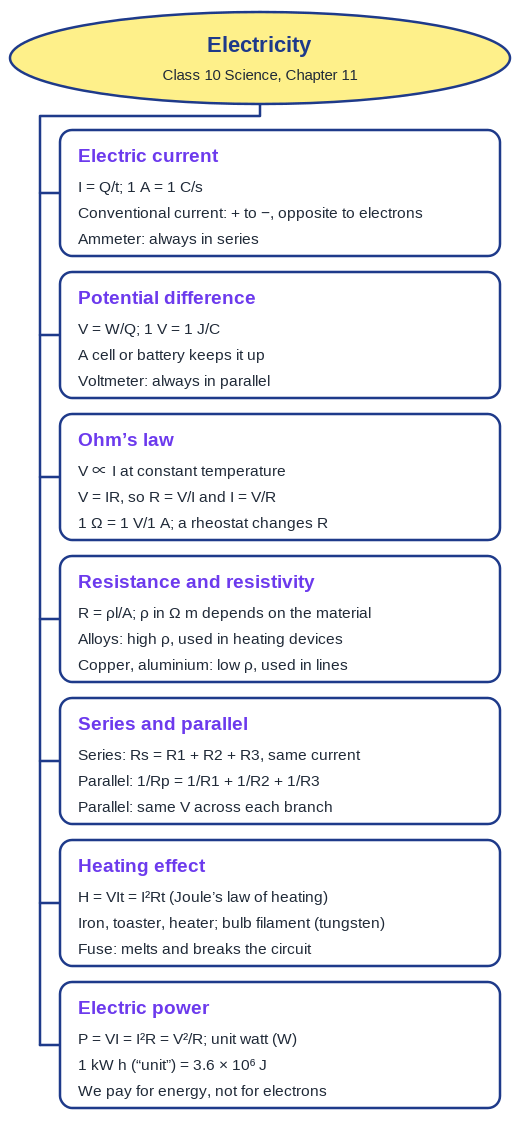
Answers to the six Questions boxes inside Chapter 11, Electricity, the thirteen solved examples, the activities and all 18 end-of-chapter exercises, from Science, the Class 10 NCERT textbook. Page numbers follow the 2026-27 reprint (pages 171–194). The exercises are quoted from the book; the in-chapter questions are restated in short. Every numerical is worked step by step and checked by computation, and the answers match the answer key at the end of the book. Points that go beyond the chapter are marked “Extra”. Several questions use a 220 V line: those numbers are for calculation only. Never experiment with the mains or a household socket. Short notes: Chapter 11 notes.
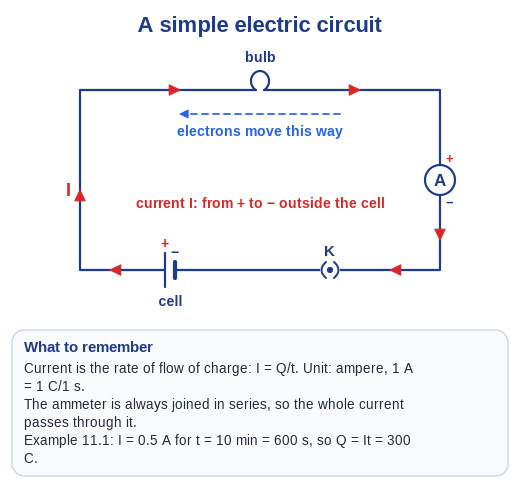
Example 11.1 and Questions, page 172
Example 11.1 (page 172): 0.5 A drawn for 10 minutes; find the charge. t = 10 × 60 = 600 s, so Q = It = 0.5 × 600 = 300 C.
Question 1 (page 172): what is an electric circuit? A continuous and closed path along which an electric current flows, for example from a cell through a key, a bulb and wires back to the cell. If the path is broken anywhere, the current stops.
Question 2 (page 172): define the unit of current. The SI unit of current is the ampere (A). One ampere is the current when one coulomb of charge flows through a cross-section of a conductor in one second: 1 A = 1 C/1 s.
Question 3 (page 172): number of electrons in one coulomb. Each electron carries 1.6 × 10⁻¹⁹ C, so n = 1 C ÷ 1.6 × 10⁻¹⁹ C = 6.25 × 10¹⁸ electrons (the chapter says “nearly 6 × 10¹⁸”).
Example 11.2 and Questions, page 174
Example 11.2 (page 173): work to move 2 C across 12 V. W = VQ = 12 × 2 = 24 J.
Question 1 (page 174): a device that keeps up a potential difference across a conductor. A cell or a battery (cells joined in series). Its chemical reaction keeps a potential difference between its terminals.
Question 2 (page 174): meaning of “the potential difference between two points is 1 V”. It means that 1 joule of work is done to move 1 coulomb of charge from one point to the other.
Question 3 (page 174): energy given to each coulomb by a 6 V battery. W = VQ = 6 V × 1 C = 6 J for every coulomb.
Examples 11.3 to 11.6 (pages 179–180)
Example 11.3 (page 179): current on 220 V through (a) a 1200 Ω bulb filament and (b) a 100 Ω heater coil. (a) I = V/R = 220/1200 = 0.18 A. (b) I = 220/100 = 2.2 A. The same source drives about 12 times more current through the heater. (The book’s working for (a) cites “Eq. (12.6)”; it means the chapter’s Ohm’s law equations, I = V/R being Eq. (11.7).)
Example 11.4 (page 180): a heater draws 4 A at 60 V; current at 120 V? R = V/I = 60/4 = 15 Ω. At 120 V, I = 120/15 = 8 A.
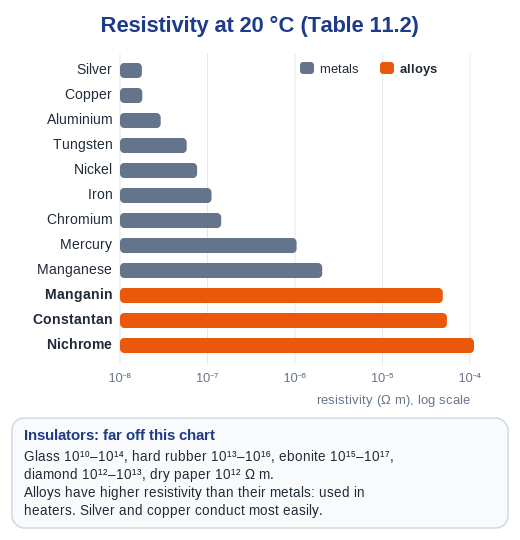
Example 11.5 (page 180): 1 m wire, 26 Ω, diameter 0.3 mm; resistivity and material. A = πd²/4, so ρ = RA/l = 26 × 3.14 × (3 × 10⁻⁴ m)² ÷ (4 × 1 m) = 1.84 × 10⁻⁶ Ω m, which Table 11.2 gives for manganese.
Example 11.6 (page 180): wire of 4 Ω; same material, length l/2 and area 2A. R2 = ρ(l/2)/(2A) = ¼ × ρl/A = ¼ × 4 = 1 Ω.
Questions, page 181
Question 1 (page 181): factors on which resistance depends. The length of the conductor (R ∝ l), its area of cross-section (R ∝ 1/A) and the nature of its material (its resistivity ρ); together R = ρl/A. (Resistance also changes with temperature.)
Question 2 (page 181): thick or thin wire of the same material on the same source? Current flows more easily through the thick wire. Its larger area of cross-section gives it a smaller resistance (R ∝ 1/A), so by I = V/R a larger current flows.
Question 3 (page 181): R stays the same and V is halved; what happens to the current? I = V/R, so the current also becomes half of its former value.
Question 4 (page 181): why are coils of toasters and irons made of an alloy? An alloy has a higher resistivity than a pure metal, so the coil produces more heat, and alloys do not oxidise (burn) readily at high temperatures, so the coil lasts.
Question 5 (page 181): from Table 11.2, (a) iron or mercury, which conducts better? (b) which material conducts most easily? (a) Iron: its resistivity, 10.0 × 10⁻⁸ Ω m, is lower than that of mercury, 94.0 × 10⁻⁸ Ω m. (b) Silver, with the lowest resistivity, 1.60 × 10⁻⁸ Ω m.
Example 11.7 and Questions, page 185
Example 11.7 (page 184): 20 Ω lamp and 4 Ω conductor in series on 6 V. (a) Rs = 20 + 4 = 24 Ω. (b) I = 6/24 = 0.25 A. (c) Across the lamp V1 = 20 × 0.25 = 5 V; across the conductor V2 = 4 × 0.25 = 1 V. A single 24 Ω resistor would draw the same 0.25 A.
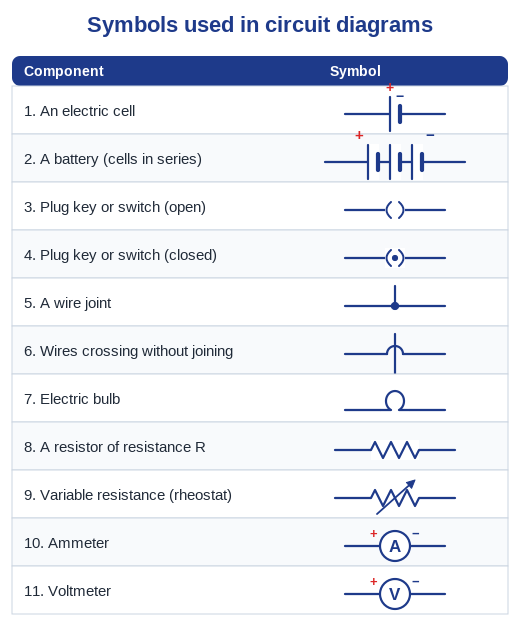
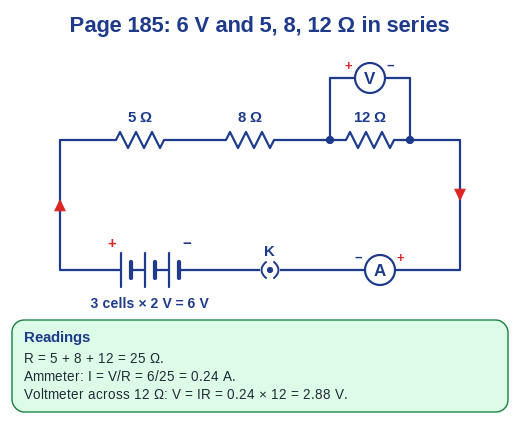
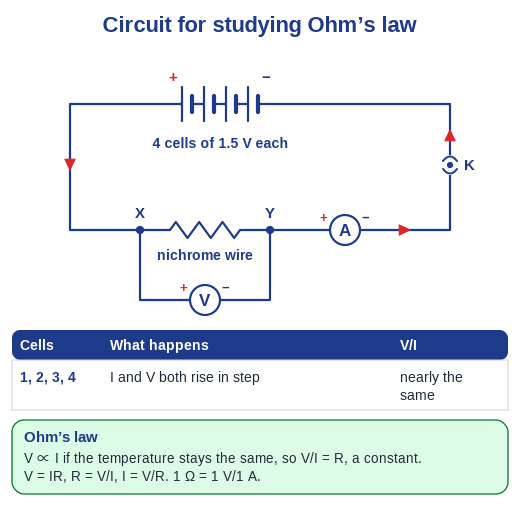
Question 1 (page 185): schematic diagram of a battery of three 2 V cells, a 5 Ω, an 8 Ω and a 12 Ω resistor and a plug key in series. The three cells are joined + to −, making a 6 V battery, and everything is in one loop, as in the diagram below (ignore the meters for this question).
Question 2 (page 185): add an ammeter for the current and a voltmeter across the 12 Ω resistor; find the readings. The ammeter goes in series anywhere in the loop; the voltmeter goes in parallel across the 12 Ω resistor. R = 5 + 8 + 12 = 25 Ω, so the ammeter reads I = 6/25 = 0.24 A, and the voltmeter reads V = IR = 0.24 × 12 = 2.88 V. (Extra: the 5 Ω and 8 Ω resistors have 1.2 V and 1.92 V across them; 1.2 + 1.92 + 2.88 = 6 V.)
Examples 11.8 and 11.9 (pages 186–187)
Example 11.8 (page 186): 5 Ω, 10 Ω and 30 Ω in parallel on 12 V. Each resistor has 12 V across it. (a) I1 = 12/5 = 2.4 A, I2 = 12/10 = 1.2 A, I3 = 12/30 = 0.4 A. (b) I = 2.4 + 1.2 + 0.4 = 4 A. (c) 1/Rp = 1/5 + 1/10 + 1/30 = (6 + 3 + 1)/30 = 1/3, so Rp = 3 Ω.
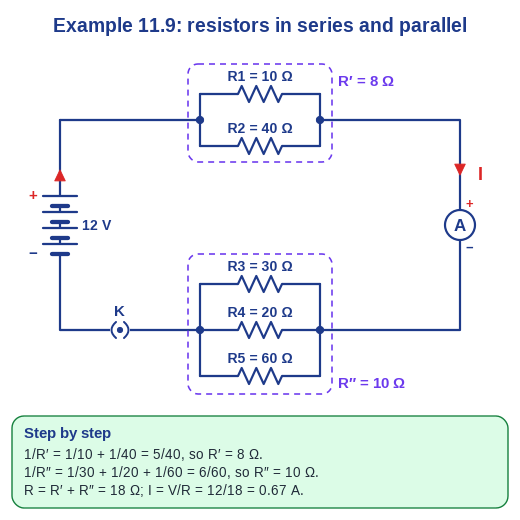
Example 11.9 (page 187): R1 = 10 Ω and R2 = 40 Ω in parallel, in series with R3 = 30 Ω, R4 = 20 Ω and R5 = 60 Ω in parallel, on 12 V. 1/R′ = 1/10 + 1/40 = 5/40, so R′ = 8 Ω. 1/R″ = 1/30 + 1/20 + 1/60 = 6/60, so R″ = 10 Ω. (a) R = 8 + 10 = 18 Ω. (b) I = 12/18 = 0.67 A.
Questions, page 188
Question 1 (page 188): judge the equivalent resistance in parallel of (a) 1 Ω and 10⁶ Ω, (b) 1 Ω, 10³ Ω and 10⁶ Ω. In parallel the result is less than the smallest resistor. (a) Rp = (1 × 10⁶)/(1 + 10⁶) ≈ 0.999999 Ω, just under 1 Ω. (b) 1/Rp = 1 + 0.001 + 0.000001 = 1.001001, so Rp ≈ 0.999 Ω, again just under 1 Ω. A very large resistor in parallel hardly changes anything.
Question 2 (page 188): a 100 Ω lamp, a 50 Ω toaster and a 500 Ω water filter in parallel on 220 V; resistance of an iron that takes as much current as all three, and its current. 1/Rp = 1/100 + 1/50 + 1/500 = (5 + 10 + 1)/500 = 16/500, so Rp = 31.25 Ω: the iron must have this resistance. Its current is I = 220/31.25 = 7.04 A (the same as 2.2 + 4.4 + 0.44 A for the three appliances).
Question 3 (page 188): advantages of connecting devices in parallel instead of series. Each device gets the full voltage of the source; each draws the current it needs according to its own resistance; each can be switched on or off on its own, and if one fails the others still work; and the total resistance of the circuit is less.
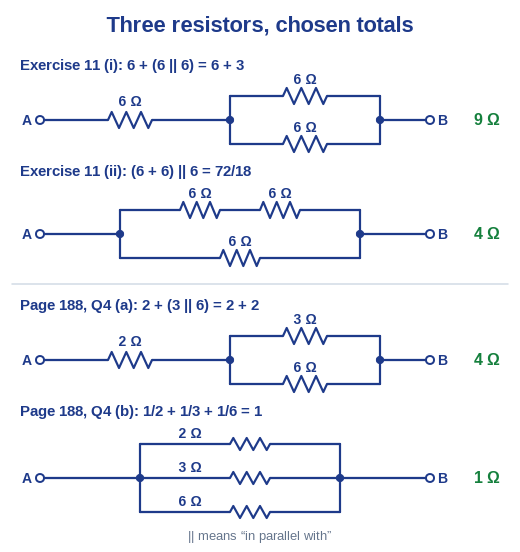
Question 4 (page 188): join 2 Ω, 3 Ω and 6 Ω to get (a) 4 Ω, (b) 1 Ω. (a) Put 3 Ω and 6 Ω in parallel: 3 × 6/(3 + 6) = 2 Ω; then 2 Ω in series with it: 2 + 2 = 4 Ω. (b) Put all three in parallel: 1/2 + 1/3 + 1/6 = 1, so 1 Ω.
Question 5 (page 188): highest and lowest total resistance from coils of 4 Ω, 8 Ω, 12 Ω and 24 Ω. (a) Highest, all in series: 4 + 8 + 12 + 24 = 48 Ω. (b) Lowest, all in parallel: 1/Rp = 1/4 + 1/8 + 1/12 + 1/24 = (6 + 3 + 2 + 1)/24 = 1/2, so 2 Ω.
Examples 11.10, 11.11 and Questions, page 190
Example 11.10 (page 189): an iron uses 840 W (maximum) and 360 W (minimum) on 220 V; currents and resistances. I = P/V. (a) I = 840/220 = 3.82 A, R = V/I = 57.6 Ω. (b) I = 360/220 = 1.64 A, R = 134 Ω. The book writes 57.60 Ω and 134.15 Ω because it divides by the rounded currents; R = V²/P gives 57.62 Ω and 134.44 Ω.
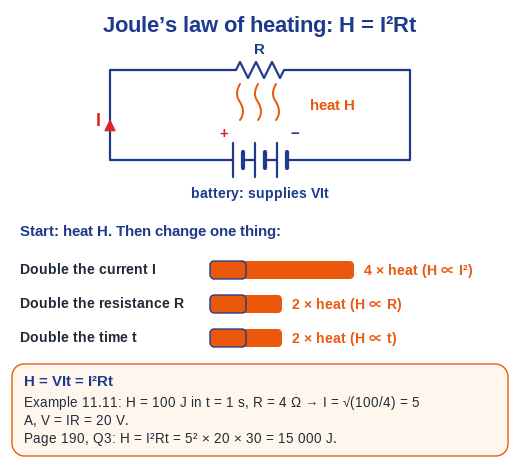
Example 11.11 (page 189): 100 J each second in 4 Ω; potential difference. H = I²Rt, so I = √(H/Rt) = √(100/(4 × 1)) = 5 A and V = IR = 5 × 4 = 20 V.
Question 1 (page 190): why does the cord of a heater not glow while its element does? The same current flows through both, and heat H = I²Rt depends on resistance. The cord is made of copper, with a very low resistance, so it produces very little heat. The element is an alloy of high resistance, so it produces a lot of heat and glows.
Question 2 (page 190): heat when 96 000 C are moved in one hour through 50 V. H = VQ = 50 × 96 000 = 4.8 × 10⁶ J. (The current is 96 000/3600 = 26.7 A, but it is not needed: H = VIt = VQ.)
Question 3 (page 190): iron of 20 Ω taking 5 A; heat in 30 s. H = I²Rt = 5² × 20 × 30 = 15 000 J (1.5 × 10⁴ J).
Examples 11.12, 11.13 and Questions, page 192
Example 11.12 (page 191): bulb on 220 V carrying 0.50 A; its power. P = VI = 220 × 0.50 = 110 W.
Example 11.13 (page 191): 400 W refrigerator, 8 hours a day, 30 days, Rs 3.00 per kW h. Energy = 400 × 8 × 30 = 96 000 W h = 96 kW h; cost = 96 × 3.00 = Rs 288.00.
Question 1 (page 192): what decides the rate at which a current delivers energy? That rate is the electric power, P = VI. It depends on the potential difference and the current, which in turn depends on the resistance: P = I²R = V²/R.
Question 2 (page 192): a motor takes 5 A from a 220 V line; power, and energy in 2 h. P = VI = 220 × 5 = 1100 W. Energy = P × t = 1100 W × 2 h = 2200 W h = 2.2 kW h (= 1100 × 7200 s = 7.92 × 10⁶ J).
What the activities show (Activities 11.1–11.6)
All six activities use dry cells, a plug key, wires and meters. Do them with a teacher and take the key out after each reading, so that the wires do not heat up.
- 11.1, Ohm’s law: with one, two, three and four cells across a nichrome wire, V and I both rise and V/I stays nearly constant; the V–I graph is a straight line through the origin.
- 11.2, different components in the gap XY: a nichrome wire, a torch bulb and a 10 W bulb give different ammeter readings, because they have different resistances.
- 11.3, wires of different sizes: doubling the length halves the current; a thicker wire increases it; a copper wire of the same size gives a different (much larger) current. So R depends on length, area and material.
- 11.4, series: the ammeter reading is the same wherever it is placed in the series circuit.
- 11.5, series voltages: the voltage across the whole combination equals the battery voltage and the sum of the voltages across the three resistors.
- 11.6, parallel: each resistor has the same voltage, and the branch currents add up to the total current.
Exercises 1 to 5
1. “A piece of wire of resistance R is cut into five equal parts. These parts are then connected in parallel. If the equivalent resistance of this combination is R′, then the ratio R/R′ is – (a) 1/25 (b) 1/5 (c) 5 (d) 25”
(d) 25. Each part has resistance R/5. Five equal resistors R/5 in parallel give R′ = (R/5)/5 = R/25, so R/R′ = 25.
2. “Which of the following terms does not represent electrical power in a circuit? (a) I²R (b) IR² (c) VI (d) V²/R”
(b) IR². Power is P = VI = I²R = V²/R. IR² is not one of these (its unit would be V Ω, not W).
3. “An electric bulb is rated 220 V and 100 W. When it is operated on 110 V, the power consumed will be – (a) 100 W (b) 75 W (c) 50 W (d) 25 W”
(d) 25 W. R = V²/P = 220²/100 = 484 Ω. On 110 V, P = V²/R = 110²/484 = 25 W. Halving the voltage makes the power one quarter (taking R as unchanged).
4. “Two conducting wires of the same material and of equal lengths and equal diameters are first connected in series and then parallel in a circuit across the same potential difference. The ratio of heat produced in series and parallel combinations would be – (a) 1:2 (b) 2:1 (c) 1:4 (d) 4:1”
(c) 1:4. Let each wire have resistance R. Series: 2R; parallel: R/2. For the same V and t, H = V²t/R, so Hs : Hp = (1/2R) : (2/R) = 1 : 4.
5. “How is a voltmeter connected in the circuit to measure the potential difference between two points?”
In parallel, with its terminals joined across the two points, the + terminal to the point at higher potential (the side joined to the + terminal of the cell).
Exercises 6 to 9
6. “A copper wire has diameter 0.5 mm and resistivity of 1.6 × 10⁻⁸ Ω m. What will be the length of this wire to make its resistance 10 Ω? How much does the resistance change if the diameter is doubled?”
- Diameter d = 0.5 mm = 5 × 10⁻⁴ m. Area of cross-section A = πd²/4 = 3.14 × (5 × 10⁻⁴)² ÷ 4 = 1.96 × 10⁻⁷ m².
- From R = ρl/A, the length is l = RA/ρ = (10 × 1.96 × 10⁻⁷) ÷ (1.6 × 10⁻⁸) = 122.7 m.
- If the diameter is doubled, the area becomes 2 × 2 = 4 times. Resistance is inversely proportional to area, so it becomes one quarter: 10 Ω ÷ 4 = 2.5 Ω.
Answer: the wire must be 122.7 m long. With double the diameter, the resistance becomes one quarter (2.5 Ω), a decrease of 7.5 Ω.
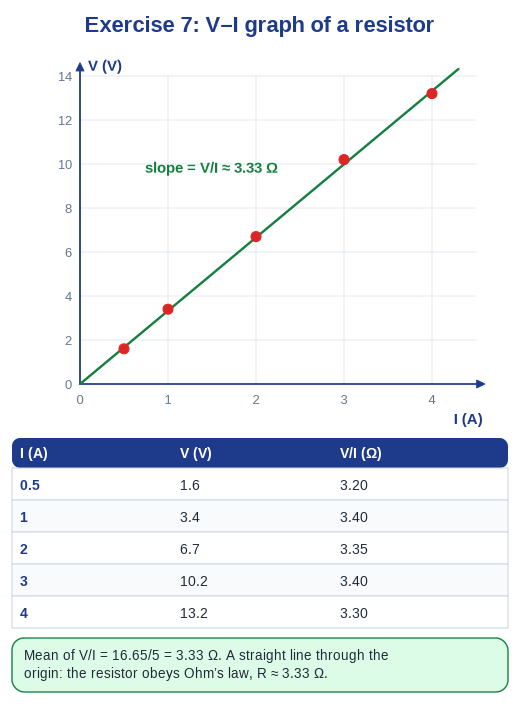
7. “The values of current I flowing in a given resistor for the corresponding values of potential difference V across the resistor are given below – I (amperes) 0.5, 1.0, 2.0, 3.0, 4.0; V (volts) 1.6, 3.4, 6.7, 10.2, 13.2. Plot a graph between V and I and calculate the resistance of that resistor.”
- Plot V on the y-axis and I on the x-axis. The points lie close to a straight line through the origin, so the resistor follows Ohm’s law.
- The resistance is the slope of this line, R = V/I. For the five readings, V/I = 3.20, 3.40, 3.35, 3.40 and 3.30 Ω.
- Their average is 16.65 ÷ 5 = 3.33 Ω.
Answer: R ≈ 3.33 Ω.
8. “When a 12 V battery is connected across an unknown resistor, there is a current of 2.5 mA in the circuit. Find the value of the resistance of the resistor.”
I = 2.5 mA = 2.5 × 10⁻³ A. R = V/I = 12/(2.5 × 10⁻³) = 4800 Ω = 4.8 kΩ.
9. “A battery of 9 V is connected in series with resistors of 0.2 Ω, 0.3 Ω, 0.4 Ω , 0.5 Ω and 12 Ω, respectively. How much current would flow through the 12 Ω resistor?”
Rs = 0.2 + 0.3 + 0.4 + 0.5 + 12 = 13.4 Ω. I = 9/13.4 = 0.67 A. In series the same current flows through every resistor, including the 12 Ω one.
Exercises 10 to 13
10. “How many 176 Ω resistors (in parallel) are required to carry 5 A on a 220 V line?”
Each resistor has 220 V across it and carries 220/176 = 1.25 A. To carry 5 A in all, n = 5/1.25 = 4 resistors. (Check: four 176 Ω in parallel give 44 Ω, and 220/44 = 5 A.)
11. “Show how you would connect three resistors, each of resistance 6 Ω, so that the combination has a resistance of (i) 9 Ω, (ii) 4 Ω.”
(i) Join two in parallel (6 × 6/12 = 3 Ω) and the third in series with them: 3 + 6 = 9 Ω. (ii) Join two in series (12 Ω) and put the third in parallel with them: 12 × 6/(12 + 6) = 4 Ω.
12. “Several electric bulbs designed to be used on a 220 V electric supply line, are rated 10 W. How many lamps can be connected in parallel with each other across the two wires of 220 V line if the maximum allowable current is 5 A?”
Each lamp draws I = P/V = 10/220 = 1/22 A. The number of lamps is n = 5 ÷ (1/22) = 110 lamps. (Or: the line can supply P = VI = 220 × 5 = 1100 W, and 1100/10 = 110.)
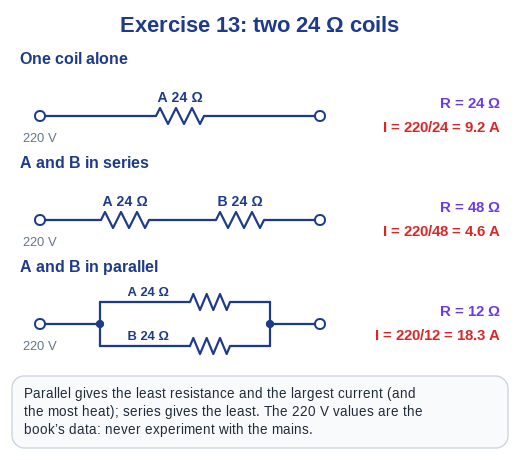
13. “A hot plate of an electric oven connected to a 220 V line has two resistance coils A and B, each of 24 Ω resistance, which may be used separately, in series, or in parallel. What are the currents in the three cases?”
- Separately: R = 24 Ω, I = 220/24 = 9.2 A.
- In series: R = 48 Ω, I = 220/48 = 4.6 A.
- In parallel: R = 12 Ω, I = 220/12 = 18.3 A.
Exercises 14 to 17
14. “Compare the power used in the 2 Ω resistor in each of the following circuits: (i) a 6 V battery in series with 1 Ω and 2 Ω resistors, and (ii) a 4 V battery in parallel with 12 Ω and 2 Ω resistors.”
(i) Series circuit. Total resistance = 1 + 2 = 3 Ω. Current I = V/R = 6/3 = 2 A, and this same current flows through the 2 Ω resistor. Power P = I²R = 2² × 2 = 8 W.
(ii) Parallel circuit. In parallel, each resistor gets the full battery voltage, 4 V. Power in the 2 Ω resistor P = V²/R = 4²/2 = 8 W.
Answer: the power in the 2 Ω resistor is 8 W in both circuits, so it is the same.
15. “Two lamps, one rated 100 W at 220 V, and the other 60 W at 220 V, are connected in parallel to electric mains supply. What current is drawn from the line if the supply voltage is 220 V?”
In parallel each lamp gets 220 V and works at its rated power. I = I1 + I2 = 100/220 + 60/220 = 160/220 = 0.73 A.
16. “Which uses more energy, a 250 W TV set in 1 hr, or a 1200 W toaster in 10 minutes?”
Energy = power × time.
- TV: E = 250 W × 1 h = 250 W h (= 9.0 × 10⁵ J).
- Toaster: 10 minutes = 10/60 h, so E = 1200 W × (10/60) h = 200 W h (= 7.2 × 10⁵ J).
Answer: the 250 W TV set in 1 hour uses more energy.
17. “An electric heater of resistance 44 Ω draws 5 A from the service mains for 2 hours. Calculate the rate at which heat is developed in the heater.”
The rate of heating is the power: P = I²R = 5² × 44 = 1100 W (1100 J every second). (Extra: in 2 hours the heat is 1100 W × 2 h = 2.2 kW h = 7.92 × 10⁶ J.)
Exercise 18
18. “Explain the following. (a) Why is the tungsten used almost exclusively for filament of electric lamps? (b) Why are the conductors of electric heating devices, such as bread-toasters and electric irons, made of an alloy rather than a pure metal? (c) Why is the series arrangement not used for domestic circuits? (d) How does the resistance of a wire vary with its area of cross-section? (e) Why are copper and aluminium wires usually employed for electricity transmission?”
- (a) A filament must get hot enough to glow without melting. Tungsten is a strong metal with a very high melting point (3380 °C), so it can glow white-hot, and it keeps much of the heat produced in it.
- (b) Alloys have a higher resistivity than pure metals, so they produce more heat, and they do not oxidise (burn) readily at high temperatures, so the element lasts.
- (c) In series the same current flows through every device, but appliances need different currents; the voltage is shared, so no device gets the full supply voltage; and if one device fails or is switched off, the circuit breaks and all the others stop.
- (d) Resistance is inversely proportional to the area of cross-section (R ∝ 1/A): a thicker wire has less resistance.
- (e) Copper and aluminium have a very low resistivity (1.62 × 10⁻⁸ and 2.63 × 10⁻⁸ Ω m in Table 11.2), so little energy is lost as heat in long transmission wires.
Go back to the Chapter 11 notes, or read Ohm’s law and resistance, resistors in series and parallel and heating effect and electric power.
Practice
-
Three resistors of 3 Ω each are joined in parallel. The equivalent resistance is:
Show answer
Answer: (c) 1 Ω
-
A 60 W bulb is used on 220 V. The current through it is about:
Show answer
Answer: (a) 0.27 A
-
The current through a resistor is tripled. The heat produced in the same time becomes:
Show answer
Answer: (c) 9 times
-
A 2 kW heater is used 3 hours a day for 30 days at Rs 3.00 per kW h. Find the cost.
Show answer
Answer: Energy = 2 kW × 3 h/day × 30 days = 180 kW h. Cost = 180 × Rs 3.00 = Rs 540.
-
Resistors of 4 Ω and 12 Ω are in parallel, and this pair is in series with a 1 Ω resistor and a 6 V battery. Find the current from the battery.
Show answer
Answer: 1/Rp = 1/4 + 1/12 = 4/12, so Rp = 3 Ω. Total R = 3 + 1 = 4 Ω. I = V/R = 6/4 = 1.5 A.
Stuck on a question?
Take a photo and Lagnever AI explains it step by step. Try it for 7 days for ₹2.
Get it on Google Play Open in browser
For parents: after the trial, the plan renews monthly by UPI or card autopay. You can cancel anytime in the app.