
Class 10 Science Chapter 11: Electricity Notes
This chapter in five lines
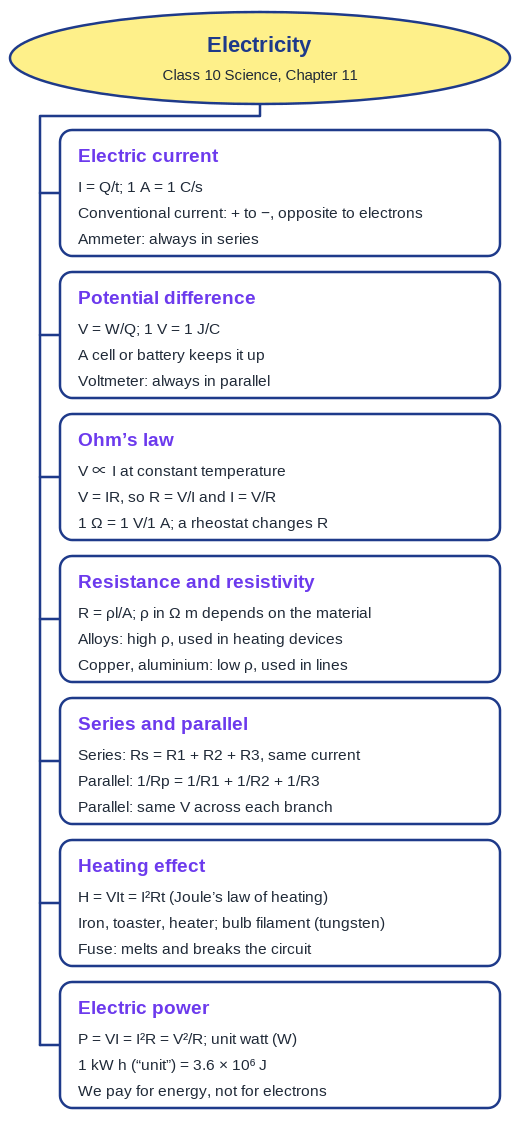
Electric current is the rate of flow of charge, I = Q/t, and it flows only when a cell or battery keeps a potential difference, V = W/Q, across a conductor. Ohm’s law says V = IR at constant temperature; the resistance R = ρl/A depends on length, thickness and material. Resistors add up in series and their reciprocals add in parallel. Current heats a resistor by H = I²Rt, and electric power is P = VI, with energy sold in kilowatt hours.
What is this chapter about?
Electricity runs lights, fans and machines in homes, schools, hospitals and industries because it is an easy energy to control and to carry. This chapter answers a few basic questions. What is an electric current, and what makes charge flow? What decides how much current flows through a wire? What happens to the energy that a cell or battery supplies? The answers lead to three ideas you will use in every numerical: Ohm’s law, the rules for resistors in series and in parallel, and the formulas for heat and power.
What is an electric current?
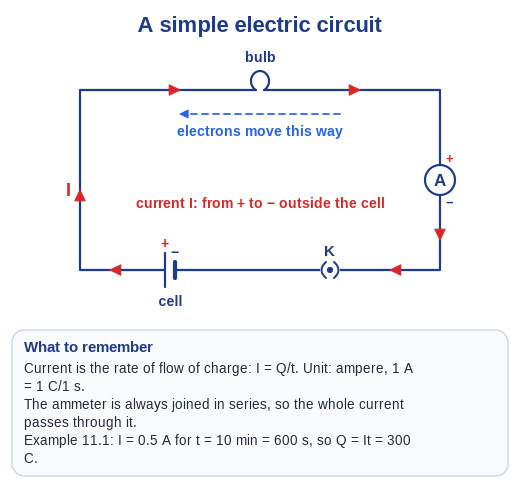
When electric charge flows through a conductor such as a metal wire, there is an electric current in it. In a torch, the cells send a current through the bulb only when the switch closes the path. A continuous, closed path for current is an electric circuit; if it is broken anywhere, the current stops.
Current is the rate of flow of charge. If a net charge Q crosses a section of the wire in time t, the current is
I = Q/t.
The SI unit of charge is the coulomb (C), nearly the charge of 6 × 10¹⁸ electrons (an electron carries 1.6 × 10⁻¹⁹ C). The unit of current is the ampere (A): 1 A is a flow of 1 C each second. Small currents are given in milliampere (1 mA = 10⁻³ A) and microampere (1 µA = 10⁻⁶ A). In Example 11.1, a bulb drawing 0.5 A for 10 minutes passes Q = It = 0.5 × 600 = 300 C.
In metal wires the moving charges are electrons. But current was defined before electrons were known, as a flow of positive charge, so the conventional current flows from the + terminal to the − terminal outside the cell, opposite to the electrons. An ammeter measures current and is always joined in series.
What is potential difference?
Water in a level pipe does not flow; it flows when one end is joined to a raised tank, because of a pressure difference. In the same way, electrons in a wire move only if there is a difference of “electric pressure” between its ends: a potential difference. A cell or battery produces it by chemical action, and it has to keep spending its chemical energy to keep the current going.
The potential difference between two points is the work done to move a unit charge from one point to the other:
V = W/Q, and 1 volt = 1 joule per coulomb (1 V = 1 J/C).
So a 6 V battery gives 6 J to every coulomb that passes through it. In Example 11.2, moving 2 C across 12 V needs W = VQ = 24 J. A voltmeter measures potential difference and is always joined in parallel across the two points.
What symbols are used in circuit diagrams?
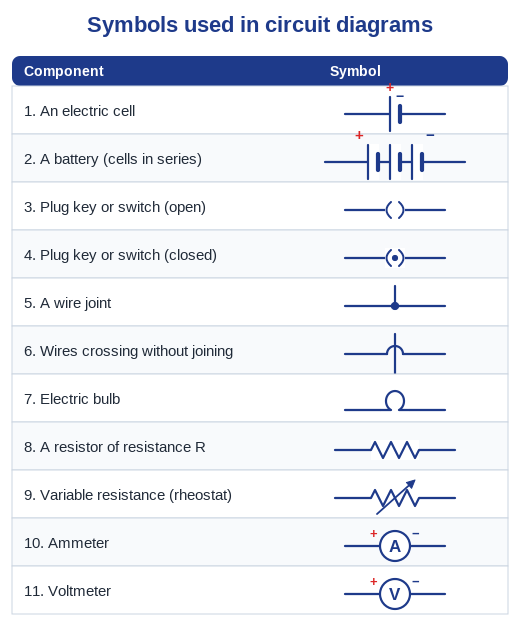
A circuit is drawn as a schematic diagram with standard symbols (Table 11.1 of the chapter): the cell (a long thin line for + and a short thick line for −), a battery of cells, the plug key open or closed, a wire joint, wires crossing without joining, a bulb, a resistor, a rheostat, an ammeter and a voltmeter.
What is Ohm’s law?
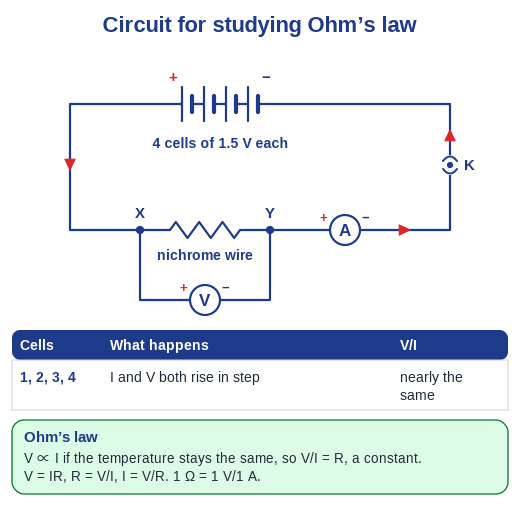
In Activity 11.1 a nichrome wire is connected first to one cell, then to two, three and four cells, with an ammeter in series and a voltmeter across the wire. Each time, V/I comes out nearly the same, and the V–I graph is a straight line through the origin. Georg Simon Ohm found this rule in 1827:
Ohm’s law: the potential difference V across a metallic wire is directly proportional to the current I through it, provided its temperature stays the same. So V/I = R, a constant, and
V = IR, or R = V/I, or I = V/R.
R is the resistance of the wire. Its SI unit is the ohm (Ω): 1 Ω = 1 V/1 A. For a fixed voltage, doubling the resistance halves the current. A rheostat (variable resistance) changes the current in a circuit without changing the source. Read more in Ohm’s law and resistance.
On what does resistance depend?
Electrons in a wire are held back by the attraction of the atoms among which they move, so every conductor resists the current a little. A good conductor has low resistance; a resistor has an appreciable resistance; an insulator of the same size has a very high resistance. Activity 11.3 shows that the resistance of a uniform metal wire depends on:
- its length l: double the length, and the current halves, so R ∝ l;
- its area of cross-section A: a thicker wire carries more current, so R ∝ 1/A;
- its material.
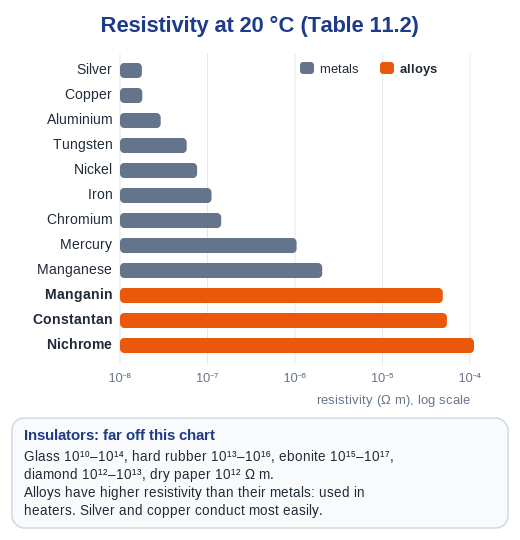
Together, R = ρ l/A, where ρ (rho) is the resistivity of the material, in Ω m. Metals and alloys have very low resistivity (about 10⁻⁸ to 10⁻⁶ Ω m); insulators such as rubber and glass have about 10¹² to 10¹⁷ Ω m (Table 11.2). Alloys have a higher resistivity than their metals and do not oxidise easily when hot, so they are used in electric irons and toasters. Tungsten is used for bulb filaments; copper and aluminium for transmission lines.
How do resistors combine in series and in parallel?
In series (end to end), the same current I flows through each resistor, and the voltages across them add up to the total: V = V1 + V2 + V3. The equivalent resistance is
Rs = R1 + R2 + R3, larger than any one of them.
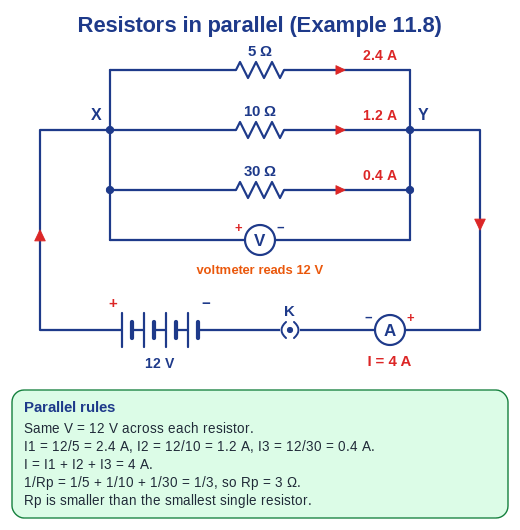
In parallel (side by side between the same two points), each resistor has the same voltage V across it, and the currents in the branches add up: I = I1 + I2 + I3. The equivalent resistance follows
1/Rp = 1/R1 + 1/R2 + 1/R3, smaller than the smallest one.
In Example 11.8, resistors of 5 Ω, 10 Ω and 30 Ω in parallel on 12 V draw 2.4 A, 1.2 A and 0.4 A, in all 4 A, and Rp = 3 Ω. A series circuit is not used at home: a bulb and a heater need very different currents, and if one device fails the whole circuit breaks (as in a string of “fairy lights”). In parallel, each device gets the full voltage and its own current. Read more in resistors in series and parallel.
What is the heating effect of electric current?
Part of the energy a source supplies may do useful work, like turning a fan, and the rest heats the device; a fan gets warm after long use. In a circuit of resistors only, all of it becomes heat. This is the heating effect of electric current. Moving a charge Q through a potential difference V takes energy VQ, so the power supplied is P = VQ/t = VI and the heat in time t is H = VIt. With V = IR,
H = I²Rt (Joule’s law of heating):
heat is proportional to the square of the current, to the resistance and to the time. It is used in electric irons, toasters, ovens, kettles and heaters. A bulb filament gets hot enough to glow; it is made of tungsten, which has a melting point of 3380 °C, and bulbs are filled with inactive nitrogen and argon to make the filament last longer. A fuse, a wire of suitable melting point placed in series with the device, melts and breaks the circuit when the current is too large. Read more in heating effect and electric power.
What is electric power?
Electric power is the rate at which electric energy is consumed:
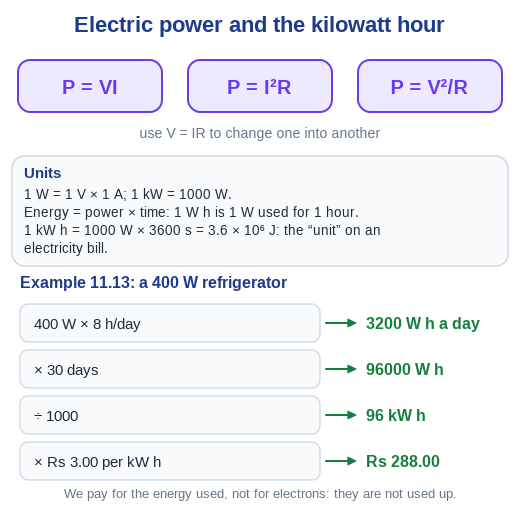
P = VI = I²R = V²/R.
Its unit is the watt (W), the power used by a device carrying 1 A at 1 V; 1 kW = 1000 W. Energy is power × time, so the commercial unit of energy is the kilowatt hour, or “unit”: 1 kW h = 1000 W × 3600 s = 3.6 × 10⁶ J. In Example 11.13, a 400 W refrigerator used 8 hours a day for 30 days takes 96 kW h, which costs Rs 288 at Rs 3.00 per kW h. Electrons are not used up in a circuit: we pay for the energy that moves them.
Before we move on
The activities in this chapter use dry cells of 1.5 V, a plug key and meters. Do them only with a teacher, and take the key out after each reading so the wire does not heat up. Never experiment with the mains or a household socket: the 220 V numbers in the examples are for calculation only. Answers to all six Questions boxes, the thirteen examples and all 18 exercises are in the NCERT solutions for Chapter 11.
Key terms
| Term | Meaning |
|---|---|
| Electric current (I) | The rate of flow of electric charge through a cross-section of a conductor: I = Q/t. SI unit: ampere (A); 1 A = 1 C/1 s. |
| Conventional current | The direction of current taken as the flow of positive charge, from the + terminal to the − terminal outside the cell. It is opposite to the flow of electrons. |
| Electric circuit | A continuous, closed path along which an electric current flows. |
| Potential difference (V) | The work done to move a unit charge from one point to another in a circuit: V = W/Q. SI unit: volt (V); 1 V = 1 J/C. |
| Ammeter and voltmeter | An ammeter measures current and is always joined in series. A voltmeter measures potential difference and is always joined in parallel across the two points. |
| Ohm’s law | The potential difference across a metallic wire is directly proportional to the current through it, provided its temperature stays the same: V = IR. |
| Resistance (R) | The property of a conductor that opposes the flow of charge through it. R = V/I. SI unit: ohm (Ω); 1 Ω = 1 V/1 A. |
| Rheostat | A variable resistance used to change the current in a circuit without changing the source. |
| Resistivity (ρ) | The constant in R = ρl/A. It depends only on the material (and temperature), not on the size of the wire. SI unit: Ω m. |
| Joule’s law of heating | The heat produced in a resistor is H = I²Rt: proportional to the square of the current, to the resistance and to the time. |
| Electric power (P) | The rate at which electric energy is consumed: P = VI = I²R = V²/R. SI unit: watt (W); 1 W = 1 V × 1 A. |
| Kilowatt hour (kW h) | The commercial unit of electric energy, called a “unit”: 1 kW h = 3.6 × 10⁶ J. |
Topics in this chapter
Practice
-
A charge of 300 C flows through a bulb in 10 minutes. The current is:
Show answer
Answer: (c) 0.5 A
-
How is a voltmeter joined in a circuit?
Show answer
Answer: (b) in parallel across the two points
-
A wire of the same material and thickness but twice as long has a resistance that is:
Show answer
Answer: (c) twice
-
Two resistors of 6 Ω each are joined in parallel. The equivalent resistance is:
Show answer
Answer: (c) 3 Ω
-
1 kW h is equal to:
Show answer
Answer: (d) 3.6 × 10⁶ J
Questions students ask
What are the main topics of Class 10 Science Chapter 11?
Electric current and circuits, electric potential and potential difference, circuit diagram symbols, Ohm’s law, the factors on which resistance depends and resistivity, resistors in series and in parallel, the heating effect of current and its uses, and electric power with the kilowatt hour.
Is Electricity in the 2026-27 NCERT book?
Yes. It is Chapter 11 of Science, the Class 10 NCERT textbook marked Reprint 2026-27, on pages 171 to 194. It has six Questions boxes, thirteen solved examples and 18 exercises.
Which parts of this chapter should I practise for the board exam?
Numericals on Ohm’s law, resistivity, series and parallel combinations, heat (H = I²Rt), power and the cost of energy in kW h; drawing circuit diagrams with the right symbols; and the reasons behind uses such as alloys in heaters, tungsten in bulbs, fuses and parallel wiring at home.
Why is the current said to flow from + to − when electrons flow from − to +?
Electricity was studied before electrons were discovered, and current was taken to be a flow of positive charge. That convention was kept. In metal wires the electrons actually move the other way, from the − terminal towards the + terminal.
Are electrons used up in a circuit?
No. The chapter stresses this. The electrons only carry energy round the circuit; what we pay the electricity company for is the energy used to move them through our appliances.
Stuck on a question?
Take a photo and Lagnever AI explains it step by step. Try it for 7 days for ₹2.
Get it on Google Play Open in browser
For parents: after the trial, the plan renews monthly by UPI or card autopay. You can cancel anytime in the app.