
How does current produce heat, and what is electric power?
Answer in short
When current flows through a resistor, the energy supplied by the source turns into heat: H = VIt = I²Rt, Joule’s law of heating. It is used in irons, toasters, heaters, bulb filaments and fuses. Electric power is the rate of using energy, P = VI = I²R = V²/R, and energy is sold in kilowatt hours.
Stuck on a question? Take a photo and Lagnever AI explains it step by step. Try it for 7 days for ₹2. Get it on Google Play
Where does the energy from a cell go?
A cell or battery uses its chemical energy to keep a potential difference between its terminals, and that keeps the current flowing. Some of this energy may do useful work, like turning the blades of a fan. The rest heats the device: a fan gets warm when it runs for a long time. If the circuit has only resistors, all the energy from the source is turned into heat. This is the heating effect of electric current, and devices like electric heaters and irons use it.
How much heat is produced?
Let a steady current I flow for a time t through a resistor R with a potential difference V across it, so that a charge Q passes. Moving Q through V takes work VQ. The power supplied by the source is
P = VQ/t = VI,
and the energy supplied in time t is VIt. In a resistor all of it becomes heat:
H = VIt. Using V = IR, H = I²Rt.
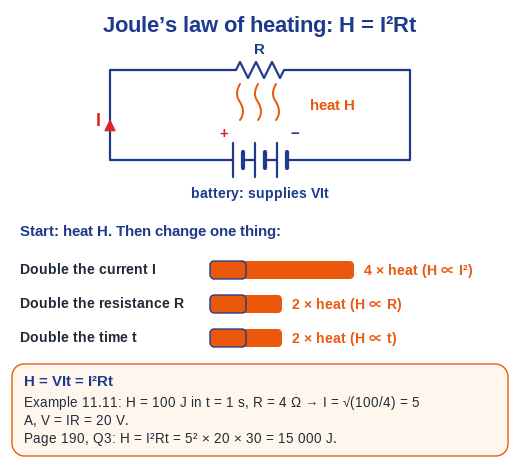
This is Joule’s law of heating. The heat produced in a resistor is
- directly proportional to the square of the current, for a given resistance;
- directly proportional to the resistance, for a given current;
- directly proportional to the time for which the current flows.
For an appliance on a known supply, first find the current with I = V/R, then use H = I²Rt.
Example 11.10: an iron uses 840 W at its highest setting and 360 W at its lowest, on 220 V. I = P/V = 840/220 = 3.82 A and R = V/I = 57.6 Ω; at the low setting I = 1.64 A and R = 134 Ω. (The chapter gives 57.60 Ω and 134.15 Ω after rounding the currents; with R = V²/P directly, they are 57.62 Ω and 134.44 Ω.)
Example 11.11: 100 J of heat each second in a 4 Ω resistor. I = √(H/Rt) = √(100/4) = 5 A, and V = IR = 20 V.
Where is the heating effect used?
The heat is often unwanted, since it turns useful electrical energy into heat and can change how components behave. But many devices depend on it: the electric iron, toaster, oven, kettle and heater.
It also gives light in a filament bulb. The filament must keep as much heat as possible so that it glows, without melting. Tungsten, a strong metal with a melting point of 3380 °C, is used, held on insulating supports. Bulbs are filled with chemically inactive nitrogen and argon to make the filament last longer. Most of the power still appears as heat, and only a small part as light.
A fuse protects circuits and appliances from too large a current. It is a short wire of a metal or alloy of suitable melting point (such as aluminium, copper, iron or lead), placed in series with the device, usually inside a porcelain cartridge with metal ends. If the current exceeds the rated value, the wire heats up, melts and breaks the circuit. Domestic fuses are rated 1 A, 2 A, 3 A, 5 A, 10 A and so on. A 1 kW iron on 220 V draws 1000/220 ≈ 4.5 A, so it needs a 5 A fuse. (This is information from the chapter; never open, test or replace fuses or touch mains wiring yourself.)
What is electric power?
Power is the rate of doing work, or of using energy. For electricity,
P = VI = I²R = V²/R.
The SI unit is the watt (W): the power used by a device carrying 1 A at a potential difference of 1 V, so 1 W = 1 V × 1 A. The watt is small, so the kilowatt (1 kW = 1000 W) is used in practice. Example 11.12: a bulb on 220 V carrying 0.50 A has P = 220 × 0.50 = 110 W.
What is a kilowatt hour?
Energy is power × time, so energy can be measured in watt hours: 1 W h is the energy used when 1 W is used for 1 hour. The commercial unit, called a “unit”, is the kilowatt hour:
1 kW h = 1000 W × 3600 s = 3.6 × 10⁶ J.
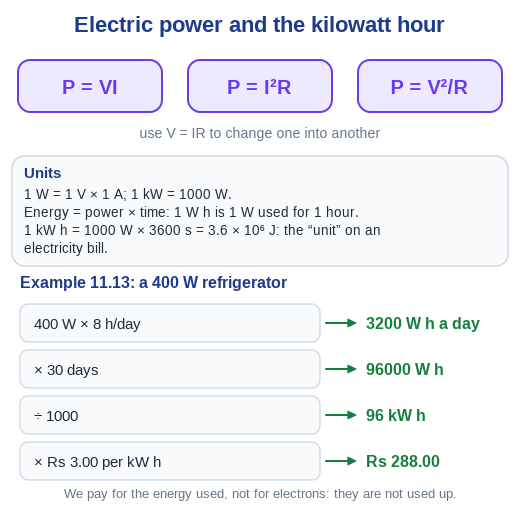
Example 11.13: a 400 W refrigerator runs 8 hours a day. In 30 days it uses 400 × 8 × 30 = 96 000 W h = 96 kW h, which at Rs 3.00 per kW h costs Rs 288.
Many people think a circuit uses up electrons. It does not. We pay the electricity company for the energy that moves electrons through our bulbs, fans and motors.
The questions and exercises on heat and power are solved in the NCERT solutions for Chapter 11. See also Ohm’s law and resistance, or go back to the Chapter 11 notes.
Practice
-
An electric iron of resistance 20 Ω takes 5 A. The heat developed in 30 s is:
Show answer
Answer: (b) 15 000 J
-
A bulb on 220 V carries 0.50 A. Its power is:
Show answer
Answer: (b) 110 W
-
1 kilowatt hour equals:
Show answer
Answer: (c) 3.6 × 10⁶ J
-
A 100 W bulb is used 10 hours a day for 30 days. How many units (kW h) does it use?
Show answer
Answer: Energy = 100 W × 10 h/day × 30 days = 30 000 W h = 30 kW h, that is, 30 units.
-
Why does the cord of a heater stay cool while its element glows?
Show answer
Answer: The same current flows through both, and H = I²Rt. The cord is copper, of very low resistance, so it makes very little heat; the element is an alloy of high resistance, so it makes a lot.
Questions students ask
Is the heating effect always useful?
No. It is inevitable whenever current flows, and in many devices it wastes energy and can raise the temperature of components enough to change how they work. But it is useful in heaters, irons, bulbs and fuses.
Why are bulbs filled with nitrogen and argon?
These gases are chemically inactive, so the very hot filament does not react with them. The chapter says this prolongs the life of the filament.
Why does a 1 kW iron need a 5 A fuse?
At 220 V it draws I = P/V = 1000/220, about 4.5 A (the chapter writes 4.54 A). Fuses come in ratings like 1, 2, 3, 5 and 10 A, so the next rating above the normal current, 5 A, is used.
What does a “unit” on an electricity bill mean?
One unit is 1 kilowatt hour: the energy used by a 1000 W device in one hour, equal to 3.6 × 10⁶ J.
Stuck on a question?
Take a photo and Lagnever AI explains it step by step. Try it for 7 days for ₹2.
Get it on Google Play Open in browser
For parents: after the trial, the plan renews monthly by UPI or card autopay. You can cancel anytime in the app.