
Class 10 Science Chapter 13: Our Environment Notes
This chapter in five lines
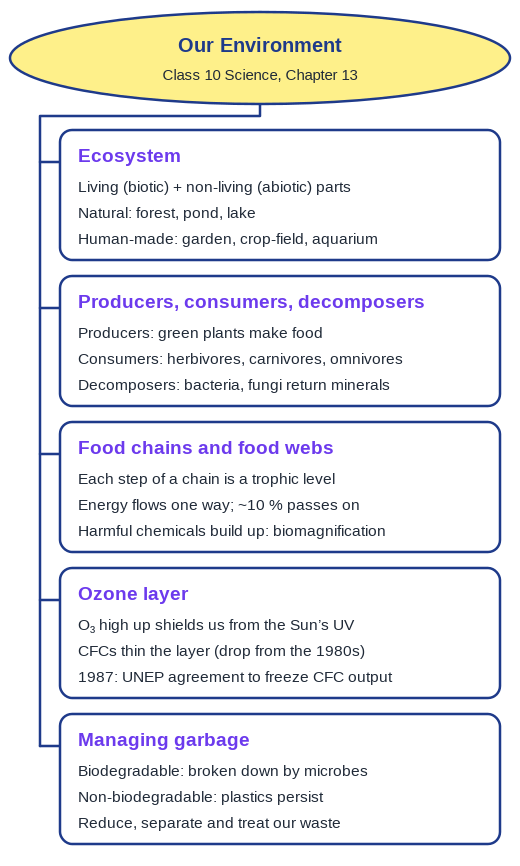
An ecosystem is all the living things of an area together with its non-living surroundings. Producers make food from sunlight, consumers eat them, and decomposers return minerals to the soil. Each step of a food chain is a trophic level; energy flows one way, and only about 10 per cent passes to the next level, so chains have three or four steps. Chemicals that do not break down build up along a chain (biological magnification). Ozone high in the atmosphere shields us from UV and is thinned by CFCs. Waste is biodegradable or non-biodegradable, and its disposal causes serious problems.
What is this chapter about?
We hear the word “environment” on the news, at home and in school, and countries meet regularly to talk about environmental problems. This short chapter, the last one in the Class 10 Science book, looks at two things: how the parts of our environment depend on each other, and how our own activities change it. The first half is about ecosystems, food chains and the flow of energy; the second is about two problems in detail, the thinning of the ozone layer and the disposal of waste.
What is an ecosystem?
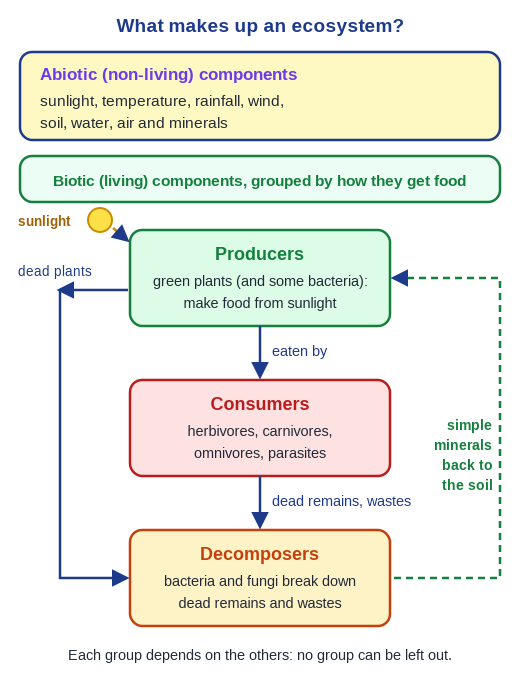
Plants, animals, microorganisms, human beings and their physical surroundings all act on each other and keep a balance in nature. An ecosystem is all the interacting organisms of an area together with the non-living parts of their environment. It has:
- biotic components: the living organisms;
- abiotic components: physical factors such as temperature, rainfall, wind, soil and minerals.
A garden is an ecosystem: grasses, trees, flowering plants such as rose and sunflower, and animals such as frogs, insects and birds interact with each other, and their growth and other activities depend on the abiotic factors. Forests, ponds and lakes are natural ecosystems; gardens and crop-fields are human-made (artificial) ecosystems.
In Activity 13.1 you plan an aquarium: the fish need room to swim, water, oxygen (from an aerator) and food. With a few water plants and animals added, it can sustain itself for a while, so an aquarium is a human-made ecosystem. It still has to be cleaned now and then, because it is small and closed and wastes collect in it faster than they are broken down.
Who are producers, consumers and decomposers?
Organisms are grouped by how they get their food:
- Producers: all green plants and certain bacteria. They make organic food such as sugar and starch from simple inorganic substances, using the energy of sunlight in the presence of chlorophyll (photosynthesis).
- Consumers: organisms that depend on producers, directly or through other consumers. They are herbivores (eat plants), carnivores (eat animals), omnivores (eat both) and parasites (live on or in a host).
- Decomposers: microorganisms, mainly bacteria and fungi, that break down the dead remains and wastes of organisms. They turn complex organic substances into simple inorganic ones that go back into the soil and are used again by plants. Without them, dead bodies and wastes would pile up and the soil would not be replenished.
What are food chains and trophic levels?
In Activity 13.2 you list the water organisms of an aquarium in the order of who eats whom. Such a series of organisms, each feeding on the one before, is a food chain, for example grass → deer → tiger. Each step of a food chain is a trophic level:
- Producers (autotrophs): first trophic level. They trap solar energy and make it available to the rest.
- Herbivores, the primary consumers: second level.
- Small carnivores, the secondary consumers: third level.
- Large carnivores, the tertiary consumers: fourth level.
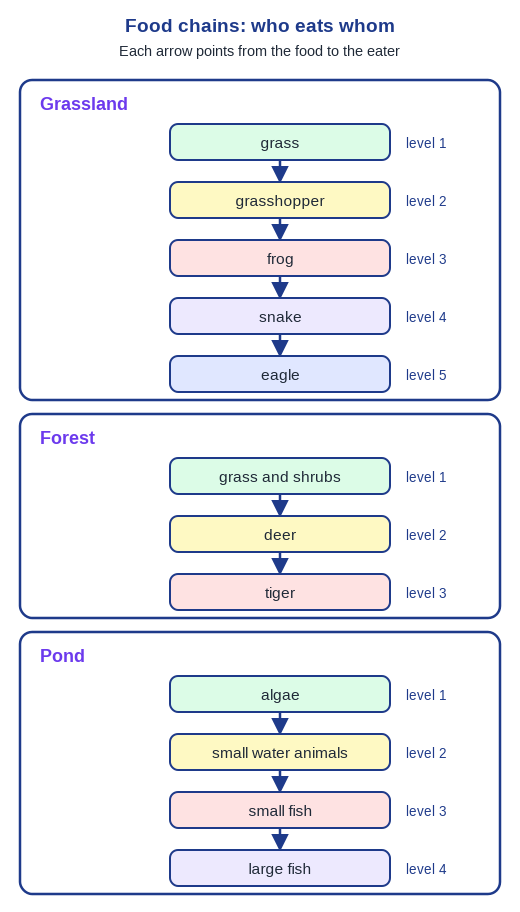
Most organisms are eaten by two or more kinds of organisms, which in turn are eaten by several others. So the real feeding links form a network of branching chains, a food web. Read more in food chains and food webs.
How does energy flow, and what is the 10 per cent law?
Producers capture the energy of sunlight and turn it into chemical energy in food. This energy then passes to the consumers and the decomposers. Every time energy changes form, some is lost to the surroundings in a form that cannot be used again. Studies of energy flow show that:
- green plants on land capture about 1 % of the sunlight that falls on their leaves;
- when a herbivore eats plants, a great deal of energy is lost as heat, some goes into digestion and work, and the rest into growth and reproduction. On average about 10 % of the food eaten becomes the animal’s own body and is available to the next level. This is the 10 per cent law;
- since so little energy reaches the next level, food chains usually have only three or four steps;
- lower trophic levels usually have more individuals, and producers are the most numerous.
Worked example (our own numbers): if 1,000,000 J of sunlight falls on the leaves, the plants store about 10,000 J. Then herbivores get about 1,000 J, small carnivores about 100 J and large carnivores about 10 J.
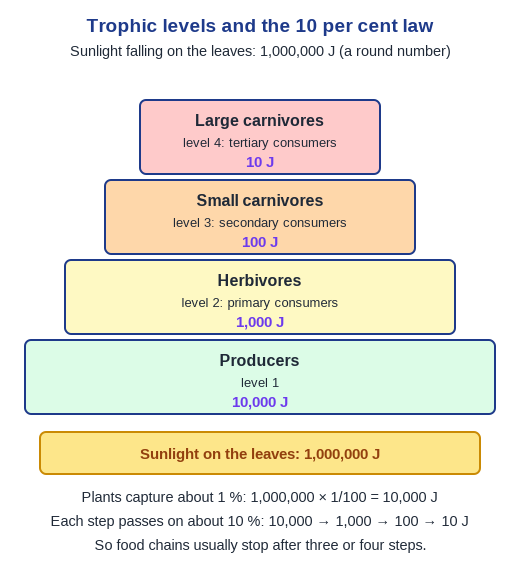
Two things follow. Energy flows one way only: energy taken in by producers does not go back to the Sun, and energy passed to herbivores does not go back to the plants. And the energy available becomes less at each level.
What is biological magnification?
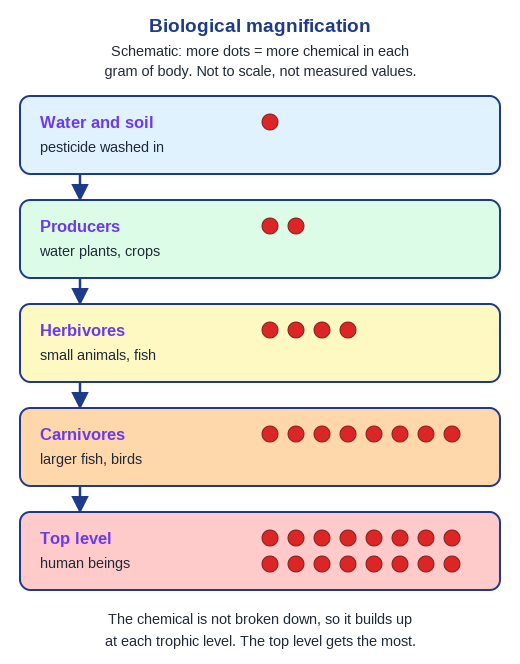
Farmers use pesticides and other chemicals to protect crops. Some of these wash into the soil or into water bodies. Plants absorb them from the soil with water and minerals, and water plants and animals take them up from ponds and rivers; this is one way they enter the food chain. Because these chemicals are not degradable, they are not broken down and build up at each trophic level. Human beings sit at the top of most food chains, so the highest concentration collects in our bodies. This is biological magnification. It is why grains such as wheat and rice, vegetables, fruits and even meat contain varying amounts of pesticide residue, which washing cannot always remove.
What is the ozone layer, and why is it thinning?
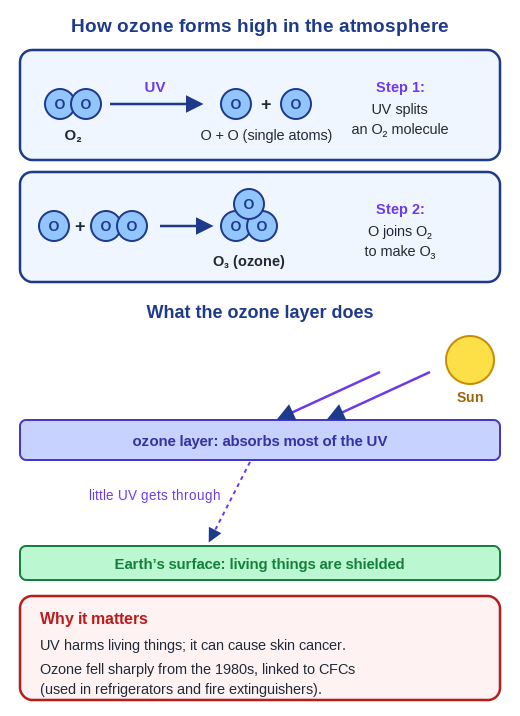
Ozone (O₃) is a molecule of three oxygen atoms. Ordinary oxygen, O₂, is essential for aerobic life, but the book describes ozone as a deadly poison to breathe. High in the atmosphere, however, ozone does an essential job: it shields the earth from the Sun’s ultraviolet (UV) radiation, which harms living things and can cause skin cancer in human beings.
Up there, ozone is made by UV acting on oxygen. High-energy UV splits some O₂ molecules into single oxygen atoms, and each atom joins an O₂ molecule:
- O₂ → O + O (in the presence of UV)
- O + O₂ → O₃ (ozone)
The amount of ozone began to drop sharply in the 1980s. This fall has been linked to synthetic chemicals called chlorofluorocarbons (CFCs), used as refrigerants and in fire extinguishers. In 1987 the United Nations Environment Programme (UNEP) succeeded in forging an agreement to freeze CFC production at 1986 levels, and the book adds that manufacturers everywhere must now make refrigerators without CFCs. Read more in ozone depletion and managing garbage.
What happens to the garbage we produce?
Every day we throw away kitchen waste, paper, packets, bottles, old clothes and more. In Activity 13.5 such waste is buried in a pit in the school garden (or a pot of soil) and checked every 15 days: some things change form quickly, others do not change at all.
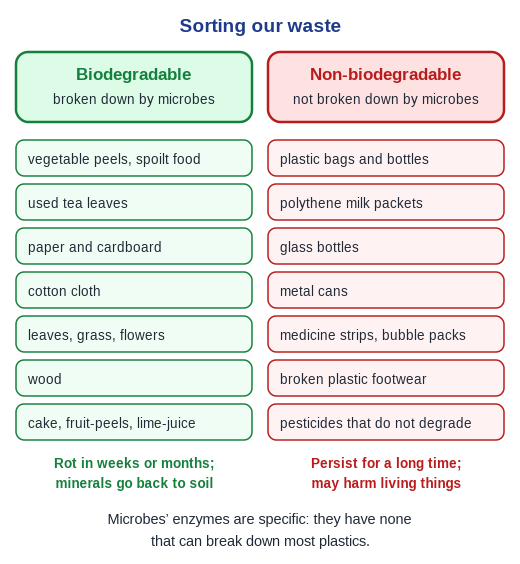
The reason lies in enzymes. Enzymes are specific: each breaks down only particular substances. That is why we would get no energy from eating coal, and why bacteria and other saprophytes cannot break down many human-made materials such as plastics. Heat and pressure act on them, but under ordinary conditions they last a long time.
- Biodegradable substances are broken down by biological processes: peels, food, paper, cotton, wood, leaves.
- Non-biodegradable substances are not: most plastics, polythene, glass and metal cans. They may be inert and simply persist, or they may harm members of the ecosystem.
Better lifestyles produce more waste, more things are now disposable, and much packaging is non-biodegradable. The book asks you to find out how your local body (panchayat, municipal corporation or resident welfare association) collects waste, whether it treats biodegradable and non-biodegradable waste separately, how sewage and factory wastes are treated, and what hazards electronic waste and plastic recycling bring. Its “Think it over” box uses tea cups in trains as an example: returnable plastic glasses gave way to disposable cups for hygiene, clay kulhads were suggested but making them on a large scale would remove fertile top-soil, and paper cups are now used.
Before we move on
Activities 13.5 to 13.9 involve collecting waste and finding out about local systems. Do the waste-burying activity only with a teacher, in the school garden or a pot of soil as the book says; wear gloves, leave out anything sharp or broken, and wash your hands afterwards. Answers to all three Questions boxes, the activities and all 9 exercises are in the NCERT solutions for Chapter 13.
Key terms
| Term | Meaning |
|---|---|
| Ecosystem | All the interacting living organisms of an area together with the non-living parts of their surroundings. A pond, a forest and a garden are ecosystems. |
| Biotic and abiotic components | Biotic components are the living organisms. Abiotic components are physical factors such as temperature, rainfall, wind, soil and minerals. |
| Producers | Green plants and certain bacteria that make organic food such as sugar and starch from inorganic substances, using sunlight and chlorophyll. |
| Consumers | Organisms that eat food made by producers, directly or by eating other consumers: herbivores, carnivores, omnivores and parasites. |
| Decomposers | Bacteria and fungi that break down dead remains and wastes into simple inorganic substances, which go back into the soil for plants to use. |
| Food chain | A series of organisms in which each one eats the one before it, such as grass → deer → tiger. |
| Trophic level | Each step or level of a food chain. Producers are the first trophic level, herbivores the second, small carnivores the third and large carnivores the fourth. |
| Food web | A network of branching, interlinked food chains, because most organisms are eaten by two or more kinds of organisms. |
| 10 per cent law | On average only about 10 per cent of the energy in the food at one trophic level is available to the next level; the rest is lost, mostly as heat. |
| Biological magnification | The build-up of a harmful chemical that does not break down, such as some pesticides, at each higher trophic level of a food chain. |
| Ozone (O₃) | A molecule of three oxygen atoms. High in the atmosphere it forms a layer that shields the earth from the Sun’s ultraviolet (UV) radiation. |
| Biodegradable and non-biodegradable | Biodegradable substances are broken down by biological processes, mainly by bacteria and other microorganisms. Non-biodegradable substances, such as most plastics, are not, and persist for a long time. |
Topics in this chapter
Practice
-
Which of these is a producer?
Show answer
Answer: (b) grass
-
In the food chain grass → goat → human, the goat is at the:
Show answer
Answer: (b) second trophic level
-
If producers store 20,000 J, about how much energy reaches the third trophic level?
Show answer
Answer: (b) 200 J
-
The maximum amount of a non-degradable pesticide is found at the:
Show answer
Answer: (d) top of the food chain
-
Which chemicals have been linked to the depletion of the ozone layer?
Show answer
Answer: (b) chlorofluorocarbons (CFCs)
Questions students ask
What are the main topics of Class 10 Science Chapter 13?
The ecosystem and its components (producers, consumers and decomposers), food chains and food webs, trophic levels, the flow of energy and the 10 per cent law, biological magnification, the ozone layer and its depletion, and managing the garbage we produce (biodegradable and non-biodegradable substances).
Is Our Environment in the 2026-27 NCERT book?
Yes. It is Chapter 13, the last chapter of Science, the Class 10 NCERT textbook marked Reprint 2026-27, on pages 208 to 217. It has nine activities, three Questions boxes and 9 exercises.
Why do food chains usually have only three or four steps?
Only about 10 per cent of the energy at one trophic level reaches the next. After three or four steps so little usable energy is left that it cannot support another level of consumers.
Why is ozone harmful at ground level but useful high up?
The book calls ozone a deadly poison to breathe, so it is harmful near the ground. High in the atmosphere, though, the ozone layer absorbs most of the Sun’s ultraviolet radiation and so protects living things on the earth.
Which parts of this chapter should I practise for the board exam?
Writing food chains with their trophic levels, working out energy at each level with the 10 per cent law, explaining biological magnification, the formation of ozone and the role of CFCs, and sorting waste into biodegradable and non-biodegradable with their effects.
Stuck on a question?
Take a photo and Lagnever AI explains it step by step. Try it for 7 days for ₹2.
Get it on Google Play Open in browser
For parents: after the trial, the plan renews monthly by UPI or card autopay. You can cancel anytime in the app.