
How do our activities affect the environment?
Answer in short
Ozone (O₃) forms high in the atmosphere when UV splits O₂ and the oxygen atoms join O₂. This layer shields the earth from UV, which can cause skin cancer. Ozone fell sharply from the 1980s, linked to CFCs, and in 1987 UNEP forged an agreement to freeze CFC production. Our waste is biodegradable or non-biodegradable; plastics persist.
Stuck on a question? Take a photo and Lagnever AI explains it step by step. Try it for 7 days for ₹2. Get it on Google Play
This page covers section 13.2 of the chapter: the ozone layer and how it is getting depleted (13.2.1), and managing the garbage we produce (13.2.2). We are part of the environment: changes in it affect us, and our activities change it. Of the many problems, the chapter looks at these two in detail.
What is ozone, and where does it come from?
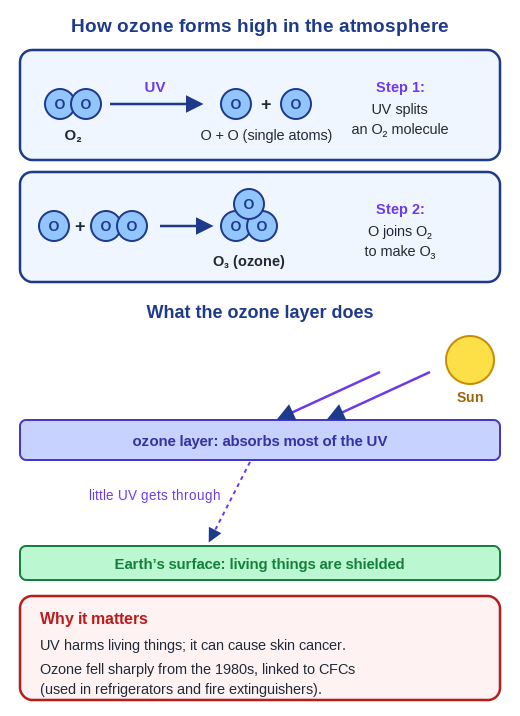
Ozone (O₃) is a molecule made of three oxygen atoms. Ordinary oxygen (O₂) is essential for all aerobic life, but ozone is poisonous to breathe; the book calls it a deadly poison. Yet high in the atmosphere it does an essential job: it shields the earth’s surface from the Sun’s ultraviolet (UV) radiation. UV is highly damaging to organisms; in human beings it is known to cause skin cancer.
Ozone up there is made by UV acting on oxygen, in two steps:
- High-energy UV splits some oxygen molecules into single oxygen atoms: O₂ → O + O (in the presence of UV).
- Each oxygen atom joins an oxygen molecule: O + O₂ → O₃ (ozone).
Atom check: step 1 has 2 O atoms on each side; step 2 has 1 + 2 = 3 O atoms on the left and 3 on the right.
Why is the ozone layer getting thinner?
The amount of ozone in the atmosphere began to drop sharply in the 1980s. This fall has been linked to chlorofluorocarbons (CFCs), synthetic chemicals used as refrigerants and in fire extinguishers. In 1987, the United Nations Environment Programme (UNEP) succeeded in forging an agreement to freeze CFC production at 1986 levels. The book adds that all manufacturers throughout the world must now make refrigerators without CFCs.
A thinner ozone layer lets more UV reach the ground, which harms living things. Activity 13.4 asks you to find out from the library, the internet or newspapers which chemicals deplete the ozone layer, and whether the rules made to control them have reduced the damage. Use recent scientific reports for that, and note the source and its date.
What happens to the waste we throw away?
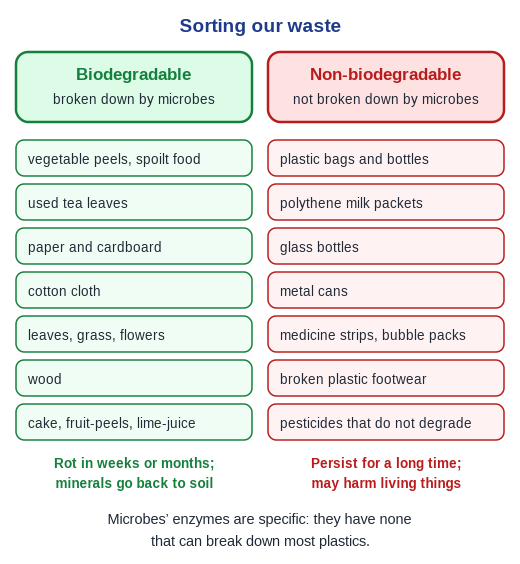
In Activity 13.5 a day’s household waste (spoilt food, vegetable peels, used tea leaves, milk packets, empty cartons, waste paper, medicine bottles and strips, old clothes, broken footwear) is buried in a pit in the school garden, or in an old bucket or flower pot under at least 15 cm of soil. It is kept moist and checked every 15 days. Peels, food scraps, tea leaves and paper change form; plastic packets, bubble packs and glass stay as they were. Food and peels change the fastest.
Why? Enzymes are specific: each enzyme breaks down only particular substances. The same idea explains why eating coal would give us no energy. Bacteria and other saprophytes have no enzymes for many human-made materials such as plastics. Heat and pressure can act on these, but under the ordinary conditions of our environment they last for a long time.
- Biodegradable substances are broken down by biological processes, mainly by microorganisms.
- Non-biodegradable substances are not. They may be inert and simply persist, or they may harm members of the ecosystem.
Why is garbage a growing problem?
Visit any town and you see heaps of garbage; visit a tourist spot and you see empty food wrappers. Three changes make it worse:
- Better lifestyles mean more waste is generated.
- Attitudes have changed: more and more things we use are disposable.
- Packaging has changed, so much of our waste is now non-biodegradable.
The book’s activities ask you to study the system around you:
- Activity 13.6: read more about the two kinds of substance, how long non-biodegradable ones last, and whether new plastics sold as biodegradable really do no harm.
- Activity 13.7: find out how your panchayat, municipal corporation or resident welfare association collects and treats waste, whether biodegradable and non-biodegradable waste are treated separately, and estimate how much waste your home and your classroom produce in a day and how much of it is biodegradable.
- Activity 13.8: find out how sewage in your area is treated and how local industries treat their wastes so that soil and water stay clean.
- Activity 13.9: find out which hazardous materials have to be handled when electronic items are thrown away, and how plastics are recycled and whether that affects the environment.
Think it over: tea cups in trains
The book’s box tells how tea in trains was once served in plastic glasses that were returned to the vendor. Disposable plastic cups came in for hygiene, without much thought for millions of cups thrown away each day. Clay kulhads were suggested, but making them on a large scale would use up fertile top-soil. Now disposable paper cups are used.
Advantages of paper cups over disposable plastic cups: paper is biodegradable, so used cups are broken down by microbes instead of piling up for years; it comes from a renewable source; and paper can be recycled. The lesson of the box is that every choice has some cost, so it is worth thinking through before a change is made.
What can each of us do? (Extra tips)
- Carry a cloth bag and refuse extra plastic packaging.
- Keep wet (biodegradable) and dry (non-biodegradable) waste in separate bins.
- Reuse things, send them for recycling, and never burn plastic.
The Questions boxes on pages 214 and 216 are solved in the NCERT solutions for Chapter 13. See also food chains and food webs, or go back to the Chapter 13 notes.
Practice
-
Ozone is a molecule made of:
Show answer
Answer: (b) three oxygen atoms
-
The ozone layer protects us from:
Show answer
Answer: (b) ultraviolet radiation
-
Which of these is non-biodegradable?
Show answer
Answer: (c) polythene bag
-
Write the two steps by which ozone forms high in the atmosphere.
Show answer
Answer: Step 1: high-energy UV radiation splits an oxygen molecule into two oxygen atoms, O₂ → O + O. Step 2: an oxygen atom joins an oxygen molecule to form ozone, O + O₂ → O₃.
-
Why can bacteria break down a vegetable peel but not a plastic bag?
Show answer
Answer: Enzymes are specific: each breaks down only certain substances. Bacteria have enzymes for the natural substances in a peel, but none for the human-made material of most plastics, so the bag persists.
Questions students ask
What are CFCs?
Chlorofluorocarbons, synthetic chemicals that have been used as refrigerants and in fire extinguishers. The book says the sharp fall in ozone from the 1980s has been linked to them.
What was decided in 1987?
The book says that in 1987 the United Nations Environment Programme (UNEP) succeeded in forging an agreement to freeze CFC production at 1986 levels, and that manufacturers throughout the world must now make refrigerators without CFCs.
Is a paper cup better than a plastic cup?
The book leaves this as a question to think about. Points you can make: paper is biodegradable and comes from a renewable source, while plastic persists; but (Extra) paper cups also need trees, water and energy to make, and a waste system to collect them.
Can I do the waste activities at home?
Activity 13.5 is meant for a pit in the school garden, or an old bucket or pot of soil, under a teacher. Wear gloves, leave out anything sharp or broken, and wash your hands. The other activities are surveys and library research.
Stuck on a question?
Take a photo and Lagnever AI explains it step by step. Try it for 7 days for ₹2.
Get it on Google Play Open in browser
For parents: after the trial, the plan renews monthly by UPI or card autopay. You can cancel anytime in the app.