
NCERT Solutions Class 10 Science Chapter 13: Our Environment
Answers to the three Questions boxes inside Chapter 13, Our Environment, the activities, the “Think it over” box and all 9 end-of-chapter exercises, from Science, the Class 10 NCERT textbook. Page numbers follow the 2026-27 reprint (pages 208–217). The exercises are quoted from the book; the in-chapter questions are restated in short. Energy values are worked out with the 10 per cent law and checked by script, and the answers to Exercises 1–3 match the answer key at the end of the book. Points that go beyond the chapter are marked “Extra”. Do the activities only with a teacher; for the waste activity, wear gloves, leave out anything sharp or broken, and wash your hands. Short notes: Chapter 13 notes.
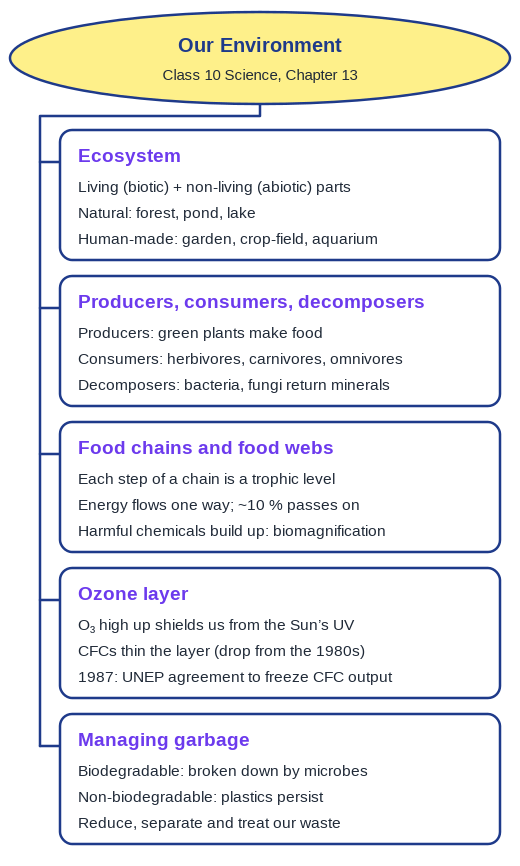
Questions, page 212
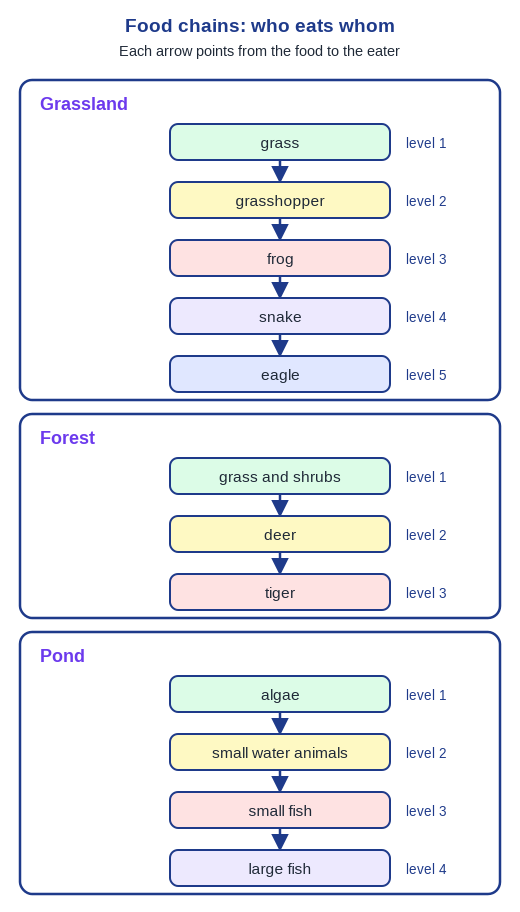
Question 1 (page 212): what are trophic levels? Give a food chain and name its trophic levels. Each step or level of a food chain at which organisms get their food is a trophic level. Example: grass → grasshopper → frog → snake.
- Grass: producer, first trophic level.
- Grasshopper: herbivore (primary consumer), second trophic level.
- Frog: small carnivore (secondary consumer), third trophic level.
- Snake: larger carnivore (tertiary consumer), fourth trophic level.
Question 2 (page 212): the role of decomposers in the ecosystem. Decomposers, mainly bacteria and fungi, break down the dead remains and wastes of plants and animals. They turn complex organic substances into simple inorganic substances that go back into the soil, where plants use them again. So they (1) recycle nutrients and keep the soil replenished, and (2) clean the environment by removing dead bodies and wastes that would otherwise pile up.
Questions, page 214
Question 1 (page 214): why are some substances biodegradable and others not? Substances are broken down in nature by the enzymes of bacteria and other saprophytes, and enzymes are specific: each acts only on particular substances. Natural materials such as food, peels, paper and cotton have matching enzymes, so they are biodegradable. Many human-made materials such as plastics have no enzymes that can act on them, so they are non-biodegradable and persist for a long time.
Question 2 (page 214): two ways in which biodegradable substances would affect the environment.
- Broken down by decomposers, they return nutrients to the soil, which plants use again; in compost pits they make good manure.
- Extra: when large amounts rot in open heaps, they give off foul smells and attract flies and germs that spread disease.
Question 3 (page 214): two ways in which non-biodegradable substances would affect the environment.
- They are not broken down, so they persist for a long time and pile up as garbage.
- They can harm members of the ecosystem: non-degradable chemicals such as some pesticides enter food chains and build up by biological magnification. (Extra: plastic bags can also choke drains, and animals may swallow them.)
Questions, page 216
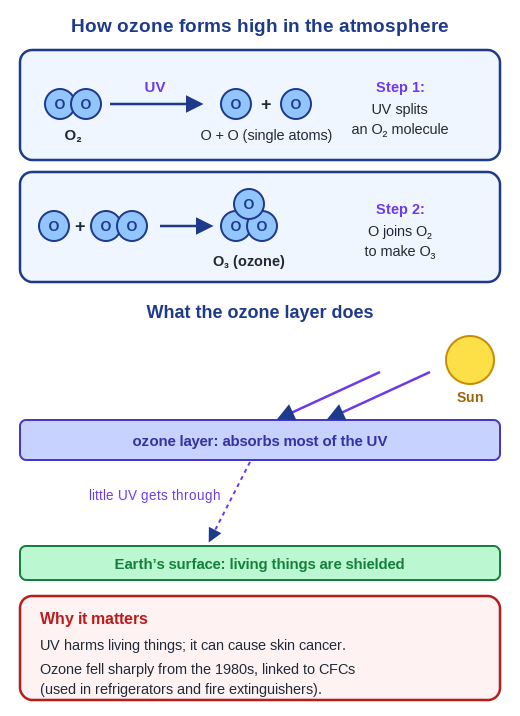
Question 1 (page 216): what is ozone, and how does it affect an ecosystem? Ozone (O₃) is a molecule of three oxygen atoms. It forms high in the atmosphere when UV splits O₂ into oxygen atoms that join O₂ molecules (O₂ → O + O; O + O₂ → O₃). The ozone layer shields the earth from the Sun’s UV radiation, which is highly damaging to organisms; in human beings it is known to cause skin cancer. If the layer thins, more UV reaches the ground and harms the living things of every ecosystem. (At ground level ozone is itself poisonous to breathe.)
Question 2 (page 216): two ways you can help reduce the problem of waste disposal.
- Separate waste at home into biodegradable and non-biodegradable bins, and compost the biodegradable part.
- Reduce and reuse: carry a cloth bag instead of taking polythene bags, avoid disposable items, and send paper, glass, metal and plastic for recycling.
What the activities show (Activities 13.1–13.9)
Do the activities only with a teacher. Most of them are surveys, discussion and library research.
- Activity 13.1 (aquarium): the fish need room to swim, water, oxygen (an aerator) and food; with water plants and animals added it becomes nearly self-sustaining, a human-made ecosystem. It must still be cleaned now and then, because it is small and closed: wastes and dead matter collect faster than its few decomposers can break them down. Ponds and lakes are not cleaned like this, because they are large natural ecosystems in which decomposers break down wastes and the water is renewed.
- Activity 13.2 (who eats whom): do not put a predatory fish in the aquarium, or it would eat the others. A chain of three steps: water plants → small fish → larger fish. Producers, consumers and decomposers all depend on each other; producers are the start of every chain, but no group can be called the only important one, since without decomposers minerals would not return and without consumers numbers would not be kept in balance. (The book’s text on page 210 refers to this as “Activity 13.4”; it is Activity 13.2 in this reprint.)
- Activity 13.3 (pesticides in food): the pesticides come from crops sprayed in the field, washed into soil and water; they can reach us through grains, vegetables, fruits and meat too. Ways to reduce intake: wash and peel produce, use only the pesticide doses advised, and prefer methods of pest control that need fewer chemicals. Keep the group debate on the science and give each side a fair hearing.
- Activity 13.4 (ozone): CFCs are the chemicals named by the chapter. Extra: international scientific assessments report that the amount of ozone-depleting chemicals in the atmosphere has been falling since controls began, and that the ozone layer is expected to recover only slowly, over decades; check the latest report for current details.
- Activity 13.5 (buried waste): peels, spoilt food, tea leaves, paper and cotton change form, food and peels fastest; polythene, plastic packets, bubble packs, glass and metal stay unchanged.
- Activities 13.6–13.9 (surveys): these are research and survey tasks about biodegradable materials, local waste and sewage systems, industrial wastes, electronic waste and plastic recycling. Record what you find with its source; the answers differ from place to place.
Think it over (page 215): paper cups over disposable plastic cups? Paper cups are biodegradable, so they are broken down by microbes instead of persisting for years; paper comes from a renewable source and can be recycled; and unlike kulhads, making them does not remove fertile top-soil.
Exercises 1 to 3
1. “Which of the following groups contain only biodegradable items? (a) Grass, flowers and leather (b) Grass, wood and plastic (c) Fruit-peels, cake and lime-juice (d) Cake, wood and grass”
(a), (c) and (d). Grass, flowers, leather, fruit-peels, cake, lime-juice and wood are all broken down by microorganisms (leather and wood only slowly). Group (b) contains plastic, which is non-biodegradable. This matches the answer key.
2. “Which of the following constitute a food-chain? (a) Grass, wheat and mango (b) Grass, goat and human (c) Goat, cow and elephant (d) Grass, fish and goat”
(b) Grass, goat and human. Grass (producer) → goat (herbivore) → human (consumer). In (a) all three are plants, in (c) all three are herbivores, and in (d) a goat does not eat fish.
3. “Which of the following are environment-friendly practices? (a) Carrying cloth-bags to put purchases in while shopping (b) Switching off unnecessary lights and fans (c) Walking to school instead of getting your mother to drop you on her scooter (d) All of the above”
(d) All of the above. Cloth bags cut down plastic waste, switching off saves electricity, and walking saves fuel and avoids exhaust gases.
Exercises 4 to 9
4. “What will happen if we kill all the organisms in one trophic level?”
The food chain breaks at that point. The level above loses its food: its organisms would starve, die out or move away, and the effect passes up to the higher levels. The level below loses what was eating it, so its numbers may grow unchecked and over-use its own food. For example, if all the herbivores are killed, the plants grow unchecked while the carnivores starve. The balance of the ecosystem is upset.
5. “Will the impact of removing all the organisms in a trophic level be different for different trophic levels? Can the organisms of any trophic level be removed without causing any damage to the ecosystem?”
Yes, the impact differs.
- Removing the producers is the most damaging: no energy enters the ecosystem, so every other level collapses.
- Removing the herbivores starves the carnivores, and the plants grow unchecked.
- Removing the carnivores lets the herbivores multiply and overgraze the plants.
- Removing the decomposers stops dead matter from being broken down; wastes pile up and minerals do not return to the soil.
No. Every trophic level is linked to the others through food and energy, so removing any of them damages the ecosystem.
6. “What is biological magnification? Will the levels of this magnification be different at different levels of the ecosystem?”
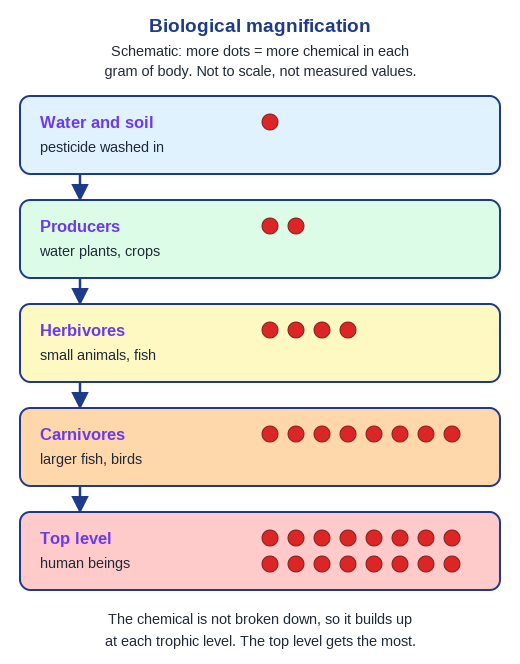
Biological magnification is the build-up of harmful chemicals that are not degradable, such as some pesticides, at each successive trophic level of a food chain. They enter through plants (from soil) and water organisms (from water bodies) and are not broken down, so they collect in the bodies of the organisms that eat them.
Yes, the levels differ. The concentration is lowest at the producer level and rises at each higher trophic level, because each organism eats many organisms of the level below. It is highest at the top, where human beings are in most food chains.
7. “What are the problems caused by the non-biodegradable wastes that we generate?”
- They are not broken down, so they persist and pile up in the environment as garbage heaps.
- Non-degradable chemicals such as some pesticides enter food chains and build up by biological magnification.
- They can harm the members of the ecosystem.
- Extra: plastic bags block drains and sewers, causing water-logging; in soil they stop water from soaking in; and animals that swallow them can be harmed or killed.
- Burning them gives off harmful gases that pollute the air (Extra).
8. “If all the waste we generate is biodegradable, will this have no impact on the environment?”
No, it will still have an impact, though a smaller and shorter one. Biodegradable waste takes time to break down. Extra: if large amounts are dumped in heaps, they rot, smell and breed flies and germs that spread disease, and dumped in water they make it dirty and can use up the oxygen in it as they decay. So even biodegradable waste must be collected and treated properly, for example by composting.
9. “Why is damage to the ozone layer a cause for concern? What steps are being taken to limit this damage?”
Concern: the ozone layer shields the earth from the Sun’s UV radiation, which is highly damaging to organisms and is known to cause skin cancer in human beings. If the layer is damaged, more UV reaches the ground and harms living things.
Steps: the damage has been linked to CFCs. In 1987 the United Nations Environment Programme (UNEP) succeeded in forging an agreement to freeze CFC production at 1986 levels, and all manufacturers throughout the world must now make refrigerators without CFCs.
Go back to the Chapter 13 notes, or read food chains and food webs and ozone depletion and managing garbage.
Practice
-
Which of these groups contains only non-biodegradable items?
Show answer
Answer: (b) polythene, glass bottle, aluminium can
-
In the chain plants → insect → frog → snake → hawk, the snake is at the:
Show answer
Answer: (c) fourth trophic level
-
Human beings are at the top of a food chain. With a non-degradable pesticide, they get:
Show answer
Answer: (c) the highest concentration
-
Producers in a field store 50,000 J. How much energy is available to the tertiary consumers?
Show answer
Answer: Tertiary consumers are the fourth trophic level. 50,000 J → 5,000 J (primary consumers) → 500 J (secondary consumers) → 50 J (tertiary consumers), taking 10 per cent at each step.
-
Balance-check the two steps of ozone formation by counting oxygen atoms.
Show answer
Answer: O₂ → O + O: 2 atoms on the left, 1 + 1 = 2 on the right. O + O₂ → O₃: 1 + 2 = 3 atoms on the left, 3 on the right. Both are balanced.
Stuck on a question?
Take a photo and Lagnever AI explains it step by step. Try it for 7 days for ₹2.
Get it on Google Play Open in browser
For parents: after the trial, the plan renews monthly by UPI or card autopay. You can cancel anytime in the app.