
What are food chains and food webs?
Answer in short
A food chain is a series of organisms, each eating the one before it, such as grass → grasshopper → frog → snake. Each step is a trophic level, starting with the producers. Energy flows one way and only about 10 per cent passes to the next level, so chains have three or four steps. Linked chains form a food web.
Stuck on a question? Take a photo and Lagnever AI explains it step by step. Try it for 7 days for ₹2. Get it on Google Play
This page covers section 13.1 of the chapter: the ecosystem and its components, and food chains and webs (13.1.1).
What is an ecosystem made of?
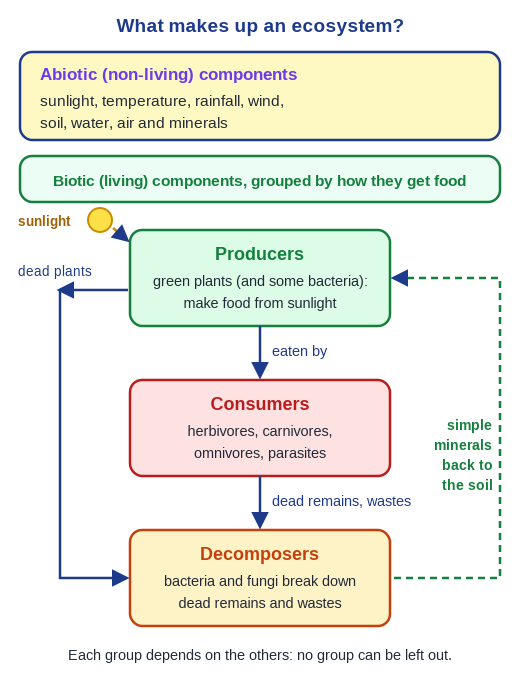
An ecosystem is all the interacting organisms of an area together with the non-living parts of their surroundings. It has biotic components (living organisms) and abiotic components (temperature, rainfall, wind, soil, minerals). Forests, ponds and lakes are natural ecosystems; gardens, crop-fields and an aquarium are human-made.
The living part is grouped by how each organism gets food:
- Producers: green plants and certain bacteria, which make sugar and starch from inorganic substances using sunlight and chlorophyll.
- Consumers: herbivores, carnivores, omnivores and parasites, which depend on producers directly or indirectly.
- Decomposers: bacteria and fungi, which break down dead remains and wastes into simple inorganic substances that return to the soil.
Each group depends on the others. Remove the decomposers and dead matter piles up while the soil runs short of minerals; remove the producers and no energy enters the system at all.
How is a food chain built?
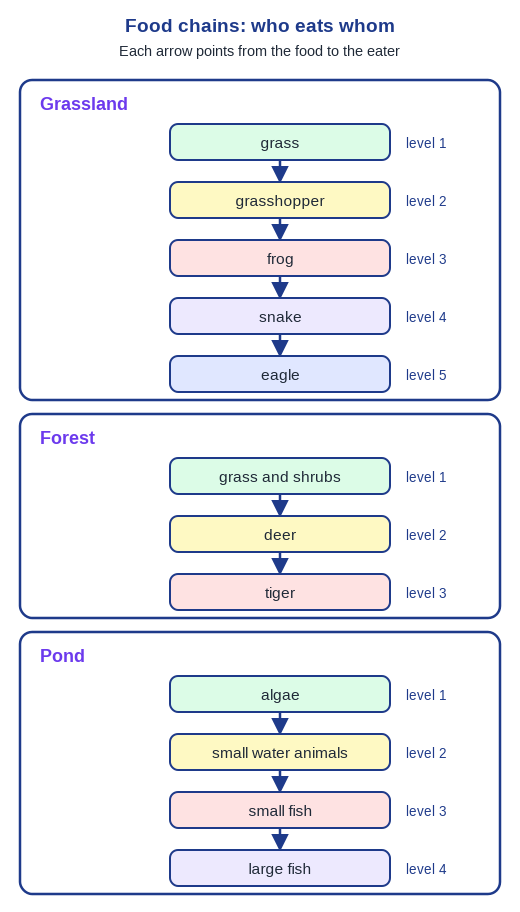
A food chain lists organisms in the order in which each eats the one before it. The arrow points from the food to the eater. Each step is a trophic level:
| Trophic level | Who | Also called |
|---|---|---|
| First | Producers (autotrophs) | — |
| Second | Herbivores | Primary consumers |
| Third | Small carnivores | Secondary consumers |
| Fourth | Large carnivores | Tertiary consumers |
Some examples (our own):
- Forest: grass and shrubs → deer → tiger (three levels).
- Pond: algae → small water animals → small fish → large fish (four levels).
- Grassland: grass → grasshopper → frog → snake → eagle (five levels; longer chains like this are less common).
What is a food web?
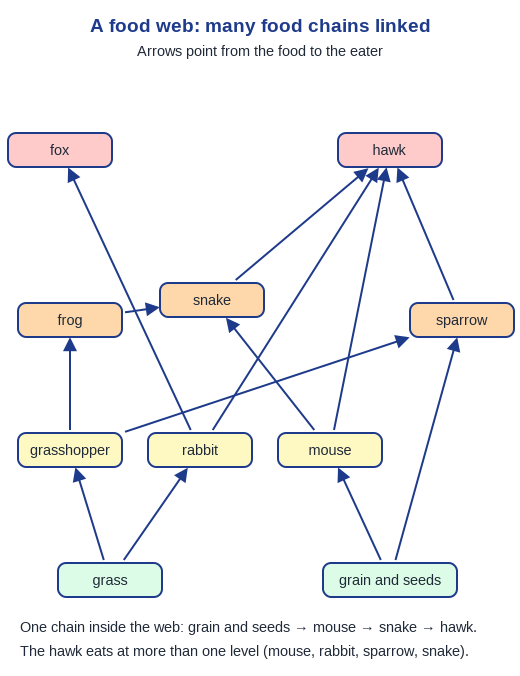
Food chains vary greatly in length and complexity. Each organism is usually eaten by two or more kinds of organisms, and those by several others. So the feeding links are better shown as branching lines: a food web. In the web below, the hawk eats the mouse, the rabbit, the sparrow and the snake, so it sits at more than one trophic level.
How does energy flow through the levels?
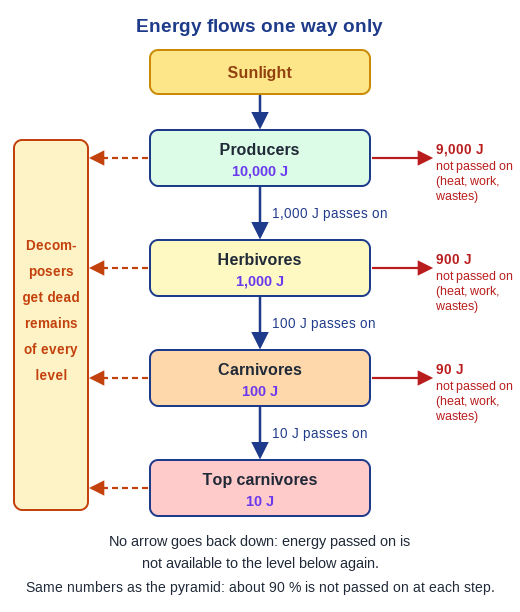
Producers trap sunlight and store it as chemical energy in food. Whenever energy changes form, some is lost to the surroundings in a form that cannot be used again. So:
- green plants on land capture about 1 % of the sunlight on their leaves;
- a herbivore loses much of the energy in its food as heat, uses some for digestion and work, and puts the rest into growth and reproduction. On average about 10 % of the food eaten becomes its own body and is available to the next level: the 10 per cent law;
- so little energy is left after three or four steps that food chains are usually that short;
- there are generally more individuals at lower levels; producers are the most numerous.
Worked example (our own numbers): 1,000,000 J of sunlight on the leaves → producers 10,000 J (1 %) → herbivores 1,000 J → small carnivores 100 J → large carnivores 10 J. At each step about 90 % is not passed on. So the fourth level gets only 10 ÷ 1,000,000 = 0.001 % of the sunlight that fell on the leaves.
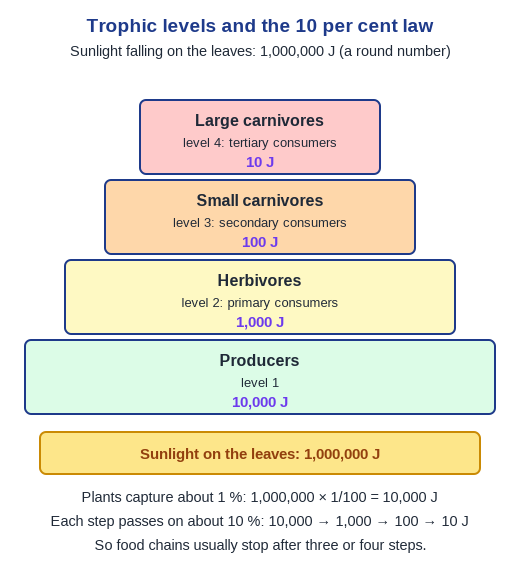
The chapter draws two conclusions from the energy-flow diagram:
- The flow of energy is unidirectional. Energy taken in by producers does not go back to the Sun, and energy passed to herbivores does not go back to the producers. Once it moves up, it is no longer available to the level below.
- The energy available becomes less and less at each trophic level, because of the loss at every step.
How do harmful chemicals climb a food chain?
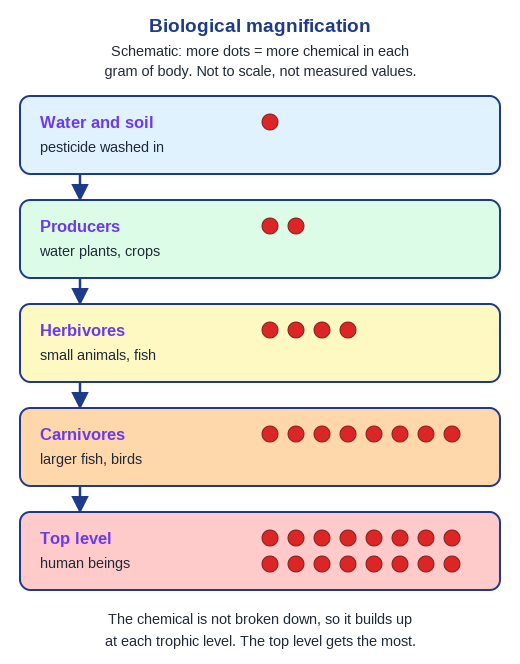
Pesticides and other chemicals sprayed on crops are washed into the soil and into water bodies. Plants take them up from the soil with water and minerals, and water plants and animals take them up from the water. Many of these chemicals are not degradable, so they are not broken down in the body. Each animal eats many organisms from the level below, and the chemical accumulates more at each higher trophic level. Human beings are at the top of most food chains, so the highest concentration ends up in our bodies. This is biological magnification.
That is why wheat, rice, vegetables, fruits and even meat can carry pesticide residues, which washing or other means cannot always remove. Activity 13.3 asks you to debate, in groups, bans on food items with pesticide levels reported in the news, to think about where those pesticides came from, and to discuss ways to reduce how much we take in. Keep such a debate to the science: where residues come from, how they build up, and what each side of the argument says.
The Questions box on page 212 is solved in the NCERT solutions for Chapter 13. See also ozone depletion and managing garbage, or go back to the Chapter 13 notes.
Practice
-
In grass → grasshopper → frog → snake → eagle, the frog is a:
Show answer
Answer: (c) secondary consumer
-
Energy flow in an ecosystem is:
Show answer
Answer: (b) one-way
-
If a herbivore level gets 500 J, the next level gets about:
Show answer
Answer: (c) 50 J
-
In a pond, plants store 60,000 J of energy. Using the 10 per cent law, find the energy at the fourth trophic level.
Show answer
Answer: Level 2 gets 60,000 × 10/100 = 6,000 J; level 3 gets 600 J; level 4 gets 60 J.
-
Why does a hawk usually have more pesticide in its body than a mouse in the same field?
Show answer
Answer: The pesticide does not break down. The mouse takes it in from seeds; the hawk eats many mice and other animals, and the chemical stays and builds up in its body. A higher trophic level collects more: this is biological magnification.
Questions students ask
What is the difference between a food chain and a food web?
A food chain is a single straight line of who eats whom. A food web shows all the branching feeding links in an ecosystem, made of many food chains joined together, because most organisms eat, and are eaten by, more than one kind of organism.
Why are there more producers than carnivores?
Each level gets only about 10 per cent of the energy of the level below, so less energy is left to support each higher level. The book notes that there are generally more individuals at the lower levels, and the greatest number are producers.
Where do decomposers fit in a food chain?
They are not one step of the chain. They break down dead remains and wastes from every trophic level and return simple substances to the soil, which plants use again.
Can washing remove pesticides from food?
Not always. The book says the pesticide residues in grains, vegetables, fruits and meat cannot always be removed by washing or other means.
Stuck on a question?
Take a photo and Lagnever AI explains it step by step. Try it for 7 days for ₹2.
Get it on Google Play Open in browser
For parents: after the trial, the plan renews monthly by UPI or card autopay. You can cancel anytime in the app.