
Class 10 Science Chapter 8: Heredity Notes
This chapter in five lines
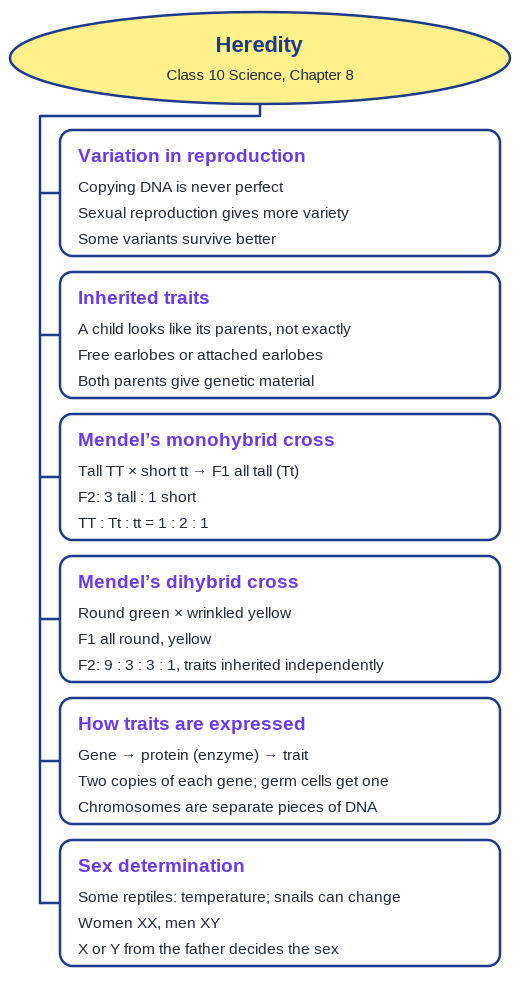
Offspring are similar to their parents but slightly different, and these variations build up over generations. Mendel’s pea experiments showed that each trait is controlled by two copies of a gene, one from each parent. A dominant form can hide a recessive one, and different traits are inherited independently. In human beings, the father’s X or Y chromosome decides the child’s sex.
What is this chapter about?
Children look like their parents, yet no two are exactly alike. Every kind of living thing makes offspring of the same basic design, with small differences. This chapter asks two questions: how do these differences, the variations, arise and build up, and by what rules are traits passed on? Those rules are called heredity. The chapter is short, six pages, and keeps to two parts: variation during reproduction, and heredity.
How does variation build up during reproduction?
Each new generation inherits the basic body design from the one before, along with some small changes. When that generation reproduces, its offspring carry the old differences and add new ones, so variation keeps accumulating. In asexual reproduction, for example a bacterium dividing into two and then four, the copies are very much alike: the only differences come from small errors in copying DNA. Sexual reproduction mixes the genetic material of two parents, so it produces much more variety.
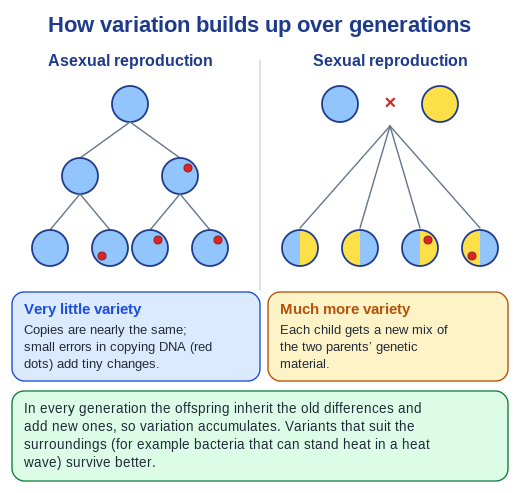
Variations do not all give the same chance of survival. Depending on its nature, a variation can be an advantage in some surroundings. Bacteria that can withstand heat, for instance, survive a heat wave better. So the surroundings select some variants over others.
What are inherited traits?
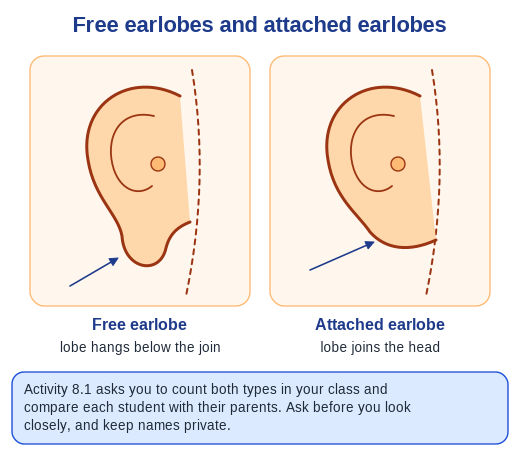
A child has all the basic features of a human being but does not look exactly like either parent. One easy trait to observe is the earlobe, the lowest part of the ear. In some people it hangs below the point where the ear joins the head (a free earlobe); in others it joins the side of the head directly (an attached earlobe). Both are normal variants. Activity 8.1 asks you to count both types in your class and compare each student with their parents.
Father and mother contribute practically equal amounts of genetic material to the child. So every trait can be influenced by both, and the child has two versions of each trait. Which one shows? Gregor Johann Mendel (1822–1884) found the main rules by growing garden peas.
What did Mendel find with tall and short pea plants?
Mendel studied pea plants with clear, contrasting characters: round or wrinkled seeds, tall or short plants, violet or white flowers. He crossed a tall plant with a short one and counted the offspring. His new idea was to keep count of the plants showing each trait in every generation.
- F1 (first generation): all plants were tall. There were no medium-height plants, so the traits did not blend.
- F2 (second generation): when the F1 tall plants self-pollinated, about one quarter of the offspring were short.
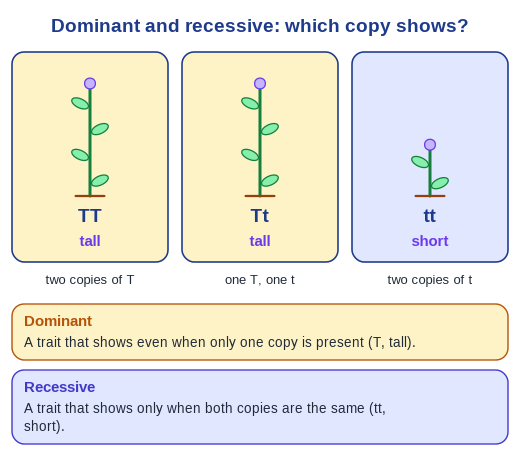
So the shortness trait had been inherited by the F1 plants but not expressed. Mendel proposed that each trait is controlled by two copies of a factor, now called a gene. With T for tall and t for short, the parents are TT and tt, every F1 plant is Tt, and the F2 plants are TT, Tt and tt in the ratio 1 : 2 : 1. TT and Tt are both tall, so tall : short is 3 : 1. A cross that follows one trait is called a monohybrid cross (the term is Extra). Read more in Mendel’s experiments.
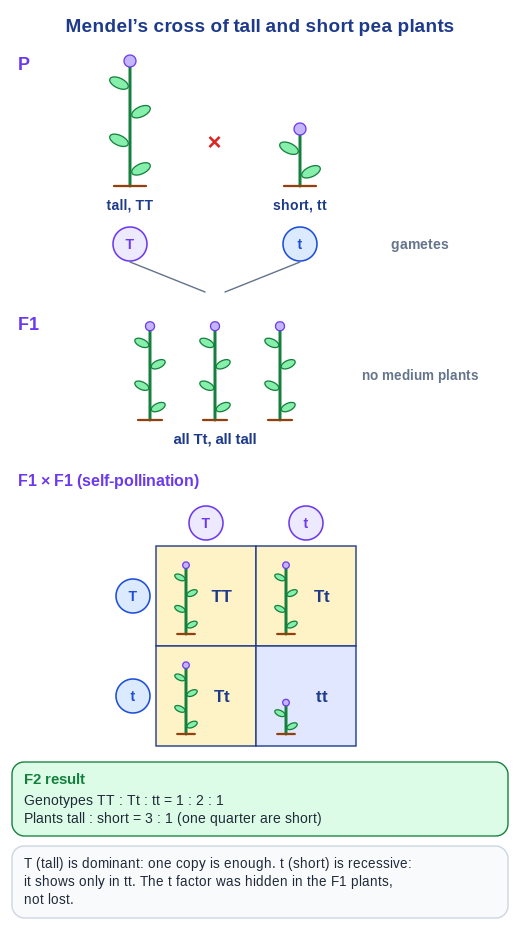
A single copy of T is enough to make the plant tall; both copies must be t for it to be short. A trait like tallness is dominant; a trait like shortness is recessive.
What happens when two traits are followed together?
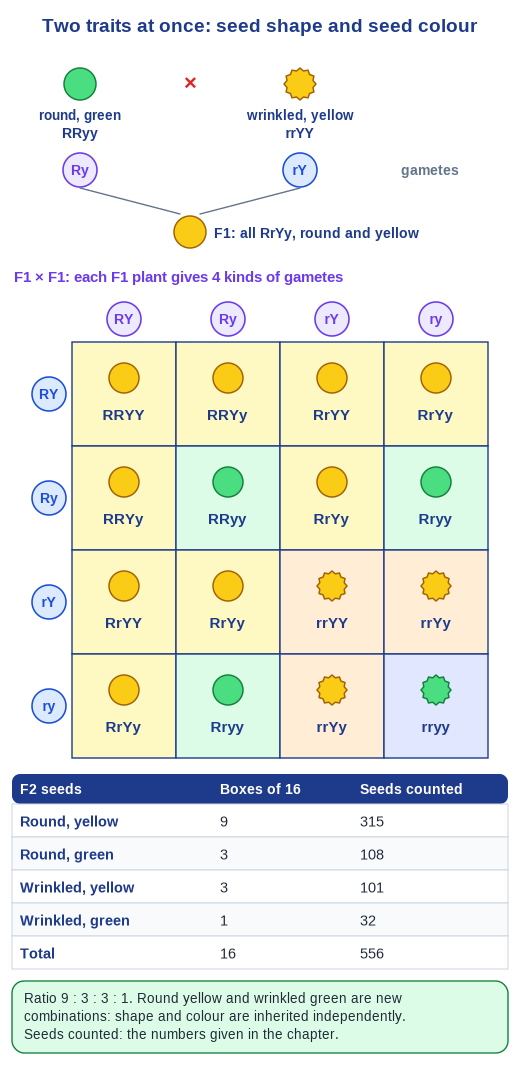
Cross a plant with round, green seeds (RRyy) with one that has wrinkled, yellow seeds (rrYY). All F1 seeds are round and yellow (RrYy), so round and yellow are the dominant forms. When the F1 plants self-pollinate, the F2 seeds come in four kinds in the ratio 9 : 3 : 3 : 1. The chapter gives a count of 556 F2 seeds: 315 round yellow, 108 round green, 101 wrinkled yellow and 32 wrinkled green. Besides the two parental types, round green and wrinkled yellow, there are two new combinations, round yellow and wrinkled green. They show that seed shape and seed colour are inherited independently. In the same way, tall plants with round seeds crossed with short plants with wrinkled seeds give F2 plants that are tall with wrinkled seeds and short with round seeds, as well as the parental types.
How do genes control traits?
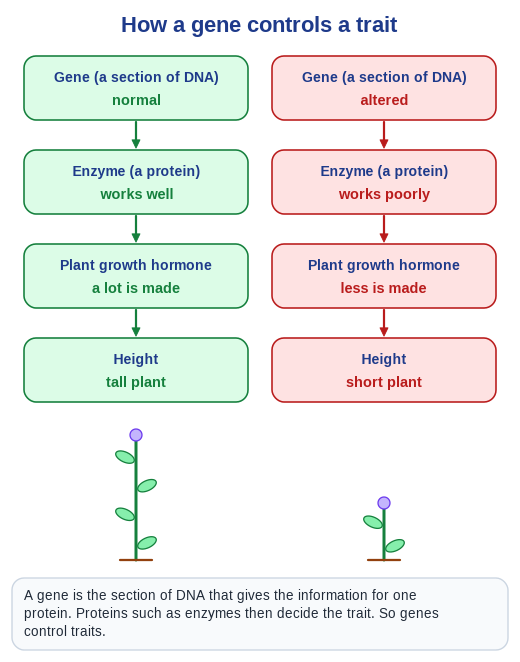
Cellular DNA is the source of information for making proteins. A section of DNA that gives the information for one protein is the gene for that protein. Take plant height. Plants have hormones that trigger growth, and the amount of a particular growth hormone depends on how efficiently it is made. If the enzyme needed for this works well, a lot of hormone is made and the plant is tall. If the gene for the enzyme has an alteration that makes the enzyme less efficient, less hormone is made and the plant is short. So genes control traits.
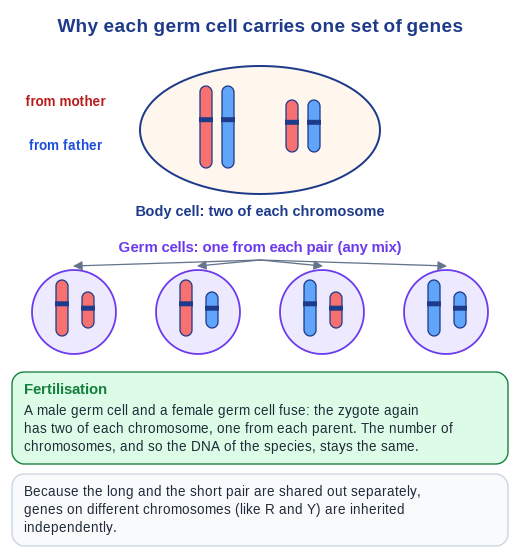
If both parents decide a trait, each must give a copy of the gene, so every pea plant has two sets of genes, and each germ cell must carry only one set. The genes are not one long thread of DNA but separate pieces, the chromosomes. Each cell has two copies of each chromosome, one from each parent, and each germ cell takes one chromosome from each pair, of either origin. When two germ cells fuse, the normal number is restored and the DNA of the species stays stable. Because the pairs are shared out separately, traits such as R and y are not tied together and can be inherited independently.
How is sex determined?
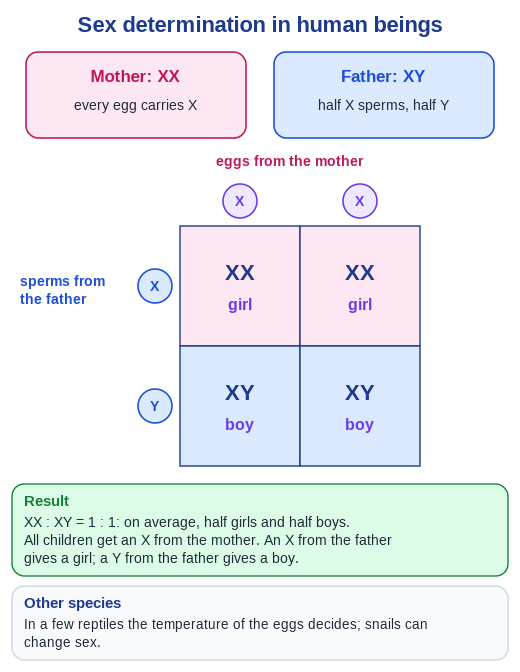
Different species use different ways. In a few reptiles, the temperature at which the fertilised eggs are kept decides whether the young are male or female. Snails can change sex, so their sex is not genetically determined. In human beings, sex is largely genetically determined. Of our chromosome pairs, 22 pairs are matched; one pair, the sex chromosomes, is not always a perfect pair. Women have two X chromosomes (XX). Men have one X and one shorter Y (XY). Every child gets an X from the mother, so the sex of the child depends on the father: an X from the father gives a girl, a Y gives a boy. On average, half the children are girls and half are boys. Read more in sex determination.
Before we move on
Practise the two crosses until you can draw them from memory with their ratios, 3 : 1 (and 1 : 2 : 1) and 9 : 3 : 3 : 1, and the XX/XY diagram. Activity 8.1 involves looking at classmates’ ears and asking about parents: ask first, be kind, and keep names out of anything you share. Answers to both Questions boxes, the activities and all four exercises are in the NCERT solutions for Chapter 8.
Key terms
| Term | Meaning |
|---|---|
| Variation | A small difference between individuals of the same kind. Some variations are inherited by the next generation. |
| Heredity | The passing of traits and characteristics from parents to offspring by fixed rules. |
| Trait | A feature of an organism, such as plant height, seed shape or the type of earlobe. |
| Gene | A section of DNA that gives the information for making one protein. Mendel called it a factor. |
| Dominant trait | The trait that shows when the two copies of a gene are different, such as tallness (T) in pea plants. |
| Recessive trait | The trait that shows only when both copies are the same, such as shortness (tt) in pea plants. |
| F1 and F2 | The first and second generations of offspring after a cross between two parent plants. |
| Chromosome | A separate, independent piece of DNA. Each body cell has two copies of each chromosome, one from each parent. |
| Germ cell | A reproductive cell, egg or sperm. It carries only one copy of each chromosome, so only one set of genes. |
| Sex chromosomes | The one pair of chromosomes that differs between the sexes: XX in women, XY in men. |
Topics in this chapter
Practice
-
When a pure tall pea plant (TT) is crossed with a short one (tt), the F1 plants are:
Show answer
Answer: (b) all tall
-
In the F2 generation of Mendel’s tall × short cross, the fraction of short plants is about:
Show answer
Answer: (b) one quarter
-
The ratio of the four kinds of F2 seeds in Mendel’s cross for seed shape and colour is:
Show answer
Answer: (c) 9 : 3 : 3 : 1
-
A section of DNA that gives the information for one protein is called a:
Show answer
Answer: (b) gene
-
A child who gets a Y chromosome from the father will be:
Show answer
Answer: (b) a boy
-
Each human germ cell has:
Show answer
Answer: (b) one copy of each chromosome
Questions students ask
What are the main topics of Class 10 Science Chapter 8?
How variation builds up during reproduction, inherited traits (such as free earlobes and attached earlobes), the rules for the inheritance of traits from Mendel’s experiments with pea plants (one trait and two traits at a time), how genes control traits, and how sex is determined in human beings.
Is Heredity in the 2026-27 NCERT book?
Yes. It is Chapter 8 of Science, the Class 10 NCERT textbook marked Reprint 2026-27, on pages 128 to 133. It has two Questions boxes and four exercises. The rationalised chapter no longer covers evolution.
Which parts of this chapter should I practise for the board exam?
Practise drawing Mendel’s tall × short cross up to F2 with the ratios 3 : 1 and 1 : 2 : 1, the seed shape and colour cross with its 9 : 3 : 3 : 1 ratio, and the XX/XY diagram of sex determination. Be ready to explain dominant and recessive traits and independent inheritance in your own words.
Why are the F2 ratios not exactly 9 : 3 : 3 : 1 in a real count?
Which germ cells meet is a matter of chance, so real counts only come close to the expected ratio. In the chapter’s count of 556 seeds, 315, 108, 101 and 32 are close to the expected 312.75, 104.25, 104.25 and 34.75.
Stuck on a question?
Take a photo and Lagnever AI explains it step by step. Try it for 7 days for ₹2.
Get it on Google Play Open in browser
For parents: after the trial, the plan renews monthly by UPI or card autopay. You can cancel anytime in the app.