
What did Mendel’s experiments with pea plants show?
Answer in short
Mendel crossed pea plants with contrasting traits and counted the offspring. Tall × short gave all tall plants in F1 and 3 tall : 1 short in F2, so each trait has two gene copies and a dominant form hides a recessive one. A seed shape and colour cross gave 9 : 3 : 3 : 1: traits are inherited independently.
Stuck on a question? Take a photo and Lagnever AI explains it step by step. Try it for 7 days for ₹2. Get it on Google Play
Why do both parents matter?
Both parents contribute practically equal amounts of genetic material to their offspring. So every trait can be influenced by the father’s DNA and by the mother’s, and the child has two versions of each trait. Which version is seen? Gregor Johann Mendel (1822–1884), who studied science and mathematics and then grew peas in his monastery, worked out the main rules. His new step was to count the plants showing each trait in every generation.
What happened when tall and short plants were crossed?
Mendel crossed a tall pea plant with a short one.
- F1: every plant was tall. There were no medium-height plants, so the two traits did not mix.
- Are the F1 tall plants the same as the tall parent? To test this, both were allowed to self-pollinate. The tall parent gave only tall plants. The F1 tall plants gave F2 plants of which about one quarter were short.
- Conclusion: the F1 plants had inherited both tallness and shortness, but only tallness was expressed. So there must be two copies of the factor (now called a gene) for each trait. They may be the same or different, depending on the parents.
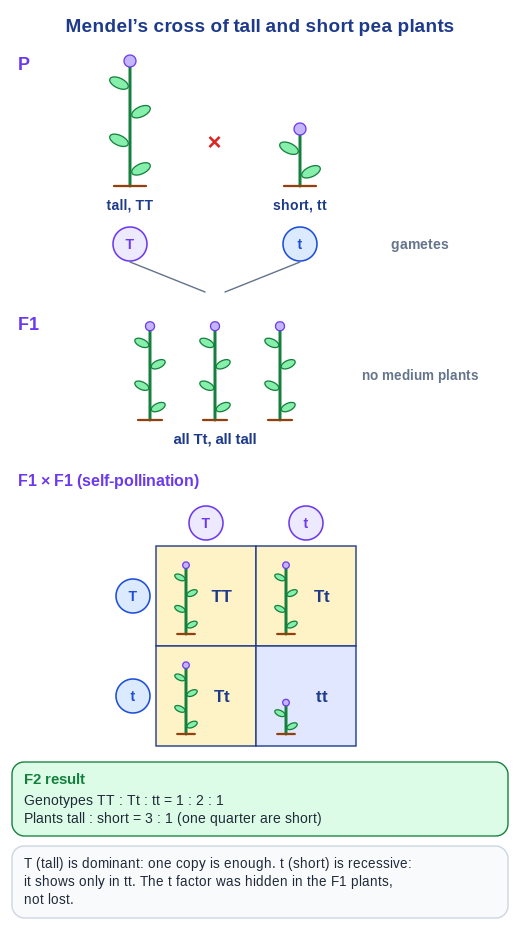
With T for tallness and t for shortness:
| Generation | Plants | What we see |
|---|---|---|
| Parents | TT × tt | tall × short |
| Germ cells | T from the tall parent, t from the short one | one copy each |
| F1 | all Tt | all tall |
| F1 germ cells | T and t in equal numbers | one copy each |
| F2 | 1 TT : 2 Tt : 1 tt | 3 tall : 1 short |
What are dominant and recessive traits?
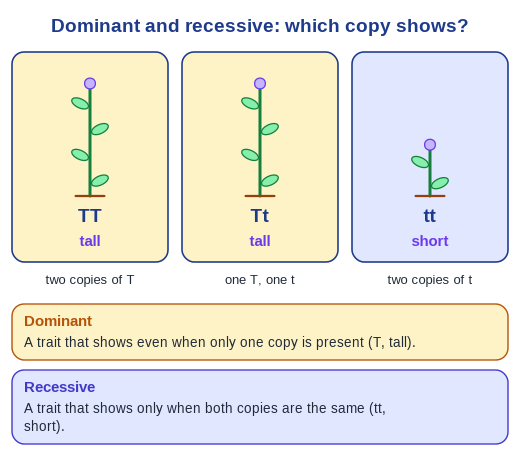
TT and Tt plants are both tall; only tt plants are short. A single copy of T is enough to make a plant tall, but both copies must be t for it to be short. Traits that behave like T are dominant; those that behave like t are recessive. Flower colour works the same way: violet is dominant over white, so a cross of pure violet with white gives all violet F1 plants and about 3 violet : 1 white in F2 (worked out by the same square).
How can we check the 1 : 2 : 1 ratio?
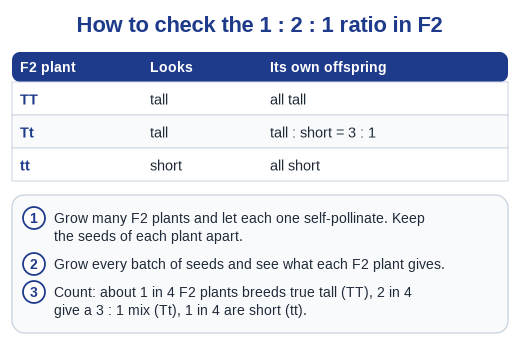
TT and Tt plants look alike, so we cannot sort them by eye. Activity 8.2 asks how to check. Let every F2 plant self-pollinate and grow its seeds separately. A TT plant gives only tall offspring, a Tt plant gives tall and short in the ratio 3 : 1, and a tt plant gives only short. Counting the three kinds of F2 parents should give about 1 : 2 : 1.
What happens with two traits at once?
Crossing a tall plant with round seeds and a short plant with wrinkled seeds gives F1 plants that are all tall with round seeds, so tallness and round seeds are dominant. In F2, some plants are tall with round seeds and some short with wrinkled seeds, like the grandparents, but there are also new combinations: tall with wrinkled seeds and short with round seeds.
The chapter works this out for seed shape and seed colour. Each F1 plant (RrYy) makes four kinds of germ cells in equal numbers, RY, Ry, rY and ry. Pairing them in a 4 by 4 grid gives 16 equally likely boxes:
| F2 seeds | Boxes out of 16 | Seeds counted (chapter) |
|---|---|---|
| Round, yellow | 9 | 315 |
| Round, green | 3 | 108 |
| Wrinkled, yellow | 3 | 101 |
| Wrinkled, green | 1 | 32 |
| Total | 16 | 556 |
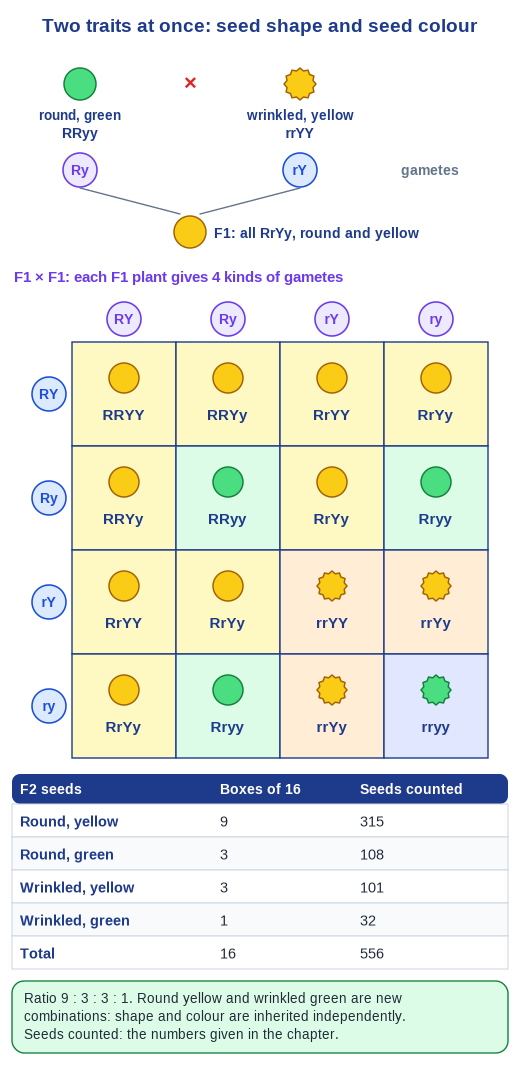
The counts are close to 9 : 3 : 3 : 1 (exactly 9 : 3 : 3 : 1 of 556 would be 312.75, 104.25, 104.25 and 34.75). Seed shape alone still follows 3 : 1 (423 round : 133 wrinkled), and so does colour (416 yellow : 140 green). Round yellow and wrinkled green are combinations that neither parent had. The factors for shape and colour recombine freely when germ cells fuse: the two traits are inherited independently. A cross that follows two traits is called a dihybrid cross (the term is Extra).
Why can traits be inherited independently?
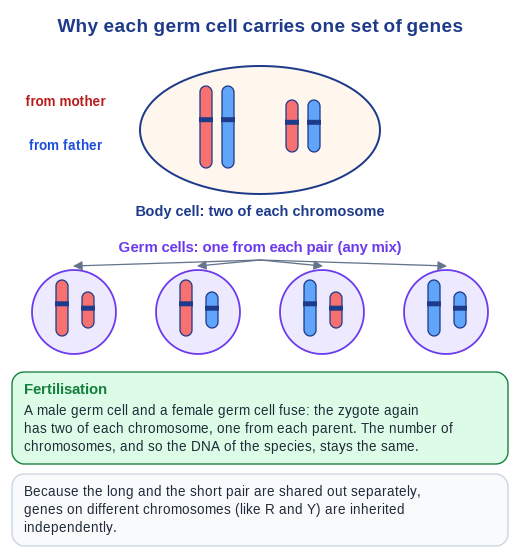
Each germ cell carries only one copy of each gene, because it takes one chromosome from each pair. The chromosome pairs are shared out separately, so R does not have to travel with y. If a whole gene set were passed on as one piece, R and y would stay linked and the new combinations could not appear.
More questions on this topic are solved in the NCERT solutions for Chapter 8. Go back to the Chapter 8 notes.
Practice
-
What do the F1 plants of a tall (TT) × short (tt) cross look like?
Show answer
Answer: (b) All tall
-
Out of 16 F2 boxes in the seed shape and colour cross, how many give wrinkled green seeds?
Show answer
Answer: (a) 1
-
Which F2 tall plants will give only tall plants when self-pollinated?
Show answer
Answer: (a) TT
-
Why are round and yellow called dominant in the seed cross?
Show answer
Answer: Because all the F1 seeds, which carry one copy of each form (RrYy), are round and yellow. The wrinkled and green forms are hidden in F1 and show again only in F2 seeds that have two copies of r or of y.
-
The parents had round green seeds and wrinkled yellow seeds. Which F2 seeds are new combinations, and what do they show?
Show answer
Answer: Round yellow seeds and wrinkled green seeds. Neither parent had these combinations, so the factors for shape and for colour must have separated and recombined: the two traits are inherited independently.
Questions students ask
Why did Mendel choose pea plants?
The chapter says he used a number of contrasting visible characters of garden peas, such as round or wrinkled seeds, tall or short plants and violet or white flowers. Extra: peas also grow quickly, give many seeds and can self-pollinate or be cross-pollinated by hand.
What was new about Mendel’s method?
Others had studied inheritance in peas before him, but Mendel combined science with mathematics. He was the first to keep count of the individuals showing a particular trait in each generation, and the counts revealed the rules.
What is the 1 : 2 : 1 ratio?
It is the ratio of TT, Tt and tt plants in the F2 generation of the tall × short cross. Out of every four F2 plants, on average one is TT, two are Tt and one is tt.
What is a Punnett square?
It is a grid that pairs every kind of male germ cell with every kind of female germ cell to show all the possible offspring. The name is Extra; the chapter draws such a grid for the seed shape and colour cross.
Stuck on a question?
Take a photo and Lagnever AI explains it step by step. Try it for 7 days for ₹2.
Get it on Google Play Open in browser
For parents: after the trial, the plan renews monthly by UPI or card autopay. You can cancel anytime in the app.