
NCERT Solutions Class 10 Science Chapter 8: Heredity
Answers to the two Questions boxes inside Chapter 8, Heredity, the other questions the chapter asks along the way, Activities 8.1 and 8.2, and all four end-of-chapter exercises, from Science, the Class 10 NCERT textbook. Page numbers follow the 2026-27 reprint (pages 128–133). The exercises are quoted from the book; the in-chapter questions are restated in short. Points that go beyond the chapter are marked “Extra”. Short notes: Chapter 8 notes.
Questions, page 129
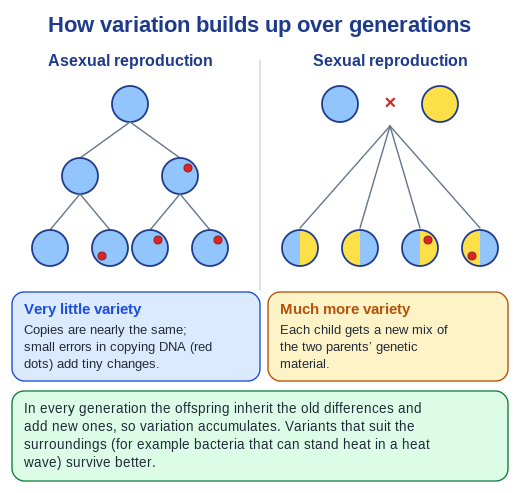
Question 1 (page 129): trait A is in 10% and trait B in 60% of an asexually reproducing population; which probably arose earlier? Trait B. In asexual reproduction a new variation, once it arises, is passed on to all the descendants of the individual that has it. The longer a trait has existed, the more generations it has had to be copied into, so the more individuals carry it. Trait B, found in 60% of the population, has most likely been around longer than trait A, found in only 10%. (This assumes both traits help survival about equally; Extra.)
Question 2 (page 129): how creating variations helps a species survive. Individuals with different variations have different kinds of advantages. If the surroundings change, for example in a heat wave, some variants (bacteria that can withstand heat) survive while others die. Because a species has many variants, at least some of them are likely to survive the change and carry the species on. Without variation, one change could wipe out every individual.
Questions, page 133
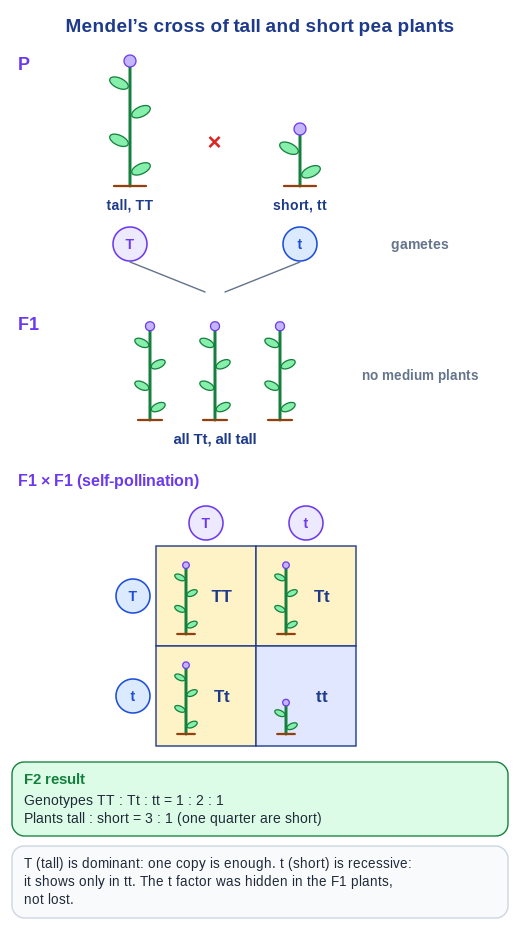
Question 1 (page 133): how Mendel’s experiments show that traits can be dominant or recessive. Mendel crossed tall (TT) and short (tt) pea plants. All F1 plants were tall, though each carried one factor for tallness and one for shortness (Tt). When the F1 plants self-pollinated, one quarter of the F2 plants were short (tt). So the shortness factor was present in F1 but hidden: one copy of T was enough to make the plant tall. A trait that shows with one copy, like tallness, is dominant; a trait that shows only with two copies, like shortness, is recessive.
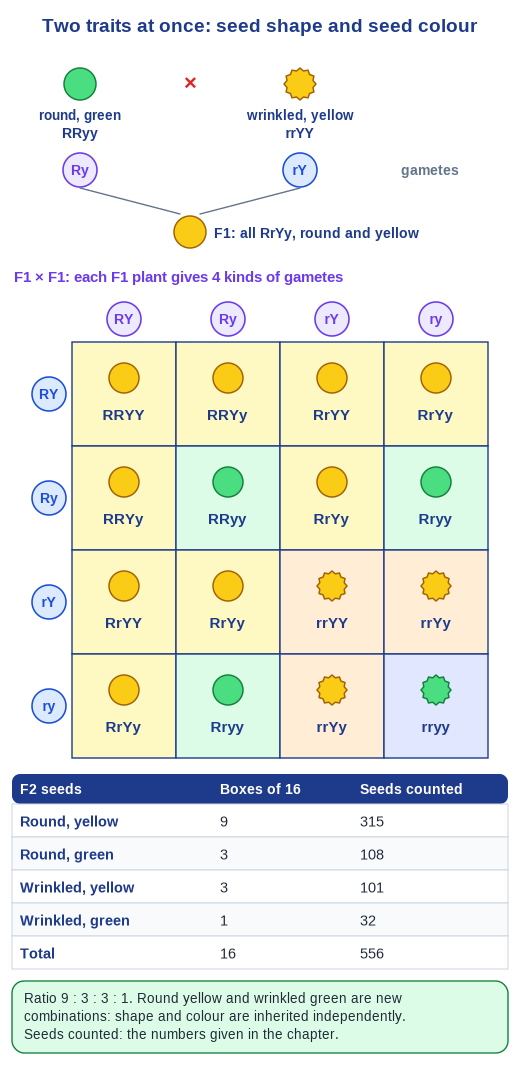
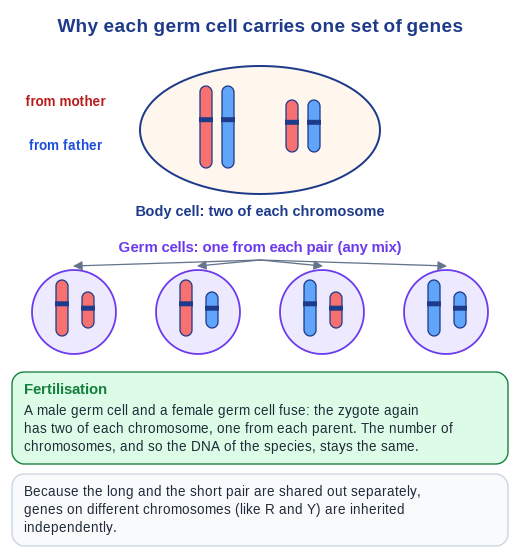
Question 2 (page 133): how Mendel’s experiments show that traits are inherited independently. Mendel crossed plants differing in two traits, for example round green seeds (RRyy) and wrinkled yellow seeds (rrYY). The F1 seeds were all round and yellow (RrYy). In F2 he found four kinds of seeds: round yellow, round green, wrinkled yellow and wrinkled green, in the ratio 9 : 3 : 3 : 1 (the chapter’s count is 315 : 108 : 101 : 32 of 556 seeds). Round yellow and wrinkled green are new combinations that neither parent had. They can appear only if the factors for shape and for colour separate and recombine on their own, so the two traits are inherited independently. Each trait on its own still gives 3 : 1 in F2 (423 round : 133 wrinkled; 416 yellow : 140 green).
Question 3 (page 133): a man with blood group A and a woman with blood group O have a daughter with blood group O; does this tell us which of A and O is dominant? No. Both possibilities fit the family:
- If A is dominant, the father can carry one hidden O factor (AO). He passes on O, the mother passes on O, and the daughter is OO, blood group O.
- If O is dominant, the mother shows O and can pass on O; any child who gets one O from her shows O whatever the father gives. The daughter again has blood group O.
One family with a single child cannot separate these cases. We would need data from many families, for example how often two group-A parents have a group-O child, or crosses with known parents. (Extra: real blood groups have more than two forms, A, B and O; the factor for A is dominant over that for O.)
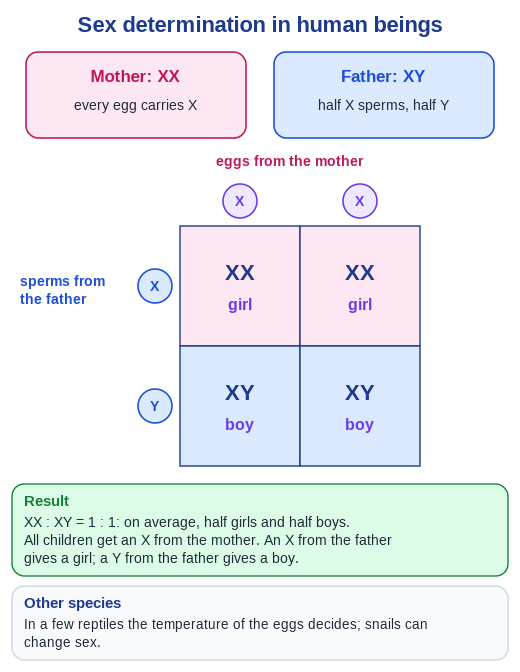
Question 4 (page 133): how the sex of a child is determined in human beings. Women have two X chromosomes (XX) and men have one X and one Y (XY). Every egg carries an X. Half of a man’s sperms carry X and half carry Y. If the egg is fertilised by an X-carrying sperm, the child is XX, a girl; if by a Y-carrying sperm, the child is XY, a boy. So the sex of the child depends on the sex chromosome it inherits from the father, and on average half the children are girls and half are boys.
Other questions inside the chapter (pages 130–132)
Which trait is dominant in Fig. 8.4? (page 130) The figure shows violet and white flowers: the F1 plants are all violet and F2 has 3 violet : 1 white. So violet is dominant and white is recessive.
How might inheritance work in asexually reproducing organisms? (page 132) There is only one parent, so there is no mixing of two sets of genes. The parent copies its DNA and each offspring gets a copy of it, so the offspring inherit the parent’s traits almost unchanged. The only new variations come from small errors in copying DNA, and these are passed on to all the descendants of that individual.
Can we work out the inheritance pattern of X and Y? (page 132) Yes: every child gets one X from the mother and either an X or a Y from the father, so the children are XX and XY in the ratio 1 : 1 (see Question 4 above).
What the activities show (Activities 8.1 and 8.2)
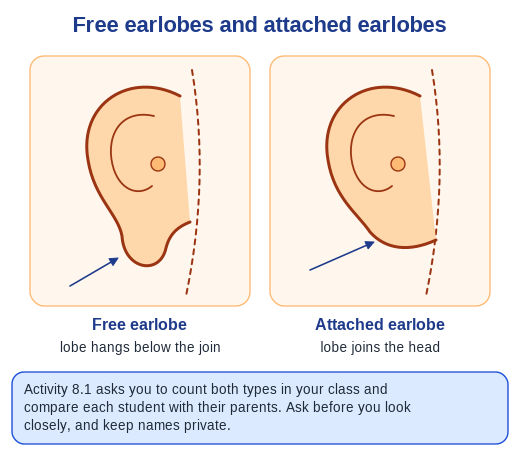
- 8.1, earlobes in the class: each student is listed as having free earlobes or attached earlobes, the percentage of each type is worked out, and each student’s type is compared with that of their parents. Your class will have its own numbers, so there is no fixed answer. The rule to look for is like Mendel’s: two parents with attached earlobes would be expected to have children with attached earlobes; parents with free earlobes may have children of either type. That would fit free earlobes being the dominant form (Extra: this simple rule is a common textbook model; real earlobe shapes vary more and may involve more than one gene). Ask your classmates before looking closely, and keep names private when you share the results.
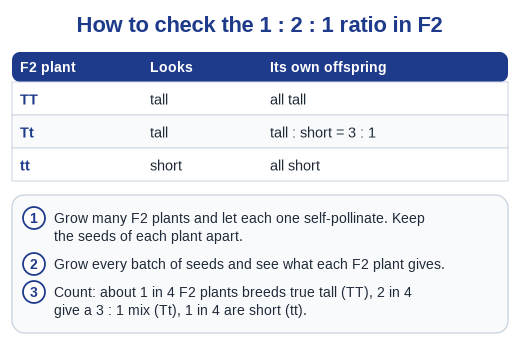
- 8.2, confirming 1 : 2 : 1 in F2: TT and Tt plants look alike, so let every F2 plant self-pollinate and grow its seeds separately. TT plants give only tall offspring, Tt plants give tall and short offspring in the ratio 3 : 1, and tt plants give only short offspring. Counting the F2 plants of each kind should give about 1 TT : 2 Tt : 1 tt.
Exercises 1 and 2: reading crosses
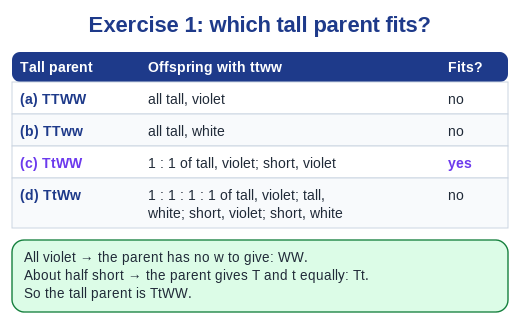
1. “A Mendelian experiment consisted of breeding tall pea plants bearing violet flowers with short pea plants bearing white flowers. The progeny all bore violet flowers, but almost half of them were short. This suggests that the genetic make-up of the tall parent can be depicted as (a) TTWW (b) TTww (c) TtWW (d) TtWw”
(c) TtWW. The short white parent is ttww, so it can give only t and w. All the progeny are violet, so the tall parent must give W every time: it is WW. Almost half the progeny are short (tt), so the tall parent gives t half the time: it is Tt. Checking every option against ttww: TTWW gives all tall violet; TTww gives all tall white; TtWW gives 1 tall violet : 1 short violet; TtWw gives tall violet, tall white, short violet and short white in equal numbers. Only TtWW fits.
2. “A study found that children with light-coloured eyes are likely to have parents with light-coloured eyes. On this basis, can we say anything about whether the light eye colour trait is dominant or recessive? Why or why not?”
No. The study only shows that the trait is inherited: children tend to have the same eye colour as their parents. Both a dominant and a recessive trait would give this result. If light eye colour were recessive, two light-eyed parents could pass on only light-eye factors, so their children would be light-eyed. If it were dominant, light-eyed parents with two light-eye factors would also have light-eyed children. To decide, we would need to look at parents with different eye colours, light-eyed with dark-eyed, and see which colour the children show, and then the children of such children, as Mendel did with peas.
Exercises 3 and 4: planning and explaining
3. “Outline a project which aims to find the dominant coat colour in dogs.”
The plan follows Mendel’s method, using records of dogs bred anyway rather than breeding dogs for the project. (The plan is ours; the dog details are Extra.)
- Choose a pair of contrasting colours, for example black and brown, in one breed.
- Find true-breeding parents: dogs whose families, for several generations, have had only black puppies or only brown puppies. Breeders and kennel records can tell you this.
- First cross: collect records of litters from a true-breeding black dog and a true-breeding brown dog. Note the colour of every puppy. If all the puppies are one colour, say black, that colour is dominant.
- Second cross: collect records of litters where both parents came from such first-cross litters. Count the puppies of each colour. The dominant colour should appear in about three quarters of them and the other colour in about one quarter, as in Mendel’s 3 : 1.
- Use many litters, because a single litter is small and chance can change the numbers.
Work only with records or under the guidance of a veterinarian or an experienced breeder. Animals must never be bred just for a school project.
4. “How is the equal genetic contribution of male and female parents ensured in the progeny?”
Every body cell has two copies of each chromosome, one from each parent. When germ cells are made, each germ cell receives only one chromosome from each pair, so the sperm and the egg each carry one complete set. At fertilisation, the sperm (from the male parent) and the egg (from the female parent) fuse, and the zygote again has two copies of each chromosome: one set from the father and one set from the mother. So each parent gives exactly half the chromosomes, and the normal number is kept the same from one generation to the next. (The sex chromosomes too: the mother gives an X, and the father an X or a Y.)
Go back to the Chapter 8 notes, or read Mendel’s experiments and sex determination.
Practice
-
A tall pea plant crossed with a short one gives about half tall and half short offspring. The tall parent was:
Show answer
Answer: (b) Tt
-
In Mendel’s seed cross, the F1 seeds were all round and yellow. This shows that:
Show answer
Answer: (b) round and yellow are dominant
-
Which sex chromosome does every human egg carry?
Show answer
Answer: (b) X
-
Name the two kinds of F2 seeds that show new combinations in the cross of round green (RRyy) with wrinkled yellow (rrYY) seeds.
Show answer
Answer: Round yellow and wrinkled green. Neither parent had these combinations; they show that seed shape and seed colour are inherited independently.
-
Why does each germ cell have only one copy of each chromosome?
Show answer
Answer: So that when a male and a female germ cell fuse, the zygote gets two copies of each chromosome again, one from each parent. If germ cells had two copies, the number of chromosomes would double in every generation.
Stuck on a question?
Take a photo and Lagnever AI explains it step by step. Try it for 7 days for ₹2.
Get it on Google Play Open in browser
For parents: after the trial, the plan renews monthly by UPI or card autopay. You can cancel anytime in the app.