
How is sex determined in human beings?
Answer in short
In some reptiles egg temperature decides sex, and snails can change sex. In human beings sex is largely genetic: women are XX and men are XY. Every egg carries an X; half the sperms carry X and half carry Y. An X from the father gives a girl (XX); a Y gives a boy (XY).
Stuck on a question? Take a photo and Lagnever AI explains it step by step. Try it for 7 days for ₹2. Get it on Google Play
Why does sex need a rule at all?
Sexual reproduction needs two sexes that are somewhat different from each other, as the previous chapter discussed. So how is the sex of a newborn individual decided? Different species use very different strategies.
| Organism | What decides the sex |
|---|---|
| A few reptiles | the temperature at which the fertilised eggs are kept |
| Snails | individuals can change sex, so it is not genetically determined |
| Human beings | largely the genes: the sex chromosomes inherited from the parents |
What are sex chromosomes?
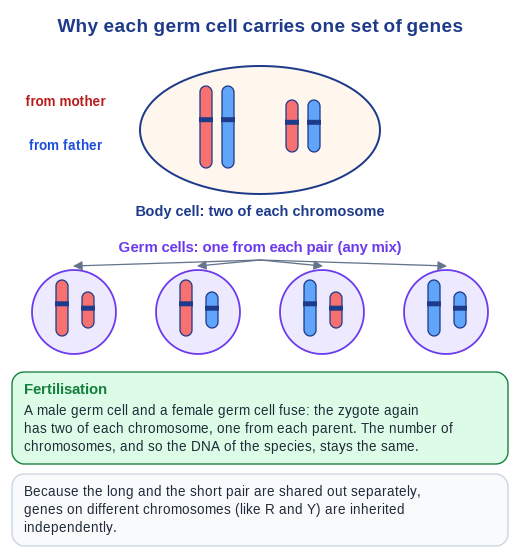
So far we have assumed that both parents pass on similar sets of genes. That is true for most human chromosomes: each has a copy from the mother and a copy from the father, and there are 22 such pairs. One pair, the sex chromosomes, is not always a perfect pair.
- Women have a perfect pair, both called X: they are XX.
- Men have a mismatched pair, one normal-sized X and one shorter Y: they are XY.
How is the sex of a child decided?
Each germ cell carries one chromosome of each pair, so one sex chromosome.
- The mother is XX, so every egg carries an X.
- The father is XY, so half of his sperms carry X and half carry Y.
- If a sperm with X fertilises the egg, the zygote is XX: a girl.
- If a sperm with Y fertilises the egg, the zygote is XY: a boy.
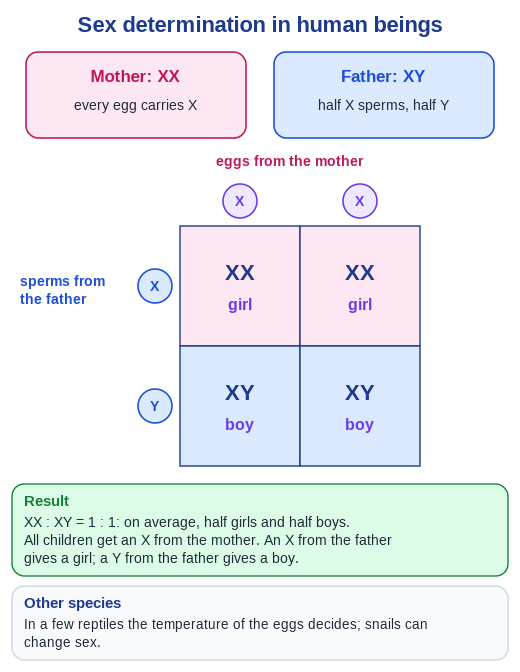
| Egg X | Egg X | |
|---|---|---|
| Sperm X | XX, girl | XX, girl |
| Sperm Y | XY, boy | XY, boy |
Two boxes of four are XX and two are XY, so on average half the children are girls and half are boys. All children inherit an X from their mother whether they are boys or girls, so the sex of the child depends on what it inherits from the father.
Does the mother or the father decide?
The mother’s eggs are all alike for the sex chromosome: each carries an X. The father’s sperms are of two kinds in equal numbers. Which kind reaches and fertilises the egg is a matter of chance, so the father’s contribution, X or Y, decides whether the child is a girl or a boy. Neither parent chooses it, and no one is to blame for the sex of a child.
Each birth is a separate event. A family with two daughters still has an even chance of a son next time, because the third child’s sex depends only on which sperm fertilises that egg. The 1 : 1 ratio describes large numbers of births, not every family.
Why is this the same rule as Mendel’s?
The sex chromosomes are shared out exactly like any other chromosome pair: each germ cell takes one of the pair, and fertilisation brings two together again. The XX/XY square is drawn in the same way as Mendel’s squares for pea plants.
More questions on this topic are solved in the NCERT solutions for Chapter 8. Go back to the Chapter 8 notes, or read Mendel’s experiments.
Practice
-
The sex chromosomes of a human female are:
Show answer
Answer: (b) XX
-
In some reptiles, what decides whether an egg develops into a male or a female?
Show answer
Answer: (b) the temperature at which the egg is kept
-
What fraction of a man’s sperms carry a Y chromosome?
Show answer
Answer: (c) a half
-
A couple has two daughters. What is the chance that their next child is a son?
Show answer
Answer: Still one half. Each child is a separate event: the egg always carries X, and the sperm that fertilises it carries X or Y with equal chance, whatever happened before.
-
Why do we say the sex of a human child is decided by the father?
Show answer
Answer: The mother is XX, so every egg has an X. The father is XY, so his sperms carry either X or Y. Whether the child is XX (girl) or XY (boy) depends on which of the father’s sperms fertilises the egg.
Questions students ask
What are sex chromosomes?
Most human chromosomes come in matched pairs, one from the mother and one from the father, and there are 22 such pairs. The remaining pair is called the sex chromosomes. In women it is a matched pair of X chromosomes; in men it is one normal-sized X and one short Y.
Is sex genetically determined in all animals?
No. Species use very different ways. In a few reptiles, the temperature of the fertilised eggs decides; snails can change sex. In human beings, sex is largely genetically determined.
Why are there roughly equal numbers of boys and girls?
Half of the father’s sperms carry X and half carry Y, and every egg carries X. So on average half the zygotes are XX and half are XY. Real families vary by chance.
What is a zygote?
The single cell formed when a sperm fuses with an egg. Its sex chromosomes, XX or XY, are set at that moment.
Stuck on a question?
Take a photo and Lagnever AI explains it step by step. Try it for 7 days for ₹2.
Get it on Google Play Open in browser
For parents: after the trial, the plan renews monthly by UPI or card autopay. You can cancel anytime in the app.