
What are AIDS and cancer?
Answer in short
AIDS is a deficiency of the immune system caused by HIV, a retrovirus that destroys helper T-lymphocytes; it spreads only through body fluids and is prevented rather than cured. Cancer is uncontrolled cell division after cells lose contact inhibition; malignant tumours spread by metastasis. Early detection allows many cancers to be treated successfully.
Stuck on a question? Take a photo and Lagnever AI explains it step by step. Try it for 7 days for ₹2. Get it on Google Play
What does AIDS stand for?
AIDS is Acquired Immuno Deficiency Syndrome. Each word means something:
- Acquired: gained during a person’s life, so it is not congenital.
- Immuno deficiency: the immune system becomes deficient.
- Syndrome: a group of symptoms.
AIDS was first reported in 1981. Within about twenty-five years, the book records, it had reached every part of the world and caused more than 25 million deaths.
What causes AIDS, and how does HIV spread?
AIDS is caused by the Human Immuno deficiency Virus (HIV), a retrovirus: a virus with an RNA genome inside an envelope.
HIV spreads by:
- sexual contact with an infected person;
- transfusion of contaminated blood and blood products;
- sharing infected needles, as among people who inject drugs;
- from an infected mother to her child through the placenta.
So people at high risk include those with multiple sexual partners, people who inject drugs, patients who often need blood transfusions, and babies of mothers with HIV.
HIV/AIDS does not pass by touch or ordinary contact; it passes only through body fluids. Infected people should not be isolated from family and society. There is a time-lag between infection and the appearance of AIDS symptoms, which can range from months to years; it is usually 5–10 years.
How does HIV damage the immune system?
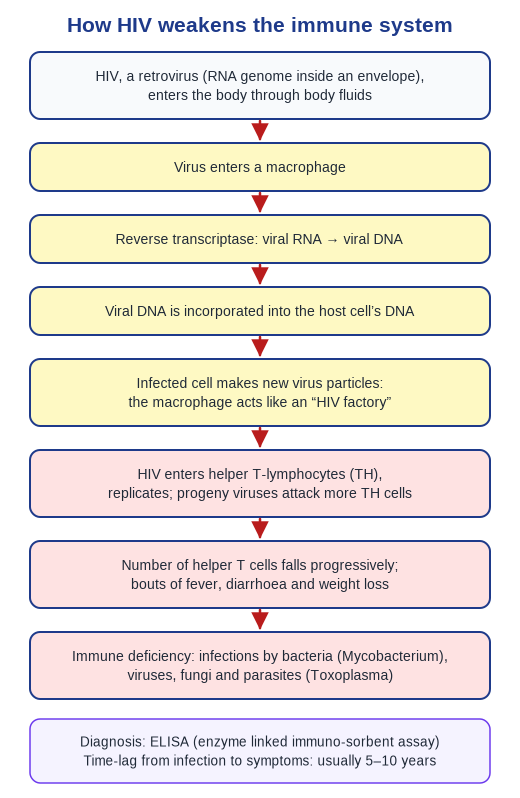
- HIV enters macrophages.
- The enzyme reverse transcriptase makes viral DNA from the viral RNA.
- The viral DNA is incorporated into the host cell’s DNA and directs the cell to make virus particles. The macrophage keeps producing virus, acting like an “HIV factory”.
- HIV also enters helper T-lymphocytes (TH), replicates and releases progeny viruses into the blood, which attack more helper T cells.
- The number of helper T cells falls steadily. The person has bouts of fever, diarrhoea and weight loss.
- The person can no longer fight infections the body would normally overcome: bacteria (especially Mycobacterium), viruses, fungi and parasites such as Toxoplasma.
A widely used diagnostic test is ELISA (enzyme linked immuno-sorbent assay). Anti-retroviral drugs are only partly effective.
How can AIDS be prevented?
AIDS has no cure, so prevention is the main approach. Steps described in the book, taken in India by the National AIDS Control Organisation (NACO) and NGOs, and worldwide by WHO:
- screening blood in blood banks so that it carries no HIV;
- using only disposable needles and syringes in hospitals and clinics;
- distributing condoms and advocating safe sex;
- controlling drug abuse;
- encouraging people at higher risk to get tested for HIV regularly.
The book stresses that HIV infection should not be hidden, and that infected people need help and sympathy, not rejection. Society and the medical community must act together, because ignorance about how HIV spreads should never cost anyone their life.
What happens in a cancer cell?
Cell growth and differentiation in the body are tightly controlled. In cancer cells these controls break down. Normal cells show contact inhibition: touching other cells stops their uncontrolled growth. Cancer cells lose this property and keep dividing, forming masses called tumours.
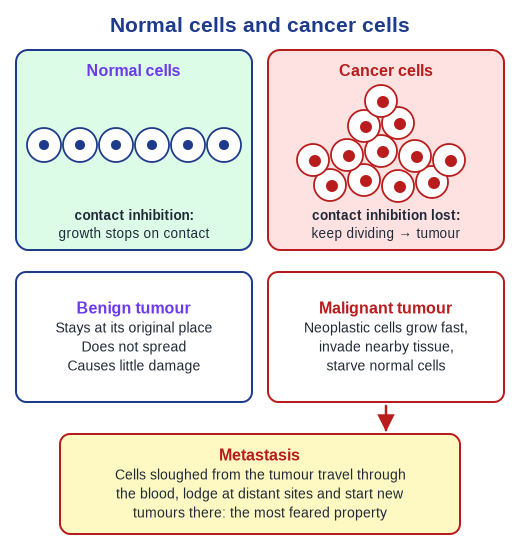
| Benign tumour | Malignant tumour |
|---|---|
| Stays at its original location | Neoplastic (tumour) cells grow very rapidly and invade surrounding tissue |
| Does not spread | Spreads by metastasis: cells reach distant sites through the blood and start new tumours |
| Causes little damage | Damages tissue and starves normal cells by competing for nutrients |
What causes cancer?
Agents that transform normal cells into cancerous cells are carcinogens:
- Physical: ionising radiation such as X-rays and gamma rays, and non-ionising UV, which damage DNA.
- Chemical: chemicals in tobacco smoke, a major cause of lung cancer.
- Biological: oncogenic viruses carry viral oncogenes. Normal cells also carry cellular oncogenes (c-onc) or proto-oncogenes, which, when activated under certain conditions, can cause oncogenic transformation.
How is cancer detected and treated?
Detection. Early detection allows many cancers to be treated successfully.
- Biopsy: a thin, stained section of the suspected tissue is examined under a microscope by a pathologist (histopathology).
- Blood and bone marrow tests look for raised cell counts in leukaemias.
- Radiography (X-rays), CT (X-rays used to build a three-dimensional image) and MRI (strong magnetic fields and non-ionising radiation) detect cancers of internal organs.
- Antibodies against cancer-specific antigens, and molecular biology tests for genes that raise inherited susceptibility, also help. People with such genes may be advised to avoid particular carcinogens, such as tobacco smoke for lung cancer.
Treatment. Doctors combine surgery, radiotherapy (tumour cells are irradiated while protecting normal tissue), chemotherapy (drugs that kill cancer cells, with side-effects such as hair loss and anaemia) and immunotherapy: biological response modifiers such as α-interferon activate the immune system against the tumour.
Next: Chapter 7 NCERT solutions. Back to the Chapter 7 notes, or see immunity.
Practice
-
HIV belongs to the group of viruses called:
Show answer
Answer: (b) retroviruses
-
Which is a widely used diagnostic test for AIDS?
Show answer
Answer: (b) ELISA
-
Which technique uses strong magnetic fields and non-ionising radiation?
Show answer
Answer: (c) MRI
-
Why are α-interferons given to cancer patients?
Show answer
Answer: Tumour cells can avoid detection and destruction by the immune system. α-interferon is a biological response modifier: it activates the patient's immune system and helps destroy the tumour.
-
Why does a person with AIDS suffer from many infections?
Show answer
Answer: HIV keeps destroying helper T-lymphocytes, so their number falls. The immune system becomes so deficient that infections by bacteria such as Mycobacterium, viruses, fungi and parasites such as Toxoplasma, which a healthy body would overcome, cannot be fought off.
Questions students ask
Why should people with HIV not be isolated?
Touching or ordinary physical contact does not pass on HIV; only body fluids do. The book says that for their physical and psychological well-being, infected people should not be isolated from family and society; they need help and sympathy.
Can AIDS be cured?
The book says AIDS has no cure. Anti-retroviral drugs are only partially effective: they can prolong life but cannot prevent death. That is why prevention is the main approach.
What is the difference between benign and malignant tumours?
Benign tumours stay at their original location, do not spread and cause little damage. Malignant tumours are masses of rapidly dividing neoplastic cells that invade and damage nearby tissue, starve normal cells of nutrients, and spread to distant sites by metastasis.
Why is early detection of cancer important?
The chapter says that when cancer is found early it can often be treated with success, and that many cancers are curable if found early and treated properly. Testing and treatment are decided by doctors.
Stuck on a question?
Take a photo and Lagnever AI explains it step by step. Try it for 7 days for ₹2.
Get it on Google Play Open in browser
For parents: after the trial, the plan renews monthly by UPI or card autopay. You can cancel anytime in the app.