
What is immunity, and how does the body defend itself?
Answer in short
Immunity is the overall ability of the host to fight disease-causing organisms, given by the immune system. Innate immunity is non-specific and present at birth, with four barriers. Acquired immunity is pathogen-specific and has memory: B-lymphocytes make antibodies and T-lymphocytes mediate cell-mediated immunity. Vaccination uses this memory.
Stuck on a question? Take a photo and Lagnever AI explains it step by step. Try it for 7 days for ₹2. Get it on Google Play
Why don’t we fall ill every time we meet a germ?
We are exposed to many infectious agents every day, but only a few exposures cause disease, because the body fights off most foreign agents. The host’s total capacity to resist pathogens, provided by the immune system, is called immunity. It is of two types: innate and acquired.
What is innate immunity?
Innate immunity is a non-specific defence that is present at birth. It works by putting barriers in the way of foreign agents.
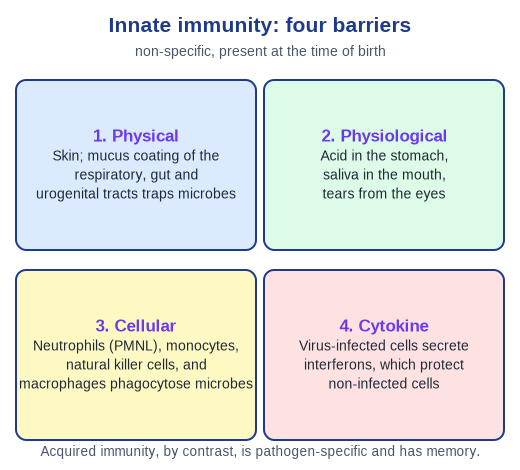
| Barrier | What it is |
|---|---|
| Physical | Skin is the main barrier; mucus on the lining of the respiratory, gastrointestinal and urogenital tracts traps microbes |
| Physiological | Acid in the stomach, saliva in the mouth and tears from the eyes stop microbial growth |
| Cellular | Leukocytes such as polymorpho-nuclear leukocytes (PMNL-neutrophils), monocytes and natural killer cells in the blood, and macrophages in tissues, phagocytose and destroy microbes |
| Cytokine | Virus-infected cells secrete interferons, which keep the virus from infecting healthy cells nearby |
What is acquired immunity?
Acquired immunity is pathogen-specific and has memory. The first encounter with a pathogen produces a low-intensity primary response. A later encounter with the same pathogen produces a highly intensified secondary or anamnestic response, as if the body remembers the first meeting.
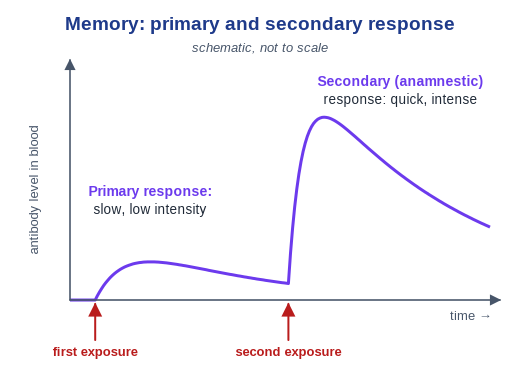
Two kinds of lymphocytes in the blood carry out these responses:
- B-lymphocytes release an army of proteins, the antibodies, into the blood. Because antibodies are in the blood, this is the humoral immune response (antibody-mediated).
- T-lymphocytes do not secrete antibodies but help B cells make them. They mediate the cell-mediated immune response (CMI).
What does an antibody look like?
An antibody is built from four peptide chains: a pair of short light chains and a pair of long heavy chains, so it is written H₂L₂. The chains form a Y shape; the tips of the two arms are the antigen binding sites. Types of antibodies include IgA, IgM, IgE and IgG.
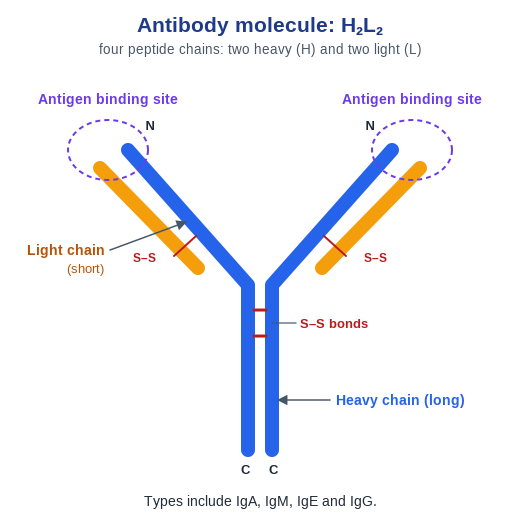
Why can’t organs be taken from just anyone?
When an organ such as the heart, eye, liver or kidney fails, a transplant may be the only remedy. A graft taken from an unmatched donor, whether an animal, another primate or an unmatched person, is rejected sooner or later. The body tells “self” from “non-self”, and cell-mediated immunity causes graft rejection. So doctors do tissue matching and blood group matching first, and even then the patient takes immuno-suppressants for life.
What are active and passive immunity?
| Active immunity | Passive immunity | |
|---|---|---|
| Antibodies | Made by the host’s own body after exposure to antigens | Ready-made antibodies given directly |
| Speed | Slow; takes time to reach full effect | Immediate |
| Examples | Natural infection; immunisation with a vaccine | Colostrum (IgA) for the new-born; antibodies from mother to foetus through the placenta; antitoxin for tetanus; antivenom for snakebite |
How do vaccination and immunisation work?
Vaccination depends on the memory of the immune system. A vaccine (antigenic proteins of a pathogen, or the inactivated or weakened pathogen) is introduced into the body. The antibodies made neutralise the pathogen during a real infection, and memory B and T cells recognise it quickly next time and overwhelm it with antibodies.
For deadly microbes that need a quick response, as in tetanus, preformed antibodies or antitoxin are injected; the injection for snakebite also contains preformed antibodies against the venom. This is passive immunisation. Recombinant DNA technology produces antigenic polypeptides in bacteria or yeast, allowing large-scale vaccines such as the hepatitis B vaccine from yeast.
What are allergies and autoimmunity?
Allergy is an exaggerated immune response to certain antigens in the environment. These allergens include dust mites, pollen and animal dander. The antibodies are of the IgE type, and mast cells release chemicals such as histamine and serotonin, causing sneezing, watery eyes, running nose and difficulty in breathing. A doctor identifies the cause by testing very small amounts of possible allergens and decides any treatment.
Autoimmunity. Memory-based acquired immunity in higher vertebrates rests on telling foreign organisms from self-cells. Sometimes, for genetic and other unknown reasons, the body attacks its own cells: an auto-immune disease, such as rheumatoid arthritis.
Where is the immune system in the body?
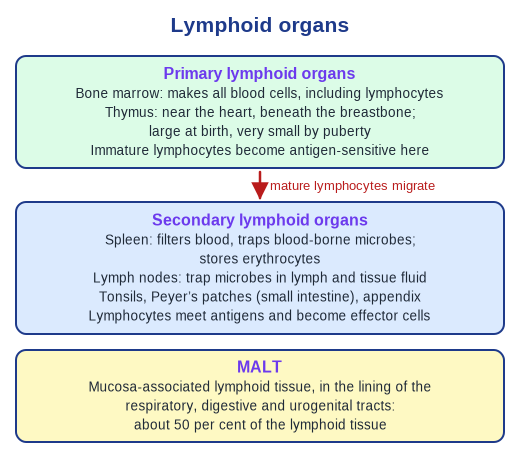
- Primary lymphoid organs: the bone marrow, where all blood cells including lymphocytes are made, and the thymus, a lobed organ near the heart beneath the breastbone. Immature lymphocytes become antigen-sensitive here; both give the micro-environment for T-lymphocytes to develop.
- Secondary lymphoid organs: spleen (filters blood, traps microbes, stores erythrocytes), lymph nodes (trap microbes in lymph and tissue fluid), tonsils, Peyer’s patches of the small intestine and appendix. Here lymphocytes meet antigens and become effector cells.
- MALT (mucosa-associated lymphoid tissue), in the lining of the respiratory, digestive and urogenital tracts, is about 50 per cent of the lymphoid tissue.
Next: AIDS and cancer. Back to the Chapter 7 notes, or see common diseases in humans.
Practice
-
Interferons belong to which barrier of innate immunity?
Show answer
Answer: (d) Cytokine
-
Which response is called anamnestic?
Show answer
Answer: (b) Secondary response
-
The hepatitis B vaccine mentioned in the book is produced from:
Show answer
Answer: (b) yeast
-
Why does a transplanted organ get rejected?
Show answer
Answer: The body can tell 'self' from 'non-self'. The cell-mediated immune response, carried out by T-lymphocytes, attacks the graft as foreign. That is why tissue and blood group matching are done before a transplant, and the patient takes immuno-suppressants all his or her life.
-
Why is the thymus small in adults?
Show answer
Answer: The thymus is large in a new-born and shrinks steadily as a person grows; by puberty only a small thymus remains.
Questions students ask
What is the difference between humoral and cell-mediated immunity?
Humoral immunity is the antibody-mediated response: B-lymphocytes release antibodies into the blood. Cell-mediated immunity is carried out by T-lymphocytes themselves, and it is responsible for graft rejection.
Why is mother's milk important for a new-born?
Colostrum, the yellowish fluid secreted in the first days of lactation, has abundant IgA antibodies that protect the infant. This is passive immunity, because the baby receives ready-made antibodies.
How does a vaccine work?
A vaccine contains antigenic proteins of a pathogen, or the inactivated or weakened pathogen. The body makes antibodies and memory B and T cells. On a real infection, the memory cells recognise the pathogen quickly and a large amount of antibodies overwhelms it.
Why are allergies said to be more common in metro cities?
The book suggests that modern life style has lowered immunity and raised sensitivity to allergens, possibly because children are kept in very protected surroundings when young; allergies and asthma are therefore rising among children in India's metro cities.
Stuck on a question?
Take a photo and Lagnever AI explains it step by step. Try it for 7 days for ₹2.
Get it on Google Play Open in browser
For parents: after the trial, the plan renews monthly by UPI or card autopay. You can cancel anytime in the app.