
What are the common diseases in humans?
Answer in short
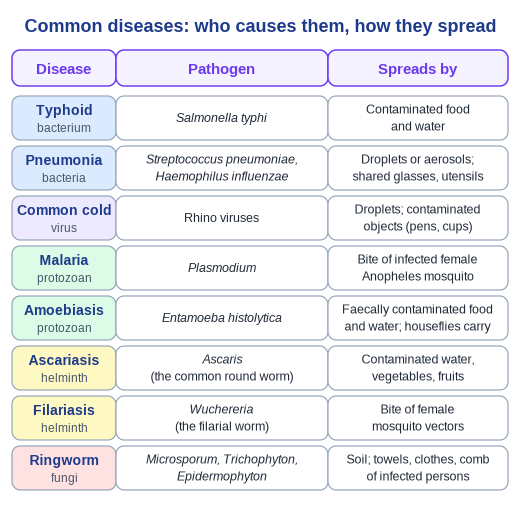
Pathogens such as bacteria, viruses, protozoans, helminths and fungi cause common human diseases. Bacteria cause typhoid and pneumonia, rhino viruses cause the common cold, protozoans cause malaria and amoebiasis, helminths cause ascariasis and filariasis, and fungi cause ringworm. Personal and public hygiene, vector control and vaccines prevent and control them.
Stuck on a question? Take a photo and Lagnever AI explains it step by step. Try it for 7 days for ₹2. Get it on Google Play
What is a pathogen?
Organisms that cause disease are pathogens. They belong to many groups: bacteria, viruses, fungi, protozoans, helminths and others. Most parasites are pathogens, because they harm the host they live in or on. A pathogen enters the body, multiplies and interferes with normal activities, damaging structure and function. It also has to adapt to life inside the host: a pathogen entering the gut, for example, must survive the low pH of the stomach and resist the digestive enzymes.
Which diseases do bacteria cause?
Typhoid. Salmonella typhi usually enters the small intestine through contaminated food and water and moves to other organs through the blood. Symptoms: sustained high fever (39° to 40 °C), weakness, stomach pain, constipation, headache and loss of appetite. In severe cases, the intestine can perforate and the patient can die. The Widal test confirms typhoid. The book recalls Mary Mallon (“Typhoid Mary”), a cook who was a carrier and infected others through her cooking over several years.
Pneumonia. Streptococcus pneumoniae and Haemophilus influenzae infect the alveoli of the lungs, which fill with fluid and make breathing very difficult. Symptoms: fever, chills, cough and headache; in severe cases the lips and finger nails turn grey to bluish. It spreads by inhaling droplets or aerosols from an infected person, or by using the same glasses and utensils. Dysentery, plague and diphtheria are other bacterial diseases.
Which disease do viruses cause here?
Common cold. Rhino viruses infect the nose and respiratory passage but not the lungs. Symptoms: nasal congestion and discharge, sore throat, hoarseness, cough, headache and tiredness, usually for 3–7 days. Droplets from coughs or sneezes are inhaled directly, or picked up from objects such as pens, books, cups, doorknobs, a keyboard or mouse.
Which diseases do protozoans cause?
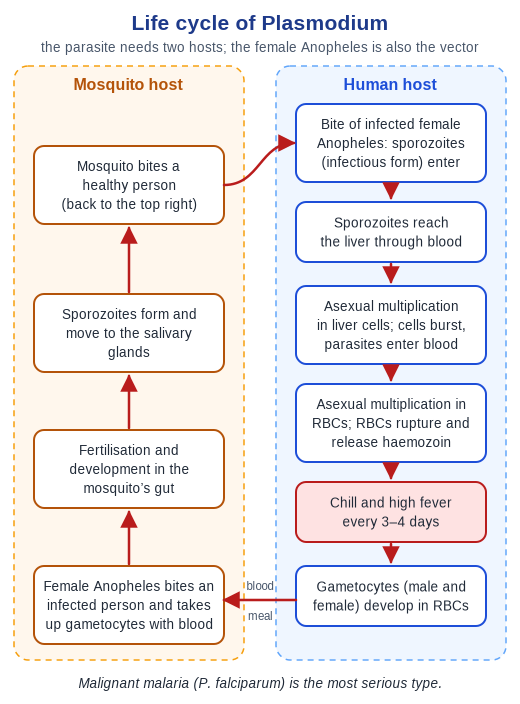
Malaria. Plasmodium causes it; P. vivax, P. malaria and P. falciparum cause different types. Malignant malaria from P. falciparum is the most serious and can be fatal.
- An infected female Anopheles bites and injects sporozoites, the infectious form.
- The parasites multiply first in liver cells, then attack red blood cells.
- RBCs rupture and release haemozoin, a toxic substance that causes chill and high fever recurring every three to four days.
- Gametocytes form in RBCs. A female Anopheles biting the patient takes them up; fertilisation and development happen in the mosquito, and sporozoites are stored in its salivary glands.
The parasite needs two hosts, and the female Anopheles is also the vector.
Amoebiasis (amoebic dysentery). Entamoeba histolytica lives in the large intestine. Symptoms: constipation, abdominal pain and cramps, and stools with excess mucus and blood clots. Houseflies act as mechanical carriers, taking the parasite from faeces to food. Food and water contaminated by faecal matter are the main source.
Which diseases do helminths and fungi cause?
Ascariasis. Ascaris, the common round worm, is an intestinal parasite. Symptoms: internal bleeding, muscular pain, fever, anaemia and blockage of the intestinal passage. Its eggs pass out in the faeces of infected people and contaminate soil, water and plants; a healthy person is infected through contaminated water, vegetables and fruits.
Filariasis (elephantiasis). The filarial worms Wuchereria bancrofti and W. malayi cause slow, chronic inflammation of the organs they live in for many years, most often the lymph vessels of the legs; the genital organs are often affected too. They are transmitted by the bite of female mosquito vectors.
Ringworm. Fungi of the genera Microsporum, Trichophyton and Epidermophyton cause one of the most common infectious diseases. Symptoms: dry, scaly lesions on skin, nails and scalp, with intense itching. Heat and moisture help the fungi, so they thrive in skin folds. Ringworm is picked up from soil, or from towels, clothes or combs of infected people.
How are these diseases prevented and controlled?
| Route | Diseases | Main measures |
|---|---|---|
| Food and water | Typhoid, amoebiasis, ascariasis | Personal hygiene; clean water and food; proper disposal of waste and excreta; cleaning and disinfecting water reservoirs, pools, cesspools and tanks; hygiene in public catering |
| Air | Pneumonia, common cold | The above, plus avoiding close contact with infected people and their belongings |
| Insect vectors | Malaria, filariasis | Control vectors and breeding places: no stagnant water, clean coolers, mosquito nets, Gambusia fish, insecticides in ditches and swamps, wire mesh on doors and windows |
The book notes that vector control has become more important with the spread of dengue and chikungunya, carried by Aedes mosquitoes. Vaccines and immunisation eradicated smallpox and have largely controlled polio, diphtheria, pneumonia and tetanus, and antibiotics and other drugs help treat infections; a doctor decides any treatment.
Next: immunity. Back to the Chapter 7 notes, or see the NCERT solutions.
Practice
-
In which form does Plasmodium enter the human body?
Show answer
Answer: (b) Sporozoites
-
Gambusia fish help control malaria because they:
Show answer
Answer: (b) feed on mosquito larvae
-
Ringworm is caused by:
Show answer
Answer: (c) fungi
-
Why does the malaria parasite need two hosts?
Show answer
Answer: Its life cycle is split between them. Asexual multiplication happens in the human liver cells and red blood cells, and gametocytes form there. Fertilisation and the development of sporozoites happen in the female Anopheles mosquito, which then passes sporozoites to a new human when it bites.
-
Which diseases are controlled mainly by clean food and water, and why?
Show answer
Answer: Typhoid, amoebiasis and ascariasis, because their pathogens (or eggs) reach a healthy person through food and water contaminated with them, often by faecal matter.
Questions students ask
Which is the most serious type of malaria?
Malignant malaria, caused by Plasmodium falciparum. The chapter says it is the most serious type and can even be fatal.
How do houseflies spread amoebiasis?
They act as mechanical carriers: they carry the parasite from an infected person's faeces onto food. Most infections come from food or water that faecal matter has reached.
Why does ringworm often appear in skin folds?
Heat and moisture help the ringworm fungi grow, so they thrive in skin folds such as the groin or between the toes. The infection is usually picked up from soil or from towels, clothes or combs used by infected people.
What should I do if I have symptoms like these?
This page explains the textbook only. Diagnosis and treatment need a doctor, so tell a parent or teacher and see a doctor.
Stuck on a question?
Take a photo and Lagnever AI explains it step by step. Try it for 7 days for ₹2.
Get it on Google Play Open in browser
For parents: after the trial, the plan renews monthly by UPI or card autopay. You can cancel anytime in the app.