
What is crystal field theory?
Answer in short
Crystal field theory treats ligands as point charges or point dipoles. Their electrostatic field splits the five d orbitals of the metal into sets of different energy. In an octahedral complex the gap between the two sets is Δo. Comparing Δo with the pairing energy gives high or low spin, and d–d transitions explain colour.
Stuck on a question? Take a photo and Lagnever AI explains it step by step. Try it for 7 days for ₹2. Get it on Google Play
Why was a new theory needed?
Valence bond theory explains shapes and, in part, magnetic behaviour. But it does not explain why complexes are coloured, gives no numbers for magnetic or stability data, and cannot tell a weak ligand from a strong one. Crystal field theory (CFT) answers several of these questions with one simple picture.
CFT is an electrostatic model. It treats the metal–ligand bond as purely ionic. An anionic ligand is a point charge; a neutral ligand such as NH₃ or H₂O is a point dipole with its negative end towards the metal.
What happens to the d orbitals?
In an isolated gaseous metal ion the five d orbitals have the same energy: they are degenerate. If the negative charge were spread evenly over a sphere around the ion, all five would be raised by the same amount and would stay degenerate. Real ligands sit at particular points, so the field is not symmetrical. Orbitals pointing at the ligands are repelled more than those pointing between them, and the set splits. The pattern depends on the geometry.
How do they split in an octahedral complex?
Six ligands lie along the x, y and z axes.
- d_x²−y² and d_z² point along the axes, straight at the ligands. They are repelled more and rise in energy. This pair is the e_g set.
- d_xy, d_yz and d_xz point between the axes. They are repelled less and fall, relative to the average. These three are the t₂g set.
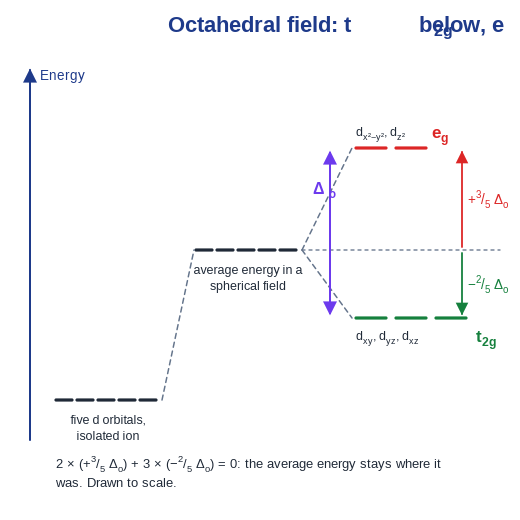
The gap is the crystal field splitting, Δo (o for octahedral). The e_g orbitals rise by (3/5)Δo and the t₂g orbitals fall by (2/5)Δo, so the average energy is unchanged: 2 × (3/5) = 3 × (2/5).
What is the spectrochemical series?
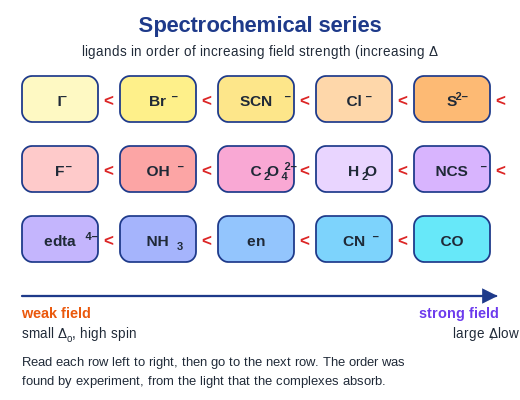
Δo depends on the field produced by the ligand and on the charge of the metal ion. Ligands arranged in order of increasing field strength form the spectrochemical series. It was found by experiment, from the light absorbed by complexes of different ligands.
High spin or low spin?
For d¹, d² and d³ ions the electrons simply enter the t₂g orbitals singly (Hund’s rule). The choice starts at d⁴. The fourth electron can pair up in t₂g, which costs the pairing energy P, or go up to e_g, which costs Δo.
- Δo < P (weak field ligand): the electron goes to e_g. d⁴ is t₂g³e_g¹. These are high spin complexes.
- Δo > P (strong field ligand): the electron pairs in t₂g. d⁴ is t₂g⁴e_g⁰. These are low spin complexes.
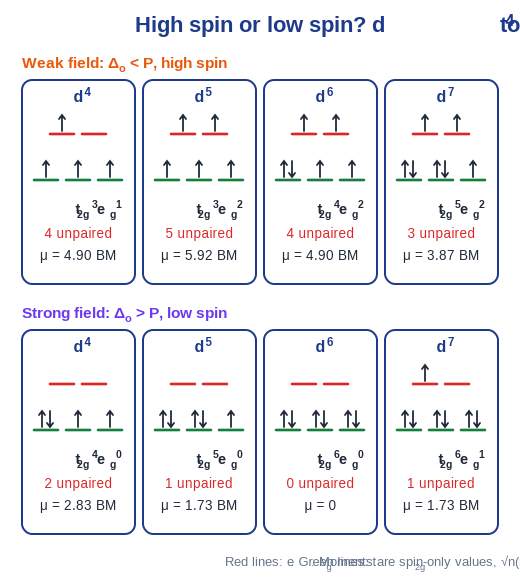
The book notes that d⁴ to d⁷ entities are more stable in strong fields than in weak fields. The count of unpaired electrons gives the spin-only moment, μ = √n(n+2) BM. For example, [Mn(H₂O)₆]²⁺ (d⁵, weak field) has five unpaired electrons, while [Mn(CN)₆]⁴⁻ (d⁵, strong field) has one.
How do they split in a tetrahedral complex?
In a tetrahedron no ligand lies on an axis, and the pattern is inverted: the three t₂ orbitals are higher and the two e orbitals lower.
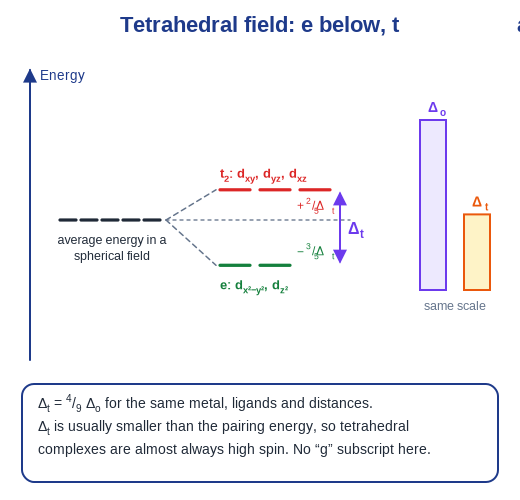
The splitting is also smaller. For the same metal, ligands and metal–ligand distances, Δt = (4/9)Δo. This is rarely enough to force pairing, so low spin tetrahedral complexes are rarely observed. The subscript g is used only for shapes with a centre of symmetry (octahedral, square planar), so the tetrahedral levels are written e and t₂.
How does CFT explain colour?
White light passing through a complex loses the wavelengths whose energy matches the splitting. An electron uses that energy to jump from the lower set to the upper set: a d–d transition. The light that comes out is the complementary colour.
[Ti(H₂O)₆]³⁺ is a 3d¹ ion. Its one electron sits in t₂g. It absorbs blue-green light (about 498 nm) and moves to e_g (t₂g¹e_g⁰ → t₂g⁰e_g¹), so the solution looks violet.
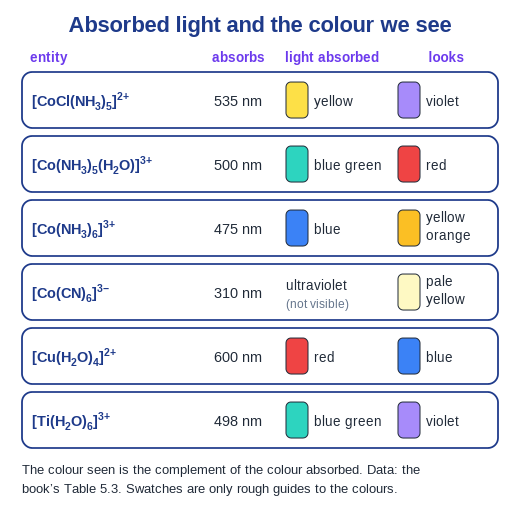
- No ligand, no colour. Heating [Ti(H₂O)₆]Cl₃ drives off the water and it becomes colourless. Anhydrous CuSO₄ is white; CuSO₄·5H₂O is blue.
- Change the ligand, change the colour. Adding ethane-1,2-diamine to green [Ni(H₂O)₆]²⁺ gives pale blue [Ni(H₂O)₄(en)]²⁺, then blue/purple [Ni(H₂O)₂(en)₂]²⁺, then violet [Ni(en)₃]²⁺.
- Gemstones. Ruby is Al₂O₃ with about 0.5–1% Cr³⁺ in place of Al³⁺. Emerald has Cr³⁺ in octahedral sites of beryl, Be₃Al₂Si₆O₁₈. In both, d–d transitions of Cr³⁺ (d³) give the colour.
Where does CFT fall short?
- If ligands were only point charges, anions should split the d orbitals most. In fact anionic ligands come at the weak end of the spectrochemical series.
- It ignores the covalent character of the metal–ligand bond.
Ligand field theory and molecular orbital theory deal with these points; they are beyond this course.
Before: isomerism in coordination compounds. Practise with the NCERT solutions, or go back to the chapter notes.
Practice
-
For a d⁴ ion in an octahedral field with Δo > P, the configuration is:
Show answer
Answer: (b) t₂g⁴e_g⁰
-
For the same metal, ligands and distances, Δt equals:
Show answer
Answer: (b) (4/9)Δo
-
The number of unpaired electrons in [Mn(CN)₆]⁴⁻ (Mn²⁺, d⁵, strong field) is:
Show answer
Answer: (c) 1
-
Why is anhydrous CuSO₄ white while CuSO₄·5H₂O is blue?
Show answer
Answer: Without a ligand there is no crystal field splitting, so no d–d transition takes place and the solid is white. With water as a ligand the d orbitals split, visible light is absorbed and the complementary blue colour is seen.
-
Find the spin-only magnetic moment of high spin [FeF₆]³⁻.
Show answer
Answer: Fe³⁺ is d⁵. With the weak field ligand F⁻ the configuration is t₂g³e_g², with n = 5 unpaired electrons. μ = √n(n+2) = √35 = 5.92 BM.
Questions students ask
What is crystal field splitting energy?
It is the energy gap between the two sets of d orbitals that form when ligands surround a metal ion. In an octahedral complex it is the difference between the e_g and t₂g levels and is written Δo. Its size depends on the field of the ligand and on the charge of the metal ion.
What is the difference between weak field and strong field ligands?
Weak field ligands, such as I⁻, Cl⁻ and F⁻, cause a small splitting, so Δo is less than the pairing energy P and electrons stay unpaired: high spin. Strong field ligands, such as CN⁻ and CO, cause a large splitting, so Δo is greater than P and electrons pair up in t₂g: low spin.
Why are tetrahedral complexes usually high spin?
The tetrahedral splitting is small: Δt is only four-ninths of Δo for the same metal, ligands and distances. It is rarely large enough to force electrons to pair, so low spin tetrahedral complexes are rarely seen.
What are the limitations of crystal field theory?
It treats ligands as point charges, so anionic ligands should cause the greatest splitting, but in the spectrochemical series they come at the weak end. It also ignores the covalent character of the metal–ligand bond. Ligand field theory and molecular orbital theory deal with these points.
Stuck on a question?
Take a photo and Lagnever AI explains it step by step. Try it for 7 days for ₹2.
Get it on Google Play Open in browser
For parents: after the trial, the plan renews monthly by UPI or card autopay. You can cancel anytime in the app.