
Class 12 Chemistry Chapter 5: Coordination Compounds Notes
This chapter in five lines
A coordination compound has a central metal atom or ion that holds a fixed number of ligands, as in [Co(NH₃)₆]Cl₃. Werner explained such compounds with primary and secondary valences. Today we name them by IUPAC rules, sort their isomers into stereo and structural types, and explain their shapes, magnetism and colours with valence bond theory and crystal field theory.
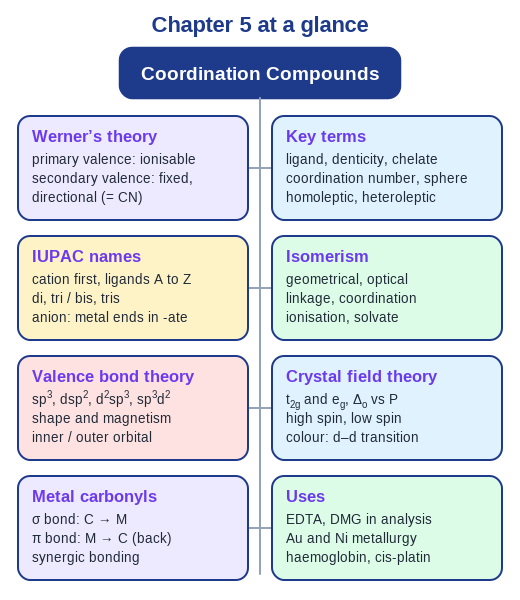
What is this chapter about?
The green of a leaf, the red of blood and vitamin B₁₂ have one thing in common: each has a metal held at its centre by surrounding groups. Chlorophyll has magnesium, haemoglobin has iron and vitamin B₁₂ has cobalt. Compounds like these, in which a metal atom or ion holds a fixed number of ions or molecules around it, are coordination compounds. Chapter 4 showed that transition metals form many of them. This chapter, Unit 5 of Chemistry Part I, explains how they are built, named, drawn and bonded.
What did Werner find out?
Alfred Werner, a Swiss chemist, studied the compounds that cobalt(III) chloride forms with ammonia. With excess silver nitrate in the cold, only some of the chlorine came down as AgCl.
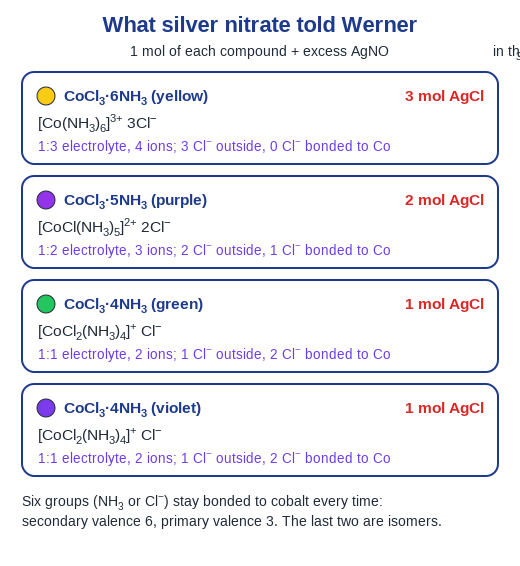
In every compound six groups, NH₃ or Cl⁻, stay bonded to cobalt. Werner’s theory (1898) says:
- A metal shows two kinds of linkage: primary and secondary valences.
- Primary valences can normally be ionised; negative ions satisfy them.
- Secondary valences cannot be ionised. Neutral molecules or negative ions satisfy them, and their number, the coordination number, is fixed for a given metal.
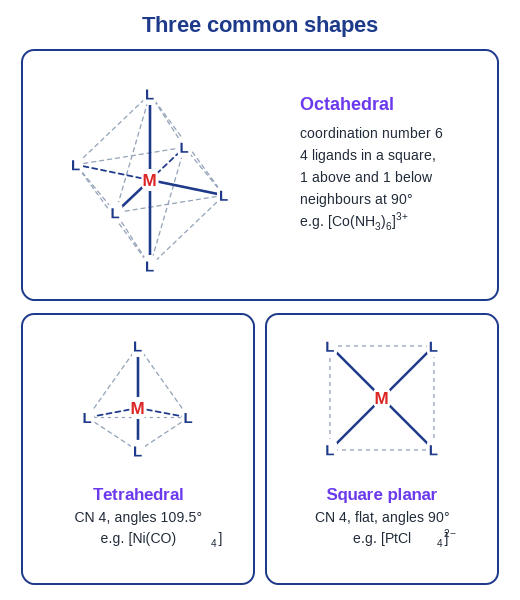
- The groups held by secondary valences are arranged in space in a definite way: octahedral, tetrahedral or square planar.
In today’s language the primary linkages are the ionisable (ionic) bonds and the secondary linkages are the non-ionisable (covalent) bonds; the secondary valence is the coordination number. The green and violet forms of CoCl₃·4NH₃ have the same formula but different properties, so they are isomers.
A double salt such as Mohr’s salt, FeSO₄·(NH₄)₂SO₄·6H₂O, also forms from two compounds, but it breaks up fully into simple ions in water. A complex ion such as [Fe(CN)₆]⁴⁻ does not give Fe²⁺ and CN⁻. Read Werner’s theory and naming.
Which terms must you know?
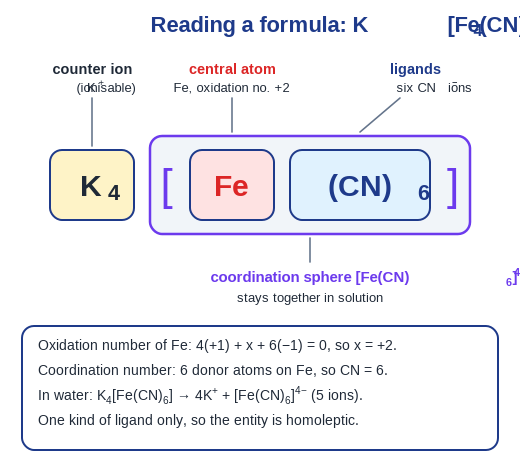
- Coordination entity: the metal with its ligands, such as [CoCl₃(NH₃)₃] or [Fe(CN)₆]⁴⁻.
- Central atom or ion: the metal at the centre, a Lewis acid. In [NiCl₂(H₂O)₄] it is Ni²⁺.
- Ligands: the ions or molecules bonded to it.
- Coordination number: the number of donor atoms bonded to the metal by sigma bonds. It is 6 in [PtCl₆]²⁻, 4 in [Ni(NH₃)₄]²⁺ and 6 in [Fe(C₂O₄)₃]³⁻, because each oxalate uses two donor atoms.
- Coordination sphere: everything inside the square brackets. Ions outside are counter ions.
- Coordination polyhedron: the shape made by the donor atoms.
- Oxidation number: the charge left on the metal when the ligands leave with their electron pairs. In [Cu(CN)₄]³⁻ copper is +1, written Cu(I).
- Homoleptic complexes have one kind of donor group, [Co(NH₃)₆]³⁺; heteroleptic ones have more, [Co(NH₃)₄Cl₂]⁺.
How are coordination compounds named?
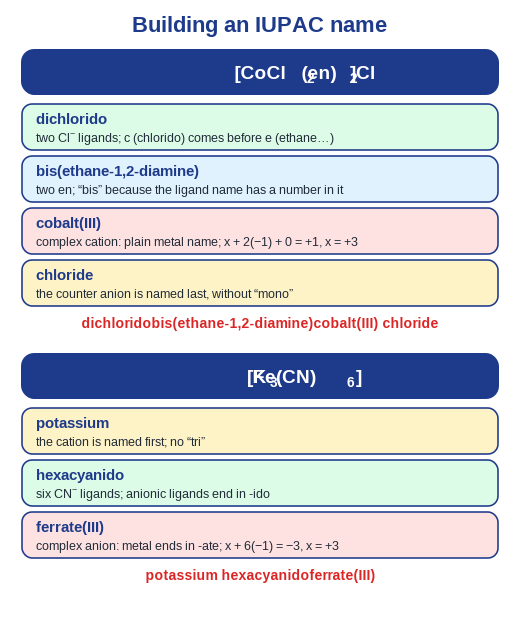
Formula. Write the central atom first, then the ligands in alphabetical order (charge does not matter), and put the whole entity in square brackets. Polyatomic ligands and abbreviations such as (en) go in parentheses. A charge is written outside the bracket, number before sign: [Co(CN)₆]³⁻.
Name.
- Name the cation first, then the anion.
- Inside the entity, name the ligands in alphabetical order, then the metal.
- Anionic ligands end in -o: chlorido, cyanido, hydroxido, oxalato, nitrito. Neutral ligands keep their names, except aqua (H₂O), ammine (NH₃), carbonyl (CO) and nitrosyl (NO).
- Use di, tri, tetra for the number of each ligand. If the ligand name already has a number prefix, use bis, tris, tetrakis with the name in parentheses.
- Give the oxidation state of the metal as a Roman numeral in parentheses.
- In a complex anion the metal name ends in -ate, sometimes from the Latin: ferrate, argentate. In a cation or a neutral molecule the metal keeps its name.
What kinds of isomers do they form?
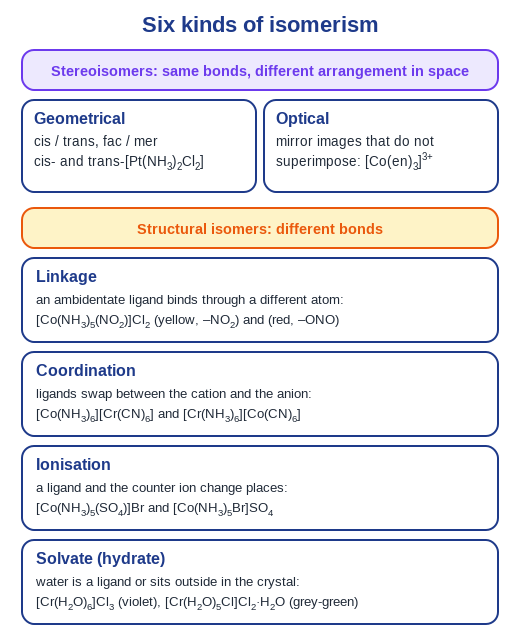
Stereoisomers have the same bonds but a different arrangement in space.
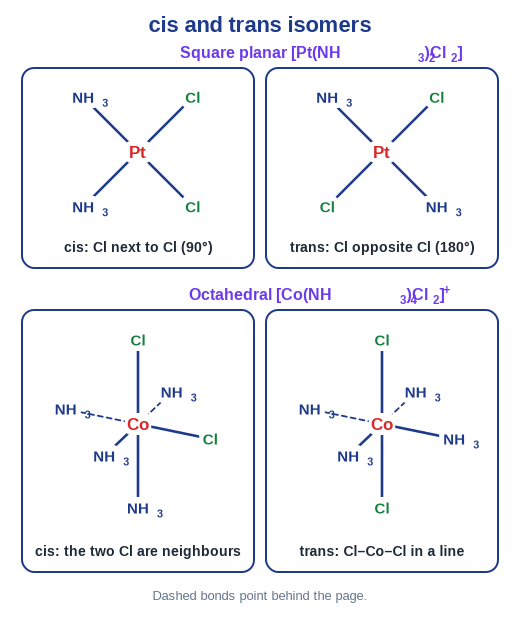
- Geometrical isomers. In square planar [MX₂L₂] and octahedral [MX₂L₄] the two X ligands can be neighbours (cis) or opposite (trans). Octahedral [Ma₃b₃] has fac and mer forms. Tetrahedral complexes show none, because all four positions are neighbours of one another.
- Optical isomers are mirror images that do not fit over each other, as in [Co(en)₃]³⁺. In [PtCl₂(en)₂]²⁺ only the cis isomer is optically active.
Structural isomers have different bonds: linkage, coordination, ionisation and solvate isomers. Read isomerism in coordination compounds.
How does valence bond theory explain the bonding?
In valence bond theory (VBT) the metal ion mixes its (n−1)d, ns and np orbitals, or its ns, np and nd orbitals, into a set of equal hybrid orbitals pointing in definite directions. Each hybrid orbital overlaps with a ligand orbital that donates an electron pair.
| Coordination number | Hybridisation | Shape |
|---|---|---|
| 4 | sp³ | tetrahedral |
| 4 | dsp² | square planar |
| 5 | sp³d | trigonal bipyramidal |
| 6 | sp³d² | octahedral |
| 6 | d²sp³ | octahedral |
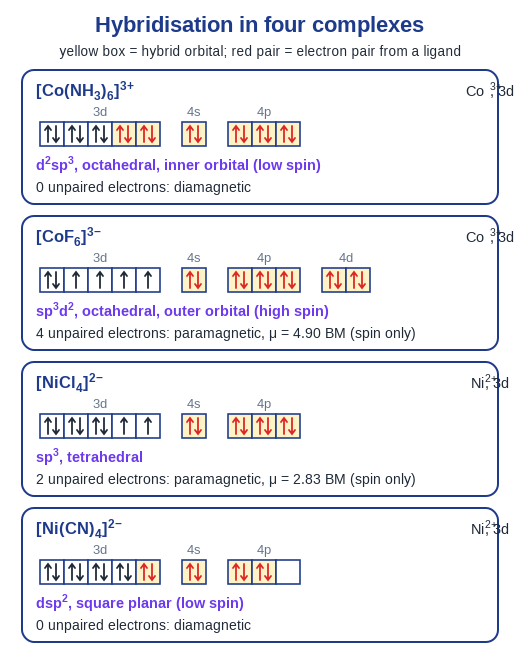
- [Co(NH₃)₆]³⁺ uses inner 3d orbitals (d²sp³): an inner orbital or low spin complex, diamagnetic.
- [CoF₆]³⁻ uses outer 4d orbitals (sp³d²): an outer orbital or high spin complex, with four unpaired electrons.
- [NiCl₄]²⁻ is sp³, tetrahedral, with two unpaired electrons. [Ni(CO)₄] is also tetrahedral but diamagnetic, since nickel is in the zero oxidation state.
- [Ni(CN)₄]²⁻ is dsp², square planar and diamagnetic.
The number of unpaired electrons, n, comes from the measured magnetic moment, μ = √n(n+2) BM (Chapter 4). So magnetic data tell us the hybridisation: [MnBr₄]²⁻ has μ = 5.9 BM, five unpaired electrons, so it is tetrahedral and not square planar.
Limits of VBT. It rests on several assumptions. It gives no quantitative account of magnetic data or of stability, does not explain colour, cannot predict tetrahedral against square planar for coordination number 4, and does not tell weak ligands from strong ones.
What does crystal field theory add?
Crystal field theory (CFT) treats the metal–ligand bond as purely electrostatic. Anions are point charges and neutral molecules are point dipoles. Their field removes the equality of the five d orbitals.
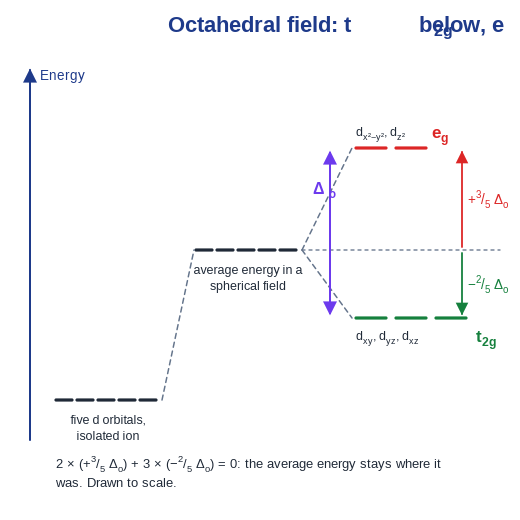
In an octahedral field the two orbitals pointing at the ligands (the e_g set) rise by ⅗Δo and the three pointing between them (the t₂g set) fall by ⅖Δo. For d⁴ to d⁷ ions the filling depends on Δo and the pairing energy P: weak field ligands (Δo < P) give high spin complexes and strong field ligands (Δo > P) give low spin complexes. In a tetrahedral field the order is inverted and Δt = (4/9)Δo.
Colour. A complex absorbs the visible light whose energy matches Δo, and an electron jumps from t₂g to e_g (a d–d transition). We see the complementary colour. [Ti(H₂O)₆]³⁺ absorbs blue-green light and looks violet. Without ligands there is no splitting: anhydrous CuSO₄ is white, CuSO₄·5H₂O is blue.
Limits of CFT. If ligands were point charges, anions should split the most, yet they sit at the weak end of the series. CFT also ignores the covalent part of the bond. Read crystal field theory.
How is CO bonded in metal carbonyls?
Homoleptic carbonyls contain only CO ligands: [Ni(CO)₄] is tetrahedral, [Fe(CO)₅] trigonal bipyramidal and [Cr(CO)₆] octahedral. [Mn₂(CO)₁₀] is two square pyramidal Mn(CO)₅ units joined by an Mn–Mn bond, and in [Co₂(CO)₈] two CO groups bridge a Co–Co bond.
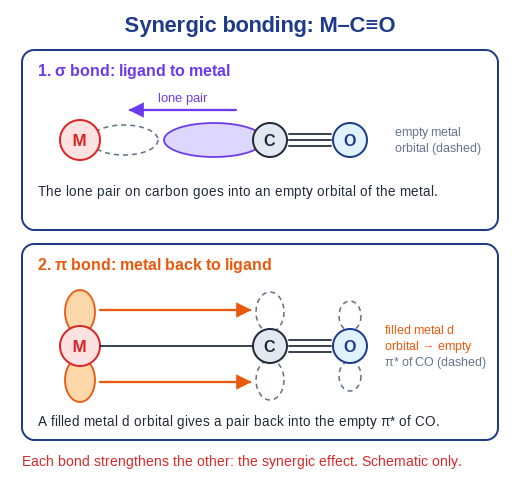
The M–C bond has two parts. The lone pair on carbon is donated into an empty metal orbital (σ bond). A filled metal d orbital donates back into the empty π* orbital of CO (π bond). Each strengthens the other: the synergic effect.
Where are coordination compounds used?
- Analysis. Coloured complexes with EDTA, DMG (dimethylglyoxime), α-nitroso-β-naphthol and cupron detect and estimate metal ions. Hardness of water is found by titration with Na₂EDTA.
- Metallurgy. Gold dissolves in cyanide solution, with oxygen and water, as [Au(CN)₂]⁻ and is recovered with zinc. Impure nickel is turned into [Ni(CO)₄], which is decomposed to pure nickel.
- Biology. Chlorophyll (Mg), haemoglobin (Fe), vitamin B₁₂ (Co) and enzymes such as carboxypeptidase A and carbonic anhydrase.
- Catalysis. Wilkinson catalyst, [(Ph₃P)₃RhCl], hydrogenates alkenes.
- Electroplating. Silver and gold deposit smoothly from [Ag(CN)₂]⁻ and [Au(CN)₂]⁻.
- Photography. Hypo dissolves undecomposed AgBr as [Ag(S₂O₃)₂]³⁻.
- Medicine. Chelating ligands remove excess metals: D-penicillamine and desferrioxime B for copper and iron, EDTA for lead. cis-platin and related platinum compounds slow the growth of tumours.
Stay safe
Cyanides, carbon monoxide and metal carbonyls are highly poisonous (Extra: the book does not give safety notes here). Chelating medicines are given only by doctors. Do any test from this chapter only in the school laboratory with your teacher, and never taste or sniff a chemical.
Before we move on
Three skills carry this chapter: finding the oxidation state and coordination number from a formula, writing the IUPAC name, and deciding the number of unpaired electrons from the ligand and the geometry. Practise each on ten complexes. Every exercise, Intext Question and worked example of the unit is answered in the NCERT solutions for Chapter 5.
Key terms
| Term | Meaning |
|---|---|
| Coordination entity | A central metal atom or ion together with the fixed number of ions or molecules attached to it, written in square brackets, such as [Fe(CN)₆]⁴⁻ or [Ni(CO)₄]. |
| Ligand | An ion or molecule bonded to the central atom through a donor atom, such as Cl⁻, H₂O, NH₃ or CN⁻. |
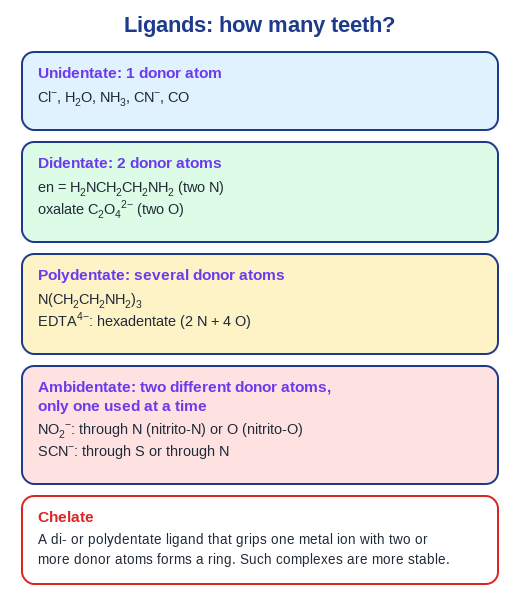
| Denticity | The number of donor atoms through which one ligand binds a metal ion: unidentate (1), didentate (2), polydentate (several). |
| Chelate | A complex in which a di- or polydentate ligand holds one metal ion with two or more donor atoms, forming a ring. It is more stable than a similar complex of unidentate ligands. |
| Ambidentate ligand | A ligand with two different donor atoms that binds through either one, such as NO₂⁻ (N or O) and SCN⁻ (S or N). |
| Coordination number | The number of ligand donor atoms bonded directly to the metal by sigma bonds: 6 in [Co(en)₃]³⁺, 4 in [Ni(CO)₄]. |
| Coordination sphere | The central atom and its ligands, enclosed in square brackets. Ions outside the brackets are counter ions. |
| Oxidation number of the central atom | The charge the metal would carry if every ligand were removed along with its shared electron pair. It is written as a Roman numeral, as in Cu(I). |
| Homoleptic and heteroleptic | Homoleptic: only one kind of donor group, as in [Co(NH₃)₆]³⁺. Heteroleptic: more than one kind, as in [Co(NH₃)₄Cl₂]⁺. |
| Geometrical isomers | Isomers that differ in the positions of ligands around the metal: cis and trans, or fac and mer. |
| Enantiomers | Optical isomers: a pair of mirror images that cannot be superimposed. A species that has such a mirror image is chiral. |
| Inner and outer orbital complex | In valence bond theory, an octahedral complex using (n−1)d orbitals (d²sp³) is inner orbital; one using nd orbitals (sp³d²) is outer orbital. |
| Crystal field splitting (Δo) | The energy gap between the t₂g and e_g sets of d orbitals in an octahedral field of ligands. |
| Spectrochemical series | Ligands arranged in order of increasing field strength, from I⁻ (weak) to CO (strong). |
| Synergic bonding | In metal carbonyls, the σ bond from CO to the metal and the π bond from the metal back to CO strengthen each other. |
Topics in this chapter
Practice
-
How many moles of AgCl does 1 mol of CoCl₃·5NH₃ give with excess AgNO₃?
Show answer
Answer: (c) 2
-
The coordination number of cobalt in [Co(en)₃]³⁺ is:
Show answer
Answer: (d) 6
-
The IUPAC name of K₃[Fe(CN)₆] is:
Show answer
Answer: (b) potassium hexacyanidoferrate(III)
-
Which complex is square planar and diamagnetic?
Show answer
Answer: (b) [Ni(CN)₄]²⁻
-
In an octahedral field, the d orbitals that are raised in energy are:
Show answer
Answer: (c) d_x²−y² and d_z²
-
Which ligand lies at the strong-field end of the spectrochemical series?
Show answer
Answer: (d) CO
Questions students ask
What are the main topics of Class 12 Chemistry Chapter 5?
Werner’s theory, the terms used for coordination compounds, IUPAC formulas and names, isomerism (geometrical, optical, linkage, coordination, ionisation, solvate), bonding by valence bond theory and crystal field theory, colour and magnetic behaviour, bonding in metal carbonyls, and the importance and uses of coordination compounds.
How is a double salt different from a complex?
Both form when stable compounds combine in a fixed ratio. A double salt such as Mohr’s salt, FeSO₄·(NH₄)₂SO₄·6H₂O, breaks up completely into simple ions in water. A complex ion such as [Fe(CN)₆]⁴⁻ of K₄[Fe(CN)₆] does not split into Fe²⁺ and CN⁻ ions.
Is Coordination Compounds in the 2026-27 NCERT Class 12 Chemistry book?
Yes. It is Unit 5 of Chemistry Part I, the Class 12 textbook marked Reprint 2026-27, on pages 118 to 140. The book calls it a unit; here it is Chapter 5.
Does the book write chloro or chlorido?
The 2026-27 reprint uses the -ido endings in its names: chlorido, cyanido, hydroxido. A margin note says the 2004 IUPAC draft asks for the -ido ending on anionic ligands. So write dichlorido, not dichloro, in your answers.
Stuck on a question?
Take a photo and Lagnever AI explains it step by step. Try it for 7 days for ₹2.
Get it on Google Play Open in browser
For parents: after the trial, the plan renews monthly by UPI or card autopay. You can cancel anytime in the app.