
Class 12 Chemistry Chapter 5: Coordination Compounds Notes Hinglish mein
Ye chapter 5 lines mein
Coordination compound mein ek central metal atom ya ion ligands ki ek tay ginti se juda hota hai, jaise [Co(NH₃)₆]Cl₃. Werner ne inhe primary aur secondary valence se samjhaya. Aaj hum inke naam IUPAC rules se likhte hain, isomers ko stereo aur structural types mein baantte hain, aur shape, magnetism aur colour ko valence bond theory aur crystal field theory se samjhate hain.
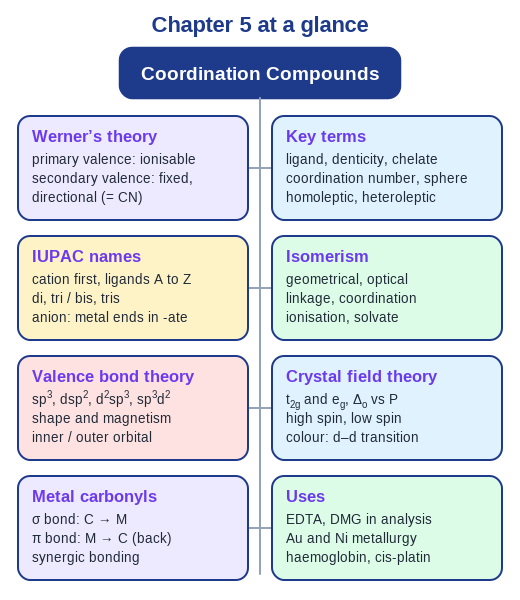
Ye chapter kis baare mein hai?
Patte ka hara rang, khoon ka laal rang aur vitamin B₁₂: teeno mein ek baat same hai. Har ek ke beech mein ek metal hai jise aas-paas ke groups ne pakad rakha hai. Chlorophyll mein magnesium hai, haemoglobin mein iron aur vitamin B₁₂ mein cobalt. Aise compounds, jinme metal atom ya ion ions ya molecules ki tay ginti se juda hota hai, coordination compounds kehlate hain. Chapter 4 mein dekha tha ki transition metals aise bahut compounds banate hain. Ye chapter, Chemistry Part I ki Unit 5, batata hai ki ye kaise bante hain, inka naam kaise likhte hain, inhe kaise draw karte hain aur inme bonding kaisi hoti hai.
Werner ne kya pata lagaya?
Swiss chemist Alfred Werner ne cobalt(III) chloride ke ammonia ke saath bane compounds study kiye. Thande mein excess silver nitrate daalne par chlorine ka sirf kuch hissa AgCl ban kar neeche aaya.
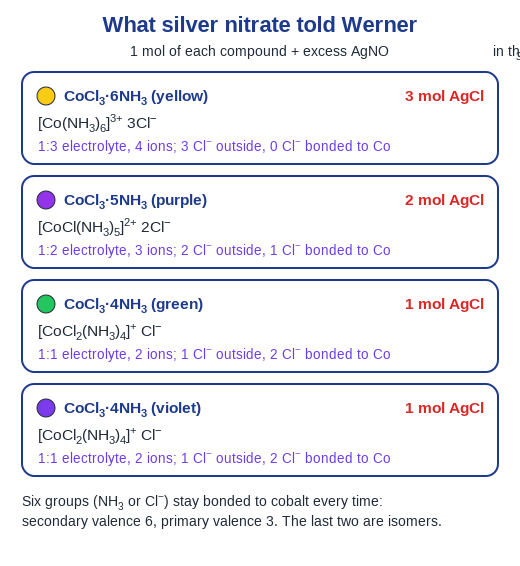
Har compound mein chhe groups, NH₃ ya Cl⁻, cobalt se jude rehte hain. Werner ki theory (1898) kehti hai:
- Metal do tarah ke linkage dikhata hai: primary aur secondary valence.
- Primary valence aam taur par ionisable hoti hai aur negative ions se poori hoti hai.
- Secondary valence non-ionisable hoti hai. Ye neutral molecules ya negative ions se poori hoti hai, aur iski ginti, yaani coordination number, ek metal ke liye fixed hai.
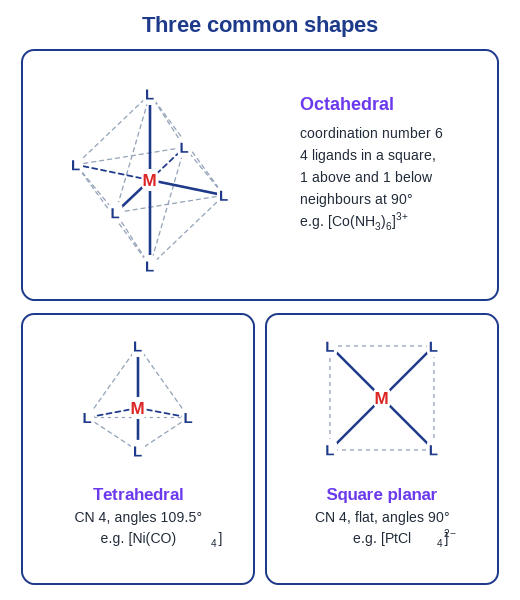
- Secondary valence se jude groups space mein ek tay tareeke se lage hote hain: octahedral, tetrahedral ya square planar.
Aaj ki bhasha mein primary linkages ionisable (ionic) bonds hain aur secondary linkages non-ionisable (covalent) bonds; secondary valence hi coordination number hai. CoCl₃·4NH₃ ke green aur violet forms ka formula same hai lekin properties alag, isliye wo isomers hain.
Double salt, jaise Mohr’s salt FeSO₄·(NH₄)₂SO₄·6H₂O, bhi do compounds se banta hai, lekin paani mein poori tarah simple ions mein toot jaata hai. Complex ion, jaise [Fe(CN)₆]⁴⁻, Fe²⁺ aur CN⁻ nahi deta. Padho: Werner ki theory aur IUPAC naming.
Kaunse terms aane chahiye?
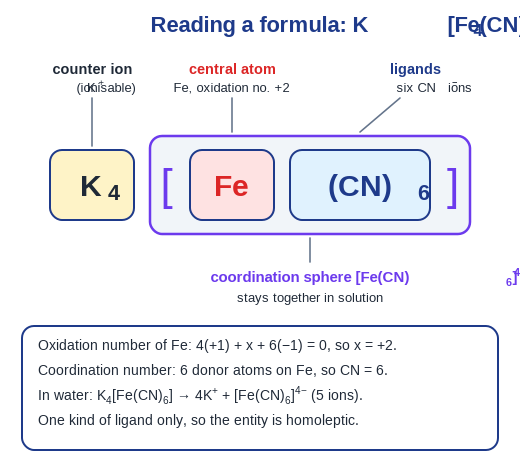
- Coordination entity: metal aur uske ligands, jaise [CoCl₃(NH₃)₃] ya [Fe(CN)₆]⁴⁻.
- Central atom ya ion: beech ka metal, jo Lewis acid hai. [NiCl₂(H₂O)₄] mein ye Ni²⁺ hai.
- Ligands: us se jude ions ya molecules.
- Coordination number: metal se sigma bond se jude donor atoms ki ginti. [PtCl₆]²⁻ mein 6, [Ni(NH₃)₄]²⁺ mein 4 aur [Fe(C₂O₄)₃]³⁻ mein 6, kyunki har oxalate do donor atoms use karta hai.
- Coordination sphere: square brackets ke andar ka sab kuch. Bahar ke ions counter ions hain.
- Coordination polyhedron: donor atoms se bani shape.
- Oxidation number: ligands apne electron pairs ke saath hat jaayein to metal par bacha charge. [Cu(CN)₄]³⁻ mein copper +1 hai, Cu(I).
- Homoleptic complex mein ek hi tarah ka donor group hota hai, [Co(NH₃)₆]³⁺; heteroleptic mein zyada, [Co(NH₃)₄Cl₂]⁺.
Coordination compounds ka naam kaise likhte hain?
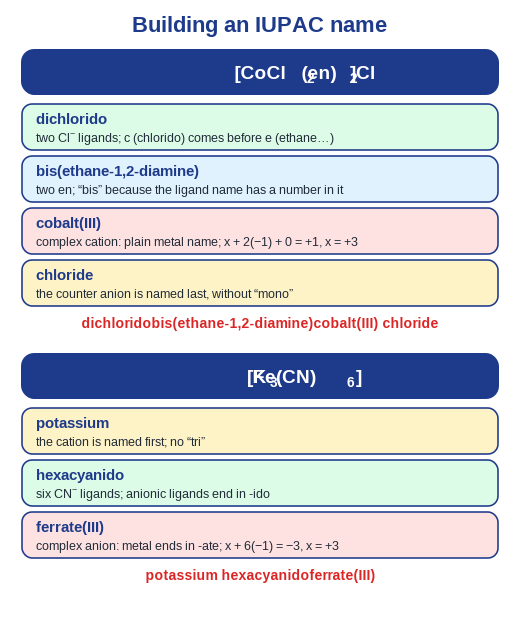
Formula. Pehle central atom likho, phir ligands alphabetical order mein (charge se fark nahi padta), aur poori entity ko square brackets mein rakho. Polyatomic ligands aur (en) jaise abbreviations parentheses mein aate hain. Charge bracket ke bahar likhte hain, pehle number phir sign: [Co(CN)₆]³⁻.
Naam.
- Pehle cation ka naam, phir anion ka.
- Entity ke andar ligands alphabetical order mein, phir metal.
- Anionic ligands -o par khatm hote hain: chlorido, cyanido, hydroxido, oxalato, nitrito. Neutral ligands ka naam wahi rehta hai, sivaay aqua (H₂O), ammine (NH₃), carbonyl (CO) aur nitrosyl (NO) ke.
- Har ligand ki ginti ke liye di, tri, tetra lagao. Agar ligand ke naam mein pehle se number prefix ho, to bis, tris, tetrakis lagao aur naam parentheses mein rakho.
- Metal ka oxidation state Roman numeral mein, parentheses ke andar.
- Complex anion mein metal ka naam -ate par khatm hota hai, kabhi-kabhi Latin naam se: ferrate, argentate. Cation ya neutral molecule mein metal ka naam wahi rehta hai.
Inme kis-kis tarah ke isomers hote hain?
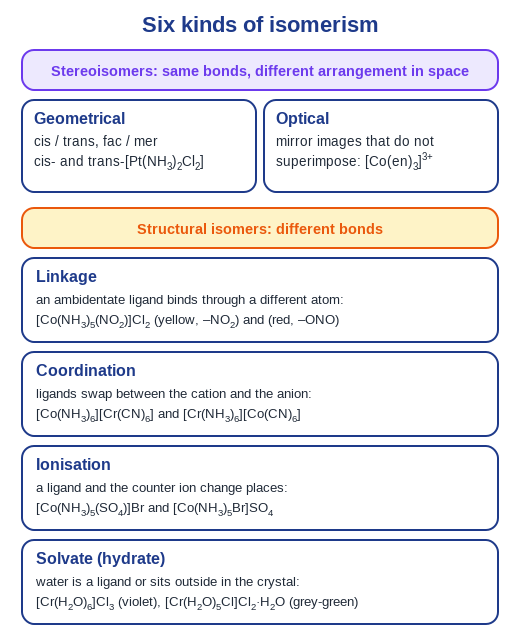
Stereoisomers mein bonds same hote hain lekin space mein arrangement alag.
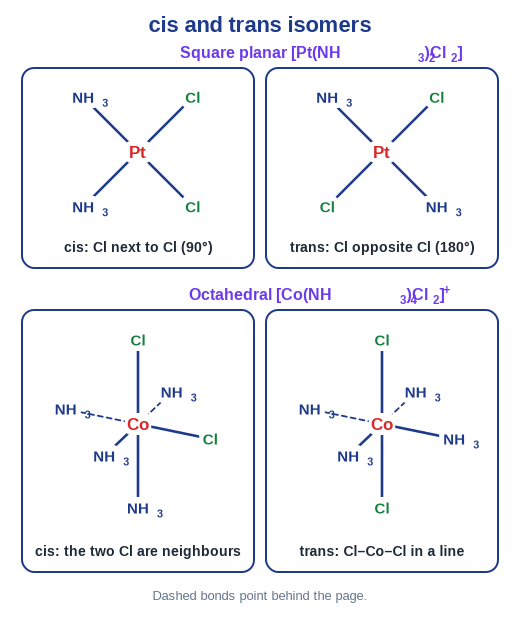
- Geometrical isomers. Square planar [MX₂L₂] aur octahedral [MX₂L₄] mein do X ligands paas-paas (cis) ya aamne-saamne (trans) ho sakte hain. Octahedral [Ma₃b₃] ke fac aur mer forms hote hain. Tetrahedral complex mein ye nahi hota, kyunki chaaron positions ek doosre ki padosi hain.
- Optical isomers aisi mirror images hain jo superimpose nahi hoti, jaise [Co(en)₃]³⁺. [PtCl₂(en)₂]²⁺ mein sirf cis isomer optically active hai.
Structural isomers mein bonds alag hote hain: linkage, coordination, ionisation aur solvate isomers. Padho: coordination compounds mein isomerism.
Valence bond theory bonding ko kaise samjhati hai?
Valence bond theory (VBT) mein metal ion apne (n−1)d, ns aur np orbitals, ya ns, np aur nd orbitals, ko mila kar barabar hybrid orbitals banata hai jo tay directions mein hote hain. Har hybrid orbital ek ligand orbital se overlap karta hai jo electron pair deta hai.
| Coordination number | Hybridisation | Shape |
|---|---|---|
| 4 | sp³ | tetrahedral |
| 4 | dsp² | square planar |
| 5 | sp³d | trigonal bipyramidal |
| 6 | sp³d² | octahedral |
| 6 | d²sp³ | octahedral |
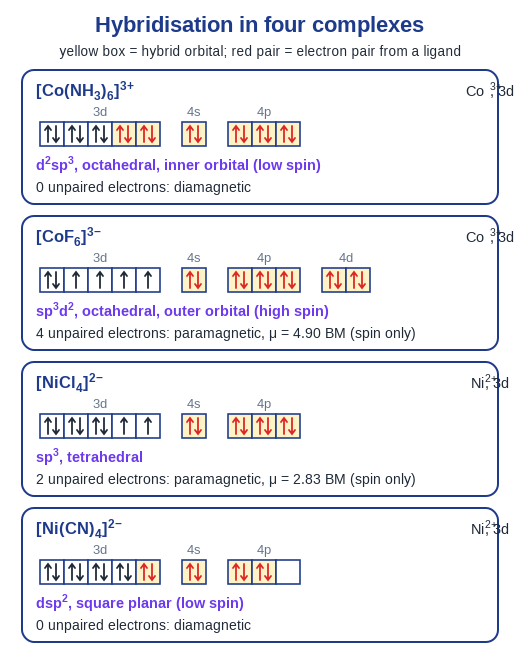
- [Co(NH₃)₆]³⁺ andar ke 3d orbitals use karta hai (d²sp³): inner orbital ya low spin complex, diamagnetic.
- [CoF₆]³⁻ bahar ke 4d orbitals use karta hai (sp³d²): outer orbital ya high spin complex, chaar unpaired electrons ke saath.
- [NiCl₄]²⁻ sp³ hai, tetrahedral, do unpaired electrons. [Ni(CO)₄] bhi tetrahedral hai lekin diamagnetic, kyunki nickel zero oxidation state mein hai.
- [Ni(CN)₄]²⁻ dsp² hai, square planar aur diamagnetic.
Unpaired electrons ki ginti n, measure kiye gaye magnetic moment se milti hai, μ = √n(n+2) BM (Chapter 4). Isliye magnetic data se hybridisation pata chalta hai: [MnBr₄]²⁻ ka μ = 5.9 BM hai, yaani paanch unpaired electrons, to ye tetrahedral hai, square planar nahi.
VBT ki limits. Ye kai assumptions par tiki hai. Magnetic data ya stability ka quantitative hisaab nahi deti, colour nahi samjhati, coordination number 4 mein tetrahedral aur square planar ke beech pakka prediction nahi kar paati, aur weak aur strong ligands mein fark nahi batati.
Crystal field theory kya naya batati hai?
Crystal field theory (CFT) metal–ligand bond ko poori tarah electrostatic maanti hai. Anions point charges hain aur neutral molecules point dipoles. Inka field paanchon d orbitals ki barabar energy ko tod deta hai.
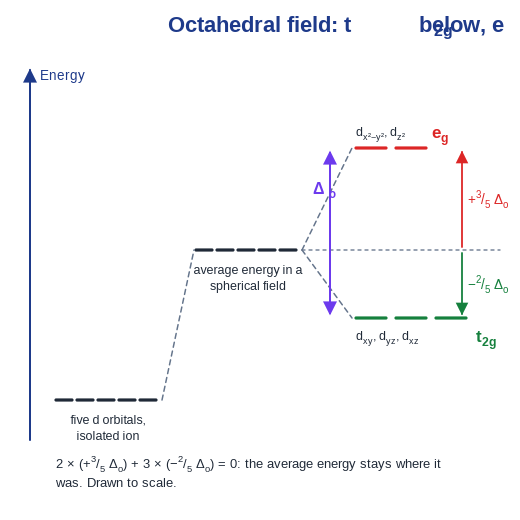
Octahedral field mein ligands ki taraf point karne wale do orbitals (e_g set) ⅗Δo upar jaate hain aur unke beech point karne wale teen (t₂g set) ⅖Δo neeche. d⁴ se d⁷ ions mein filling Δo aur pairing energy P par depend karti hai: weak field ligands (Δo < P) high spin complex dete hain aur strong field ligands (Δo > P) low spin. Tetrahedral field mein order ulta hota hai aur Δt = (4/9)Δo.
Colour. Complex wo visible light absorb karta hai jiski energy Δo ke barabar ho, aur ek electron t₂g se e_g mein jaata hai (d–d transition). Hume complementary colour dikhta hai. [Ti(H₂O)₆]³⁺ blue-green light absorb karta hai aur violet dikhta hai. Ligand na ho to splitting nahi hoti: anhydrous CuSO₄ safed hai, CuSO₄·5H₂O neela.
CFT ki limits. Agar ligands point charges hote, to anions ko sabse zyada splitting karni chahiye thi, lekin wo series ke weak sire par hain. CFT bond ke covalent hisse ko bhi nahi ginti. Padho: crystal field theory kya hai.
Metal carbonyls mein CO kaise juda hota hai?
Homoleptic carbonyls mein sirf CO ligands hote hain: [Ni(CO)₄] tetrahedral hai, [Fe(CO)₅] trigonal bipyramidal aur [Cr(CO)₆] octahedral. [Mn₂(CO)₁₀] do square pyramidal Mn(CO)₅ units hain jo Mn–Mn bond se jude hain, aur [Co₂(CO)₈] mein Co–Co bond hai jise do CO groups bridge karte hain.
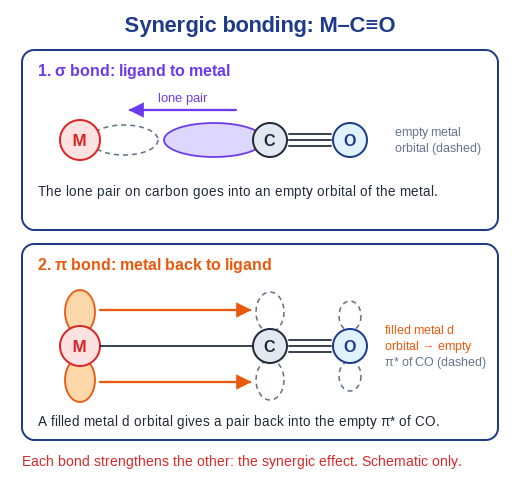
M–C bond ke do hisse hain. Carbon ka lone pair metal ke khaali orbital mein jaata hai (σ bond). Metal ka bhara hua d orbital CO ke khaali π* orbital mein electrons wapas deta hai (π bond). Dono ek doosre ko mazboot karte hain: yahi synergic effect hai.
Coordination compounds kahan kaam aate hain?
- Analysis. EDTA, DMG (dimethylglyoxime), α-nitroso-β-naphthol aur cupron ke saath bane rangeen complexes se metal ions detect aur estimate hote hain. Paani ki hardness Na₂EDTA se titration karke nikaalte hain.
- Metallurgy. Gold oxygen aur paani ki maujoodgi mein cyanide solution mein [Au(CN)₂]⁻ ban kar ghulta hai aur zinc daal kar wapas nikaala jaata hai. Impure nickel ko [Ni(CO)₄] mein badla jaata hai, jise todne par pure nickel milta hai.
- Biology. Chlorophyll (Mg), haemoglobin (Fe), vitamin B₁₂ (Co), aur carboxypeptidase A aur carbonic anhydrase jaise enzymes.
- Catalysis. Wilkinson catalyst, [(Ph₃P)₃RhCl], alkenes ka hydrogenation karta hai.
- Electroplating. [Ag(CN)₂]⁻ aur [Au(CN)₂]⁻ ke solutions se silver aur gold ki parat zyada smooth chadhti hai.
- Photography. Hypo solution bina toote AgBr ko [Ag(S₂O₃)₂]³⁻ bana kar ghol deta hai.
- Medicine. Chelating ligands zyada metal ko nikaalte hain: copper aur iron ke liye D-penicillamine aur desferrioxime B, lead ke liye EDTA. cis-platin aur usse milte-julte platinum compounds tumour ki growth ko rokte hain.
Safe raho
Cyanides, carbon monoxide aur metal carbonyls bahut zehreele hain (Extra: book yahan safety notes nahi deti). Chelating dawaiyan sirf doctor dete hain. Is chapter ka koi bhi test sirf school lab mein apne teacher ke saath karo, aur kisi chemical ko kabhi chakho ya soongho mat.
Aage badhne se pehle
Is chapter mein teen skills sabse zyada kaam aati hain: formula se oxidation state aur coordination number nikaalna, IUPAC naam likhna, aur ligand aur geometry dekh kar unpaired electrons ki ginti batana. Har ek ko das complexes par practise karo. Unit ka har exercise, Intext Question aur solved example Chapter 5 ke NCERT solutions mein hal kiya gaya hai.
Key terms (zaroori shabd)
| Term | Matlab |
|---|---|
| Coordination entity | Ek central metal atom ya ion jo ions ya molecules ki tay ginti se juda ho; square brackets mein likhte hain, jaise [Fe(CN)₆]⁴⁻ ya [Ni(CO)₄]. |
| Ligand | Wo ion ya molecule jo donor atom ke zariye central atom se juda ho, jaise Cl⁻, H₂O, NH₃ ya CN⁻. |
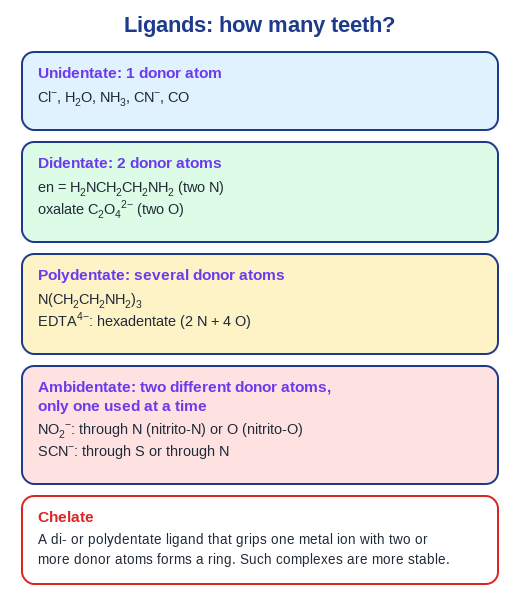
| Denticity | Ek ligand kitne donor atoms se metal ion ko pakadta hai: unidentate (1), didentate (2), polydentate (kai). |
| Chelate | Aisa complex jisme di- ya polydentate ligand ek hi metal ion ko do ya zyada donor atoms se pakad kar ring banata hai. Ye unidentate ligands wale milte-julte complex se zyada stable hota hai. |
| Ambidentate ligand | Do alag donor atoms wala ligand jo dono mein se kisi ek se judta hai, jaise NO₂⁻ (N ya O) aur SCN⁻ (S ya N). |
| Coordination number | Metal se sigma bond se seedhe jude ligand donor atoms ki ginti: [Co(en)₃]³⁺ mein 6, [Ni(CO)₄] mein 4. |
| Coordination sphere | Central atom aur uske ligands, jo square brackets ke andar likhe jaate hain. Bracket ke bahar ke ions counter ions hain. |
| Central atom ka oxidation number | Wo charge jo metal par bachega agar saare ligands apne shared electron pairs ke saath hata diye jaayein. Roman numeral mein likhte hain, jaise Cu(I). |
| Homoleptic aur heteroleptic | Homoleptic: sirf ek tarah ka donor group, jaise [Co(NH₃)₆]³⁺. Heteroleptic: ek se zyada tarah ke, jaise [Co(NH₃)₄Cl₂]⁺. |
| Geometrical isomers | Wo isomers jinme metal ke charon taraf ligands ki jagah alag hoti hai: cis aur trans, ya fac aur mer. |
| Enantiomers | Optical isomers: mirror images ka joda jo ek doosre par superimpose nahi hote. Aisi mirror image wali species chiral kehlati hai. |
| Inner aur outer orbital complex | Valence bond theory mein jo octahedral complex (n−1)d orbitals use kare (d²sp³) wo inner orbital hai; jo nd orbitals use kare (sp³d²) wo outer orbital. |
| Crystal field splitting (Δo) | Ligands ke octahedral field mein d orbitals ke t₂g aur e_g sets ke beech ka energy gap. |
| Spectrochemical series | Ligands ko badhti field strength ke order mein lagana, I⁻ (weak) se CO (strong) tak. |
| Synergic bonding | Metal carbonyls mein CO se metal ka σ bond aur metal se wapas CO ka π bond ek doosre ko mazboot karte hain. |
Is chapter ke topics
Practice karo
-
1 mol CoCl₃·5NH₃ excess AgNO₃ ke saath kitne mol AgCl deta hai?
Jawab dekho
Jawab: (c) 2
-
[Co(en)₃]³⁺ mein cobalt ka coordination number hai:
Jawab dekho
Jawab: (d) 6
-
K₃[Fe(CN)₆] ka IUPAC naam hai:
Jawab dekho
Jawab: (b) potassium hexacyanidoferrate(III)
-
Kaunsa complex square planar aur diamagnetic hai?
Jawab dekho
Jawab: (b) [Ni(CN)₄]²⁻
-
Octahedral field mein kaunse d orbitals ki energy badhti hai?
Jawab dekho
Jawab: (c) d_x²−y² aur d_z²
-
Spectrochemical series ke strong-field sire par kaunsa ligand hai?
Jawab dekho
Jawab: (d) CO
Students ke sawal
Class 12 Chemistry Chapter 5 ke main topics kya hain?
Werner ki theory, coordination compounds ke terms, IUPAC formulas aur naam, isomerism (geometrical, optical, linkage, coordination, ionisation, solvate), valence bond theory aur crystal field theory se bonding, colour aur magnetic behaviour, metal carbonyls mein bonding, aur coordination compounds ka importance aur uses.
Double salt aur complex mein kya fark hai?
Dono tab bante hain jab stable compounds tay ratio mein milte hain. Double salt, jaise Mohr’s salt FeSO₄·(NH₄)₂SO₄·6H₂O, paani mein poori tarah simple ions mein toot jaata hai. Complex ion, jaise K₄[Fe(CN)₆] ka [Fe(CN)₆]⁴⁻, Fe²⁺ aur CN⁻ ions mein nahi toot-ta.
Kya Coordination Compounds 2026-27 ki NCERT Class 12 Chemistry book mein hai?
Haan. Ye Chemistry Part I ki Unit 5 hai, Class 12 ki textbook (Reprint 2026-27) ke page 118 se 140 par. Book ise unit kehti hai; yahan ye Chapter 5 hai.
Book chloro likhti hai ya chlorido?
2026-27 reprint apne naamon mein -ido endings use karta hai: chlorido, cyanido, hydroxido. Margin note mein likha hai ki 2004 ka IUPAC draft anionic ligands ke liye -ido recommend karta hai. Isliye answer mein dichlorido likho, dichloro nahi.
Koi sawal atak gaya?
Photo lo, Lagnever AI step-by-step samjhayega. 7 din ka trial sirf ₹2.
Google Play se app lo Browser mein kholo
Parents ke liye: trial ke baad plan har mahine UPI ya card autopay se renew hota hai. App mein kabhi bhi cancel kar sakte hain.