
Werner ki theory kya hai, aur coordination compounds ka naam kaise likhte hain?
Short mein jawab
Werner ne kaha ki metal ki do tarah ki valence hoti hai. Primary valence ionisable hai aur negative ions se poori hoti hai. Secondary valence non-ionisable hai, coordination number ke barabar hai aur tay directions mein hoti hai. IUPAC naam mein pehle cation aata hai; complex ke andar ligands alphabetical order mein, phir metal aur Roman numeral mein oxidation state.
Koi sawal atak gaya? Photo lo, Lagnever AI step-by-step samjhayega. 7 din ka trial sirf ₹2. Google Play se app lo
Werner ne kaunsi paheli suljhayi?
Cobalt(III) chloride ammonia ke saath compounds ki ek series banata hai: CoCl₃·6NH₃, CoCl₃·5NH₃ aur do alag CoCl₃·4NH₃. Sabme har cobalt par teen chlorine hain, phir bhi thande mein excess silver nitrate solution ke saath sab barabar AgCl nahi dete.
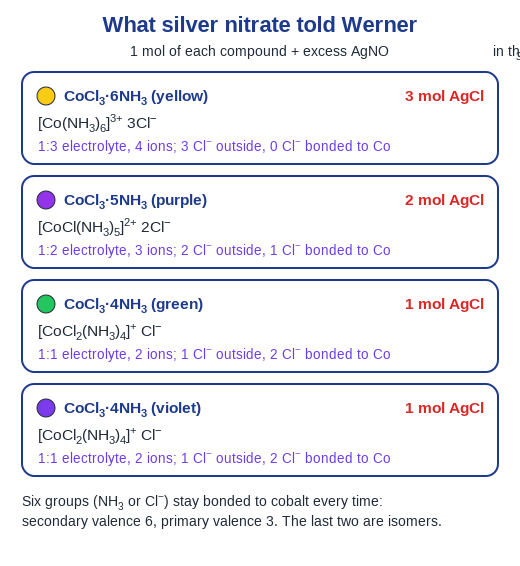
Conductivity ke measurements bhi yahi kehte the: ye compounds 1:3, 1:2 aur 1:1 electrolytes ki tarah behave karte hain. Alfred Werner ne samjhaya ki chhe groups, ammonia molecules ya chloride ions, cobalt se ek unit ki tarah jude rehte hain jo solution mein nahi toot-ti.
Werner ki theory ke postulates kya hain?
Werner ne apni theory 1898 mein di.
- Coordination compounds mein metal do tarah ke linkage dikhata hai: primary aur secondary.
- Primary valence aam taur par ionisable hoti hai aur negative ions se poori hoti hai.
- Secondary valence non-ionisable hoti hai. Ye neutral molecules ya negative ions se poori hoti hai. Secondary valence coordination number ke barabar hoti hai aur ek metal ke liye fixed hai.
- Secondary linkage se jude groups har coordination number ke liye space mein ek khaas tareeke se lage hote hain.
Aaj hum in arrangements ko coordination polyhedra kehte hain. Square brackets ke andar ki species coordination entity ya complex hai, aur bahar ke ions counter ions hain. Octahedral, tetrahedral aur square planar shapes sabse common hain: [Co(NH₃)₆]³⁺ octahedral hai, [Ni(CO)₄] tetrahedral aur [PtCl₄]²⁻ square planar.
AgCl test ka use. PdCl₂·4NH₃ se 2 mol AgCl milta hai, yaani dono chloride bahar hain: [Pd(NH₃)₄]Cl₂, secondary valence 4. PtCl₄·2HCl se bilkul nahi milta, yaani chhe ke chhe chloride jude hain: H₂[PtCl₆], secondary valence 6.
Complex ka formula kaise padhte hain?
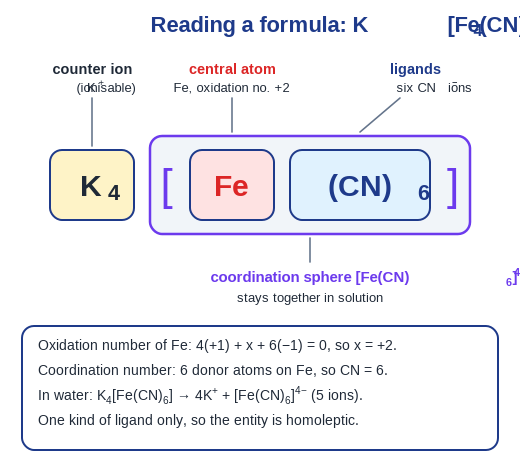
Formula se do numbers seedhe milte hain.
- Oxidation number. Metal ka oxidation number aur ligands ke charges ka jod entity ke charge ke barabar hota hai. [Cu(CN)₄]³⁻ mein: x + 4(−1) = −3, isliye x = +1.
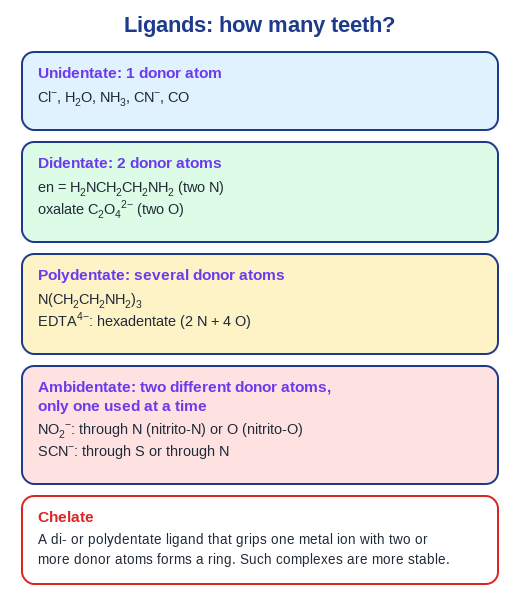
- Coordination number. Donor atoms gino, ligands nahi. Ethane-1,2-diamine (en) aur oxalate didentate hain, isliye [Co(en)₃]³⁺ aur [Fe(C₂O₄)₃]³⁻ dono ka coordination number 6 hai. Sirf sigma bonds gine jaate hain.
Formula kaise likhte hain?
- Sabse pehle central atom.
- Phir ligands alphabetical order mein, charge chahe jo ho. en jaise abbreviation ke liye uska pehla letter jagah tay karta hai.
- Poori entity square brackets mein. Polyatomic ligands aur abbreviations parentheses mein. Bracket ke andar koi space nahi.
- Agar entity bina counter ion ke likhi hai, to charge bracket ke bahar superscript mein, pehle number phir sign: [Cr(H₂O)₆]³⁺.
- Cations aur anions ke charges balance hone chahiye.
Naam kaise likhte hain?
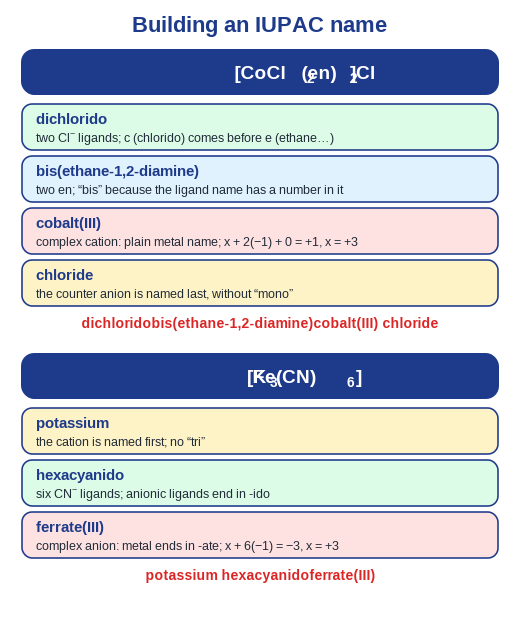
- Pehle cation ka naam, chahe wo complex ho ya counter ion.
- Ligands ke naam alphabetical order mein, metal se pehle. di aur tri jaise prefixes order mein nahi gine jaate.
- Anionic ligands -o par khatm hote hain. -ide wale ions -ido ban jaate hain (chlorido, cyanido, hydroxido); -ate ya -ite wale -ato ya -ito (oxalato, carbonato, nitrito). Neutral ligands ka naam wahi rehta hai, sivaay aqua (H₂O), ammine (NH₃), carbonyl (CO) aur nitrosyl (NO) ke.
- Har ligand ki ginti ke liye di, tri, tetra, penta, hexa. Jab ligand ke naam mein number prefix ho, to bis, tris, tetrakis lagao aur ligand ko parentheses mein rakho.
- Metal ke naam ke baad uska oxidation state Roman numeral mein, parentheses ke andar.
- Complex cation ya neutral complex mein metal ka naam wahi rehta hai. Complex anion mein wo -ate par khatm hota hai: cobaltate, chromate, zincate, aur Latin se ferrate (Fe) aur argentate (Ag).
Rules ko kaam karte dekhein?
| Formula | Naam |
|---|---|
| [Cr(NH₃)₃(H₂O)₃]Cl₃ | triamminetriaquachromium(III) chloride |
| [Co(en)₃]₂(SO₄)₃ | tris(ethane-1,2-diamine)cobalt(III) sulphate |
| [Ag(NH₃)₂][Ag(CN)₂] | diamminesilver(I) dicyanidoargentate(I) |
| K₂[Zn(OH)₄] | potassium tetrahydroxidozincate(II) |
| [Pt(NH₃)₂Cl(NO₂)] | diamminechloridonitrito-N-platinum(II) |
| [Ni(CO)₄] | tetracarbonylnickel(0) |
| [NiCl₂(PPh₃)₂] | dichloridobis(triphenylphosphine)nickel(II) |
Teen baatein dhyan do. Counter ions ki ginti kabhi nahi batate: “chloride” likhte hain, “trichloride” nahi. Teesre compound mein silver cation mein “silver” hai aur anion mein “argentate”. Aur doosre compound mein teen sulphate do complex cations ko balance karte hain, isliye har cation 3+ hai aur cobalt +3.
Spelling par ek note. Book ka rule kehta hai ki anionic ligands ke naam “-o” par khatm hote hain, lekin uske apne naamon mein naye -ido forms hain, aur margin note ke hisaab se 2004 ka IUPAC draft inhe recommend karta hai. Book ke examples follow karo aur chlorido, cyanido aur hydroxido likho.
Aage: coordination compounds mein isomerism. NCERT solutions se practise karo, ya chapter notes par wapas jao.
Practice karo
-
PtCl₄·2HCl, jo AgNO₃ ke saath AgCl nahi deta, usme platinum ki secondary valence hai:
Jawab dekho
Jawab: (c) 6
-
Potassium tetrahydroxidozincate(II) ka formula hai:
Jawab dekho
Jawab: (b) K₂[Zn(OH)₄]
-
[Co(NH₃)₅Cl]Cl₂ ka IUPAC naam hai:
Jawab dekho
Jawab: (a) pentaamminechloridocobalt(III) chloride
-
K₄[Fe(CN)₆] mein iron ka oxidation number nikaalo.
Jawab dekho
Jawab: 4(+1) + x + 6(−1) = 0, isliye x = +2. Naam hai potassium hexacyanidoferrate(II).
-
Mohr’s salt ka solution Fe²⁺ ka test deta hai lekin K₄[Fe(CN)₆] ka solution nahi. Kyun?
Jawab dekho
Jawab: Mohr’s salt double salt hai aur poori tarah Fe²⁺, NH₄⁺ aur SO₄²⁻ ions mein toot jaata hai. K₄[Fe(CN)₆] complex hai: ye K⁺ aur [Fe(CN)₆]⁴⁻ deta hai, aur complex ion Fe²⁺ nahi chhodta.
Students ke sawal
Primary aur secondary valence kya hain?
Werner ki theory mein metal ke do tarah ke linkage hote hain. Primary valence aam taur par ionisable hoti hai aur negative ions se poori hoti hai. Secondary valence non-ionisable hoti hai, neutral molecules ya negative ions se poori hoti hai, aur metal ke coordination number ke barabar hoti hai. CoCl₃·6NH₃ mein primary valence 3 aur secondary valence 6 hai.
Complex mein metal ka oxidation state kaise nikaalte hain?
Charges jodo. Metal ka oxidation number aur saare ligands ke charges ka jod coordination entity ke charge ke barabar hota hai. [Co(NH₃)₅Cl]²⁺ mein: x + 0 + (−1) = +2, isliye cobalt +3 hai.
bis, tris aur tetrakis kab use karte hain?
Jab ligand ke naam mein pehle se number prefix ho, jaise ethane-1,2-diamine ya triphenylphosphine. Tab ligand ka naam parentheses mein aata hai: tris(ethane-1,2-diamine), bis(triphenylphosphine).
nitrito-N ka kya matlab hai?
NO₂⁻ ambidentate ligand hai. nitrito-N ka matlab hai ki wo metal se nitrogen ke zariye juda hai (M–NO₂), aur nitrito-O ka matlab oxygen ke zariye (M–ONO). Isi tarah thiocyanato-S aur thiocyanato-N batate hain ki SCN⁻ ka kaunsa atom juda hai.
Koi sawal atak gaya?
Photo lo, Lagnever AI step-by-step samjhayega. 7 din ka trial sirf ₹2.
Google Play se app lo Browser mein kholo
Parents ke liye: trial ke baad plan har mahine UPI ya card autopay se renew hota hai. App mein kabhi bhi cancel kar sakte hain.