
What is Werner’s theory, and how are coordination compounds named?
Answer in short
Werner said a metal has two kinds of valence. Primary valences are ionisable and satisfied by negative ions. Secondary valences are non-ionisable, equal the coordination number and point in fixed directions. In an IUPAC name the cation comes first; inside the complex the ligands are named in alphabetical order, then the metal with its oxidation state in Roman numerals.
Stuck on a question? Take a photo and Lagnever AI explains it step by step. Try it for 7 days for ₹2. Get it on Google Play
What puzzle did Werner solve?
Cobalt(III) chloride forms a series of compounds with ammonia: CoCl₃·6NH₃, CoCl₃·5NH₃ and two different CoCl₃·4NH₃. All contain three chlorines per cobalt, yet with excess silver nitrate solution in the cold they do not give the same amount of AgCl.
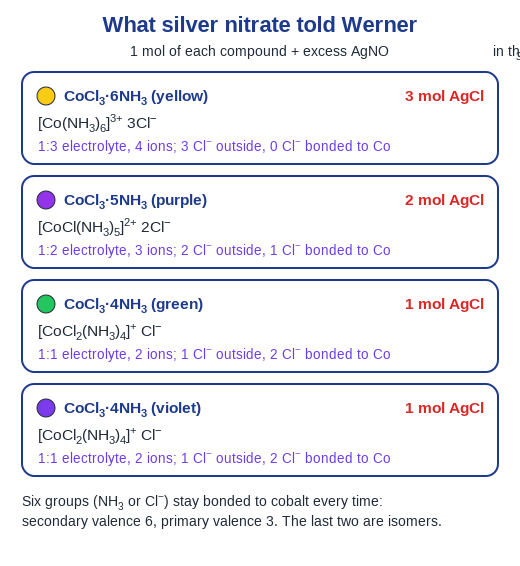
Conductivity measurements agreed: the compounds behave as 1:3, 1:2 and 1:1 electrolytes. Alfred Werner explained this by saying that six groups, ammonia molecules or chloride ions, remain bonded to cobalt as one unit that does not break up in solution.
What are the postulates of Werner’s theory?
Werner put forward his theory in 1898.
- In coordination compounds a metal shows two types of linkage: primary and secondary.
- Primary valences can normally be ionised; negative ions satisfy them.
- Secondary valences cannot be ionised. Neutral molecules or negative ions satisfy them. Their number is the coordination number, which is fixed for a given metal.
- The groups bound by secondary linkages have characteristic arrangements in space for each coordination number.
We now call these arrangements coordination polyhedra. The species in square brackets is the coordination entity or complex, and the ions outside are counter ions. Octahedral, tetrahedral and square planar shapes are the most common: [Co(NH₃)₆]³⁺ is octahedral, [Ni(CO)₄] is tetrahedral and [PtCl₄]²⁻ is square planar.
Using the AgCl test. PdCl₂·4NH₃ gives 2 mol of AgCl, so both chlorides are outside: [Pd(NH₃)₄]Cl₂, secondary valence 4. PtCl₄·2HCl gives none, so all six chlorides are bonded: H₂[PtCl₆], secondary valence 6.
How do you read the formula of a complex?
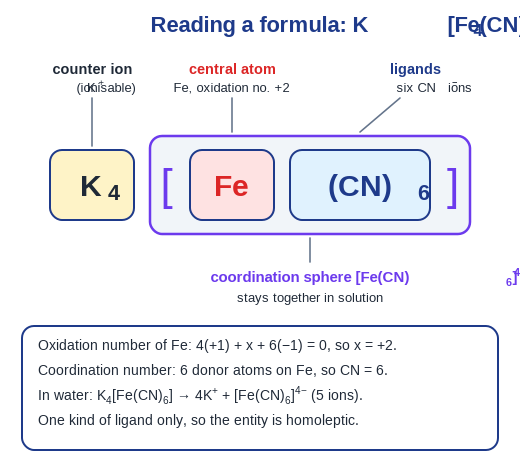
Two numbers come straight from the formula.
- Oxidation number. The metal’s oxidation number plus the charges of the ligands equals the charge of the entity. In [Cu(CN)₄]³⁻: x + 4(−1) = −3, so x = +1.
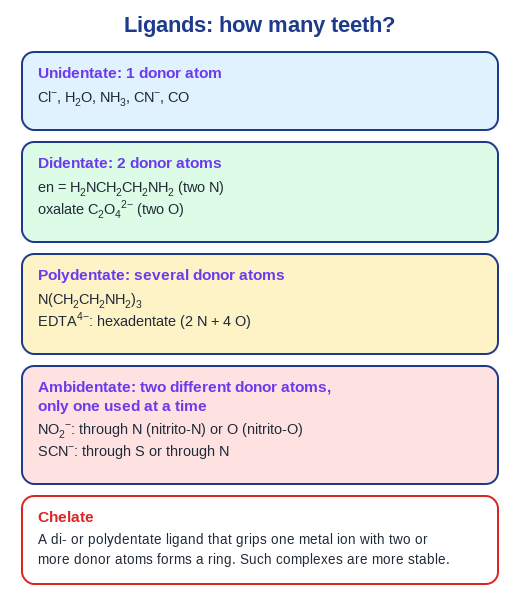
- Coordination number. Count donor atoms, not ligands. Ethane-1,2-diamine (en) and oxalate are didentate, so [Co(en)₃]³⁺ and [Fe(C₂O₄)₃]³⁻ both have coordination number 6. Only sigma bonds are counted.
How do you write the formula?
- The central atom comes first.
- The ligands follow in alphabetical order, whatever their charge. For an abbreviation such as en, its first letter decides the place.
- The whole entity goes in square brackets. Polyatomic ligands and abbreviations go in parentheses. There are no spaces inside the bracket.
- If the entity is written without its counter ion, the charge goes outside the bracket as a superscript, number before sign: [Cr(H₂O)₆]³⁺.
- The charges of cations and anions must balance.
How do you write the name?
- The cation is named first, whether it is the complex or the counter ion.
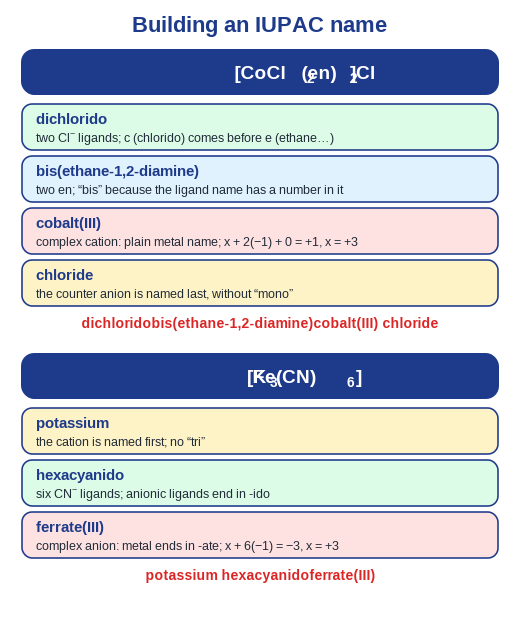
- Ligands are named in alphabetical order before the metal. Prefixes such as di and tri do not count for the order.
- Anionic ligands end in -o. Ions ending in -ide become -ido (chlorido, cyanido, hydroxido); those ending in -ate or -ite become -ato or -ito (oxalato, carbonato, nitrito). Neutral ligands keep their names, except aqua (H₂O), ammine (NH₃), carbonyl (CO) and nitrosyl (NO).
- Use di, tri, tetra, penta, hexa for the number of each ligand. When the ligand name has a number prefix in it, use bis, tris, tetrakis and put the ligand in parentheses.
- The oxidation state of the metal follows its name as a Roman numeral in parentheses.
- In a complex cation or a neutral complex the metal keeps its name. In a complex anion it ends in -ate: cobaltate, chromate, zincate, and from Latin, ferrate (Fe) and argentate (Ag).
Can we see the rules at work?
| Formula | Name |
|---|---|
| [Cr(NH₃)₃(H₂O)₃]Cl₃ | triamminetriaquachromium(III) chloride |
| [Co(en)₃]₂(SO₄)₃ | tris(ethane-1,2-diamine)cobalt(III) sulphate |
| [Ag(NH₃)₂][Ag(CN)₂] | diamminesilver(I) dicyanidoargentate(I) |
| K₂[Zn(OH)₄] | potassium tetrahydroxidozincate(II) |
| [Pt(NH₃)₂Cl(NO₂)] | diamminechloridonitrito-N-platinum(II) |
| [Ni(CO)₄] | tetracarbonylnickel(0) |
| [NiCl₂(PPh₃)₂] | dichloridobis(triphenylphosphine)nickel(II) |
Notice three things. The number of counter ions is never stated: it is “chloride”, not “trichloride”. Silver is “silver” in the cation and “argentate” in the anion of the third compound. And for the second compound, three sulphates balance two complex cations, so each cation is 3+ and cobalt is +3.
A note on spelling. The book’s rule says anionic ligand names end in “-o”, but its own names use the newer -ido forms, and a margin note says the 2004 IUPAC draft recommends them. Follow the book’s examples and write chlorido, cyanido and hydroxido.
Next: isomerism in coordination compounds. Practise with the NCERT solutions, or go back to the chapter notes.
Practice
-
The secondary valence of platinum in PtCl₄·2HCl, which gives no AgCl with AgNO₃, is:
Show answer
Answer: (c) 6
-
The formula of potassium tetrahydroxidozincate(II) is:
Show answer
Answer: (b) K₂[Zn(OH)₄]
-
The IUPAC name of [Co(NH₃)₅Cl]Cl₂ is:
Show answer
Answer: (a) pentaamminechloridocobalt(III) chloride
-
Find the oxidation number of iron in K₄[Fe(CN)₆].
Show answer
Answer: 4(+1) + x + 6(−1) = 0, so x = +2. The name is potassium hexacyanidoferrate(II).
-
Why does Mohr’s salt solution give the test for Fe²⁺ while K₄[Fe(CN)₆] solution does not?
Show answer
Answer: Mohr’s salt is a double salt and breaks up fully into Fe²⁺, NH₄⁺ and SO₄²⁻ ions. K₄[Fe(CN)₆] is a complex: it gives K⁺ and [Fe(CN)₆]⁴⁻, and the complex ion does not release Fe²⁺.
Questions students ask
What are primary and secondary valences?
In Werner’s theory a metal has two kinds of linkage. Primary valences can normally be ionised; negative ions satisfy them. Secondary valences cannot be ionised; neutral molecules or negative ions satisfy them, and their number is the coordination number of the metal. In CoCl₃·6NH₃ the primary valence is 3 and the secondary valence is 6.
How do you find the oxidation state of the metal in a complex?
Add up the charges. The sum of the metal’s oxidation number and the charges of all ligands equals the charge on the coordination entity. In [Co(NH₃)₅Cl]²⁺: x + 0 + (−1) = +2, so cobalt is +3.
When do we use bis, tris and tetrakis?
When the name of the ligand already contains a number prefix, such as ethane-1,2-diamine or triphenylphosphine. The ligand name then goes in parentheses: tris(ethane-1,2-diamine), bis(triphenylphosphine).
What does nitrito-N mean?
NO₂⁻ is an ambidentate ligand. Nitrito-N means it is bonded to the metal through nitrogen (M–NO₂), and nitrito-O means through oxygen (M–ONO). In the same way thiocyanato-S and thiocyanato-N tell which atom of SCN⁻ is bonded.
Stuck on a question?
Take a photo and Lagnever AI explains it step by step. Try it for 7 days for ₹2.
Get it on Google Play Open in browser
For parents: after the trial, the plan renews monthly by UPI or card autopay. You can cancel anytime in the app.