
What types of isomerism do coordination compounds show?
Answer in short
Coordination compounds show two main types of isomerism. Stereoisomers have the same bonds but a different arrangement in space: geometrical isomers (cis and trans, fac and mer) and optical isomers (mirror images that do not superimpose). Structural isomers have different bonds: linkage, coordination, ionisation and solvate isomers. Each type has a standard example to learn.
Stuck on a question? Take a photo and Lagnever AI explains it step by step. Try it for 7 days for ₹2. Get it on Google Play
What are isomers?
Isomers are two or more compounds that share one chemical formula but have their atoms arranged differently. Because the arrangement differs, at least one physical or chemical property differs too. Werner’s green and violet forms of CoCl₃·4NH₃ were the first clue that complexes have fixed shapes.
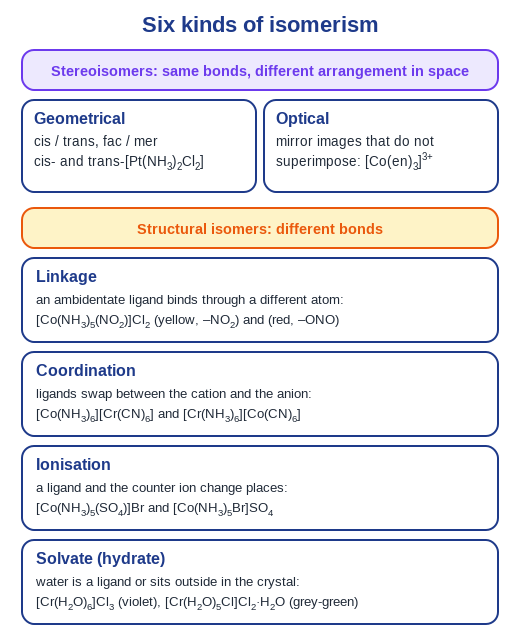
There are two principal types. Stereoisomers have the same bonds but a different arrangement in space. Structural isomers have different bonds.
What is geometrical isomerism?
Geometrical isomerism arises in heteroleptic complexes, because the ligands can take different positions around the metal. It is important for coordination numbers 4 and 6.
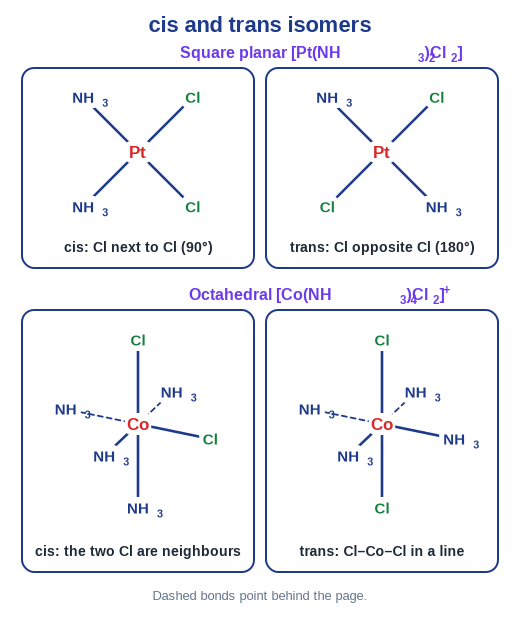
- Square planar [MX₂L₂], such as [Pt(NH₃)₂Cl₂]: the two X ligands are next to each other in the cis isomer and opposite each other in the trans isomer.
- Square planar [MABXL], with four different unidentate ligands, has three isomers: two cis and one trans.
- Tetrahedral complexes show no geometrical isomerism: however the ligands are placed, each one has the same neighbours at the same angles.
- Octahedral [MX₂L₄], such as [Co(NH₃)₄Cl₂]⁺: cis and trans.
- Octahedral [MX₂(L–L)₂], where L–L is a didentate ligand, such as [CoCl₂(en)₂]⁺: cis and trans.
- Octahedral [Ma₃b₃], such as [Co(NH₃)₃(NO₂)₃]: fac and mer.
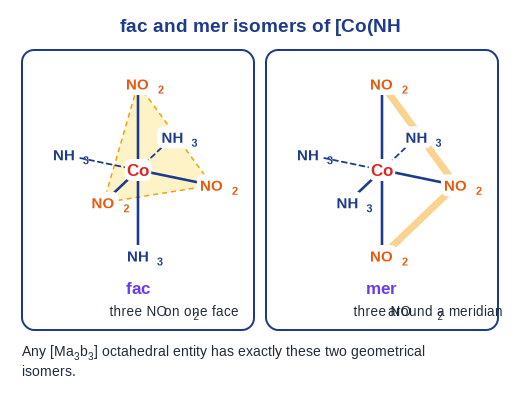
In the facial (fac) isomer the three donor atoms of the same kind sit at the corners of one triangular face. In the meridional (mer) isomer they lie around a meridian of the octahedron.
What is optical isomerism?
Optical isomers are a pair of mirror images that do not fit over each other, like a left and a right hand. They are called enantiomers, and a molecule or ion that has such a mirror image is chiral. In a polarimeter the two forms turn the plane of polarised light in opposite directions: dextro (d) to the right and laevo (l) to the left.
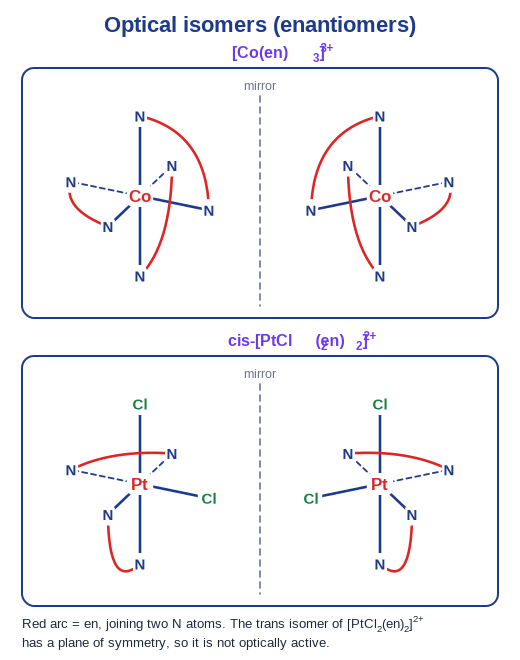
Optical isomerism is common in octahedral complexes with didentate ligands.
- [Co(en)₃]³⁺ exists as a d and an l form.
- In [PtCl₂(en)₂]²⁺ only the cis isomer is optically active. The trans isomer has a plane of symmetry, so it is the same as its mirror image.
- In the same way cis-[CrCl₂(ox)₂]³⁻ is chiral and trans-[CrCl₂(ox)₂]³⁻ is not.
A drawing cannot tell you which form is d and which is l; that comes from the polarimeter.
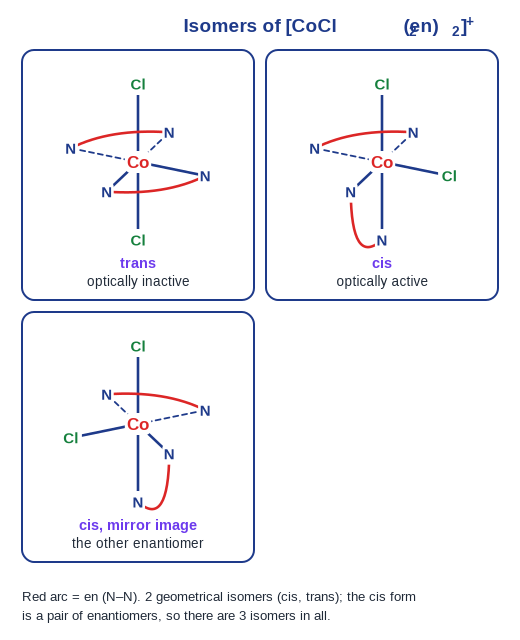
So [CoCl₂(en)₂]⁺ has two geometrical isomers and three stereoisomers in all.
What is linkage isomerism?
Linkage isomerism needs an ambidentate ligand, one that can bind through either of two different atoms.
- Thiocyanate can bind through nitrogen (M–NCS) or through sulphur (M–SCN).
- Jørgensen found the first case in [Co(NH₃)₅(NO₂)]Cl₂. The red form has nitrite bound through oxygen (–ONO); the yellow form has it bound through nitrogen (–NO₂).
What is coordination isomerism?
Here both the cation and the anion are complexes of different metals, and ligands are exchanged between them. In [Co(NH₃)₆][Cr(CN)₆] the NH₃ ligands are on Co³⁺ and the CN⁻ ligands on Cr³⁺. In its coordination isomer, [Cr(NH₃)₆][Co(CN)₆], it is the other way round.
What is ionisation isomerism?
This arises when the counter ion of a complex salt can itself act as a ligand. It changes places with a ligand, which then becomes the counter ion. An example is [Co(NH₃)₅(SO₄)]Br and [Co(NH₃)₅Br]SO₄.
The two give different ions in water, so simple tests tell them apart. The first has bromide outside the bracket and gives AgBr with silver nitrate. The second has sulphate outside and gives BaSO₄ with barium chloride. Do such tests only in the school laboratory with your teacher.
What is solvate isomerism?
Solvate isomerism is like ionisation isomerism, with a solvent molecule in place of the anion. It is called hydrate isomerism when the solvent is water. The isomers differ in whether the solvent molecule is bonded directly to the metal or only held in the crystal lattice. [Cr(H₂O)₆]Cl₃ is violet; its solvate isomer [Cr(H₂O)₅Cl]Cl₂·H₂O is grey-green.
How do you spot the type quickly?
| Clue in the formula | Type to check |
|---|---|
| NO₂⁻ or SCN⁻ as a ligand | linkage |
| complex cation and complex anion together | coordination |
| counter ion that could be a ligand (Br⁻, SO₄²⁻, Cl⁻) | ionisation |
| water both inside and outside the bracket | solvate |
| [MX₂L₂] square planar, [MX₂L₄] or [Ma₃b₃] octahedral | geometrical |
| octahedral with two or three didentate ligands | optical (and geometrical) |
Before: Werner’s theory and naming. Next: crystal field theory. Practise with the NCERT solutions, or go back to the chapter notes.
Practice
-
How many geometrical isomers does square planar [Pt(NH₃)(Br)(Cl)(py)] have?
Show answer
Answer: (c) 3
-
[Co(NH₃)₅(SO₄)]Br and [Co(NH₃)₅Br]SO₄ are:
Show answer
Answer: (b) ionisation isomers
-
Which of these can show optical isomerism?
Show answer
Answer: (c) [Co(en)₃]³⁺
-
How many stereoisomers does [CoCl₂(en)₂]⁺ have in all?
Show answer
Answer: Three: the trans isomer, which is optically inactive, and the cis isomer, which exists as a pair of enantiomers.
-
How would you tell [Co(NH₃)₅(SO₄)]Br from [Co(NH₃)₅Br]SO₄ in solution?
Show answer
Answer: Add AgNO₃ solution: only the first has Br⁻ outside the bracket and gives a precipitate of AgBr. Add BaCl₂ solution: only the second has SO₄²⁻ outside and gives white BaSO₄.
Questions students ask
What is the difference between stereoisomers and structural isomers?
Stereoisomers have the same chemical formula and the same bonds, but the ligands are arranged differently in space. Structural isomers have the same formula but different bonds: a ligand is attached through a different atom, or to a different metal, or sits outside the coordination sphere.
Why do tetrahedral complexes not show geometrical isomerism?
In a tetrahedron every position is next to the other three, at the same angle. So the relative positions of unidentate ligands are the same in every arrangement, and there is nothing like cis or trans.
What are fac and mer isomers?
They are the two geometrical isomers of an octahedral [Ma₃b₃] entity such as [Co(NH₃)₃(NO₂)₃]. In the facial (fac) isomer three identical ligands occupy the corners of one face of the octahedron. In the meridional (mer) isomer they lie around a meridian, in one plane with the metal.
What is hydrate isomerism?
It is solvate isomerism when the solvent is water. The isomers differ in whether a water molecule is bonded to the metal or is only present in the crystal lattice, as in [Cr(H₂O)₆]Cl₃ (violet) and [Cr(H₂O)₅Cl]Cl₂·H₂O (grey-green).
Stuck on a question?
Take a photo and Lagnever AI explains it step by step. Try it for 7 days for ₹2.
Get it on Google Play Open in browser
For parents: after the trial, the plan renews monthly by UPI or card autopay. You can cancel anytime in the app.