
NCERT Solutions Class 12 Chemistry Chapter 5: Coordination Compounds
Answers to all 31 end-of-unit exercises, all 10 Intext Questions and all 7 worked examples of Unit 5, Coordination Compounds, of Chemistry Part I, the Class 12 NCERT textbook. Page numbers follow the 2026-27 reprint (pages 118–140). The exercises come first, quoted from the book; the Intext Questions and the examples follow, restated in short. Short notes: Chapter 5 notes.
How the answers were checked. Every oxidation state, coordination number, d-electron count, number of unpaired electrons and spin-only moment (μ = √n(n+2) BM) was computed, and every isomer count was found by listing all arrangements on an octahedron or a square. Names follow the book’s rules and its -ido spellings. Where the book’s answer key differs or is incomplete, a note says so.
Stay safe. Cyanides and hydrogen sulphide are highly poisonous. The tests described here are done only in the school laboratory with your teacher, and never by tasting or sniffing a chemical.
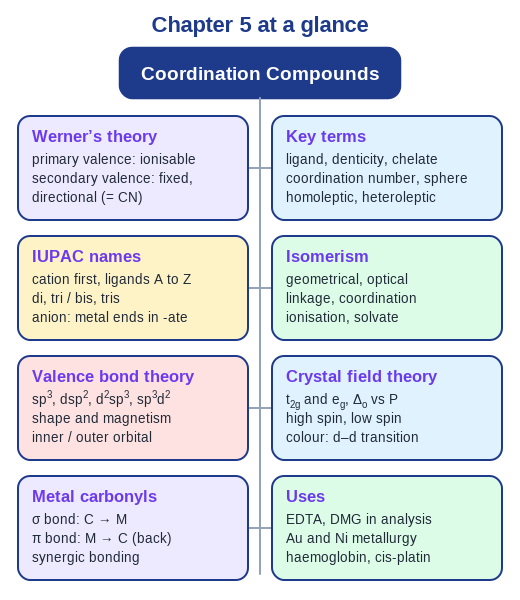
Exercises 5.1 to 5.7: Werner, terms and names
5.1 “Explain the bonding in coordination compounds in terms of Werner’s postulates.”
- A metal in a coordination compound shows two types of linkage (valence): primary and secondary.
- Primary valences can normally be ionised; negative ions satisfy them.
- Secondary valences cannot be ionised. Neutral molecules or negative ions satisfy them. Their number is the coordination number, which is fixed for a given metal.
- The groups bound by secondary valences are arranged in space in a definite way for each coordination number (octahedral, tetrahedral, square planar).
Example: in CoCl₃·6NH₃, written [Co(NH₃)₆]Cl₃, the six NH₃ molecules satisfy the secondary valence of 6 and are arranged octahedrally. The three Cl⁻ ions satisfy the primary valence of 3, are ionisable and are all precipitated by AgNO₃. In [CoCl(NH₃)₅]Cl₂ one chloride also fills a secondary valence, so only two are precipitated.
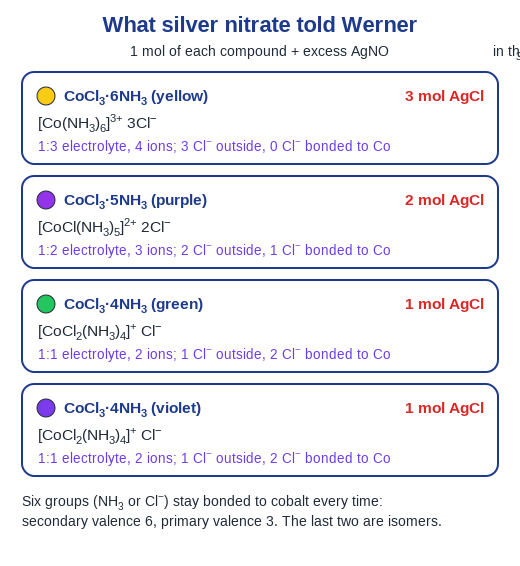
5.2 “FeSO₄ solution mixed with (NH₄)₂SO₄ solution in 1:1 molar ratio gives the test of Fe²⁺ ion but CuSO₄ solution mixed with aqueous ammonia in 1:4 molar ratio does not give the test of Cu²⁺ ion. Explain why?”
FeSO₄ and (NH₄)₂SO₄ in 1:1 ratio form Mohr’s salt, FeSO₄·(NH₄)₂SO₄·6H₂O, a double salt. In water it breaks up completely into Fe²⁺, NH₄⁺ and SO₄²⁻ ions, so Fe²⁺ is there to be tested.
CuSO₄ and ammonia in 1:4 ratio form a complex, [Cu(NH₃)₄]SO₄. In water it gives [Cu(NH₃)₄]²⁺ and SO₄²⁻. The copper stays inside the coordination sphere, and the complex ion does not split into Cu²⁺ and NH₃, so the test for simple Cu²⁺ ions fails.
5.3 “Explain with two examples each of the following: coordination entity, ligand, coordination number, coordination polyhedron, homoleptic and heteroleptic.”
| Term | Meaning | Two examples |
|---|---|---|
| Coordination entity | a central metal atom or ion together with the fixed number of ions or molecules attached to it | [Fe(CN)₆]⁴⁻, [Ni(CO)₄] |
| Ligand | an ion or molecule bonded to the central atom | Cl⁻, NH₃ |
| Coordination number | number of donor atoms bonded directly to the metal | 6 in [PtCl₆]²⁻, 4 in [Ni(NH₃)₄]²⁺ |
| Coordination polyhedron | the arrangement in space of the donor atoms around the metal | octahedral [Co(NH₃)₆]³⁺, tetrahedral [Ni(CO)₄] |
| Homoleptic | metal bound to only one kind of donor group | [Co(NH₃)₆]³⁺, [Fe(CN)₆]⁴⁻ |
| Heteroleptic | metal carrying two or more kinds of donor group | [Co(NH₃)₄Cl₂]⁺, [PtCl₂(NH₃)₂] |
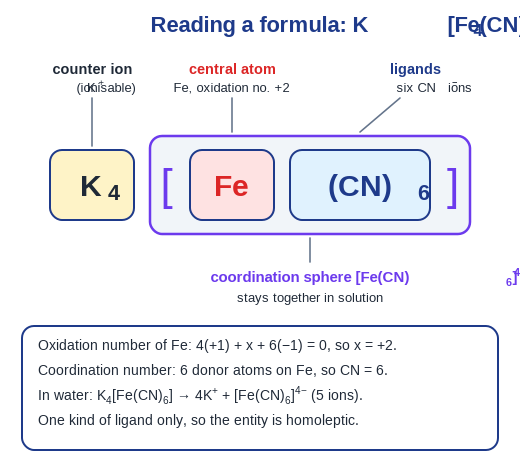
5.4 “What is meant by unidentate, didentate and ambidentate ligands? Give two examples for each.”
- Unidentate: binds through a single donor atom. Examples: Cl⁻, NH₃ (also H₂O).
- Didentate: binds through two donor atoms. Examples: ethane-1,2-diamine, H₂NCH₂CH₂NH₂ (two N), and oxalate, C₂O₄²⁻ (two O).
- Ambidentate: has two different donor atoms and binds through either one of them. Examples: NO₂⁻ (through N or O) and SCN⁻ (through S or N).
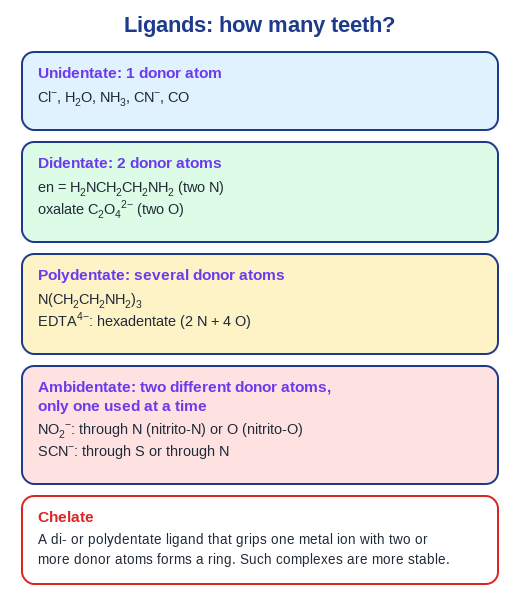
5.5 “Specify the oxidation numbers of the metals in the following coordination entities: (i) [Co(H₂O)(CN)(en)₂]²⁺ (ii) [CoBr₂(en)₂]⁺ (iii) [PtCl₄]²⁻ (iv) K₃[Fe(CN)₆] (v) [Cr(NH₃)₃Cl₃]”
Let the oxidation number be x. H₂O, en and NH₃ are neutral; CN⁻, Br⁻ and Cl⁻ are −1.
| Entity | Equation | Oxidation number |
|---|---|---|
| (i) [Co(H₂O)(CN)(en)₂]²⁺ | x + 0 + (−1) + 0 = +2 | Co = +3 |
| (ii) [CoBr₂(en)₂]⁺ | x + 2(−1) + 0 = +1 | Co = +3 |
| (iii) [PtCl₄]²⁻ | x + 4(−1) = −2 | Pt = +2 |
| (iv) K₃[Fe(CN)₆] | 3(+1) + x + 6(−1) = 0 | Fe = +3 |
| (v) [Cr(NH₃)₃Cl₃] | x + 0 + 3(−1) = 0 | Cr = +3 |
These agree with the book’s key.
5.6 “Using IUPAC norms write the formulas for the following: (i) Tetrahydroxidozincate(II) (ii) Potassium tetrachloridopalladate(II) (iii) Diamminedichloridoplatinum(II) (iv) Potassium tetracyanidonickelate(II) (v) Pentaamminenitrito-O-cobalt(III) (vi) Hexaamminecobalt(III) sulphate (vii) Potassium tri(oxalato)chromate(III) (viii) Hexaammineplatinum(IV) (ix) Tetrabromidocuprate(II) (x) Pentaamminenitrito-N-cobalt(III)”
| Formula | Charge check | |
|---|---|---|
| (i) | [Zn(OH)₄]²⁻ | +2 + 4(−1) = −2 |
| (ii) | K₂[PdCl₄] | [PdCl₄]²⁻: +2 − 4 = −2, so 2 K⁺ |
| (iii) | [Pt(NH₃)₂Cl₂] | +2 − 2 = 0 |
| (iv) | K₂[Ni(CN)₄] | +2 − 4 = −2, so 2 K⁺ |
| (v) | [Co(NH₃)₅(ONO)]²⁺ | +3 − 1 = +2; nitrite bound through O |
| (vi) | [Co(NH₃)₆]₂(SO₄)₃ | two 3+ cations balance three SO₄²⁻ |
| (vii) | K₃[Cr(C₂O₄)₃] | +3 + 3(−2) = −3, so 3 K⁺ |
| (viii) | [Pt(NH₃)₆]⁴⁺ | +4 + 0 = +4 |
| (ix) | [CuBr₄]²⁻ | +2 − 4 = −2 |
| (x) | [Co(NH₃)₅(NO₂)]²⁺ | +3 − 1 = +2; nitrite bound through N |
All ten agree with the key. The key writes (iii) as [Pt(NH₃)₂Cl₂]; by the alphabetical rule for formulas it can also be written [PtCl₂(NH₃)₂], as the chapter text does.
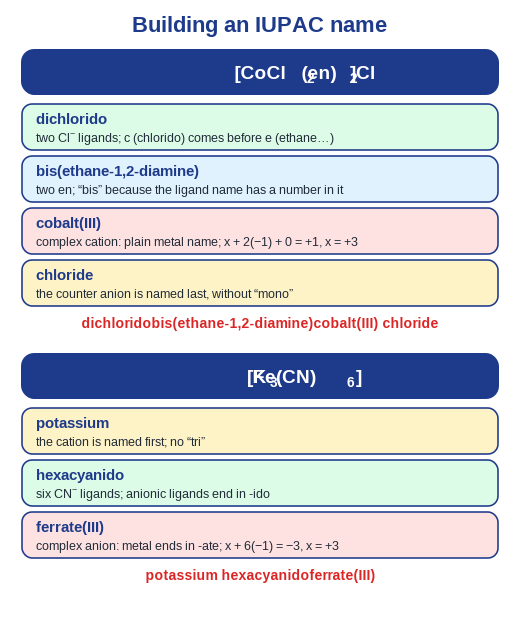
5.7 “Using IUPAC norms write the systematic names of the following: (i) [Co(NH₃)₆]Cl₃ (ii) [Pt(NH₃)₂Cl(NH₂CH₃)]Cl (iii) [Ti(H₂O)₆]³⁺ (iv) [Co(NH₃)₄Cl(NO₂)]Cl (v) [Mn(H₂O)₆]²⁺ (vi) [NiCl₄]²⁻ (vii) [Ni(NH₃)₆]Cl₂ (viii) [Co(en)₃]³⁺ (ix) [Ni(CO)₄]”
| Metal | Name | |
|---|---|---|
| (i) | Co +3 | hexaamminecobalt(III) chloride |
| (ii) | Pt +2 | diamminechlorido(methanamine)platinum(II) chloride |
| (iii) | Ti +3 | hexaaquatitanium(III) ion |
| (iv) | Co +3 | tetraamminechloridonitrito-N-cobalt(III) chloride |
| (v) | Mn +2 | hexaaquamanganese(II) ion |
| (vi) | Ni +2 | tetrachloridonickelate(II) ion |
| (vii) | Ni +2 | hexaamminenickel(II) chloride |
| (viii) | Co +3 | tris(ethane-1,2-diamine)cobalt(III) ion |
| (ix) | Ni 0 | tetracarbonylnickel(0) |
In (ii) the ligands are in alphabetical order: ammine, chlorido, methanamine. In (iv) NO₂ is written with N next to the metal, so it is nitrito-N. The key gives no names for this question; (i) and (ii) match the book’s answers to Intext 5.2.
Exercises 5.8 to 5.12: isomerism
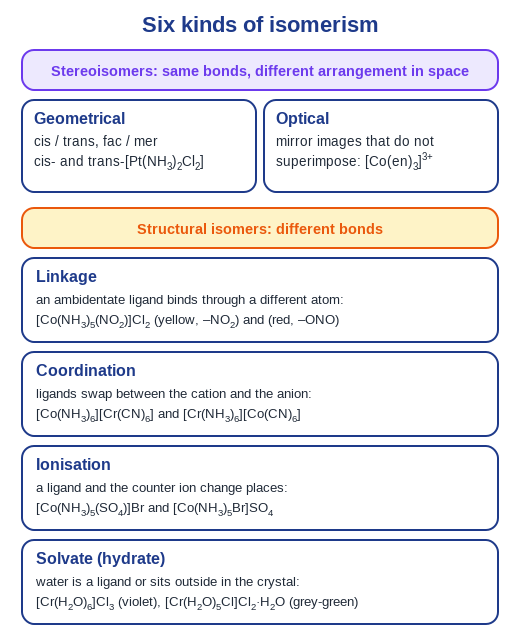
5.8 “List various types of isomerism possible for coordination compounds, giving an example of each.”
Stereoisomerism
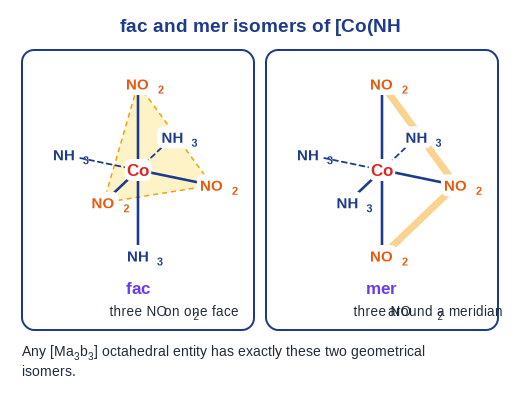
- Geometrical isomerism: cis- and trans-[Pt(NH₃)₂Cl₂]; fac- and mer-[Co(NH₃)₃(NO₂)₃].
- Optical isomerism: the d and l forms of [Co(en)₃]³⁺.
Structural isomerism
- Linkage isomerism: [Co(NH₃)₅(NO₂)]Cl₂ (yellow, bound through N) and [Co(NH₃)₅(ONO)]Cl₂ (red, bound through O).
- Coordination isomerism: [Co(NH₃)₆][Cr(CN)₆] and [Cr(NH₃)₆][Co(CN)₆].
- Ionisation isomerism: [Co(NH₃)₅(SO₄)]Br and [Co(NH₃)₅Br]SO₄.
- Solvate (hydrate) isomerism: [Cr(H₂O)₆]Cl₃ (violet) and [Cr(H₂O)₅Cl]Cl₂·H₂O (grey-green).
5.9 “How many geometrical isomers are possible in the following coordination entities? (i) [Cr(C₂O₄)₃]³⁻ (ii) [Co(NH₃)₃Cl₃]”
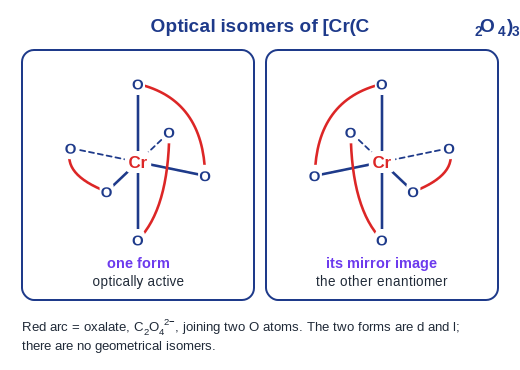
(i) None. All three ligands are the same didentate ligand, so there is only one way to place them. (The entity does have two optical isomers; see 5.10.)
(ii) Two: the fac isomer, with the three Cl on one face of the octahedron, and the mer isomer, with the three Cl around a meridian. It is an [Ma₃b₃] entity.
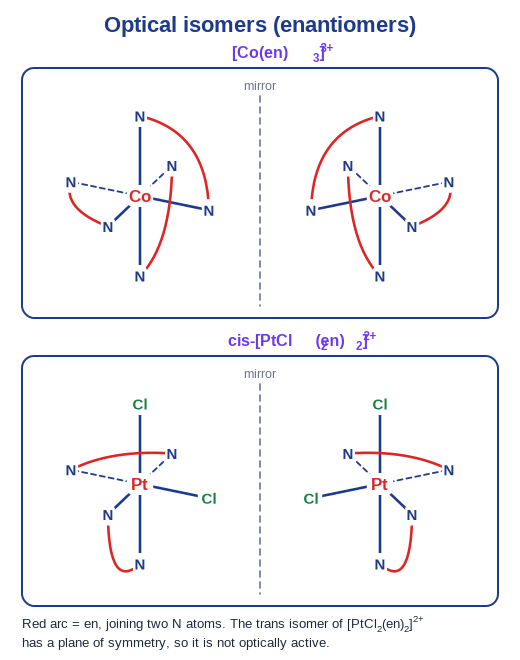
5.10 “Draw the structures of optical isomers of: (i) [Cr(C₂O₄)₃]³⁻ (ii) [PtCl₂(en)₂]²⁺ (iii) [Cr(NH₃)₂Cl₂(en)]⁺”
(i) [Cr(C₂O₄)₃]³⁻ exists as a pair of mirror images, d and l.
(ii) Only the cis isomer of [PtCl₂(en)₂]²⁺ is chiral. The trans isomer has a plane of symmetry. The lower half of this figure shows the pair:
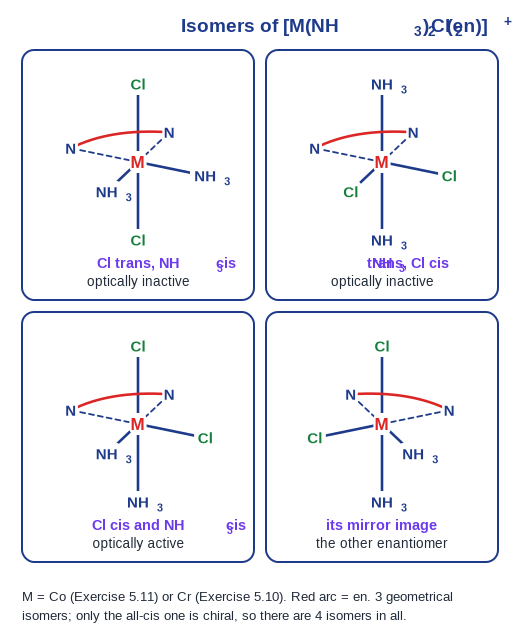
(iii) [Cr(NH₃)₂Cl₂(en)]⁺ has three geometrical isomers. Only the one in which the two Cl are cis and the two NH₃ are cis is chiral. It and its mirror image are the optical isomers (the two lower drawings, with M = Cr).
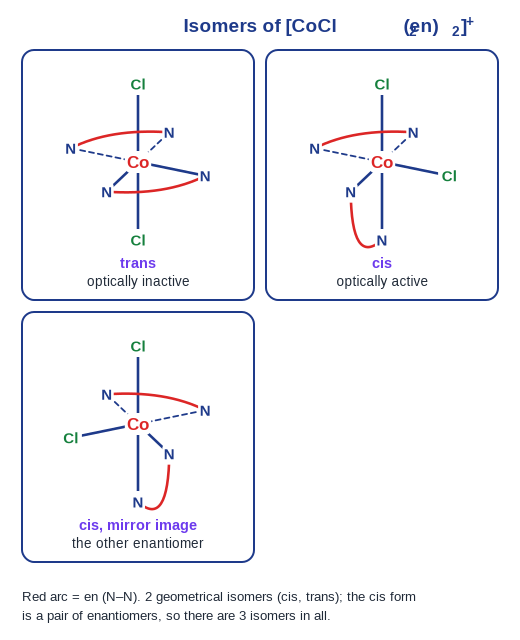
5.11 “Draw all the isomers (geometrical and optical) of: (i) [CoCl₂(en)₂]⁺ (ii) [Co(NH₃)Cl(en)₂]²⁺ (iii) [Co(NH₃)₂Cl₂(en)]⁺”
(i) [CoCl₂(en)₂]⁺: three isomers. trans (optically inactive) and cis, which is a pair of enantiomers.
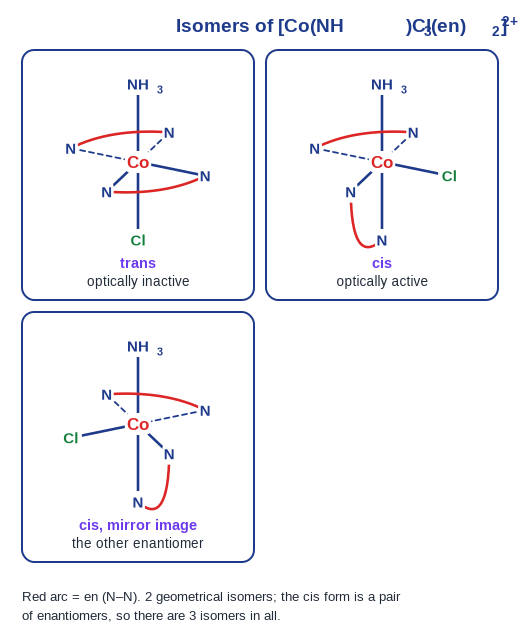
(ii) [Co(NH₃)Cl(en)₂]²⁺: three isomers. trans (NH₃ opposite Cl, optically inactive) and cis, which is a pair of enantiomers.
(iii) [Co(NH₃)₂Cl₂(en)]⁺: four isomers. Three are geometrical isomers (Cl trans; NH₃ trans; both pairs cis), and the all-cis one is a pair of enantiomers. See the figure under 5.10 (iii), with M = Co.
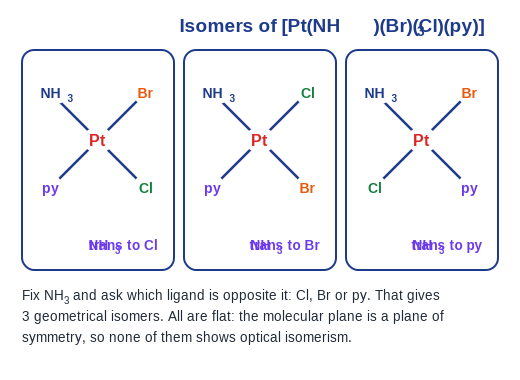
5.12 “Write all the geometrical isomers of [Pt(NH₃)(Br)(Cl)(py)] and how many of these will exhibit optical isomers?”
It is a square planar [MABXL] entity. Fix NH₃; the ligand opposite it can be Cl, Br or py. So there are three geometrical isomers (the key says two cis and one trans).
None shows optical isomerism. A square planar entity is flat, and the plane of the molecule is a plane of symmetry.
Exercises 5.13 to 5.22: reactions and bonding
5.13 “Aqueous copper sulphate solution (blue in colour) gives: (i) a green precipitate with aqueous potassium fluoride and (ii) a bright green solution with aqueous potassium chloride. Explain these experimental results.”
Aqueous copper sulphate contains [Cu(H₂O)₄]²⁺ ions, which are blue. Water is a weak field ligand and can be replaced.
(i) With KF, fluoride ions replace the water ligands. Following the book’s key, [CuF₄]²⁻ forms and comes down as a green precipitate:
[Cu(H₂O)₄]²⁺ + 4F⁻ → [CuF₄]²⁻ + 4H₂O
(ii) With KCl, chloride ions replace the water ligands and give [CuCl₄]²⁻, which is bright green in solution:
[Cu(H₂O)₄]²⁺ + 4Cl⁻ → [CuCl₄]²⁻ + 4H₂O
A new ligand means a new splitting of the d orbitals, so a different colour is seen.
5.14 “What is the coordination entity formed when excess of aqueous KCN is added to an aqueous solution of copper sulphate? Why is it that no precipitate of copper sulphide is obtained when H₂S(g) is passed through this solution?”
The book’s key gives the entity as [Cu(CN)₄]²⁻:
[Cu(H₂O)₄]²⁺ + 4CN⁻ → [Cu(CN)₄]²⁻ + 4H₂O
CN⁻ is a strong ligand, so the complex is highly stable. The copper stays locked inside the coordination sphere and practically no simple copper ions are left in solution. When H₂S is passed, there are not enough of them to form a precipitate of CuS.
Extra, for your teacher: in the laboratory cyanide first reduces Cu²⁺ to copper(I), and the stable entity is the copper(I) complex [Cu(CN)₄]³⁻, the ion the chapter itself uses as its example of Cu(I). The reason for getting no CuS is the same.
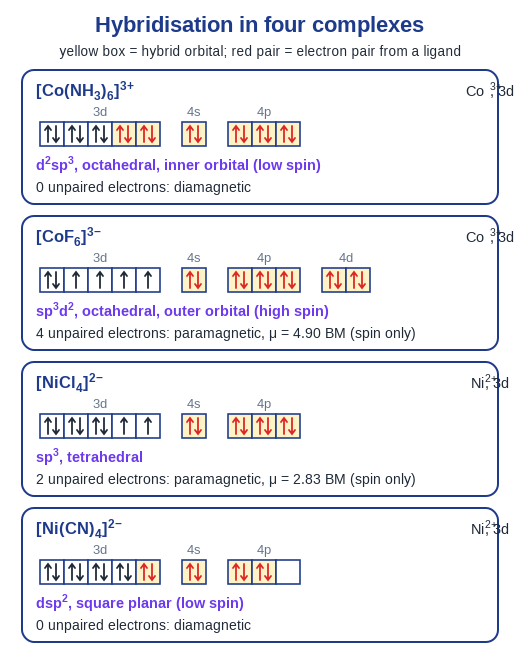
5.15 “Discuss the nature of bonding in the following coordination entities on the basis of valence bond theory: (i) [Fe(CN)₆]⁴⁻ (ii) [FeF₆]³⁻ (iii) [Co(C₂O₄)₃]³⁻ (iv) [CoF₆]³⁻”
| Entity | Metal ion | What the d electrons do | Hybridisation | Unpaired e⁻ | Result |
|---|---|---|---|---|---|
| (i) [Fe(CN)₆]⁴⁻ | Fe²⁺, 3d⁶ | pair up in three 3d orbitals | d²sp³ | 0 | octahedral, inner orbital, diamagnetic |
| (ii) [FeF₆]³⁻ | Fe³⁺, 3d⁵ | stay unpaired | sp³d² | 5 | octahedral, outer orbital, paramagnetic |
| (iii) [Co(C₂O₄)₃]³⁻ | Co³⁺, 3d⁶ | pair up in three 3d orbitals | d²sp³ | 0 | octahedral, inner orbital, diamagnetic |
| (iv) [CoF₆]³⁻ | Co³⁺, 3d⁶ | stay as in the ion | sp³d² | 4 | octahedral, outer orbital, paramagnetic |
In (i) and (iii) pairing empties two 3d orbitals; these mix with the 4s and the three 4p orbitals. In (ii) and (iv) the 3d electrons are left alone and two outer 4d orbitals are used with 4s and 4p. In every case the six hybrid orbitals each take an electron pair from a donor atom (the three oxalate ions give six pairs). Spin-only moments: 5.92 BM for (ii) and 4.90 BM for (iv).
5.16 “Draw figure to show the splitting of d orbitals in an octahedral crystal field.”
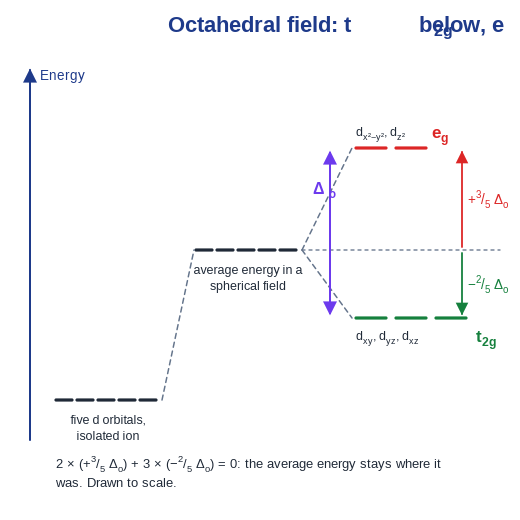
The d_x²−y² and d_z² orbitals (e_g) point at the ligands and rise by (3/5)Δo. The d_xy, d_yz and d_xz orbitals (t₂g) point between the ligands and fall by (2/5)Δo.
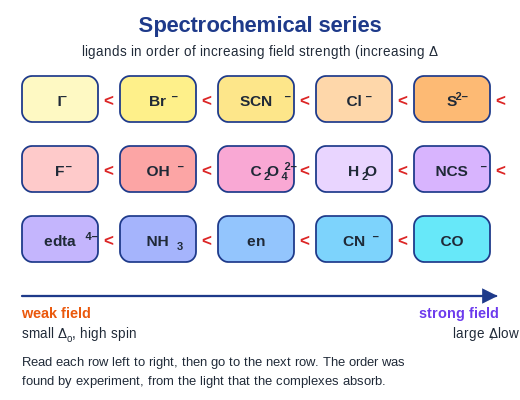
5.17 “What is spectrochemical series? Explain the difference between a weak field ligand and a strong field ligand.”
The spectrochemical series is the list of ligands in order of increasing field strength, that is, increasing crystal field splitting. It was found by experiment from the light absorbed by complexes of different ligands:
I⁻ < Br⁻ < SCN⁻ < Cl⁻ < S²⁻ < F⁻ < OH⁻ < C₂O₄²⁻ < H₂O < NCS⁻ < edta⁴⁻ < NH₃ < en < CN⁻ < CO
| Weak field ligand | Strong field ligand | |
|---|---|---|
| Splitting | small Δo | large Δo |
| Compared with pairing energy | Δo < P | Δo > P |
| Electrons | enter e_g before pairing | pair up in t₂g first |
| Complex | high spin | low spin |
| Examples | I⁻, Cl⁻, F⁻ | CN⁻, CO |
5.18 “What is crystal field splitting energy? How does the magnitude of Δo decide the actual configuration of d orbitals in a coordination entity?”
When ligands approach a metal ion in a definite geometry, the five degenerate d orbitals split into sets of different energy. The energy separation between the sets is the crystal field splitting energy; for an octahedral entity it is Δo, the gap between t₂g and e_g.
The first three electrons go singly into t₂g. For the fourth, Δo is compared with the pairing energy P:
- If Δo < P, the electron enters e_g: t₂g³e_g¹. High spin.
- If Δo > P, it pairs in t₂g: t₂g⁴e_g⁰. Low spin.
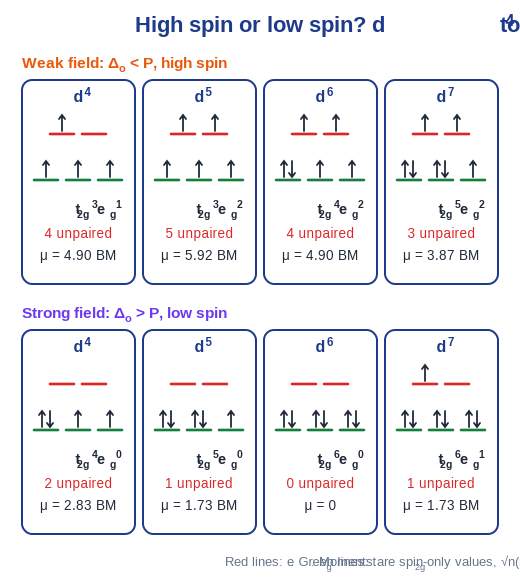
5.19 “[Cr(NH₃)₆]³⁺ is paramagnetic while [Ni(CN)₄]²⁻ is diamagnetic. Explain why?”
In [Cr(NH₃)₆]³⁺, Cr³⁺ is 3d³. Its three electrons sit singly in three 3d orbitals; the other two 3d orbitals, the 4s and the three 4p orbitals form d²sp³ hybrids for the six NH₃. The three unpaired electrons make it paramagnetic (3.87 BM).
In [Ni(CN)₄]²⁻, Ni²⁺ is 3d⁸. CN⁻ is a strong ligand: the eight electrons pair up in four 3d orbitals, and the empty one joins 4s and two 4p orbitals in dsp² hybridisation (square planar). There is no unpaired electron, so it is diamagnetic.
5.20 “A solution of [Ni(H₂O)₆]²⁺ is green but a solution of [Ni(CN)₄]²⁻ is colourless. Explain.”
In [Ni(H₂O)₆]²⁺, Ni²⁺ (d⁸) is surrounded by the weak field ligand water. It has two unpaired electrons, and the splitting is small enough for d–d transitions to absorb part of the visible light. The complementary colour, green, is seen.
In [Ni(CN)₄]²⁻ the strong field ligand CN⁻ pairs up all the d electrons in a square planar entity, and the splitting is large. No visible light is absorbed by a d–d transition, so the solution is colourless.
5.21 “[Fe(CN)₆]⁴⁻ and [Fe(H₂O)₆]²⁺ are of different colours in dilute solutions. Why?”
Both contain Fe²⁺ (3d⁶), but the ligands differ. CN⁻ is a strong field ligand and gives a large Δo; H₂O is a weak field ligand and gives a small Δo. The energy, and so the wavelength, of the light absorbed in the d–d transition is different in the two, and each shows the complement of what it absorbs. So the colours differ.
5.22 “Discuss the nature of bonding in metal carbonyls.”
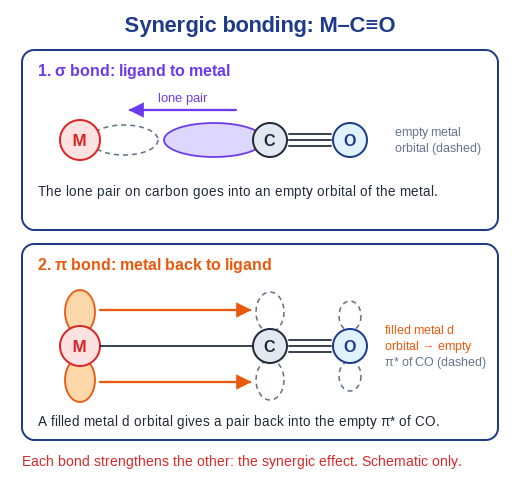
The metal–carbon bond in a metal carbonyl has both σ and π character.
- σ bond (ligand to metal): the lone pair of electrons on the carbon of CO is donated into a vacant orbital of the metal.
- π bond (metal to ligand): a filled d orbital of the metal gives an electron pair back into the empty antibonding π* orbital of CO.
The two donations help each other. This synergic effect makes the bond between CO and the metal stronger.
Exercises 5.23 to 5.31: configurations, colour and uses
5.23 “Give the oxidation state, d orbital occupation and coordination number of the central metal ion in the following complexes: (i) K₃[Co(C₂O₄)₃] (ii) cis-[CrCl₂(en)₂]Cl (iii) (NH₄)₂[CoF₄] (iv) [Mn(H₂O)₆]SO₄”
| Complex | Oxidation state | Coordination number | d orbital occupation |
|---|---|---|---|
| (i) K₃[Co(C₂O₄)₃] | 3 + x + 3(−2) = 0, +3 | 6 | d⁶: t₂g⁶e_g⁰ |
| (ii) cis-[CrCl₂(en)₂]Cl | x − 2 + 0 = +1, +3 | 6 | d³: t₂g³ |
| (iii) (NH₄)₂[CoF₄] | 2 + x − 4 = 0, +2 | 4 | d⁷: e⁴t₂³ (tetrahedral) |
| (iv) [Mn(H₂O)₆]SO₄ | x + 0 = +2, +2 | 6 | d⁵: t₂g³e_g² |
Note on (iii). The key prints “d⁷ (t₂g⁵e_g²)”, which is the high spin octahedral way of writing d⁷. With coordination number 4 and the weak field ligand F⁻ the entity is tetrahedral, where the lower set is e and the labels have no g: e⁴t₂³. Both ways give three unpaired electrons.
5.24 “Write down the IUPAC name for each of the following complexes and indicate the oxidation state, electronic configuration and coordination number. Also give stereochemistry and magnetic moment of the complex: (i) K[Cr(H₂O)₂(C₂O₄)₂].3H₂O (ii) [Co(NH₃)₅Cl]Cl₂ (iii) [CrCl₃(py)₃] (iv) Cs[FeCl₄] (v) K₄[Mn(CN)₆]”
| IUPAC name | Oxidation state | Configuration | CN | Stereochemistry | μ (spin only) | |
|---|---|---|---|---|---|---|
| (i) | potassium diaquadioxalatochromate(III) trihydrate | Cr +3 | 3d³, t₂g³ | 6 | octahedral; cis and trans, cis is optically active | n = 3: 3.87 BM |
| (ii) | pentaamminechloridocobalt(III) chloride | Co +3 | 3d⁶, t₂g⁶ | 6 | octahedral; no geometrical isomers | n = 0: 0 (diamagnetic) |
| (iii) | trichloridotris(pyridine)chromium(III) | Cr +3 | 3d³, t₂g³ | 6 | octahedral; fac and mer | n = 3: 3.87 BM |
| (iv) | caesium tetrachloridoferrate(III) | Fe +3 | 3d⁵, e²t₂³ | 4 | tetrahedral; no geometrical isomers | n = 5: 5.92 BM |
| (v) | potassium hexacyanidomanganate(II) | Mn +2 | 3d⁵, t₂g⁵ | 6 | octahedral | n = 1: 1.73 BM |
How the spins were chosen: NH₃ with Co³⁺ and CN⁻ are strong field (low spin); Cl⁻ is weak field and [FeCl₄]⁻ is tetrahedral (high spin); d³ has only one possible arrangement. The key gives no answer for this question.
5.25 “Explain the violet colour of the complex [Ti(H₂O)₆]³⁺ on the basis of crystal field theory.”
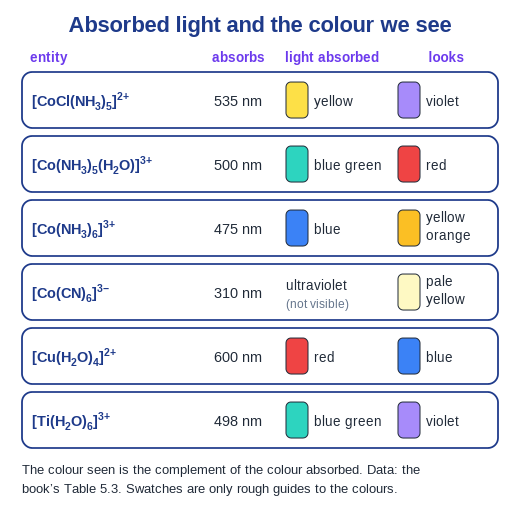
Ti³⁺ is a 3d¹ ion. In the octahedral field of six water molecules its d orbitals split into t₂g and e_g, and the single electron is in t₂g. When white light falls on the complex, light of the blue-green region (about 498 nm) has just the energy Δo. It is absorbed and the electron jumps to e_g:
t₂g¹e_g⁰ → t₂g⁰e_g¹
The light that passes through has lost its blue-green part, so the complex shows the complementary colour, violet.
5.26 “What is meant by the chelate effect? Give an example.”
When a didentate or polydentate ligand binds one metal ion through two or more donor atoms at the same time, it forms a ring and is called a chelate ligand. Complexes with such rings are more stable than similar complexes with unidentate ligands. This extra stability is the chelate effect.
Example: ethane-1,2-diamine is a chelate ligand, and [Co(en)₃]³⁺ has three chelate rings. (Extra: the usual comparison is that [Ni(en)₃]²⁺ is more stable than [Ni(NH₃)₆]²⁺, which has the same six nitrogen donor atoms but no ring.)
5.27 “Discuss briefly giving an example in each case the role of coordination compounds in: (i) biological systems (ii) medicinal chemistry and (iii) analytical chemistry (iv) extraction/metallurgy of metals.”
(i) Biological systems. Many vital molecules are coordination compounds: chlorophyll, the pigment of photosynthesis, contains magnesium; haemoglobin, the oxygen carrier of blood, contains iron; vitamin B₁₂ contains cobalt.
(ii) Medicinal chemistry. Chelate therapy removes metals present in toxic amounts: EDTA is used for lead poisoning, and D-penicillamine and desferrioxime B remove excess copper and iron. cis-platin and related platinum complexes inhibit the growth of tumours.
(iii) Analytical chemistry. Metal ions give characteristic colours with ligands such as EDTA and DMG, which is used to detect and estimate them. Hardness of water is estimated by titrating Ca²⁺ and Mg²⁺ with Na₂EDTA.
(iv) Extraction/metallurgy. Gold and silver are extracted through cyanide complexes: gold forms [Au(CN)₂]⁻ in the presence of oxygen and water, and zinc then sets the metal out. Nickel is purified by forming [Ni(CO)₄] and decomposing it.
5.28 “How many ions are produced from the complex Co(NH₃)₆Cl₂ in solution? (i) 6 (ii) 4 (iii) 3 (iv) 2”
The complex is [Co(NH₃)₆]Cl₂:
[Co(NH₃)₆]Cl₂ → [Co(NH₃)₆]²⁺ + 2Cl⁻
One complex cation and two chloride ions: 3 ions, option (iii). This matches the key.
5.29 “Amongst the following ions which one has the highest magnetic moment value? (i) [Cr(H₂O)₆]³⁺ (ii) [Fe(H₂O)₆]²⁺ (iii) [Zn(H₂O)₆]²⁺”
Water is a weak field ligand, so these are high spin.
| Ion | Metal ion | Unpaired electrons | μ = √n(n+2) |
|---|---|---|---|
| (i) | Cr³⁺, d³ (t₂g³) | 3 | 3.87 BM |
| (ii) | Fe²⁺, d⁶ (t₂g⁴e_g²) | 4 | 4.90 BM |
| (iii) | Zn²⁺, d¹⁰ | 0 | 0 |
Option (ii), [Fe(H₂O)₆]²⁺, as in the key.
5.30 “Amongst the following, the most stable complex is (i) [Fe(H₂O)₆]³⁺ (ii) [Fe(NH₃)₆]³⁺ (iii) [Fe(C₂O₄)₃]³⁻ (iv) [FeCl₆]³⁻”
All four contain Fe³⁺. Only oxalate is a didentate, chelating ligand: [Fe(C₂O₄)₃]³⁻ has three chelate rings, and chelate complexes are more stable than those of unidentate ligands. Option (iii).
5.31 “What will be the correct order for the wavelengths of absorption in the visible region for the following: [Ni(NO₂)₆]⁴⁻, [Ni(NH₃)₆]²⁺, [Ni(H₂O)₆]²⁺?”
All three have Ni²⁺, so the ligand decides Δo. The key gives the order of field strength as H₂O < NH₃ < NO₂⁻. A stronger field means a larger Δo, so the energy absorbed is in the order
[Ni(H₂O)₆]²⁺ < [Ni(NH₃)₆]²⁺ < [Ni(NO₂)₆]⁴⁻
Since E = hc/λ, wavelength runs the opposite way:
[Ni(H₂O)₆]²⁺ > [Ni(NH₃)₆]²⁺ > [Ni(NO₂)₆]⁴⁻
Note on the key’s numbering. The key lists answers up to “5.32”: 5.28 (iii), 5.29 (ii), 5.30 (iii), 5.31 (iii) and this order as 5.32. The 2026-27 reprint has only 31 exercises, and its 5.31 is this question, which has no options. So the key carries one extra “(iii)” from an older numbering; the answers to 5.28, 5.29 and 5.30 are still right. Also note that NO₂⁻ is not in the spectrochemical series printed in the chapter; its place comes from the key.
Intext Questions
These are restated in short, not quoted.
Intext 5.1 (page 125): formulas from names.
| Name | Formula |
|---|---|
| (i) tetraamminediaquacobalt(III) chloride | [Co(NH₃)₄(H₂O)₂]Cl₃ |
| (ii) potassium tetracyanidonickelate(II) | K₂[Ni(CN)₄] |
| (iii) tris(ethane-1,2-diamine)chromium(III) chloride | [Cr(en)₃]Cl₃ |
| (iv) amminebromidochloridonitrito-N-platinate(II) | [Pt(NH₃)BrCl(NO₂)]⁻ |
| (v) dichloridobis(ethane-1,2-diamine)platinum(IV) nitrate | [PtCl₂(en)₂](NO₃)₂ |
| (vi) iron(III) hexacyanidoferrate(II) | Fe₄[Fe(CN)₆]₃ |
Checks: in (iv) +2 − 1 − 1 − 1 = −1; in (v) +4 − 2 = +2, so two nitrates; in (vi) four Fe³⁺ (+12) balance three [Fe(CN)₆]⁴⁻ (−12).
Intext 5.2 (page 125): names from formulas.
| Formula | Name |
|---|---|
| (i) [Co(NH₃)₆]Cl₃ | hexaamminecobalt(III) chloride |
| (ii) [Co(NH₃)₅Cl]Cl₂ | pentaamminechloridocobalt(III) chloride |
| (iii) K₃[Fe(CN)₆] | potassium hexacyanidoferrate(III) |
| (iv) K₃[Fe(C₂O₄)₃] | potassium trioxalatoferrate(III) |
| (v) K₂[PdCl₄] | potassium tetrachloridopalladate(II) |
| (vi) [Pt(NH₃)₂Cl(NH₂CH₃)]Cl | diamminechlorido(methanamine)platinum(II) chloride |
Intext 5.3 (page 128): types of isomerism in four complexes.
(i) K[Cr(H₂O)₂(C₂O₄)₂]: geometrical isomers (cis and trans, by the positions of the two water molecules), and the cis isomer also has a pair of optical isomers. Three stereoisomers in all.
(ii) [Co(en)₃]Cl₃: optical isomers, a d and an l form (upper half of the optical isomers figure under Exercise 5.10).
(iii) [Co(NH₃)₅(NO₂)](NO₃)₂: linkage isomers, [Co(NH₃)₅(NO₂)](NO₃)₂ and [Co(NH₃)₅(ONO)](NO₃)₂; and ionisation isomers, in which a nitrate enters the sphere and nitrite leaves, [Co(NH₃)₅(NO₃)](NO₂)(NO₃).
Note on the key. The key says “There are 10 possible isomers” and hints at geometrical, ionisation and linkage isomers. A [Co(NH₃)₅X] entity has only one arrangement, so it has no geometrical isomers; listing all arrangements on an octahedron confirms this. We could not reach ten for the formula as printed. Ask your teacher which isomers to write; linkage and ionisation are the safe answers.
(iv) [Pt(NH₃)(H₂O)Cl₂]: geometrical isomers, cis (the two Cl next to each other) and trans (the two Cl opposite), as for the square planar pair in the cis and trans figure of the chapter notes.
Intext 5.4 (page 128): evidence that [Co(NH₃)₅Cl]SO₄ and [Co(NH₃)₅(SO₄)]Cl are ionisation isomers.
They have the same composition but give different ions in water, so they answer different tests.
| Test | [Co(NH₃)₅Cl]SO₄ | [Co(NH₃)₅(SO₄)]Cl |
|---|---|---|
| BaCl₂ solution | white precipitate of BaSO₄ (sulphate is outside) | no precipitate |
| AgNO₃ solution | no precipitate | white precipitate of AgCl (chloride is outside) |
Ba²⁺ + SO₄²⁻ → BaSO₄(s) and Ag⁺ + Cl⁻ → AgCl(s). The key answers with the bromide pair [Co(NH₃)₅Br]SO₄ and [Co(NH₃)₅SO₄]Br; the reasoning is the same.
Intext 5.5 (page 135): [Ni(CN)₄]²⁻ is diamagnetic, [NiCl₄]²⁻ is paramagnetic.
Ni²⁺ is 3d⁸ in both. With the strong ligand CN⁻ the eight electrons pair up in four 3d orbitals; the empty 3d orbital, the 4s and two 4p orbitals give dsp² hybrids: square planar, no unpaired electron, diamagnetic. With the weak ligand Cl⁻ there is no pairing; 4s and three 4p orbitals give sp³ hybrids: tetrahedral, two unpaired electrons, paramagnetic (2.83 BM). See the last two rows of the box-diagram figure under Exercise 5.15.
Intext 5.6 (page 135): [NiCl₄]²⁻ is paramagnetic, [Ni(CO)₄] is diamagnetic, both tetrahedral.
In [Ni(CO)₄] nickel is in the zero oxidation state, 3d⁸4s². CO is a strong ligand: the two 4s electrons move into the 3d orbitals and all ten electrons are paired (3d¹⁰). The empty 4s and 4p orbitals form sp³ hybrids. No unpaired electron: diamagnetic. In [NiCl₄]²⁻ nickel is +2 (3d⁸) and Cl⁻ is too weak to pair the electrons, so two stay unpaired: paramagnetic.
Intext 5.7 (page 135): [Fe(H₂O)₆]³⁺ is strongly and [Fe(CN)₆]³⁻ weakly paramagnetic.
Fe³⁺ is 3d⁵ in both. H₂O is a weak ligand: no pairing, sp³d² hybridisation (outer orbital), five unpaired electrons, μ = 5.92 BM. CN⁻ is a strong ligand: the electrons pair up to leave two 3d orbitals empty for d²sp³ hybridisation (inner orbital), with only one unpaired electron, μ = 1.73 BM.
Intext 5.8 (page 135): [Co(NH₃)₆]³⁺ is inner orbital, [Ni(NH₃)₆]²⁺ is outer orbital.
Co³⁺ is 3d⁶. In the presence of NH₃ the six electrons pair up in three 3d orbitals, leaving two 3d orbitals empty for d²sp³ hybridisation: an inner orbital complex. Ni²⁺ is 3d⁸. Eight electrons need at least four of the five 3d orbitals, so two empty 3d orbitals can never be made available. The six hybrids must use outer 4d orbitals: sp³d², an outer orbital complex.
Intext 5.9 (page 135): unpaired electrons in square planar [Pt(CN)₄]²⁻.
Pt²⁺ is 5d⁸. For a square planar shape the hybridisation is dsp², which needs one empty 5d orbital. The eight electrons pair up in four 5d orbitals. No unpaired electron.
Intext 5.10 (page 135): hexaaquamanganese(II) has five unpaired electrons, the hexacyanido ion has one.
Mn²⁺ is 3d⁵. Water is a weak field ligand: Δo < P, so the electrons spread out as t₂g³e_g², five unpaired. Cyanide is a strong field ligand: Δo > P, so all five go into t₂g with pairing, t₂g⁵e_g⁰, one unpaired.
Worked examples
Restated in short, with the book’s results.
Example 5.1 (page 120): secondary valences from the AgCl test.
| Compound | AgCl per mole | Formulation | Secondary valence |
|---|---|---|---|
| (i) PdCl₂·4NH₃ | 2 | [Pd(NH₃)₄]Cl₂ | 4 |
| (ii) NiCl₂·6H₂O | 2 | [Ni(H₂O)₆]Cl₂ | 6 |
| (iii) PtCl₄·2HCl | 0 | H₂[PtCl₆] | 6 |
| (iv) CoCl₃·4NH₃ | 1 | [CoCl₂(NH₃)₄]Cl | 6 |
| (v) PtCl₂·2NH₃ | 0 | [PtCl₂(NH₃)₂] | 4 |
Chloride that is not precipitated is bonded to the metal; add it to the neutral molecules to get the secondary valence.
Example 5.2 (page 124): formulas. (a) tetraammineaquachloridocobalt(III) chloride: [Co(NH₃)₄(H₂O)Cl]Cl₂. (b) potassium tetrahydroxidozincate(II): K₂[Zn(OH)₄]. (c) potassium trioxalatoaluminate(III): K₃[Al(C₂O₄)₃]. (d) dichloridobis(ethane-1,2-diamine)cobalt(III): [CoCl₂(en)₂]⁺. (e) tetracarbonylnickel(0): [Ni(CO)₄].
Example 5.3 (page 124): names. (a) [Pt(NH₃)₂Cl(NO₂)]: diamminechloridonitrito-N-platinum(II). (b) K₃[Cr(C₂O₄)₃]: potassium trioxalatochromate(III). (c) [CoCl₂(en)₂]Cl: dichloridobis(ethane-1,2-diamine)cobalt(III) chloride. (d) [Co(NH₃)₅(CO₃)]Cl: pentaamminecarbonatocobalt(III) chloride. (e) Hg[Co(SCN)₄]: the book prints mercury(I) tetrathiocyanato-S-cobaltate(III).
Note on (e). The charges in the printed name do add up (+1 + 3 − 4 = 0), but the chapter’s own naming rule (vi) writes the anion as [Co(SCN)₄]²⁻, which contains cobalt(II). With one Hg²⁺ ion that gives mercury(II) tetrathiocyanato-S-cobaltate(II) (+2 + 2 − 4 = 0). This looks like a slip in the book; ask your teacher which name to write.
Example 5.4 (page 126): no geometrical isomers in tetrahedral complexes. In a tetrahedron every position is next to the other three, so the relative positions of the unidentate ligands are the same in every arrangement.
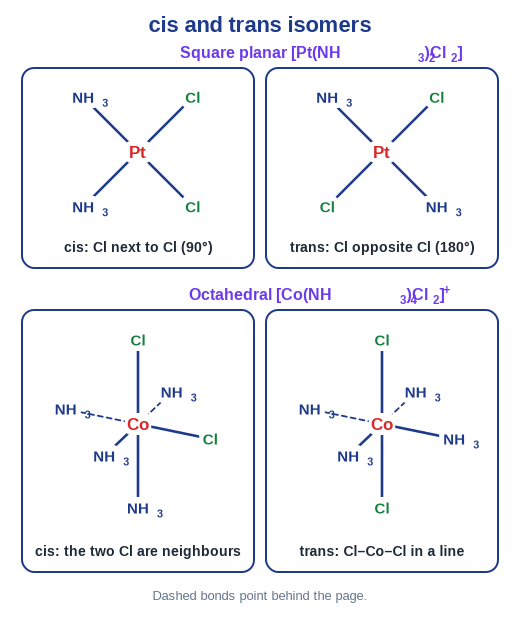
Example 5.5 (page 127): geometrical isomers of [Fe(NH₃)₂(CN)₄]⁻. Two: cis, with the two NH₃ next to each other, and trans, with the two NH₃ opposite each other. It is an [MX₂L₄] entity, like [Co(NH₃)₄Cl₂]⁺:
Example 5.6 (page 127): which of cis- and trans-[CrCl₂(ox)₂]³⁻ is chiral? The cis isomer. Its mirror image cannot be superimposed on it. The trans isomer has a plane of symmetry and is optically inactive.
Example 5.7 (page 131): geometry of [MnBr₄]²⁻, μ = 5.9 BM. Coordination number 4 means tetrahedral (sp³) or square planar (dsp²). A moment of 5.9 BM corresponds to n = 5 (√35 = 5.92 BM). Mn²⁺ is 3d⁵; dsp² would need one 3d orbital emptied by pairing, leaving only three unpaired electrons. Five unpaired electrons means no d orbital is used, so the ion is tetrahedral.
Back to the chapter notes, or read Werner’s theory and naming, isomerism and crystal field theory.
Practice
-
The oxidation number of cobalt in [Co(NH₃)₅(CO₃)]Cl is:
Show answer
Answer: (c) +3
-
The IUPAC name of [Co(NH₃)₄(H₂O)₂]Cl₃ is:
Show answer
Answer: (a) tetraamminediaquacobalt(III) chloride
-
How many unpaired electrons does [CoF₆]³⁻ have?
Show answer
Answer: (c) 4
-
Why does [Co(en)₃]³⁺ show optical isomerism but [Co(NH₃)₆]³⁺ does not?
Show answer
Answer: In [Co(en)₃]³⁺ the three didentate ligands can wrap around cobalt in two ways that are mirror images and cannot be superimposed. [Co(NH₃)₆]³⁺ has six identical unidentate ligands; its mirror image is the same as itself.
-
Find the spin-only magnetic moment of [Cr(NH₃)₆]³⁺.
Show answer
Answer: Cr³⁺ is 3d³, t₂g³, with n = 3 unpaired electrons. μ = √n(n+2) = √15 = 3.87 BM.
Stuck on a question?
Take a photo and Lagnever AI explains it step by step. Try it for 7 days for ₹2.
Get it on Google Play Open in browser
For parents: after the trial, the plan renews monthly by UPI or card autopay. You can cancel anytime in the app.