
Class 12 Chemistry Chapter 5 NCERT Solutions Hinglish mein: Coordination Compounds
Class 12 ki NCERT textbook Chemistry Part I ki Unit 5, Coordination Compounds, ke saare 31 end-of-unit exercises, saare 10 Intext Questions aur saare 7 solved examples ke answers. Page numbers 2026-27 reprint ke hain (pages 118–140). Pehle exercises hain, sawal Hinglish mein; phir Intext Questions aur examples, chhote mein. Short notes: Chapter 5 notes.
Answers kaise check kiye gaye. Har oxidation state, coordination number, d-electron count, unpaired electrons ki ginti aur spin-only moment (μ = √n(n+2) BM) calculate kiya gaya, aur har isomer count octahedron ya square par saare arrangements ki list bana kar nikaala gaya. Naam book ke rules aur uski -ido spellings ke hisaab se hain. Jahan book ki answer key alag ya adhoori hai, wahan note diya hai.
Safe raho. Cyanides aur hydrogen sulphide bahut zehreele hain. Yahan bataye gaye tests sirf school lab mein apne teacher ke saath kiye jaate hain, aur kisi chemical ko kabhi chakh kar ya soongh kar nahi.
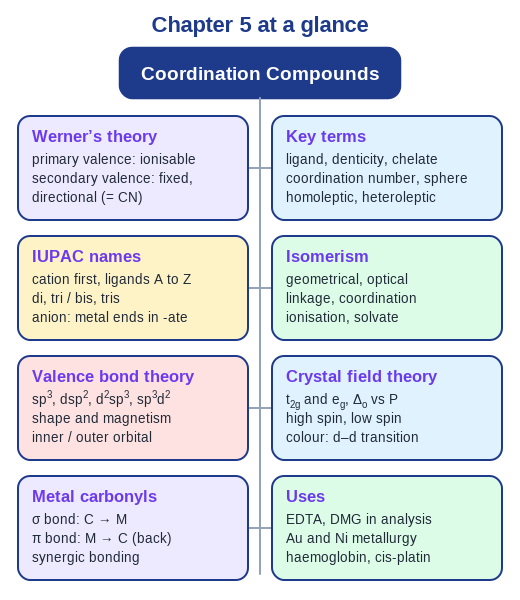
Exercises 5.1 se 5.7: Werner, terms aur naam
5.1 Werner ke postulates ke hisaab se coordination compounds mein bonding samjhao.
- Coordination compound mein metal do tarah ke linkage (valence) dikhata hai: primary aur secondary.
- Primary valence aam taur par ionisable hoti hai aur negative ions se poori hoti hai.
- Secondary valence non-ionisable hoti hai. Ye neutral molecules ya negative ions se poori hoti hai. Iski ginti coordination number ke barabar hai aur ek metal ke liye fixed hai.
- Secondary valence se jude groups har coordination number ke liye space mein ek tay tareeke se lage hote hain (octahedral, tetrahedral, square planar).
Example: CoCl₃·6NH₃, yaani [Co(NH₃)₆]Cl₃, mein chhe NH₃ molecules secondary valence 6 ko poora karte hain aur octahedral tareeke se lage hain. Teen Cl⁻ ions primary valence 3 ko poora karte hain, ionisable hain aur teeno AgNO₃ se precipitate hote hain. [CoCl(NH₃)₅]Cl₂ mein ek chloride secondary valence bhi bharta hai, isliye sirf do precipitate hote hain.
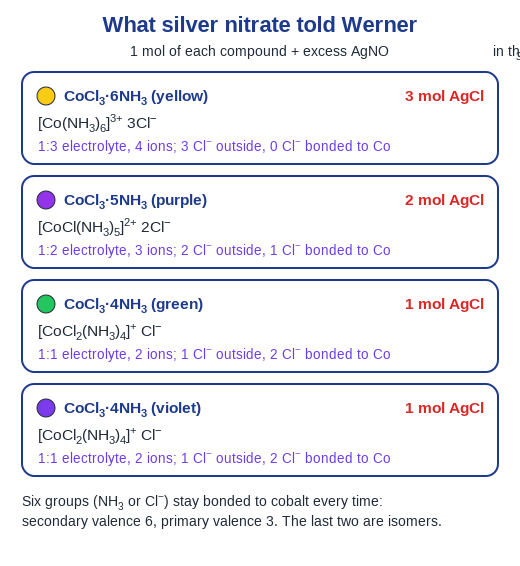
5.2 FeSO₄ solution ko (NH₄)₂SO₄ solution ke saath 1:1 molar ratio mein milane par Fe²⁺ ion ka test aata hai, lekin CuSO₄ solution ko aqueous ammonia ke saath 1:4 molar ratio mein milane par Cu²⁺ ion ka test nahi aata. Kyun?
FeSO₄ aur (NH₄)₂SO₄ 1:1 ratio mein Mohr’s salt, FeSO₄·(NH₄)₂SO₄·6H₂O, banate hain, jo double salt hai. Paani mein ye poori tarah Fe²⁺, NH₄⁺ aur SO₄²⁻ ions mein toot jaata hai, isliye Fe²⁺ test ke liye maujood rehta hai.
CuSO₄ aur ammonia 1:4 ratio mein ek complex, [Cu(NH₃)₄]SO₄, banate hain. Paani mein ye [Cu(NH₃)₄]²⁺ aur SO₄²⁻ deta hai. Copper coordination sphere ke andar hi rehta hai, aur complex ion Cu²⁺ aur NH₃ mein nahi toot-ta, isliye simple Cu²⁺ ions ka test nahi aata.
5.3 In terms ko do-do examples ke saath samjhao: coordination entity, ligand, coordination number, coordination polyhedron, homoleptic aur heteroleptic.
| Term | Matlab | Do examples |
|---|---|---|
| Coordination entity | central metal atom ya ion jo ions ya molecules ki tay ginti se juda ho | [Fe(CN)₆]⁴⁻, [Ni(CO)₄] |
| Ligand | central atom se juda ion ya molecule | Cl⁻, NH₃ |
| Coordination number | metal se seedhe jude donor atoms ki ginti | [PtCl₆]²⁻ mein 6, [Ni(NH₃)₄]²⁺ mein 4 |
| Coordination polyhedron | metal ke charon taraf donor atoms ka space mein arrangement | octahedral [Co(NH₃)₆]³⁺, tetrahedral [Ni(CO)₄] |
| Homoleptic | metal sirf ek tarah ke donor group se juda | [Co(NH₃)₆]³⁺, [Fe(CN)₆]⁴⁻ |
| Heteroleptic | metal ek se zyada tarah ke donor groups se juda | [Co(NH₃)₄Cl₂]⁺, [PtCl₂(NH₃)₂] |
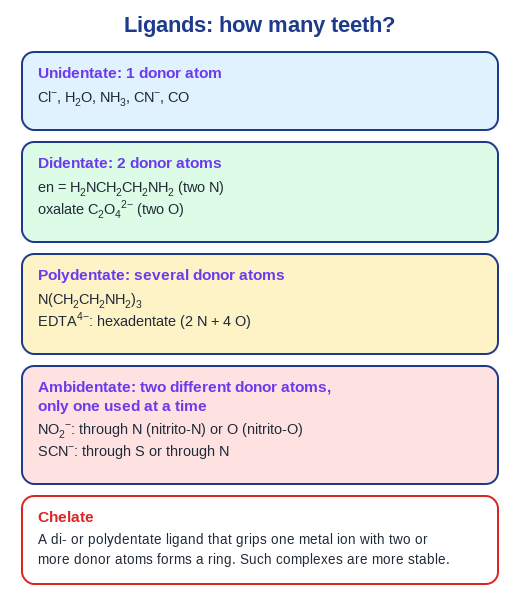
5.4 Unidentate, didentate aur ambidentate ligands ka kya matlab hai? Har ek ke do examples do.
- Unidentate: ek hi donor atom se judta hai. Examples: Cl⁻, NH₃ (H₂O bhi).
- Didentate: do donor atoms se judta hai. Examples: ethane-1,2-diamine, H₂NCH₂CH₂NH₂ (do N), aur oxalate, C₂O₄²⁻ (do O).
- Ambidentate: isme do alag donor atoms hote hain aur ye dono mein se kisi ek se judta hai. Examples: NO₂⁻ (N ya O se) aur SCN⁻ (S ya N se).
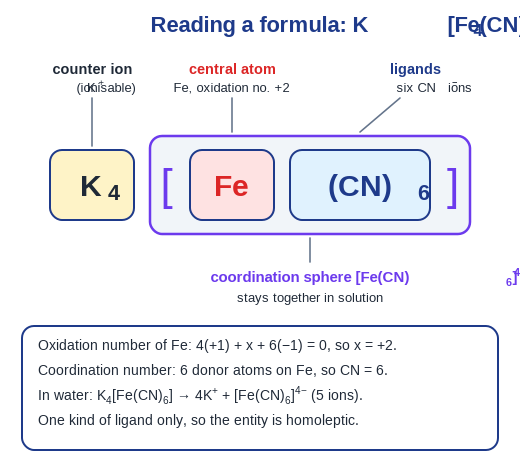
5.5 In coordination entities mein metals ke oxidation numbers batao: (i) [Co(H₂O)(CN)(en)₂]²⁺ (ii) [CoBr₂(en)₂]⁺ (iii) [PtCl₄]²⁻ (iv) K₃[Fe(CN)₆] (v) [Cr(NH₃)₃Cl₃]
Maan lo oxidation number x hai. H₂O, en aur NH₃ neutral hain; CN⁻, Br⁻ aur Cl⁻ ka charge −1 hai.
| Entity | Equation | Oxidation number |
|---|---|---|
| (i) [Co(H₂O)(CN)(en)₂]²⁺ | x + 0 + (−1) + 0 = +2 | Co = +3 |
| (ii) [CoBr₂(en)₂]⁺ | x + 2(−1) + 0 = +1 | Co = +3 |
| (iii) [PtCl₄]²⁻ | x + 4(−1) = −2 | Pt = +2 |
| (iv) K₃[Fe(CN)₆] | 3(+1) + x + 6(−1) = 0 | Fe = +3 |
| (v) [Cr(NH₃)₃Cl₃] | x + 0 + 3(−1) = 0 | Cr = +3 |
Ye book ki key se milte hain.
5.6 IUPAC norms ke hisaab se inke formulas likho: (i) Tetrahydroxidozincate(II) (ii) Potassium tetrachloridopalladate(II) (iii) Diamminedichloridoplatinum(II) (iv) Potassium tetracyanidonickelate(II) (v) Pentaamminenitrito-O-cobalt(III) (vi) Hexaamminecobalt(III) sulphate (vii) Potassium tri(oxalato)chromate(III) (viii) Hexaammineplatinum(IV) (ix) Tetrabromidocuprate(II) (x) Pentaamminenitrito-N-cobalt(III)
| Formula | Charge check | |
|---|---|---|
| (i) | [Zn(OH)₄]²⁻ | +2 + 4(−1) = −2 |
| (ii) | K₂[PdCl₄] | [PdCl₄]²⁻: +2 − 4 = −2, isliye 2 K⁺ |
| (iii) | [Pt(NH₃)₂Cl₂] | +2 − 2 = 0 |
| (iv) | K₂[Ni(CN)₄] | +2 − 4 = −2, isliye 2 K⁺ |
| (v) | [Co(NH₃)₅(ONO)]²⁺ | +3 − 1 = +2; nitrite O se juda |
| (vi) | [Co(NH₃)₆]₂(SO₄)₃ | do 3+ cations teen SO₄²⁻ ko balance karte hain |
| (vii) | K₃[Cr(C₂O₄)₃] | +3 + 3(−2) = −3, isliye 3 K⁺ |
| (viii) | [Pt(NH₃)₆]⁴⁺ | +4 + 0 = +4 |
| (ix) | [CuBr₄]²⁻ | +2 − 4 = −2 |
| (x) | [Co(NH₃)₅(NO₂)]²⁺ | +3 − 1 = +2; nitrite N se juda |
Dason key se milte hain. Key (iii) ko [Pt(NH₃)₂Cl₂] likhti hai; formula ke alphabetical rule se ise [PtCl₂(NH₃)₂] bhi likh sakte hain, jaise chapter ke text mein hai.
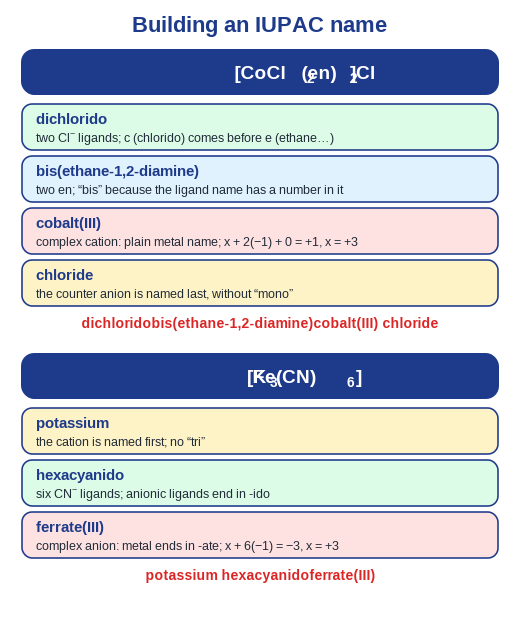
5.7 IUPAC norms ke hisaab se inke systematic naam likho: (i) [Co(NH₃)₆]Cl₃ (ii) [Pt(NH₃)₂Cl(NH₂CH₃)]Cl (iii) [Ti(H₂O)₆]³⁺ (iv) [Co(NH₃)₄Cl(NO₂)]Cl (v) [Mn(H₂O)₆]²⁺ (vi) [NiCl₄]²⁻ (vii) [Ni(NH₃)₆]Cl₂ (viii) [Co(en)₃]³⁺ (ix) [Ni(CO)₄]
| Metal | Naam | |
|---|---|---|
| (i) | Co +3 | hexaamminecobalt(III) chloride |
| (ii) | Pt +2 | diamminechlorido(methanamine)platinum(II) chloride |
| (iii) | Ti +3 | hexaaquatitanium(III) ion |
| (iv) | Co +3 | tetraamminechloridonitrito-N-cobalt(III) chloride |
| (v) | Mn +2 | hexaaquamanganese(II) ion |
| (vi) | Ni +2 | tetrachloridonickelate(II) ion |
| (vii) | Ni +2 | hexaamminenickel(II) chloride |
| (viii) | Co +3 | tris(ethane-1,2-diamine)cobalt(III) ion |
| (ix) | Ni 0 | tetracarbonylnickel(0) |
(ii) mein ligands alphabetical order mein hain: ammine, chlorido, methanamine. (iv) mein NO₂ ka N metal ke paas likha hai, isliye nitrito-N. Key is sawal ke naam nahi deti; (i) aur (ii) book ke Intext 5.2 ke answers se milte hain.
Exercises 5.8 se 5.12: isomerism
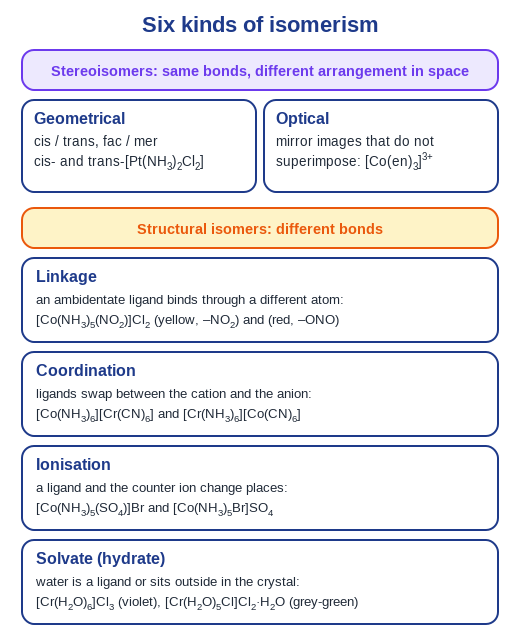
5.8 Coordination compounds mein possible isomerism ke types ki list banao, har ek ka ek example do.
Stereoisomerism
- Geometrical isomerism: cis- aur trans-[Pt(NH₃)₂Cl₂]; fac- aur mer-[Co(NH₃)₃(NO₂)₃].
- Optical isomerism: [Co(en)₃]³⁺ ke d aur l forms.
Structural isomerism
- Linkage isomerism: [Co(NH₃)₅(NO₂)]Cl₂ (yellow, N se juda) aur [Co(NH₃)₅(ONO)]Cl₂ (red, O se juda).
- Coordination isomerism: [Co(NH₃)₆][Cr(CN)₆] aur [Cr(NH₃)₆][Co(CN)₆].
- Ionisation isomerism: [Co(NH₃)₅(SO₄)]Br aur [Co(NH₃)₅Br]SO₄.
- Solvate (hydrate) isomerism: [Cr(H₂O)₆]Cl₃ (violet) aur [Cr(H₂O)₅Cl]Cl₂·H₂O (grey-green).
5.9 In coordination entities ke kitne geometrical isomers possible hain? (i) [Cr(C₂O₄)₃]³⁻ (ii) [Co(NH₃)₃Cl₃]
(i) Koi nahi. Teeno ligands same didentate ligand hain, isliye unhe lagane ka ek hi tareeka hai. (Is entity ke do optical isomers zaroor hain; 5.10 dekho.)
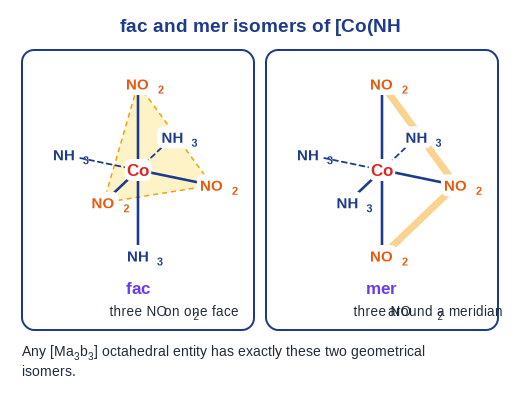
(ii) Do: fac isomer, jisme teen Cl octahedron ke ek face par hain, aur mer isomer, jisme teen Cl ek meridian par hain. Ye [Ma₃b₃] entity hai.
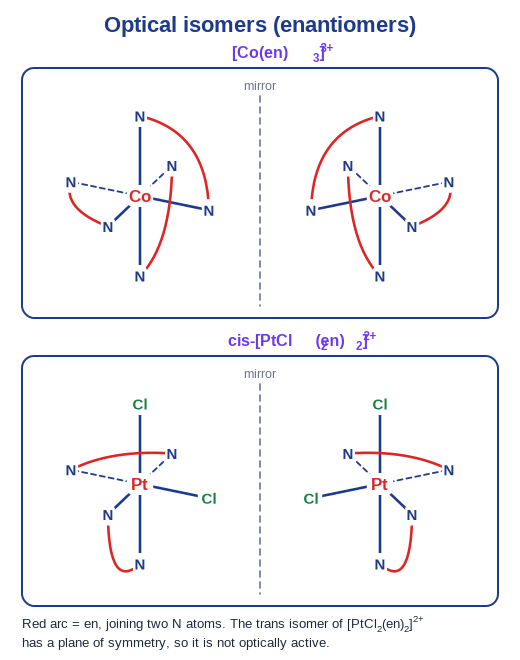
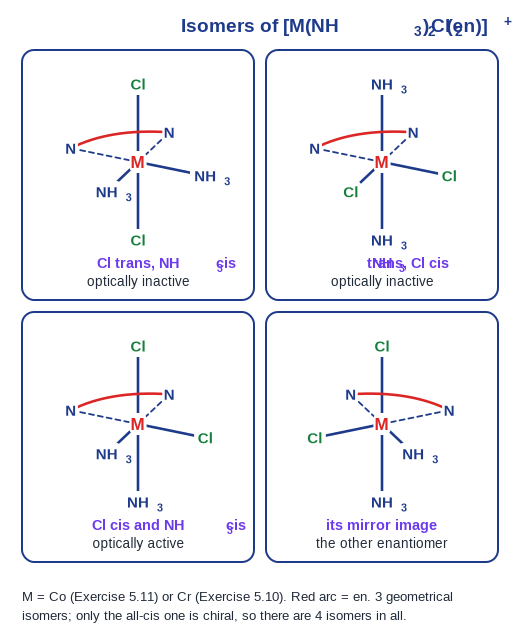
5.10 Inke optical isomers ke structures banao: (i) [Cr(C₂O₄)₃]³⁻ (ii) [PtCl₂(en)₂]²⁺ (iii) [Cr(NH₃)₂Cl₂(en)]⁺
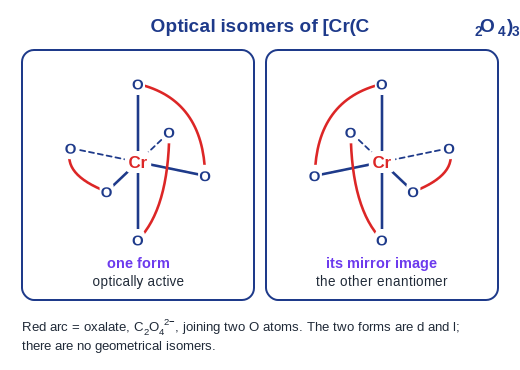
(i) [Cr(C₂O₄)₃]³⁻ mirror images ke ek jode ki tarah milta hai, d aur l.
(ii) [PtCl₂(en)₂]²⁺ ka sirf cis isomer chiral hai. trans isomer mein plane of symmetry hai. Is figure ke neeche wale hisse mein ye joda hai:
(iii) [Cr(NH₃)₂Cl₂(en)]⁺ ke teen geometrical isomers hain. Sirf wo chiral hai jisme dono Cl cis hain aur dono NH₃ bhi cis hain. Wo aur uski mirror image hi optical isomers hain (neeche ki do drawings, M = Cr).
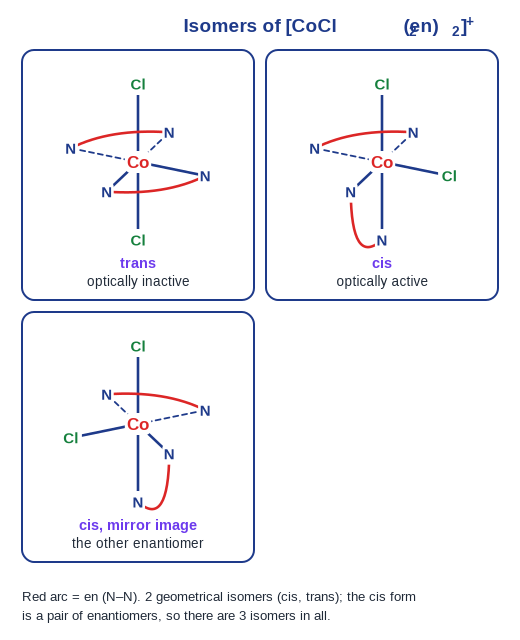
5.11 Inke saare isomers (geometrical aur optical) banao: (i) [CoCl₂(en)₂]⁺ (ii) [Co(NH₃)Cl(en)₂]²⁺ (iii) [Co(NH₃)₂Cl₂(en)]⁺
(i) [CoCl₂(en)₂]⁺: teen isomers. trans (optically inactive) aur cis, jo enantiomers ka joda hai.
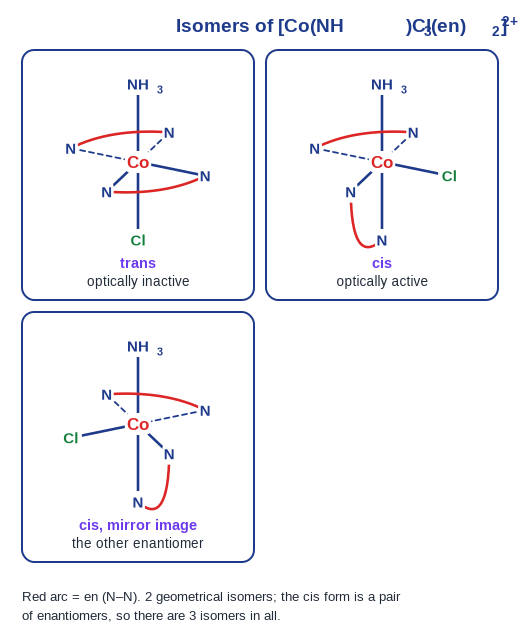
(ii) [Co(NH₃)Cl(en)₂]²⁺: teen isomers. trans (NH₃ ke saamne Cl, optically inactive) aur cis, jo enantiomers ka joda hai.
(iii) [Co(NH₃)₂Cl₂(en)]⁺: chaar isomers. Teen geometrical isomers hain (Cl trans; NH₃ trans; dono jode cis), aur all-cis wala enantiomers ka joda hai. 5.10 (iii) ke neeche wali figure dekho, M = Co.
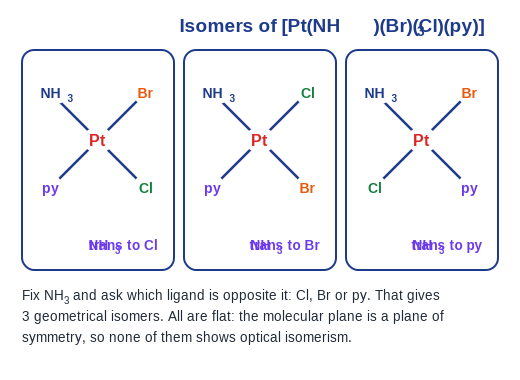
5.12 [Pt(NH₃)(Br)(Cl)(py)] ke saare geometrical isomers likho. Inme se kitne optical isomers dikhayenge?
Ye square planar [MABXL] entity hai. NH₃ ko fix karo; uske saamne Cl, Br ya py ho sakta hai. To teen geometrical isomers hain (key ke hisaab se do cis aur ek trans).
Koi bhi optical isomerism nahi dikhata. Square planar entity flat hoti hai, aur molecule ka plane hi plane of symmetry hai.
Exercises 5.13 se 5.22: reactions aur bonding
5.13 Aqueous copper sulphate solution (neele rang ka) deta hai: (i) aqueous potassium fluoride ke saath green precipitate aur (ii) aqueous potassium chloride ke saath bright green solution. In experimental results ko samjhao.
Aqueous copper sulphate mein [Cu(H₂O)₄]²⁺ ions hote hain, jo neele hain. Paani weak field ligand hai aur replace ho sakta hai.
(i) KF ke saath fluoride ions paani ke ligands ki jagah le lete hain. Book ki key ke hisaab se [CuF₄]²⁻ banta hai aur green precipitate ki tarah neeche aata hai:
[Cu(H₂O)₄]²⁺ + 4F⁻ → [CuF₄]²⁻ + 4H₂O
(ii) KCl ke saath chloride ions paani ke ligands ki jagah lete hain aur [CuCl₄]²⁻ dete hain, jo solution mein bright green hai:
[Cu(H₂O)₄]²⁺ + 4Cl⁻ → [CuCl₄]²⁻ + 4H₂O
Naya ligand yaani d orbitals ki nayi splitting, isliye alag colour dikhta hai.
5.14 Copper sulphate ke aqueous solution mein excess aqueous KCN daalne par kaunsi coordination entity banti hai? Is solution mein H₂S(g) pass karne par copper sulphide ka precipitate kyun nahi banta?
Book ki key entity ko [Cu(CN)₄]²⁻ deti hai:
[Cu(H₂O)₄]²⁺ + 4CN⁻ → [Cu(CN)₄]²⁻ + 4H₂O
CN⁻ strong ligand hai, isliye complex bahut stable hai. Copper coordination sphere ke andar band rehta hai aur solution mein simple copper ions lagbhag nahi bachte. H₂S pass karne par CuS ka precipitate banane ke liye wo kaafi nahi hote.
Extra, apne teacher ke liye: lab mein cyanide pehle Cu²⁺ ko copper(I) mein reduce karta hai, aur stable entity copper(I) ka complex [Cu(CN)₄]³⁻ hoti hai, wahi ion jo chapter khud Cu(I) ke example mein deta hai. CuS na banne ka reason wahi rehta hai.
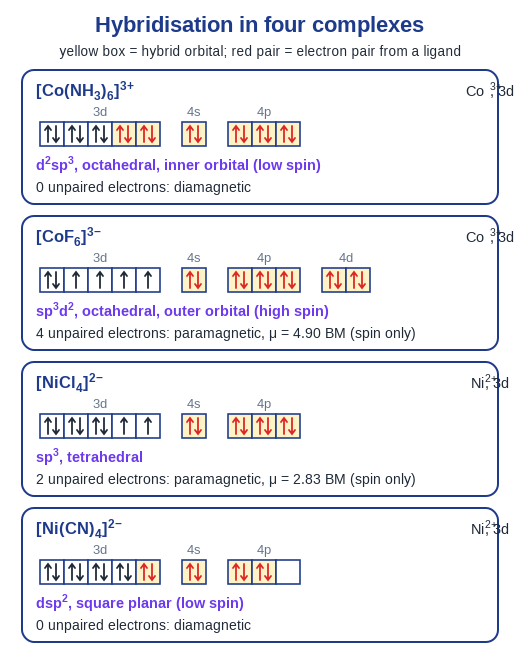
5.15 Valence bond theory ke basis par in coordination entities mein bonding ka nature batao: (i) [Fe(CN)₆]⁴⁻ (ii) [FeF₆]³⁻ (iii) [Co(C₂O₄)₃]³⁻ (iv) [CoF₆]³⁻
| Entity | Metal ion | d electrons kya karte hain | Hybridisation | Unpaired e⁻ | Result |
|---|---|---|---|---|---|
| (i) [Fe(CN)₆]⁴⁻ | Fe²⁺, 3d⁶ | teen 3d orbitals mein pair ho jaate hain | d²sp³ | 0 | octahedral, inner orbital, diamagnetic |
| (ii) [FeF₆]³⁻ | Fe³⁺, 3d⁵ | unpaired rehte hain | sp³d² | 5 | octahedral, outer orbital, paramagnetic |
| (iii) [Co(C₂O₄)₃]³⁻ | Co³⁺, 3d⁶ | teen 3d orbitals mein pair ho jaate hain | d²sp³ | 0 | octahedral, inner orbital, diamagnetic |
| (iv) [CoF₆]³⁻ | Co³⁺, 3d⁶ | ion jaise hi rehte hain | sp³d² | 4 | octahedral, outer orbital, paramagnetic |
(i) aur (iii) mein pairing se do 3d orbitals khaali hote hain; ye 4s aur teen 4p orbitals ke saath milte hain. (ii) aur (iv) mein 3d electrons ko chheda nahi jaata aur 4s aur 4p ke saath bahar ke do 4d orbitals use hote hain. Har case mein chhe hybrid orbitals ek-ek donor atom se electron pair lete hain (teen oxalate ions chhe pairs dete hain). Spin-only moments: (ii) ke liye 5.92 BM aur (iv) ke liye 4.90 BM.
5.16 Octahedral crystal field mein d orbitals ki splitting dikhane wali figure banao.
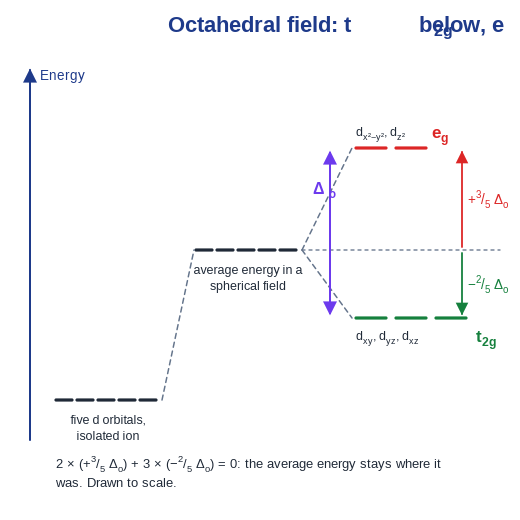
d_x²−y² aur d_z² orbitals (e_g) ligands ki taraf point karte hain aur (3/5)Δo upar jaate hain. d_xy, d_yz aur d_xz orbitals (t₂g) ligands ke beech point karte hain aur (2/5)Δo neeche aate hain.
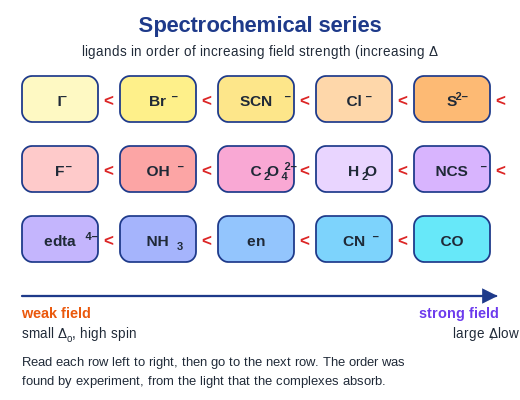
5.17 Spectrochemical series kya hai? Weak field ligand aur strong field ligand mein fark samjhao.
Spectrochemical series ligands ki wo list hai jo badhti field strength, yaani badhti crystal field splitting, ke order mein hai. Ye experiment se mili hai, alag ligands ke complexes ki absorb ki hui light se:
I⁻ < Br⁻ < SCN⁻ < Cl⁻ < S²⁻ < F⁻ < OH⁻ < C₂O₄²⁻ < H₂O < NCS⁻ < edta⁴⁻ < NH₃ < en < CN⁻ < CO
| Weak field ligand | Strong field ligand | |
|---|---|---|
| Splitting | chhota Δo | bada Δo |
| Pairing energy se tulna | Δo < P | Δo > P |
| Electrons | pair hone se pehle e_g mein jaate hain | pehle t₂g mein pair hote hain |
| Complex | high spin | low spin |
| Examples | I⁻, Cl⁻, F⁻ | CN⁻, CO |
5.18 Crystal field splitting energy kya hai? Δo ka magnitude coordination entity mein d orbitals ki actual configuration kaise tay karta hai?
Jab ligands ek tay geometry mein metal ion ke paas aate hain, to paanch degenerate d orbitals alag energy ke sets mein bant jaate hain. In sets ke beech ka energy separation crystal field splitting energy hai; octahedral entity ke liye ye Δo hai, t₂g aur e_g ke beech ka gap.
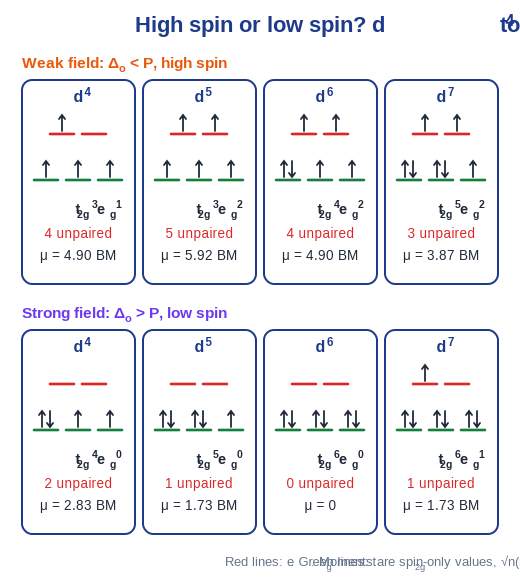
Pehle teen electrons t₂g mein ek-ek karke jaate hain. Chauthe ke liye Δo ki tulna pairing energy P se hoti hai:
- Agar Δo < P, to electron e_g mein jaata hai: t₂g³e_g¹. High spin.
- Agar Δo > P, to wo t₂g mein pair hota hai: t₂g⁴e_g⁰. Low spin.
5.19 [Cr(NH₃)₆]³⁺ paramagnetic hai jabki [Ni(CN)₄]²⁻ diamagnetic hai. Kyun?
[Cr(NH₃)₆]³⁺ mein Cr³⁺ 3d³ hai. Iske teen electrons teen 3d orbitals mein ek-ek hain; baaki do 3d orbitals, 4s aur teen 4p orbitals chhe NH₃ ke liye d²sp³ hybrids banate hain. Teen unpaired electrons ise paramagnetic banate hain (3.87 BM).
[Ni(CN)₄]²⁻ mein Ni²⁺ 3d⁸ hai. CN⁻ strong ligand hai: aath electrons chaar 3d orbitals mein pair ho jaate hain, aur khaali orbital 4s aur do 4p orbitals ke saath dsp² hybridisation karta hai (square planar). Koi unpaired electron nahi, isliye ye diamagnetic hai.
5.20 [Ni(H₂O)₆]²⁺ ka solution green hai lekin [Ni(CN)₄]²⁻ ka solution colourless hai. Samjhao.
[Ni(H₂O)₆]²⁺ mein Ni²⁺ (d⁸) ke charon taraf weak field ligand paani hai. Isme do unpaired electrons hain, aur splitting itni chhoti hai ki d–d transitions visible light ka kuch hissa absorb kar lete hain. Complementary colour, green, dikhta hai.
[Ni(CN)₄]²⁻ mein strong field ligand CN⁻ square planar entity mein saare d electrons pair kar deta hai, aur splitting badi hoti hai. d–d transition se visible light absorb nahi hoti, isliye solution colourless hai.
5.21 Dilute solutions mein [Fe(CN)₆]⁴⁻ aur [Fe(H₂O)₆]²⁺ ke colours alag hote hain. Kyun?
Dono mein Fe²⁺ (3d⁶) hai, lekin ligands alag hain. CN⁻ strong field ligand hai aur bada Δo deta hai; H₂O weak field ligand hai aur chhota Δo deta hai. d–d transition mein absorb hone wali light ki energy, aur isliye wavelength, dono mein alag hai, aur har ek absorb hui light ka complement dikhata hai. Isliye colours alag hain.
5.22 Metal carbonyls mein bonding ka nature batao.
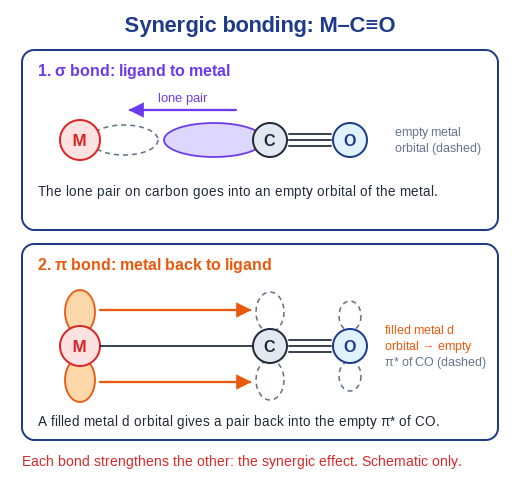
Metal carbonyl mein metal–carbon bond mein σ aur π dono character hote hain.
- σ bond (ligand se metal): CO ke carbon ka lone pair metal ke khaali orbital mein donate hota hai.
- π bond (metal se ligand): metal ke bhare hue d orbital se electrons ka ek pair CO ke khaali antibonding π* orbital mein donate hota hai.
Dono donations saath kaam karte hain: metal-to-ligand bonding se synergic effect banta hai, jo CO aur metal ke beech ke bond ko mazboot karta hai.
Exercises 5.23 se 5.31: configurations, colour aur uses
5.23 In complexes mein central metal ion ka oxidation state, d orbital occupation aur coordination number batao: (i) K₃[Co(C₂O₄)₃] (ii) cis-[CrCl₂(en)₂]Cl (iii) (NH₄)₂[CoF₄] (iv) [Mn(H₂O)₆]SO₄
| Complex | Oxidation state | Coordination number | d orbital occupation |
|---|---|---|---|
| (i) K₃[Co(C₂O₄)₃] | 3 + x + 3(−2) = 0, +3 | 6 | d⁶: t₂g⁶e_g⁰ |
| (ii) cis-[CrCl₂(en)₂]Cl | x − 2 + 0 = +1, +3 | 6 | d³: t₂g³ |
| (iii) (NH₄)₂[CoF₄] | 2 + x − 4 = 0, +2 | 4 | d⁷: e⁴t₂³ (tetrahedral) |
| (iv) [Mn(H₂O)₆]SO₄ | x + 0 = +2, +2 | 6 | d⁵: t₂g³e_g² |
(iii) par note. Key mein “d⁷ (t₂g⁵e_g²)” chhapa hai, jo d⁷ ko high spin octahedral tareeke se likhna hai. Coordination number 4 aur weak field ligand F⁻ ke saath entity tetrahedral hai, jahan neeche wala set e hai aur labels mein g nahi lagta: e⁴t₂³. Dono tareekon se teen unpaired electrons aate hain.
5.24 In complexes ka IUPAC naam likho aur oxidation state, electronic configuration aur coordination number batao. Complex ki stereochemistry aur magnetic moment bhi do: (i) K[Cr(H₂O)₂(C₂O₄)₂].3H₂O (ii) [Co(NH₃)₅Cl]Cl₂ (iii) [CrCl₃(py)₃] (iv) Cs[FeCl₄] (v) K₄[Mn(CN)₆]
| IUPAC naam | Oxidation state | Configuration | CN | Stereochemistry | μ (spin only) | |
|---|---|---|---|---|---|---|
| (i) | potassium diaquadioxalatochromate(III) trihydrate | Cr +3 | 3d³, t₂g³ | 6 | octahedral; cis aur trans, cis optically active hai | n = 3: 3.87 BM |
| (ii) | pentaamminechloridocobalt(III) chloride | Co +3 | 3d⁶, t₂g⁶ | 6 | octahedral; geometrical isomers nahi | n = 0: 0 (diamagnetic) |
| (iii) | trichloridotris(pyridine)chromium(III) | Cr +3 | 3d³, t₂g³ | 6 | octahedral; fac aur mer | n = 3: 3.87 BM |
| (iv) | caesium tetrachloridoferrate(III) | Fe +3 | 3d⁵, e²t₂³ | 4 | tetrahedral; geometrical isomers nahi | n = 5: 5.92 BM |
| (v) | potassium hexacyanidomanganate(II) | Mn +2 | 3d⁵, t₂g⁵ | 6 | octahedral | n = 1: 1.73 BM |
Spin kaise chuna: Co³⁺ ke saath NH₃ aur CN⁻ strong field hain (low spin); Cl⁻ weak field hai aur [FeCl₄]⁻ tetrahedral hai (high spin); d³ ka ek hi arrangement possible hai. Key is sawal ka answer nahi deti.
5.25 Crystal field theory ke basis par complex [Ti(H₂O)₆]³⁺ ka violet colour samjhao.
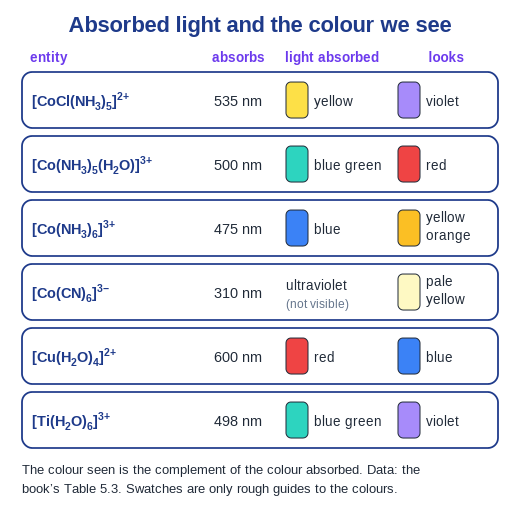
Ti³⁺ ek 3d¹ ion hai. Chhe paani molecules ke octahedral field mein iske d orbitals t₂g aur e_g mein split hote hain, aur akela electron t₂g mein hota hai. Jab white light complex par padti hai, to blue-green region ki light (lagbhag 498 nm) ki energy theek Δo ke barabar hoti hai. Wo absorb hoti hai aur electron e_g mein chala jaata hai:
t₂g¹e_g⁰ → t₂g⁰e_g¹
Jo light paar nikalti hai usme blue-green hissa nahi hota, isliye complex complementary colour, violet, dikhata hai.
5.26 Chelate effect ka kya matlab hai? Ek example do.
Jab didentate ya polydentate ligand ek hi metal ion se do ya zyada donor atoms ke zariye ek saath judta hai, to ring banti hai aur use chelate ligand kehte hain. Aisi rings wale complexes unidentate ligands wale milte-julte complexes se zyada stable hote hain. Is extra stability ko chelate effect kehte hain.
Example: ethane-1,2-diamine chelate ligand hai, aur [Co(en)₃]³⁺ mein teen chelate rings hain. (Extra: aam taur par ye tulna di jaati hai ki [Ni(en)₃]²⁺, [Ni(NH₃)₆]²⁺ se zyada stable hai, jisme wahi chhe nitrogen donor atoms hain lekin koi ring nahi.)
5.27 Har case mein ek example dete hue coordination compounds ka role chhote mein batao: (i) biological systems (ii) medicinal chemistry (iii) analytical chemistry (iv) metals ka extraction/metallurgy.
(i) Biological systems. Kai zaroori molecules coordination compounds hain: photosynthesis ka pigment chlorophyll magnesium ka compound hai; khoon mein oxygen le jaane wala haemoglobin iron ka; vitamin B₁₂ cobalt ka.
(ii) Medicinal chemistry. Chelate therapy se toxic matra mein maujood metals nikaale jaate hain: lead poisoning mein EDTA, aur zyada copper aur iron ke liye D-penicillamine aur desferrioxime B. cis-platin aur usse milte-julte platinum complexes tumour ki growth ko rokte hain.
(iii) Analytical chemistry. Metal ions EDTA aur DMG jaise ligands ke saath khaas colours dete hain, jisse unhe detect aur estimate kiya jaata hai. Paani ki hardness Ca²⁺ aur Mg²⁺ ko Na₂EDTA se titrate karke nikaali jaati hai.
(iv) Extraction/metallurgy. Gold aur silver cyanide complexes ke zariye nikaale jaate hain: gold oxygen aur paani ki maujoodgi mein [Au(CN)₂]⁻ banata hai, aur phir zinc metal ko alag kar deta hai. Nickel ko [Ni(CO)₄] bana kar aur use tod kar pure kiya jaata hai.
5.28 Complex Co(NH₃)₆Cl₂ solution mein kitne ions deta hai? (i) 6 (ii) 4 (iii) 3 (iv) 2
Complex [Co(NH₃)₆]Cl₂ hai:
[Co(NH₃)₆]Cl₂ → [Co(NH₃)₆]²⁺ + 2Cl⁻
Ek complex cation aur do chloride ions: 3 ions, option (iii). Ye key se milta hai.
5.29 In ions mein se kiska magnetic moment sabse zyada hai? (i) [Cr(H₂O)₆]³⁺ (ii) [Fe(H₂O)₆]²⁺ (iii) [Zn(H₂O)₆]²⁺
Paani weak field ligand hai, isliye ye high spin hain.
| Ion | Metal ion | Unpaired electrons | μ = √n(n+2) |
|---|---|---|---|
| (i) | Cr³⁺, d³ (t₂g³) | 3 | 3.87 BM |
| (ii) | Fe²⁺, d⁶ (t₂g⁴e_g²) | 4 | 4.90 BM |
| (iii) | Zn²⁺, d¹⁰ | 0 | 0 |
Option (ii), [Fe(H₂O)₆]²⁺, jaisa key mein hai.
5.30 In mein se sabse stable complex kaunsa hai? (i) [Fe(H₂O)₆]³⁺ (ii) [Fe(NH₃)₆]³⁺ (iii) [Fe(C₂O₄)₃]³⁻ (iv) [FeCl₆]³⁻
Chaaron mein Fe³⁺ hai. Sirf oxalate didentate, chelating ligand hai: [Fe(C₂O₄)₃]³⁻ mein teen chelate rings hain, aur chelate complexes unidentate ligands wale complexes se zyada stable hote hain. Option (iii).
5.31 In ke liye visible region mein absorption ki wavelengths ka sahi order kya hoga: [Ni(NO₂)₆]⁴⁻, [Ni(NH₃)₆]²⁺, [Ni(H₂O)₆]²⁺?
Teeno mein Ni²⁺ hai, isliye Δo ligand se tay hota hai. Key field strength ka order H₂O < NH₃ < NO₂⁻ deti hai. Zyada strong field yaani bada Δo, isliye absorb hui energy ka order hai
[Ni(H₂O)₆]²⁺ < [Ni(NH₃)₆]²⁺ < [Ni(NO₂)₆]⁴⁻
E = hc/λ hai, isliye wavelength ka order ulta hoga:
[Ni(H₂O)₆]²⁺ > [Ni(NH₃)₆]²⁺ > [Ni(NO₂)₆]⁴⁻
Key ki numbering par note. Key mein answers “5.32” tak hain: 5.28 (iii), 5.29 (ii), 5.30 (iii), 5.31 (iii) aur ye order 5.32 ke naam se. 2026-27 reprint mein sirf 31 exercises hain, aur uska 5.31 yahi sawal hai, jisme options nahi hain. Yaani key mein purani numbering ka ek extra “(iii)” reh gaya hai; 5.28, 5.29 aur 5.30 ke answers phir bhi sahi hain. Ye bhi dhyan do ki NO₂⁻ chapter mein chhapi spectrochemical series mein nahi hai; uski jagah key se li gayi hai.
Intext Questions
Ye chhote mein dobara likhe gaye hain, quote nahi kiye gaye.
Intext 5.1 (page 125): naam se formula.
| Naam | Formula |
|---|---|
| (i) tetraamminediaquacobalt(III) chloride | [Co(NH₃)₄(H₂O)₂]Cl₃ |
| (ii) potassium tetracyanidonickelate(II) | K₂[Ni(CN)₄] |
| (iii) tris(ethane-1,2-diamine)chromium(III) chloride | [Cr(en)₃]Cl₃ |
| (iv) amminebromidochloridonitrito-N-platinate(II) | [Pt(NH₃)BrCl(NO₂)]⁻ |
| (v) dichloridobis(ethane-1,2-diamine)platinum(IV) nitrate | [PtCl₂(en)₂](NO₃)₂ |
| (vi) iron(III) hexacyanidoferrate(II) | Fe₄[Fe(CN)₆]₃ |
Checks: (iv) mein +2 − 1 − 1 − 1 = −1; (v) mein +4 − 2 = +2, isliye do nitrate; (vi) mein chaar Fe³⁺ (+12) teen [Fe(CN)₆]⁴⁻ (−12) ko balance karte hain.
Intext 5.2 (page 125): formula se naam.
| Formula | Naam |
|---|---|
| (i) [Co(NH₃)₆]Cl₃ | hexaamminecobalt(III) chloride |
| (ii) [Co(NH₃)₅Cl]Cl₂ | pentaamminechloridocobalt(III) chloride |
| (iii) K₃[Fe(CN)₆] | potassium hexacyanidoferrate(III) |
| (iv) K₃[Fe(C₂O₄)₃] | potassium trioxalatoferrate(III) |
| (v) K₂[PdCl₄] | potassium tetrachloridopalladate(II) |
| (vi) [Pt(NH₃)₂Cl(NH₂CH₃)]Cl | diamminechlorido(methanamine)platinum(II) chloride |
Intext 5.3 (page 128): chaar complexes mein isomerism ke types.
(i) K[Cr(H₂O)₂(C₂O₄)₂]: geometrical isomers (cis aur trans, do paani molecules ki position se), aur cis isomer ke optical isomers ka ek joda bhi hai. Kul teen stereoisomers.
(ii) [Co(en)₃]Cl₃: optical isomers, d aur l form (Exercise 5.10 ke neeche wali optical isomers figure ka upar wala hissa).
(iii) [Co(NH₃)₅(NO₂)](NO₃)₂: linkage isomers, [Co(NH₃)₅(NO₂)](NO₃)₂ aur [Co(NH₃)₅(ONO)](NO₃)₂; aur ionisation isomers, jisme ek nitrate sphere ke andar aata hai aur nitrite bahar jaata hai, [Co(NH₃)₅(NO₃)](NO₂)(NO₃).
Key par note. Key kehti hai “10 possible isomers” aur geometrical, ionisation aur linkage isomers ka hint deti hai. [Co(NH₃)₅X] entity ka ek hi arrangement hota hai, isliye iske geometrical isomers nahi hote; octahedron par saare arrangements ki list bhi yahi batati hai. Chhape hue formula ke liye hum das tak nahi pahunch paaye. Apne teacher se poocho ki kaunse isomers likhne hain; linkage aur ionisation safe answers hain.
(iv) [Pt(NH₃)(H₂O)Cl₂]: geometrical isomers, cis (dono Cl paas-paas) aur trans (dono Cl aamne-saamne), jaise chapter notes ki cis aur trans figure ka square planar joda.
Intext 5.4 (page 128): saboot ki [Co(NH₃)₅Cl]SO₄ aur [Co(NH₃)₅(SO₄)]Cl ionisation isomers hain.
Dono ki composition same hai lekin paani mein alag ions dete hain, isliye alag tests dete hain.
| Test | [Co(NH₃)₅Cl]SO₄ | [Co(NH₃)₅(SO₄)]Cl |
|---|---|---|
| BaCl₂ solution | BaSO₄ ka safed precipitate (sulphate bahar hai) | koi precipitate nahi |
| AgNO₃ solution | koi precipitate nahi | AgCl ka safed precipitate (chloride bahar hai) |
Ba²⁺ + SO₄²⁻ → BaSO₄(s) aur Ag⁺ + Cl⁻ → AgCl(s). Key bromide wale jode [Co(NH₃)₅Br]SO₄ aur [Co(NH₃)₅SO₄]Br se answer deti hai; reasoning wahi hai.
Intext 5.5 (page 135): [Ni(CN)₄]²⁻ diamagnetic hai, [NiCl₄]²⁻ paramagnetic.
Dono mein Ni²⁺ 3d⁸ hai. Strong ligand CN⁻ ke saath aath electrons chaar 3d orbitals mein pair ho jaate hain; khaali 3d orbital, 4s aur do 4p orbitals dsp² hybrids dete hain: square planar, koi unpaired electron nahi, diamagnetic. Weak ligand Cl⁻ ke saath pairing nahi hoti; 4s aur teen 4p orbitals sp³ hybrids dete hain: tetrahedral, do unpaired electrons, paramagnetic (2.83 BM). Exercise 5.15 ke neeche wali box-diagram figure ki aakhri do rows dekho.
Intext 5.6 (page 135): [NiCl₄]²⁻ paramagnetic hai, [Ni(CO)₄] diamagnetic, dono tetrahedral.
[Ni(CO)₄] mein nickel zero oxidation state mein hai, 3d⁸4s². CO strong ligand hai: do 4s electrons 3d orbitals mein chale jaate hain aur dason electrons pair ho jaate hain (3d¹⁰). Khaali 4s aur 4p orbitals sp³ hybrids banate hain. Koi unpaired electron nahi: diamagnetic. [NiCl₄]²⁻ mein nickel +2 (3d⁸) hai aur Cl⁻ electrons ko pair karne ke liye bahut weak hai, isliye do unpaired rehte hain: paramagnetic.
Intext 5.7 (page 135): [Fe(H₂O)₆]³⁺ strongly paramagnetic hai aur [Fe(CN)₆]³⁻ weakly.
Dono mein Fe³⁺ 3d⁵ hai. H₂O weak ligand hai: pairing nahi, sp³d² hybridisation (outer orbital), paanch unpaired electrons, μ = 5.92 BM. CN⁻ strong ligand hai: electrons pair ho kar do 3d orbitals d²sp³ hybridisation ke liye khaali karte hain (inner orbital), aur sirf ek unpaired electron bachta hai, μ = 1.73 BM.
Intext 5.8 (page 135): [Co(NH₃)₆]³⁺ inner orbital hai, [Ni(NH₃)₆]²⁺ outer orbital.
Co³⁺ 3d⁶ hai. NH₃ ki maujoodgi mein chhe electrons teen 3d orbitals mein pair ho jaate hain aur do 3d orbitals d²sp³ hybridisation ke liye khaali rehte hain: inner orbital complex. Ni²⁺ 3d⁸ hai. Aath electrons ko paanch mein se kam se kam chaar 3d orbitals chahiye, isliye do khaali 3d orbitals kabhi nahi mil sakte. Chhe hybrids ke liye bahar ke 4d orbitals lene padte hain: sp³d², outer orbital complex.
Intext 5.9 (page 135): square planar [Pt(CN)₄]²⁻ mein unpaired electrons.
Pt²⁺ 5d⁸ hai. Square planar shape ke liye hybridisation dsp² hai, jisme ek khaali 5d orbital chahiye. Aath electrons chaar 5d orbitals mein pair ho jaate hain. Koi unpaired electron nahi.
Intext 5.10 (page 135): hexaaquamanganese(II) mein paanch unpaired electrons hain, hexacyanido ion mein ek.
Mn²⁺ 3d⁵ hai. Paani weak field ligand hai: Δo < P, isliye electrons t₂g³e_g² ki tarah phail jaate hain, paanch unpaired. Cyanide strong field ligand hai: Δo > P, isliye paanchon t₂g mein pairing ke saath jaate hain, t₂g⁵e_g⁰, ek unpaired.
Solved examples
Chhote mein dobara likhe gaye, book ke results ke saath.
Example 5.1 (page 120): AgCl test se secondary valence.
| Compound | AgCl per mole | Formulation | Secondary valence |
|---|---|---|---|
| (i) PdCl₂·4NH₃ | 2 | [Pd(NH₃)₄]Cl₂ | 4 |
| (ii) NiCl₂·6H₂O | 2 | [Ni(H₂O)₆]Cl₂ | 6 |
| (iii) PtCl₄·2HCl | 0 | H₂[PtCl₆] | 6 |
| (iv) CoCl₃·4NH₃ | 1 | [CoCl₂(NH₃)₄]Cl | 6 |
| (v) PtCl₂·2NH₃ | 0 | [PtCl₂(NH₃)₂] | 4 |
Jo chloride precipitate nahi hota wo metal se juda hai; use neutral molecules mein jodo to secondary valence milti hai.
Example 5.2 (page 124): formulas. (a) tetraammineaquachloridocobalt(III) chloride: [Co(NH₃)₄(H₂O)Cl]Cl₂. (b) potassium tetrahydroxidozincate(II): K₂[Zn(OH)₄]. (c) potassium trioxalatoaluminate(III): K₃[Al(C₂O₄)₃]. (d) dichloridobis(ethane-1,2-diamine)cobalt(III): [CoCl₂(en)₂]⁺. (e) tetracarbonylnickel(0): [Ni(CO)₄].
Example 5.3 (page 124): naam. (a) [Pt(NH₃)₂Cl(NO₂)]: diamminechloridonitrito-N-platinum(II). (b) K₃[Cr(C₂O₄)₃]: potassium trioxalatochromate(III). (c) [CoCl₂(en)₂]Cl: dichloridobis(ethane-1,2-diamine)cobalt(III) chloride. (d) [Co(NH₃)₅(CO₃)]Cl: pentaamminecarbonatocobalt(III) chloride. (e) Hg[Co(SCN)₄]: book mein mercury(I) tetrathiocyanato-S-cobaltate(III) chhapa hai.
(e) par note. Chhape hue naam mein charges jud to jaate hain (+1 + 3 − 4 = 0), lekin chapter ka apna naming rule (vi) is anion ko [Co(SCN)₄]²⁻ likhta hai, jisme cobalt(II) hai. Ek Hg²⁺ ion ke saath naam banta hai mercury(II) tetrathiocyanato-S-cobaltate(II) (+2 + 2 − 4 = 0). Ye book ki ek slip lagti hai; apne teacher se poocho ki kaunsa naam likhna hai.
Example 5.4 (page 126): tetrahedral complexes mein geometrical isomers nahi. Tetrahedron mein har position baaki teeno ki padosi hai, isliye unidentate ligands ki aapas ki positions har arrangement mein same rehti hain.
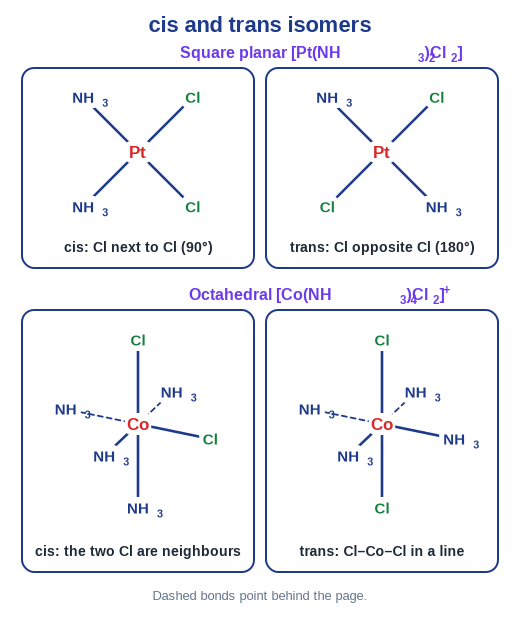
Example 5.5 (page 127): [Fe(NH₃)₂(CN)₄]⁻ ke geometrical isomers. Do: cis, jisme dono NH₃ paas-paas hain, aur trans, jisme dono NH₃ aamne-saamne hain. Ye [MX₂L₄] entity hai, [Co(NH₃)₄Cl₂]⁺ ki tarah:
Example 5.6 (page 127): cis- aur trans-[CrCl₂(ox)₂]³⁻ mein se kaun chiral hai? cis isomer. Uski mirror image us par superimpose nahi hoti. trans isomer mein plane of symmetry hai aur wo optically inactive hai.
Example 5.7 (page 131): [MnBr₄]²⁻ ki geometry, μ = 5.9 BM. Coordination number 4 ka matlab tetrahedral (sp³) ya square planar (dsp²). 5.9 BM ka moment n = 5 se milta hai (√35 = 5.92 BM). Mn²⁺ 3d⁵ hai; dsp² ke liye pairing karke ek 3d orbital khaali karna padta, jisse sirf teen unpaired electrons bachte. Paanch unpaired electrons ka matlab hai ki koi d orbital use nahi hua, isliye ion tetrahedral hai.
Wapas chapter notes par jao, ya padho: Werner ki theory aur IUPAC naming, isomerism aur crystal field theory.
Practice karo
-
[Co(NH₃)₅(CO₃)]Cl mein cobalt ka oxidation number hai:
Jawab dekho
Jawab: (c) +3
-
[Co(NH₃)₄(H₂O)₂]Cl₃ ka IUPAC naam hai:
Jawab dekho
Jawab: (a) tetraamminediaquacobalt(III) chloride
-
[CoF₆]³⁻ mein kitne unpaired electrons hain?
Jawab dekho
Jawab: (c) 4
-
[Co(en)₃]³⁺ optical isomerism dikhata hai lekin [Co(NH₃)₆]³⁺ nahi. Kyun?
Jawab dekho
Jawab: [Co(en)₃]³⁺ mein teen didentate ligands cobalt ke charon taraf do tareekon se lipat sakte hain jo ek doosre ki mirror image hain aur superimpose nahi hote. [Co(NH₃)₆]³⁺ mein chhe same unidentate ligands hain; uski mirror image wahi hai.
-
[Cr(NH₃)₆]³⁺ ka spin-only magnetic moment nikaalo.
Jawab dekho
Jawab: Cr³⁺ 3d³ hai, t₂g³, n = 3 unpaired electrons. μ = √n(n+2) = √15 = 3.87 BM.
Koi sawal atak gaya?
Photo lo, Lagnever AI step-by-step samjhayega. 7 din ka trial sirf ₹2.
Google Play se app lo Browser mein kholo
Parents ke liye: trial ke baad plan har mahine UPI ya card autopay se renew hota hai. App mein kabhi bhi cancel kar sakte hain.