
How are haloalkanes and haloarenes prepared?
Answer in short
Haloalkanes are made from alcohols with HX, PX₃, PCl₅ or SOCl₂, from alkanes by free radical halogenation, from alkenes by adding HX or X₂, and by halogen exchange (Finkelstein, Swarts). Haloarenes are made by electrophilic substitution of arenes with Cl₂ or Br₂ and a Lewis acid, or from amines by the Sandmeyer reaction.
Stuck on a question? Take a photo and Lagnever AI explains it step by step. Try it for 7 days for ₹2. Get it on Google Play
Where do we start from?
Alcohols are the usual starting point for haloalkanes, because they are easy to get. Hydrocarbons, other halides and, for haloarenes, aromatic amines are the other routes. Every method below is a laboratory or industrial method: it is done only by a teacher or a trained chemist, never at home.
How is the –OH of an alcohol replaced?
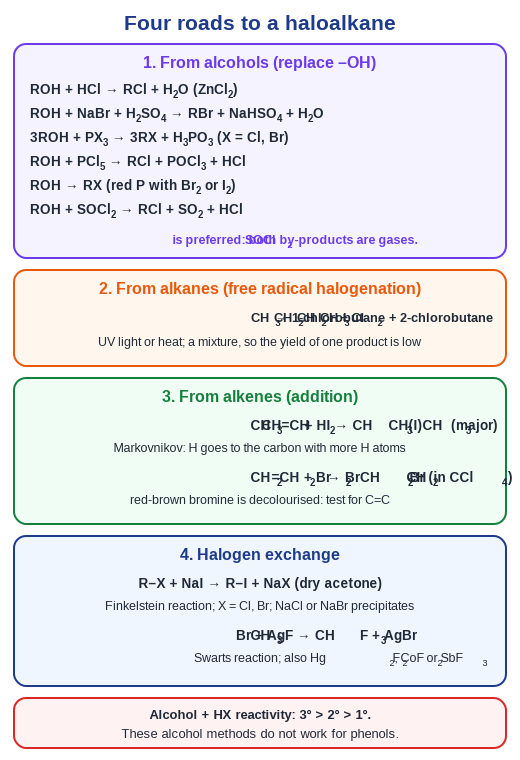
Three kinds of reagent swap –OH for a halogen: halogen acids, phosphorus halides and thionyl chloride.
- Halogen acids. ROH + HCl → RCl + H₂O. Primary and secondary alcohols need anhydrous ZnCl₂ as a catalyst; a tertiary alcohol reacts just on shaking with concentrated HCl at room temperature. Alkyl bromides are made by boiling with 48% HBr, or from NaBr and sulphuric acid: ROH + NaBr + H₂SO₄ → RBr + NaHSO₄ + H₂O. Alkyl iodides are made in good yield by heating the alcohol with NaI or KI in 95% orthophosphoric acid. With a given halogen acid the order of reactivity is 3° > 2° > 1°.
- Phosphorus halides. 3ROH + PCl₃ → 3RCl + H₃PO₃ and ROH + PCl₅ → RCl + POCl₃ + HCl. PBr₃ and PI₃ are usually made in the flask (in situ) from red phosphorus and bromine or iodine.
- Thionyl chloride. ROH + SOCl₂ → RCl + SO₂ + HCl. This is the preferred method: both by-products are gases and escape, so the alkyl chloride is pure.
None of these works for phenols. The C–O bond in phenol has some double bond character and is stronger than a single bond, so aryl halides are made in other ways.
What do hydrocarbons give?
Alkanes. Chlorine or bromine in UV light or on heating replaces hydrogen atoms by a free radical chain. Butane gives both 1-chlorobutane and 2-chlorobutane, plus polyhalogen products, and they are hard to separate. So the yield of any one compound is low and the method is rarely chosen for a pure product.
Alkenes. Hydrogen halides add across the double bond. With an unsymmetrical alkene the halogen goes to the carbon that has fewer hydrogen atoms (Markovnikov’s rule): CH₃CH=CH₂ + HI → CH₃CH(I)CH₃ is the major product, with CH₃CH₂CH₂I as the minor one. Halogens add too: CH₂=CH₂ + Br₂ → BrCH₂CH₂Br, a vic-dibromide. The reddish brown colour of bromine in CCl₄ disappears, which is a laboratory test for a C=C bond.
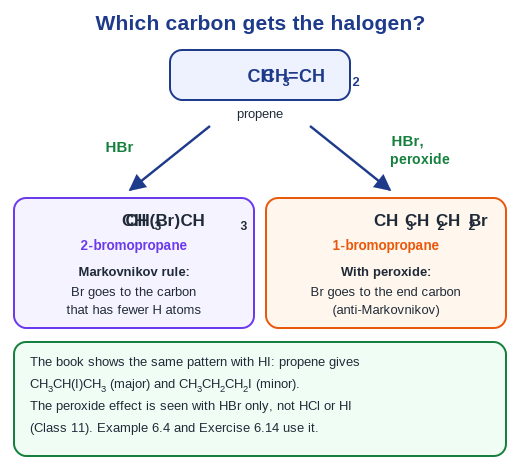
The peroxide effect, which puts bromine on the end carbon, works with HBr only (Extra: from Class 11, not stated in this unit); the chapter uses it in Example 6.4 and Exercise 6.14.
What is halogen exchange?
- Finkelstein reaction: RCl + NaI → RI + NaCl (or R–Br) in dry acetone. NaI dissolves in dry acetone but NaCl and NaBr do not; they precipitate, and by Le Chatelier’s principle the reaction keeps moving forward.
- Swarts reaction: an alkyl chloride or bromide heated with a metal fluoride such as AgF, Hg₂F₂, CoF₂ or SbF₃ gives the alkyl fluoride: CH₃Br + AgF → CH₃F + AgBr.
These two give iodides and fluorides, which are hard to make in other ways.
How are haloarenes made?
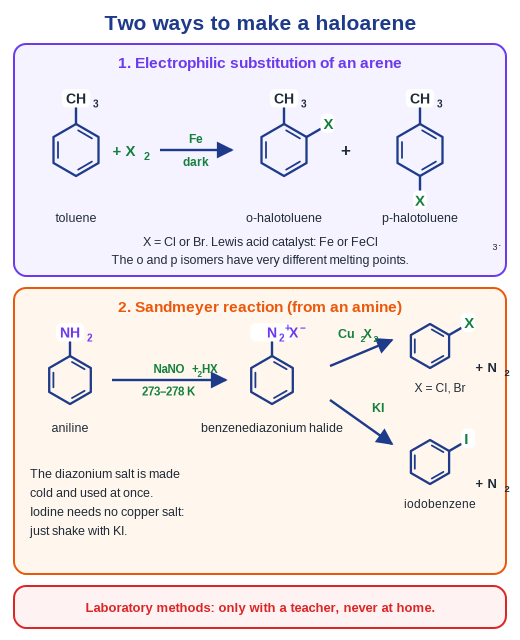
Electrophilic substitution. An arene reacts with chlorine or bromine in the presence of a Lewis acid such as iron or iron(III) chloride. Toluene gives o- and p-halotoluene, which are easy to separate because their melting points differ a lot. Iodination is reversible, so an oxidising agent (HNO₃ or HIO₄) is added to oxidise the HI formed. Fluorine is too reactive for this method.
Sandmeyer reaction. A primary aromatic amine is dissolved or suspended in cold dilute mineral acid, and sodium nitrite is added at 273–278 K; a diazonium salt forms: C₆H₅NH₂ + NaNO₂ + 2HCl → C₆H₅N₂⁺Cl⁻ + NaCl + 2H₂O. The fresh solution is mixed with cuprous chloride or cuprous bromide, and the –N₂⁺ group is replaced by –Cl or –Br with loss of nitrogen gas. For iodine no copper salt is needed: shaking with KI is enough.
How do you choose a method?
Ask what you have and what you need. An alcohol plus SOCl₂ is the cleanest route to a chloride. For an iodide or a fluoride, make the chloride or bromide first and exchange the halogen. If the halogen must go on a particular carbon of an alkene, use Markovnikov’s rule (or the peroxide effect for HBr). For an aryl halide with the halogen in an exact position, the Sandmeyer route from the amine is the most direct.
Next: SN1 and SN2 reactions. Practise with the NCERT solutions, or go back to the chapter notes.
Practice
-
Which reagent gives an alkyl chloride with SO₂ and HCl as the only by-products?
Show answer
Answer: (c) SOCl₂
-
The Finkelstein reaction is carried out in:
Show answer
Answer: (c) dry acetone
-
Free radical chlorination of butane gives:
Show answer
Answer: (c) a mixture of 1- and 2-chlorobutane
-
Write the equation for making bromoethane from ethanol with PBr₃.
Show answer
Answer: 3CH₃CH₂OH + PBr₃ → 3CH₃CH₂Br + H₃PO₃. PBr₃ is usually made in the flask from red phosphorus and bromine.
-
How is iodobenzene made from aniline?
Show answer
Answer: Aniline in cold dilute HCl is treated with NaNO₂ at 273–278 K to give benzenediazonium chloride. Shaking this solution with KI replaces the diazonium group by iodine: C₆H₅N₂⁺Cl⁻ + KI → C₆H₅I + KCl + N₂.
Questions students ask
Why is thionyl chloride preferred for making alkyl chlorides?
With SOCl₂ the other two products, SO₂ and HCl, are gases. They escape from the mixture, so the alkyl chloride is left nearly pure and no separation is needed.
Why is the Finkelstein reaction done in dry acetone?
NaI dissolves in dry acetone but NaCl and NaBr do not. As they precipitate they are removed from the equilibrium, so by Le Chatelier’s principle the reaction moves forward and the alkyl iodide forms.
Why are fluoroarenes not made by direct fluorination?
Fluorine is far too reactive for a controlled substitution on the ring. Iodination is the opposite case: it is reversible, so an oxidising agent such as HNO₃ or HIO₄ is added to remove the HI formed.
What is the Sandmeyer reaction?
A primary aromatic amine in cold mineral acid is converted by sodium nitrite into a diazonium salt. Mixing the fresh diazonium salt solution with cuprous chloride or cuprous bromide replaces the –N₂⁺ group by –Cl or –Br, and nitrogen gas is given off.
Stuck on a question?
Take a photo and Lagnever AI explains it step by step. Try it for 7 days for ₹2.
Get it on Google Play Open in browser
For parents: after the trial, the plan renews monthly by UPI or card autopay. You can cancel anytime in the app.