
What are SN1 and SN2 reactions?
Answer in short
Both are nucleophilic substitutions of alkyl halides. SN2 takes one step: the nucleophile attacks from the back as the halide leaves, the rate depends on both reactants, and configuration is inverted. SN1 takes two steps through a flat carbocation, the rate depends on the halide alone, and a chiral halide gives a racemic product.
Stuck on a question? Take a photo and Lagnever AI explains it step by step. Try it for 7 days for ₹2. Get it on Google Play
What is nucleophilic substitution?
The carbon of a C–X bond carries a partial positive charge. A nucleophile, an electron-rich species such as OH⁻, CN⁻ or NH₃, attacks that carbon and the halogen leaves as a halide ion, the leaving group: R–X + Nu⁻ → R–Nu + X⁻. The haloalkane is the substrate. Kinetic studies show two different mechanisms.
How does SN2 work?
For CH₃Cl + OH⁻ → CH₃OH + Cl⁻ the rate depends on both concentrations (second order): rate = k[CH₃Cl][OH⁻]. Hughes and Ingold proposed the mechanism in 1937.
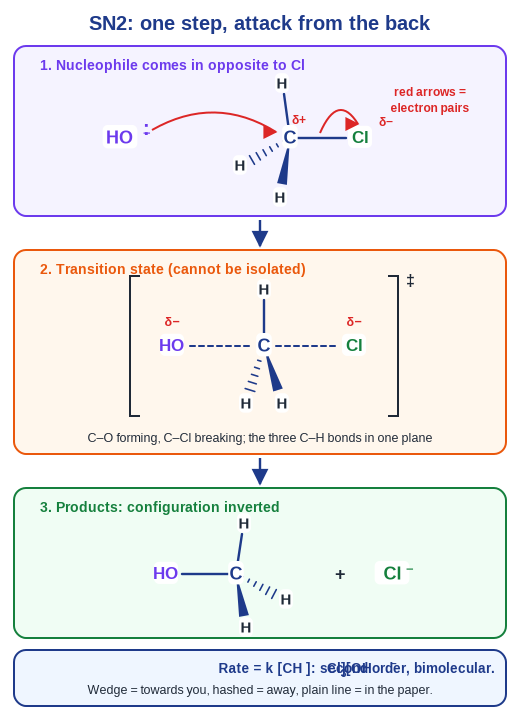
- The nucleophile approaches the carbon from the side opposite to the halogen.
- As the C–O bond forms, the C–Cl bond weakens. Both happen together, in one step, with no intermediate.
- In the transition state the carbon is partly bonded to five atoms, and the three C–H bonds lie in one plane. It cannot be isolated.
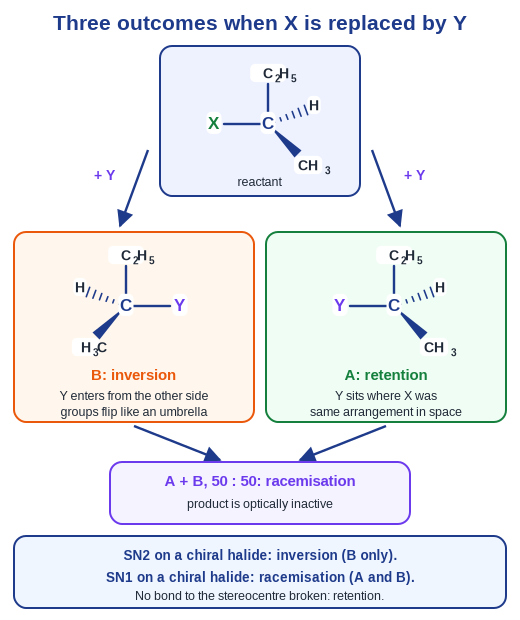
- The three groups keep moving the same way until Cl⁻ leaves. The carbon’s configuration is turned inside out like an umbrella in a strong wind: inversion of configuration.
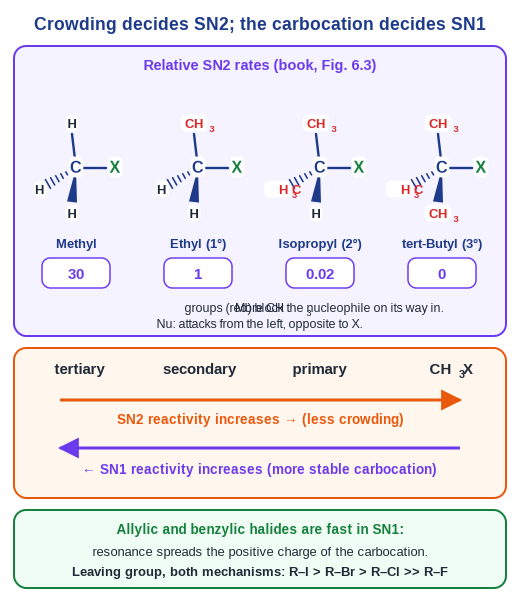
Because the nucleophile must reach the crowded back of the carbon, bulky groups slow SN2 sharply. The book’s relative rates are methyl 30, ethyl 1, isopropyl 0.02 and tert-butyl about 0.
How does SN1 work?
For (CH₃)₃CBr + OH⁻ → (CH₃)₃COH + Br⁻ the rate depends only on the halide (first order): rate = k[(CH₃)₃CBr]. SN1 reactions are usually run in polar protic solvents such as water, alcohols or acetic acid.
- Step I (slow, reversible): the polarised C–Br bond breaks to give the carbocation (CH₃)₃C⁺ and Br⁻. The energy comes from solvation of the halide ion by the protic solvent.
- Step II (fast): the nucleophile attacks the carbocation.
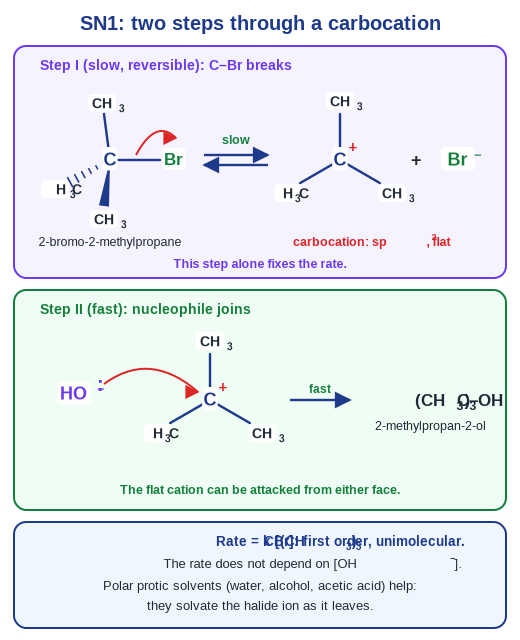
The slow step decides the rate, so the more stable the carbocation, the faster the reaction: 3° > 2° > 1°. Allylic and benzylic halides are also fast, because resonance spreads the positive charge of CH₂=CH–CH₂⁺ and C₆H₅CH₂⁺. For a given alkyl group, both mechanisms follow R–I > R–Br > R–Cl >> R–F.
Which ideas of stereochemistry do we need?
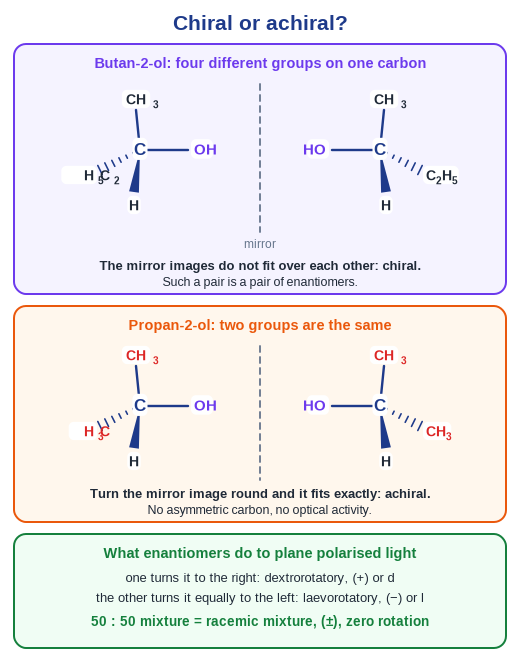
- Optical activity. Plane polarised light (made with a Nicol prism) is rotated by some compounds. The angle is measured with a polarimeter. Rotation to the right is dextrorotatory, (+) or d; to the left, laevorotatory, (−) or l.
- Chirality. An object that cannot be superimposed on its mirror image, like a hand, is chiral. A carbon with four different groups (an asymmetric carbon or stereocentre) usually makes a molecule chiral. Butan-2-ol and 2-chlorobutane are chiral; propan-2-ol is achiral.
- Enantiomers are non-superimposable mirror images. They have the same melting point, boiling point and refractive index, and rotate plane polarised light by equal amounts in opposite directions. The sign of rotation does not tell you the actual (absolute) configuration.
- A 50:50 mixture of enantiomers is a racemic mixture, written (±) or dl, with zero rotation. Turning one enantiomer into such a mixture is racemisation.
Retention, inversion or racemisation?
If no bond to the stereocentre breaks, the product keeps the same arrangement: retention. Heating (−)-2-methylbutan-1-ol with concentrated HCl gives (+)-1-chloro-2-methylbutane: same configuration, yet the sign of rotation changes, because two different compounds with the same configuration can rotate light differently.
When a bond to the stereocentre does break, three outcomes are possible: the new group in the old place (retention), the new group on the opposite side (inversion), or a 50:50 mixture of the two (racemisation).
So what happens to a chiral halide?
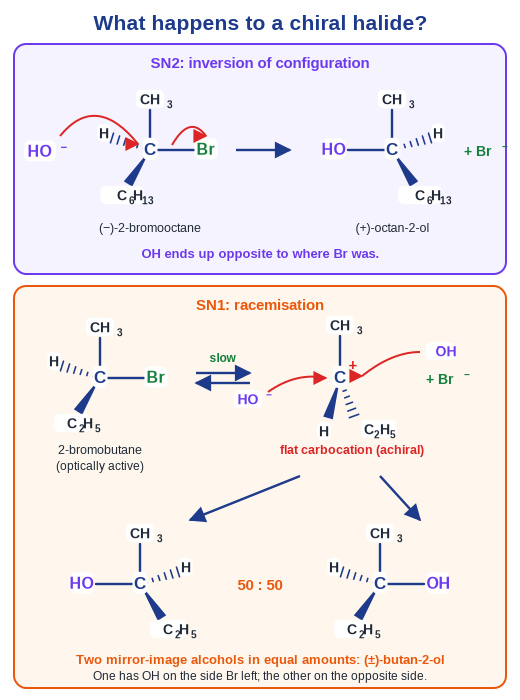
- SN2 gives inversion. The nucleophile enters opposite to the halogen. (−)-2-Bromooctane with NaOH gives (+)-octan-2-ol, with –OH on the side opposite to where Br was.
- SN1 gives racemisation. The carbocation is sp² hybridised and flat, so it is achiral. The nucleophile attacks either face, and optically active 2-bromobutane gives (±)-butan-2-ol.
A primary halide prefers SN2; a tertiary halide reacts by SN1 or elimination; a secondary halide can go either way depending on the nucleophile and the conditions.
Before: preparation of haloalkanes and haloarenes. Next: reactions of haloarenes. Practise with the NCERT solutions, or go back to the chapter notes.
Practice
-
The rate of an SN1 reaction of (CH₃)₃CBr with OH⁻ depends on:
Show answer
Answer: (b) [(CH₃)₃CBr] only
-
Which is chiral?
Show answer
Answer: (c) 2-chlorobutane
-
(−)-2-Bromooctane with NaOH by SN2 gives:
Show answer
Answer: (b) (+)-octan-2-ol with inversion
-
Arrange CH₃Br, (CH₃)₂CHBr, CH₃CH₂Br and (CH₃)₃CBr in order of increasing SN2 reactivity.
Show answer
Answer: (CH₃)₃CBr < (CH₃)₂CHBr < CH₃CH₂Br < CH₃Br. Each extra alkyl group on the carbon bearing Br crowds the back side that the nucleophile must reach.
-
Why does an SN1 reaction of an optically active halide give a racemic product?
Show answer
Answer: The slow step gives an sp² carbocation, which is flat. The nucleophile can attack either face equally, so the two mirror-image products form in equal amounts and their rotations cancel.
Questions students ask
What does SN2 stand for?
Substitution, nucleophilic, bimolecular. Two species, the halide and the nucleophile, take part in the single rate-determining step, so the rate depends on both concentrations.
Why are 3° halides slow in SN2 but fast in SN1?
In SN2 the nucleophile must reach the carbon from the back, and three bulky groups block the way. In SN1 the slow step is ionisation, and a 3° carbocation is the most stable, so it forms fastest.
Which solvents favour SN1?
Polar protic solvents such as water, alcohols and acetic acid. The book explains that the energy to break the C–X bond comes from the solvation of the halide ion by the protons of the solvent.
What is the difference between retention and inversion?
Retention: the new group takes the place of the old one and the arrangement of the other three groups stays the same. Inversion: the new group enters from the opposite side and the other three groups flip over, like an umbrella turned inside out by wind.
Stuck on a question?
Take a photo and Lagnever AI explains it step by step. Try it for 7 days for ₹2.
Get it on Google Play Open in browser
For parents: after the trial, the plan renews monthly by UPI or card autopay. You can cancel anytime in the app.