
How do haloarenes react?
Answer in short
Haloarenes resist nucleophilic substitution because their C–X bond has partial double bond character, the carbon is sp² hybridised and the phenyl cation is unstable. Nitro groups at ortho and para positions make substitution easier. Haloarenes undergo electrophilic substitution at ortho and para positions, and with sodium they give the Wurtz–Fittig and Fittig reactions.
Stuck on a question? Take a photo and Lagnever AI explains it step by step. Try it for 7 days for ₹2. Get it on Google Play
Why do haloarenes resist nucleophiles?
A haloalkane swaps its halogen for OH⁻ on warming with aqueous alkali. Chlorobenzene does not. The book gives four reasons.
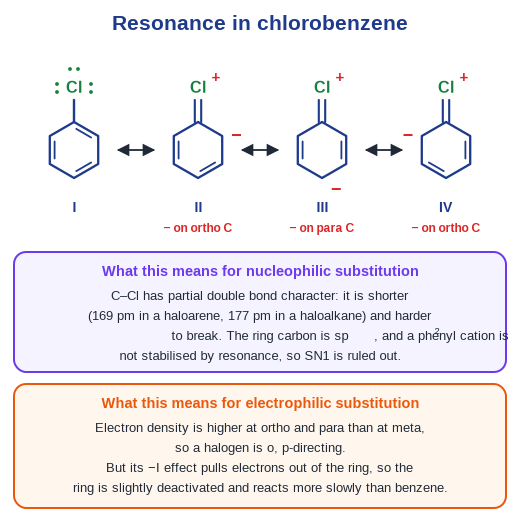
- Resonance. The lone pairs on chlorine are in conjugation with the π electrons of the ring. In three of the resonance structures chlorine is double bonded to the ring, so the C–Cl bond has partial double bond character and is harder to break.
- Hybridisation. The carbon bonded to the halogen is sp² in a haloarene but sp³ in a haloalkane. An sp² carbon has more s character, is more electronegative and holds the bond pair more tightly. The C–Cl bond is 169 pm in a haloarene against 177 pm in a haloalkane, and a shorter bond is harder to break.
- Unstable phenyl cation. If chlorobenzene ionised, the phenyl cation would not be stabilised by resonance, so the SN1 path is ruled out.
- Repulsion. An electron-rich nucleophile is less likely to approach an electron-rich ring.
How can Cl be replaced by OH after all?
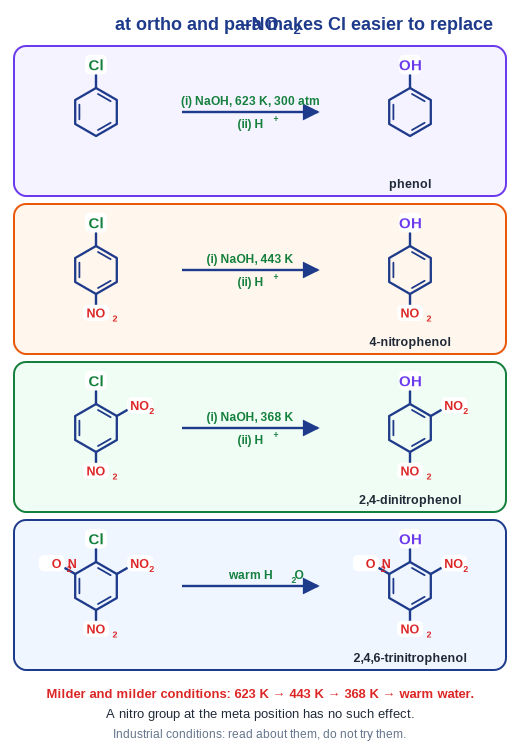
Under harsh conditions it works: chlorobenzene heated with aqueous NaOH at 623 K and 300 atmospheres, followed by acid, gives phenol. These are industrial conditions, described here only to compare.
Electron-withdrawing –NO₂ groups at the ortho and para positions make the change much easier, and each extra one lowers the temperature needed.
Why only ortho and para?
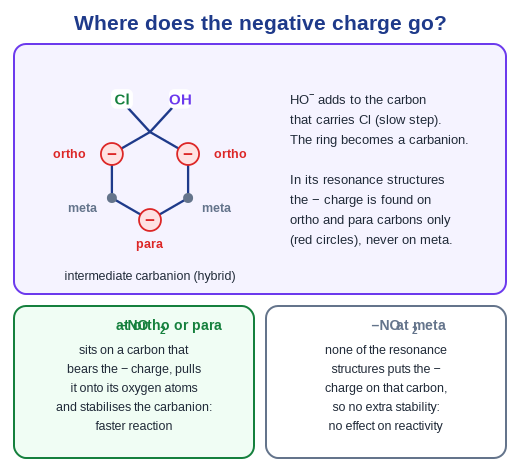
In the slow step OH⁻ adds to the ring carbon that carries Cl. That carbon becomes sp³ and the ring carries a negative charge: a carbanion. In its resonance structures the negative charge sits on the two carbons ortho to the Cl and on the carbon para to it. A nitro group on one of those carbons can pull the charge onto its own oxygen atoms and stabilise the carbanion. In the fast step Cl⁻ leaves and the ring is restored. When –NO₂ is meta, none of the resonance structures places the charge on the carbon bearing it, so it gives no such help and has no effect on the rate.
What electrophilic substitutions do haloarenes give?
Haloarenes take part in the same electrophilic substitutions as benzene. Two effects work against each other:
- The −I effect of the halogen withdraws electrons and deactivates the ring, so the reactions are slower than with benzene and need harsher conditions. This effect controls the rate.
- Resonance raises the electron density more at the ortho and para positions and stabilises the carbocation formed by attack there. This effect controls the position.
So a halogen is a deactivating but o, p-directing group, and the para product is the major one.
| Reaction | Reagent | Major product | Minor product |
|---|---|---|---|
| Halogenation | Cl₂, anhydrous FeCl₃ | 1,4-dichlorobenzene | 1,2-dichlorobenzene |
| Nitration | HNO₃, conc. H₂SO₄ | 1-chloro-4-nitrobenzene | 1-chloro-2-nitrobenzene |
| Sulphonation | conc. H₂SO₄, heat | 4-chlorobenzenesulfonic acid | 2-chlorobenzenesulfonic acid |
| Friedel–Crafts alkylation | CH₃Cl, anhydrous AlCl₃ | 1-chloro-4-methylbenzene | 1-chloro-2-methylbenzene |
| Friedel–Crafts acylation | CH₃COCl, anhydrous AlCl₃ | 4-chloroacetophenone | 2-chloroacetophenone |
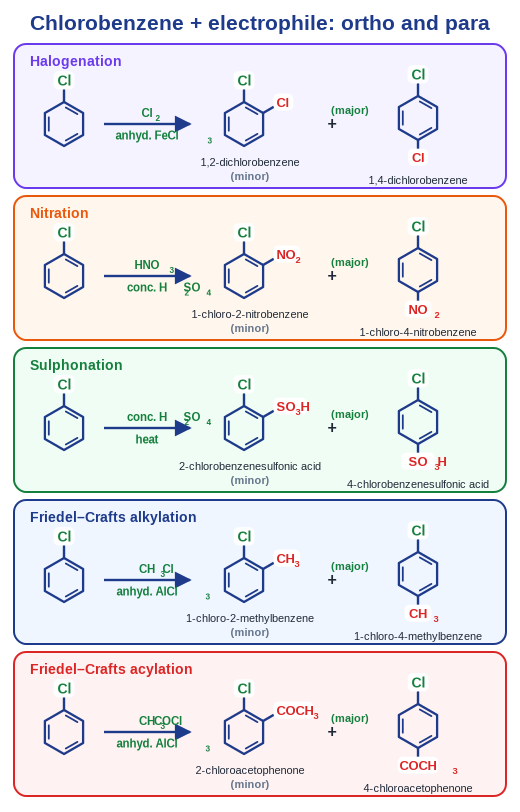
For nitration, for example: C₆H₅Cl + HNO₃ → ClC₆H₄NO₂ + H₂O, where the 4-isomer is the main product.
What do haloarenes do with sodium?
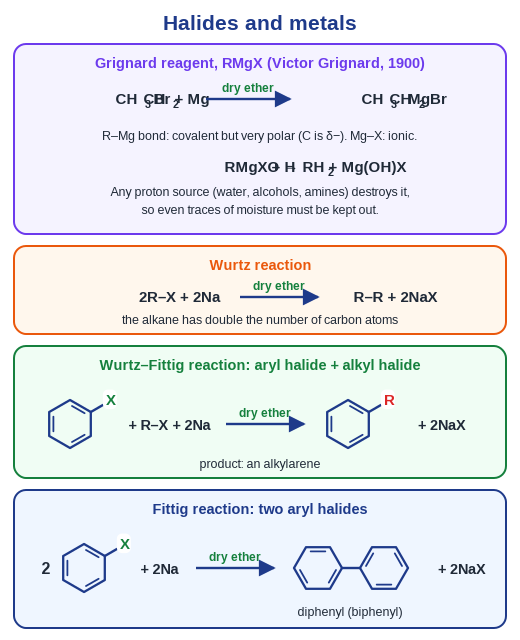
- Wurtz–Fittig reaction. An aryl halide and an alkyl halide with sodium in dry ether give an alkylarene: C₆H₅Cl + CH₃Cl + 2Na → C₆H₅CH₃ + 2NaCl.
- Fittig reaction. Two aryl halide molecules with sodium in dry ether join through their rings: 2C₆H₅Cl + 2Na → C₆H₅–C₆H₅ + 2NaCl, diphenyl.
The book draws the Wurtz–Fittig equation with one Na and one NaX. Balanced, it needs two of each, as written here.
Before: SN1 and SN2 reactions. Practise with the NCERT solutions, or go back to the chapter notes.
Practice
-
Nitration of chlorobenzene gives mainly:
Show answer
Answer: (b) 1-chloro-4-nitrobenzene
-
Which compound is converted to the phenol under the mildest conditions?
Show answer
Answer: (d) 1-chloro-2,4,6-trinitrobenzene
-
The C–Cl bond length in chlorobenzene, as given in the book, is:
Show answer
Answer: (b) 169 pm
-
Why is chlorine o, p-directing although it withdraws electrons?
Show answer
Answer: Its −I effect pulls electrons from the ring and deactivates it. Through resonance its lone pairs push electron density onto the ortho and para carbons and stabilise the carbocation formed by attack there. So the inductive effect controls the rate and resonance controls the position.
-
Write the Fittig reaction of bromobenzene.
Show answer
Answer: 2C₆H₅Br + 2Na → C₆H₅–C₆H₅ + 2NaBr, in dry ether. Two phenyl groups join to give diphenyl (biphenyl).
Questions students ask
Why are haloarenes less reactive than haloalkanes towards nucleophiles?
Resonance gives the C–X bond partial double bond character; the sp² carbon holds the bond pair more tightly, so the bond is shorter and stronger; the phenyl cation is not stabilised, so SN1 cannot happen; and the electron-rich ring repels the incoming nucleophile.
How does a nitro group make chlorobenzene more reactive?
It withdraws electron density from the ring, which helps the nucleophile attack. The negative charge of the carbanion formed in the slow step can then spread onto the nitro group when it is at the ortho or para position, which stabilises the carbanion.
Why are electrophilic substitutions of haloarenes slower than those of benzene?
The halogen’s −I effect withdraws electrons from the ring, so it is somewhat deactivated. The reactions therefore go more slowly and need harsher conditions than with benzene.
Stuck on a question?
Take a photo and Lagnever AI explains it step by step. Try it for 7 days for ₹2.
Get it on Google Play Open in browser
For parents: after the trial, the plan renews monthly by UPI or card autopay. You can cancel anytime in the app.