
NCERT Solutions Class 12 Chemistry Chapter 6: Haloalkanes and Haloarenes
Answers to all 22 end-of-unit exercises, all 9 Intext Questions and all 9 worked examples of Unit 6, Haloalkanes and Haloarenes, of Chemistry Part II, the Class 12 NCERT textbook. Page numbers follow the 2026-27 reprint (pages 159–192). The exercises come first, quoted from the book; the Intext Questions and the examples follow, restated in short. Short notes: Chapter 6 notes.
How the answers were checked. Every equation was checked atom by atom and charge by charge with a script. Every IUPAC name was checked twice against its structure: the longest chain, the lowest locants, alphabetical order, and the molecular formula worked out from both the name and the structure. The Answers section at the back of Part II starts at Unit 7 and gives nothing for Unit 6; the chapter itself prints answers to some Intext Questions on pages 191–192, and our answers agree with them.
How structures are written. Condensed formulas: a group in brackets hangs from the carbon written just before it, so CH₃CH(Br)CH₃ is 2-bromopropane. C₆H₅– is phenyl, and o-, m-, p- mark 1,2-, 1,3- and 1,4- positions on a ring.
Stay safe. Several reactions here use sodium, strong alkalis, cyanides or heat. They are described for the exam only; any practical work is done in the school laboratory with your teacher, never at home.
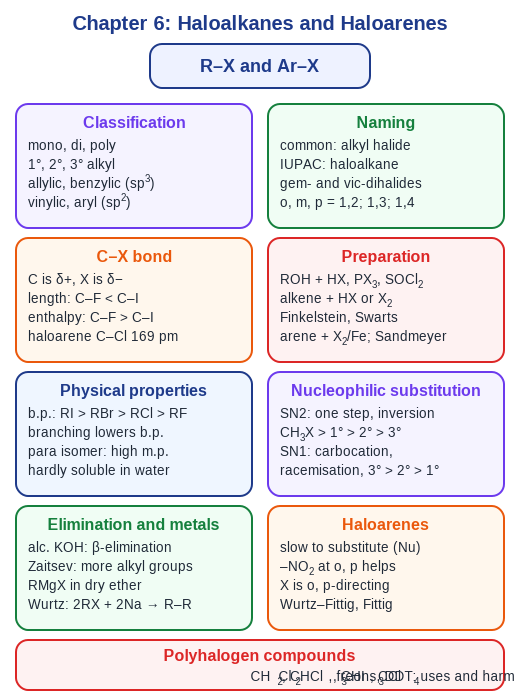
Exercises 6.1 to 6.6: names, structures and isomers
6.1 “Name the following halides according to IUPAC system and classify them as alkyl, allyl, benzyl (primary, secondary, tertiary), vinyl or aryl halides: (i) (CH₃)₂CHCH(Cl)CH₃ (ii) CH₃CH₂CH(CH₃)CH(C₂H₅)Cl (iii) CH₃CH₂C(CH₃)₂CH₂I (iv) (CH₃)₃CCH₂CH(Br)C₆H₅ (v) CH₃CH(CH₃)CH(Br)CH₃ (vi) CH₃C(C₂H₅)₂CH₂Br (vii) CH₃C(Cl)(C₂H₅)CH₂CH₃ (viii) CH₃CH=C(Cl)CH₂CH(CH₃)₂ (ix) CH₃CH=CHC(Br)(CH₃)₂ (x) p-ClC₆H₄CH₂CH(CH₃)₂ (xi) m-ClCH₂C₆H₄CH₂C(CH₃)₃ (xii) o-Br-C₆H₄CH(CH₃)CH₂CH₃”
| Main chain written out | IUPAC name | Class | |
|---|---|---|---|
| (i) | CH₃–CH(Cl)–CH(CH₃)–CH₃ | 2-chloro-3-methylbutane | alkyl, 2° |
| (ii) | CH₃CH₂–CH(CH₃)–CH(Cl)–CH₂CH₃ | 3-chloro-4-methylhexane | alkyl, 2° |
| (iii) | ICH₂–C(CH₃)₂–CH₂–CH₃ | 1-iodo-2,2-dimethylbutane | alkyl, 1° |
| (iv) | C₆H₅–CH(Br)–CH₂–C(CH₃)₃ | 1-bromo-3,3-dimethyl-1-phenylbutane | benzylic, 2° |
| (v) | CH₃–CH(Br)–CH(CH₃)–CH₃ | 2-bromo-3-methylbutane | alkyl, 2° |
| (vi) | BrCH₂–C(CH₃)(C₂H₅)–CH₂CH₃ | 1-bromo-2-ethyl-2-methylbutane | alkyl, 1° |
| (vii) | CH₃CH₂–C(Cl)(CH₃)–CH₂CH₃ | 3-chloro-3-methylpentane | alkyl, 3° |
| (viii) | CH₃–CH=C(Cl)–CH₂–CH(CH₃)–CH₃ | 3-chloro-5-methylhex-2-ene | vinylic |
| (ix) | CH₃–CH=CH–C(Br)(CH₃)–CH₃ | 4-bromo-4-methylpent-2-ene | allylic, 3° |
| (x) | Cl and CH₂CH(CH₃)₂ at 1,4 on benzene | 1-chloro-4-(2-methylpropyl)benzene | aryl |
| (xi) | ClCH₂– and (CH₃)₃CCH₂– at 1,3 on benzene | 1-(chloromethyl)-3-(2,2-dimethylpropyl)benzene | benzylic, 1° |
| (xii) | Br and CH(CH₃)CH₂CH₃ at 1,2 on benzene | 1-bromo-2-(1-methylpropyl)benzene | aryl |
Notes on the harder ones:
- (ii) The longest chain has six carbons. From either end the substituents get locants 3 and 4, so the tie is broken by alphabetical order: chloro before methyl gets 3.
- (iv) The halogen is on a carbon joined to the ring, so it is benzylic; that carbon also carries one other carbon of the chain, so it is secondary.
- (vi) The two ethyl groups and the methyl sit on one carbon. A chain through CH₂Br and one ethyl group has four carbons; the other ethyl and the methyl are branches at C-2.
- (viii) Number from the left so that the double bond gets the lowest locant (2, not 4). Cl is on a carbon of C=C: vinylic.
- (ix) Number from the left: the double bond gets 2. Br is on the carbon next to C=C (allylic), and that carbon has three carbon neighbours, so it is tertiary.
- (xii) The side chain –CH(CH₃)CH₂CH₃ is 1-methylpropyl, also called butan-2-yl or sec-butyl.
6.2 “Give the IUPAC names of the following compounds: (i) CH₃CH(Cl)CH(Br)CH₃ (ii) CHF₂CBrClF (iii) ClCH₂C≡CCH₂Br (iv) (CCl₃)₃CCl (v) CH₃C(p-ClC₆H₄)₂CH(Br)CH₃ (vi) (CH₃)₃CCH=CClC₆H₄I-p”
| IUPAC name | Reason | |
|---|---|---|
| (i) | 2-bromo-3-chlorobutane | locants 2,3 either way; bromo comes first alphabetically |
| (ii) | 1-bromo-1-chloro-1,2,2-trifluoroethane | locant set 1,1,1,2,2 is lower than 1,1,2,2,2 |
| (iii) | 1-bromo-4-chlorobut-2-yne | triple bond at 2 either way; bromo first alphabetically |
| (iv) | 1,1,1,2,3,3,3-heptachloro-2-(trichloromethyl)propane | three-carbon chain with a CCl₃ branch on C-2; ten Cl in all |
| (v) | 3-bromo-2,2-bis(4-chlorophenyl)butane | locants 2,2,3 beat 2,3,3 |
| (vi) | 1-chloro-1-(4-iodophenyl)-3,3-dimethylbut-1-ene | chain of four carbons with the double bond at C-1 |
For (vi) the newer IUPAC rules prefer the ring as the parent: 1-(1-chloro-3,3-dimethylbut-1-en-1-yl)-4-iodobenzene. Both describe the same molecule; the chain-based name is the one usually expected at this level.
6.3 “Write the structures of the following organic halogen compounds. (i) 2-Chloro-3-methylpentane (ii) p-Bromochlorobenzene (iii) 1-Chloro-4-ethylcyclohexane (iv) 2-(2-Chlorophenyl)-1-iodooctane (v) 2-Bromobutane (vi) 4-tert-Butyl-3-iodoheptane (vii) 1-Bromo-4-sec-butyl-2-methylbenzene (viii) 1,4-Dibromobut-2-ene”
| Structure | |
|---|---|
| (i) | CH₃CH(Cl)CH(CH₃)CH₂CH₃ |
| (ii) | benzene ring with Br at C-1 and Cl at C-4: Br–C₆H₄–Cl (para) |
| (iii) | cyclohexane ring with Cl at C-1 and –CH₂CH₃ at C-4 |
| (iv) | ICH₂–CH(C₆H₄Cl)–(CH₂)₅CH₃, with the Cl of the ring ortho to the chain |
| (v) | CH₃CH(Br)CH₂CH₃ |
| (vi) | CH₃CH₂CH(I)CH(C(CH₃)₃)CH₂CH₂CH₃ |
| (vii) | benzene ring with Br at C-1, CH₃ at C-2 and –CH(CH₃)CH₂CH₃ at C-4 |
| (viii) | BrCH₂CH=CHCH₂Br |
6.4 “Which one of the following has the highest dipole moment? (i) CH₂Cl₂ (ii) CHCl₃ (iii) CCl₄”
CH₂Cl₂. CCl₄ is a symmetrical tetrahedron: its four C–Cl bond moments cancel, so μ = 0. In a tetrahedron the three C–Cl moments of CHCl₃ add up to one C–Cl moment along the C–H axis, while the two C–Cl moments of CH₂Cl₂ at about 109.5° add up to 2 cos 54.75° ≈ 1.15 C–Cl moments. So CH₂Cl₂ > CHCl₃ > CCl₄. (Extra: the measured values are about 1.6 D, 1.0 D and 0 D.)
6.5 “A hydrocarbon C₅H₁₀ does not react with chlorine in dark but gives a single monochloro compound C₅H₉Cl in bright sunlight. Identify the hydrocarbon.”
C₅H₁₀ has one degree of unsaturation. It does not add chlorine in the dark, so it has no C=C: it is a ring. A single monochloro product means all ten hydrogens are equivalent. The hydrocarbon is cyclopentane: C₅H₁₀ + Cl₂ → C₅H₉Cl + HCl (light), giving chlorocyclopentane.
6.6 “Write the isomers of the compound having formula C₄H₉Br.”
| Structure | Name | Class |
|---|---|---|
| CH₃CH₂CH₂CH₂Br | 1-bromobutane | 1° |
| CH₃CH₂CH(Br)CH₃ | 2-bromobutane | 2° |
| (CH₃)₂CHCH₂Br | 1-bromo-2-methylpropane | 1° |
| (CH₃)₃CBr | 2-bromo-2-methylpropane | 3° |
These are the four structural isomers. 2-Bromobutane has an asymmetric carbon, so it also exists as two enantiomers; counting them, there are five isomers in all.
Exercises 6.7 to 6.13: reactions and reasons
6.7 “Write the equations for the preparation of 1-iodobutane from (i) 1-butanol (ii) 1-chlorobutane (iii) but-1-ene.”
(i) Heat the alcohol with KI in 95% orthophosphoric acid (or with red phosphorus and iodine):
CH₃CH₂CH₂CH₂OH + KI + H₃PO₄ → CH₃CH₂CH₂CH₂I + KH₂PO₄ + H₂O
(ii) Finkelstein reaction, in dry acetone:
CH₃CH₂CH₂CH₂Cl + NaI → CH₃CH₂CH₂CH₂I + NaCl
(iii) Adding HI directly would give 2-iodobutane (Markovnikov). So add HBr in the presence of peroxide, which puts Br on the end carbon, then exchange the halogen:
CH₃CH₂CH=CH₂ + HBr → CH₃CH₂CH₂CH₂Br (peroxide)
CH₃CH₂CH₂CH₂Br + NaI → CH₃CH₂CH₂CH₂I + NaBr (dry acetone)
6.8 “What are ambident nucleophiles? Explain with an example.”
A nucleophile with two different atoms that can each donate an electron pair is ambident. The cyanide ion is a hybrid of ⁻C≡N and C=N⁻, so it can bond through C or through N. With KCN, which is ionic, a haloalkane gives mainly the nitrile: CH₃CH₂Br + KCN → CH₃CH₂CN + KBr. With AgCN, which is mainly covalent, nitrogen donates its pair and the isocyanide forms: CH₃CH₂Br + AgCN → CH₃CH₂NC + AgBr. The nitrite ion is ambident too: KNO₂ gives the alkyl nitrite R–O–N=O, AgNO₂ the nitroalkane R–NO₂.
6.9 “Which compound in each of the following pairs will react faster in SN2 reaction with ⁻OH? (i) CH₃Br or CH₃I (ii) (CH₃)₃CCl or CH₃Cl”
(i) CH₃I. The alkyl group is the same; iodide is the better leaving group, since the C–I bond is longer and weaker (214 pm, 234 kJ mol⁻¹, against 193 pm, 293 kJ mol⁻¹ for C–Br).
(ii) CH₃Cl. SN2 needs the nucleophile to reach the back of the carbon. Three methyl groups block it in (CH₃)₃CCl; methyl chloride has only three small hydrogens.
6.10 “Predict all the alkenes that would be formed by dehydrohalogenation of the following halides with sodium ethoxide in ethanol and identify the major alkene: (i) 1-Bromo-1-methylcyclohexane (ii) 2-Chloro-2-methylbutane (iii) 2,2,3-Trimethyl-3-bromopentane.”
| Halide | β-H taken from | Alkene | |
|---|---|---|---|
| (i) 1-bromo-1-methylcyclohexane | a ring CH₂ (C-2 or C-6, equivalent) | 1-methylcyclohexene (C=C in the ring, three alkyl groups on it) | major |
| the CH₃ group | methylenecyclohexane (exocyclic C=CH₂) | minor | |
| (ii) 2-chloro-2-methylbutane, (CH₃)₂C(Cl)CH₂CH₃ | the CH₂ | 2-methylbut-2-ene, (CH₃)₂C=CHCH₃ | major |
| a CH₃ on C-2 | 2-methylbut-1-ene, CH₂=C(CH₃)CH₂CH₃ | minor | |
| (iii) 2,2,3-trimethyl-3-bromopentane, (CH₃)₃C–C(Br)(CH₃)–CH₂CH₃ | the CH₂ (C-4) | 3,4,4-trimethylpent-2-ene, (CH₃)₃C–C(CH₃)=CH–CH₃ | major |
| the CH₃ on C-3 | 2-ethyl-3,3-dimethylbut-1-ene, CH₂=C(CH₂CH₃)–C(CH₃)₃ | minor |
In (iii) C-2 carries no hydrogen, so only two alkenes are possible. By the alphabetical rule this halide’s IUPAC name is 3-bromo-2,2,3-trimethylpentane; the book lists the prefixes in a different order. In each case the major alkene has more alkyl groups on its double bond (Zaitsev rule). Extra: 3,4,4-trimethylpent-2-ene can exist as cis and trans forms.
6.11 “How will you bring about the following conversions? (i) Ethanol to but-1-yne (ii) Ethane to bromoethene (iii) Propene to 1-nitropropane (iv) Toluene to benzyl alcohol (v) Propene to propyne (vi) Ethanol to ethyl fluoride (vii) Bromomethane to propanone (viii) But-1-ene to but-2-ene (ix) 1-Chlorobutane to n-octane (x) Benzene to biphenyl.”
Extra: several steps in Exercises 6.11 and 6.19 use reactions from Class 11 and from Units 7–9, not from this unit: ethene from ethanol, NaNH₂ with dihalides and alkynes, the Williamson synthesis, nitrile hydrolysis, and the iodoform and carbylamine reactions.
(i) Ethanol → but-1-yne. Make ethyne and bromoethane from ethanol, then join them.
- CH₃CH₂OH → CH₂=CH₂ + H₂O (conc. H₂SO₄, 443 K); CH₂=CH₂ + Br₂ → BrCH₂CH₂Br
- BrCH₂CH₂Br + 2NaNH₂ → HC≡CH + 2NaBr + 2NH₃; HC≡CH + NaNH₂ → HC≡CNa + NH₃
- 3CH₃CH₂OH + PBr₃ → 3CH₃CH₂Br + H₃PO₃
- HC≡CNa + CH₃CH₂Br → HC≡CCH₂CH₃ + NaBr
(ii) Ethane → bromoethene.
- CH₃CH₃ + Br₂ → CH₃CH₂Br + HBr (light); CH₃CH₂Br + KOH → CH₂=CH₂ + KBr + H₂O (alcoholic KOH)
- CH₂=CH₂ + Br₂ → BrCH₂CH₂Br; BrCH₂CH₂Br + KOH → CH₂=CHBr + KBr + H₂O (alcoholic KOH, one equivalent)
(iii) Propene → 1-nitropropane. CH₃CH=CH₂ + HBr → CH₃CH₂CH₂Br (peroxide); CH₃CH₂CH₂Br + AgNO₂ → CH₃CH₂CH₂NO₂ + AgBr.
(iv) Toluene → benzyl alcohol. C₆H₅CH₃ + Cl₂ → C₆H₅CH₂Cl + HCl (light or heat, side chain); C₆H₅CH₂Cl + NaOH → C₆H₅CH₂OH + NaCl (aqueous).
(v) Propene → propyne. CH₃CH=CH₂ + Br₂ → CH₃CH(Br)CH₂Br; CH₃CH(Br)CH₂Br + 2NaNH₂ → CH₃C≡CH + 2NaBr + 2NH₃.
(vi) Ethanol → ethyl fluoride. CH₃CH₂OH + SOCl₂ → CH₃CH₂Cl + SO₂ + HCl; then Swarts: CH₃CH₂Cl + AgF → CH₃CH₂F + AgCl.
(vii) Bromomethane → propanone. Make a nitrile and a Grignard reagent and combine them (the nitrile–Grignard reaction is studied in Unit 8):
- CH₃Br + KCN → CH₃CN + KBr; CH₃Br + Mg → CH₃MgBr (dry ether)
- CH₃MgBr + CH₃CN → (CH₃)₂C=NMgBr; (CH₃)₂C=NMgBr + 2H₂O → (CH₃)₂C=O + NH₃ + Mg(OH)Br
(viii) But-1-ene → but-2-ene. CH₃CH₂CH=CH₂ + HBr → CH₃CH₂CH(Br)CH₃ (Markovnikov); CH₃CH₂CH(Br)CH₃ + KOH → CH₃CH=CHCH₃ + KBr + H₂O (alcoholic KOH; Zaitsev product).
(ix) 1-Chlorobutane → n-octane. Wurtz reaction: 2CH₃CH₂CH₂CH₂Cl + 2Na → CH₃(CH₂)₆CH₃ + 2NaCl (dry ether).
(x) Benzene → biphenyl. C₆H₆ + Br₂ → C₆H₅Br + HBr (Fe or FeBr₃); Fittig: 2C₆H₅Br + 2Na → C₆H₅–C₆H₅ + 2NaBr (dry ether).
6.12 “Explain why (i) the dipole moment of chlorobenzene is lower than that of cyclohexyl chloride? (ii) alkyl halides, though polar, are immiscible with water? (iii) Grignard reagents should be prepared under anhydrous conditions?”
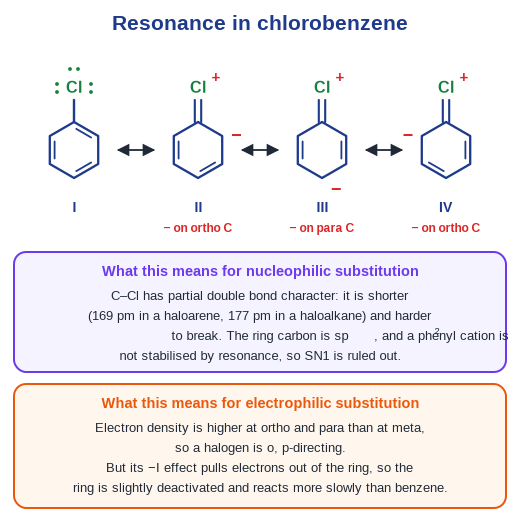
(i) In chlorobenzene the C–Cl carbon is sp² hybridised. It is more electronegative than the sp³ carbon of cyclohexyl chloride, so the bond is less polar. Also, resonance pushes the lone-pair electrons of Cl towards the ring, which works against the C–Cl bond moment. Both effects lower the dipole moment.
(ii) To dissolve a haloalkane, water must break its strong hydrogen bonds. The new attractions between haloalkane and water are weaker than those hydrogen bonds, so not enough energy is released, and the two do not mix.
(iii) A Grignard reagent reacts with any source of protons, even water: RMgX + H₂O → RH + Mg(OH)X. Traces of moisture would destroy it, so it is made in dry ether.
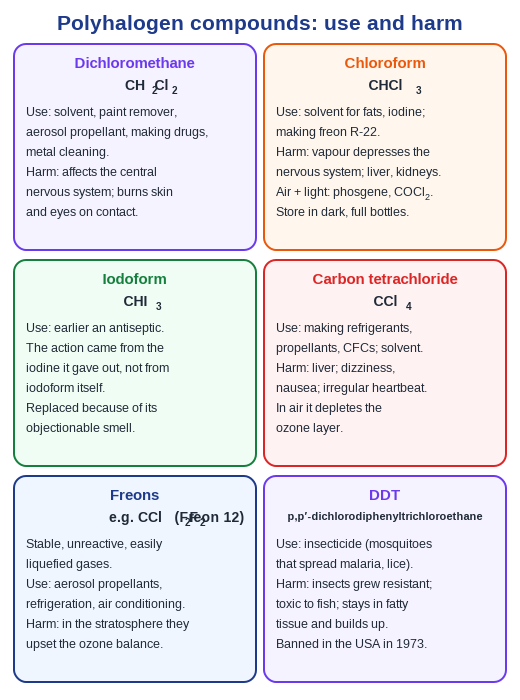
6.13 “Give the uses of freon 12, DDT, carbon tetrachloride and iodoform.”
- Freon 12 (CCl₂F₂): refrigeration and air conditioning, and aerosol propellants.
- DDT: insecticide, used against malaria mosquitoes and typhus-carrying lice.
- Carbon tetrachloride: making refrigerants and aerosol propellants, feedstock for chlorofluorocarbons and other chemicals, pharmaceutical manufacture and as a solvent. Up to the mid-1960s it also served as a cleaning fluid, spot remover and fire extinguisher.
- Iodoform: earlier used as an antiseptic, because of the iodine it releases; replaced by other iodine preparations because of its smell.
The chapter also stresses harm: freons and CCl₄ deplete the ozone layer, and DDT builds up in fatty tissue and is toxic to fish.
Exercises 6.14 to 6.18: products, mechanism and order
6.14 “Write the structure of the major organic product in each of the following reactions: (i) CH₃CH₂CH₂Cl + NaI (acetone, heat) (ii) (CH₃)₃CBr + KOH (ethanol, heat) (iii) CH₃CH(Br)CH₂CH₃ + NaOH (water) (iv) CH₃CH₂Br + KCN (aq. ethanol) (v) C₆H₅ONa + C₂H₅Cl (vi) CH₃CH₂CH₂OH + SOCl₂ (vii) CH₃CH₂CH = CH₂ + HBr (peroxide) (viii) CH₃CH = C(CH₃)₂ + HBr” (In the book the conditions are printed over the arrows.)
| Equation | Major product | |
|---|---|---|
| (i) | CH₃CH₂CH₂Cl + NaI → CH₃CH₂CH₂I + NaCl | 1-iodopropane (Finkelstein) |
| (ii) | (CH₃)₃CBr + KOH → (CH₃)₂C=CH₂ + KBr + H₂O | 2-methylpropene (elimination by a 3° halide) |
| (iii) | CH₃CH(Br)CH₂CH₃ + NaOH → CH₃CH(OH)CH₂CH₃ + NaBr | butan-2-ol (substitution) |
| (iv) | CH₃CH₂Br + KCN → CH₃CH₂CN + KBr | propanenitrile |
| (v) | C₆H₅ONa + C₂H₅Cl → C₆H₅OC₂H₅ + NaCl | ethoxybenzene (phenetole) |
| (vi) | CH₃CH₂CH₂OH + SOCl₂ → CH₃CH₂CH₂Cl + SO₂ + HCl | 1-chloropropane |
| (vii) | CH₃CH₂CH=CH₂ + HBr → CH₃CH₂CH₂CH₂Br | 1-bromobutane (peroxide effect) |
| (viii) | CH₃CH=C(CH₃)₂ + HBr → CH₃CH₂C(Br)(CH₃)₂ | 2-bromo-2-methylbutane (Markovnikov) |
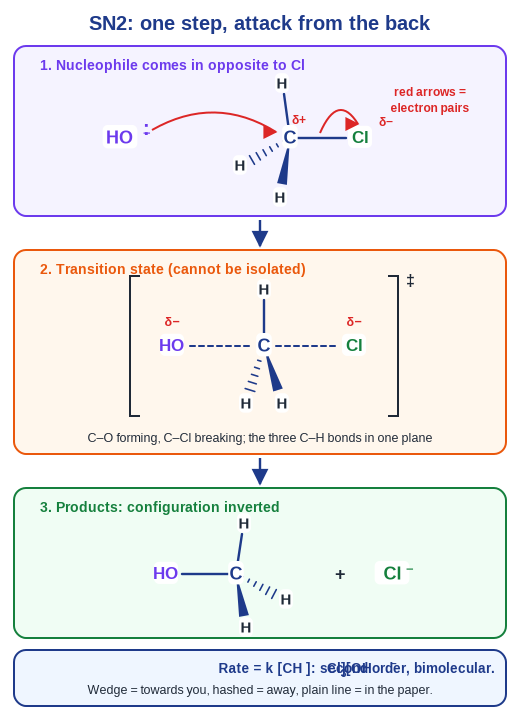
6.15 “Write the mechanism of the following reaction: nBuBr + KCN (EtOH-H₂O) → nBuCN”
n-Butyl bromide is a primary halide, so the reaction goes by SN2. KCN is ionic and supplies CN⁻ ions in solution, which attack through carbon.
- The cyanide ion approaches C-1 from the side opposite to Br.
- In one step the C–C bond forms as the C–Br bond breaks. In the transition state carbon is partly bonded to both: [NC···CH₂(C₃H₇)···Br]⁻, with the C₃H₇ group and the two H atoms in one plane.
- Br⁻ leaves and pentanenitrile forms, with inversion at C-1 (not visible here because C-1 is not a stereocentre).
CH₃CH₂CH₂CH₂Br + CN⁻ → CH₃CH₂CH₂CH₂CN + Br⁻; rate = k[nBuBr][CN⁻].
6.16 “Arrange the compounds of each set in order of reactivity towards SN2 displacement: (i) 2-Bromo-2-methylbutane, 1-Bromopentane, 2-Bromopentane (ii) 1-Bromo-3-methylbutane, 2-Bromo-2-methylbutane, 2-Bromo-3-methylbutane (iii) 1-Bromobutane, 1-Bromo-2,2-dimethylpropane, 1-Bromo-2-methylbutane, 1-Bromo-3-methylbutane.”
(i) 1-bromopentane (1°) > 2-bromopentane (2°) > 2-bromo-2-methylbutane (3°).
(ii) 1-bromo-3-methylbutane (1°) > 2-bromo-3-methylbutane (2°) > 2-bromo-2-methylbutane (3°).
(iii) 1-bromobutane > 1-bromo-3-methylbutane > 1-bromo-2-methylbutane > 1-bromo-2,2-dimethylpropane. All four are primary; the closer a branch is to the carbon carrying Br, and the more branches there are, the more the back side is crowded.
6.17 “Out of C₆H₅CH₂Cl and C₆H₅CHClC₆H₅, which is more easily hydrolysed by aqueous KOH.”
C₆H₅CHClC₆H₅. Both are benzylic halides and hydrolyse readily by the SN1 path. The carbocation (C₆H₅)₂CH⁺ is stabilised by resonance with two phenyl rings, while C₆H₅CH₂⁺ has only one, so the first forms faster (compare Example 6.7).
6.18 “p-Dichlorobenzene has higher m.p. than those of o- and m-isomers. Discuss.”
The three isomers have nearly the same boiling point, because their intermolecular forces in the liquid are similar. Melting depends on how well the molecules pack in the solid. The para isomer is symmetrical and fits into the crystal lattice better, so more energy is needed to break the lattice and it melts at a higher temperature.
Exercises 6.19 to 6.22: conversions and what happens
6.19 “How the following conversions can be carried out? (i) Propene to propan-1-ol (ii) Ethanol to but-1-yne (iii) 1-Bromopropane to 2-bromopropane (iv) Toluene to benzyl alcohol (v) Benzene to 4-bromonitrobenzene (vi) Benzyl alcohol to 2-phenylethanoic acid (vii) Ethanol to propanenitrile (viii) Aniline to chlorobenzene (ix) 2-Chlorobutane to 3, 4-dimethylhexane (x) 2-Methyl-1-propene to 2-chloro-2-methylpropane (xi) Ethyl chloride to propanoic acid (xii) But-1-ene to n-butyliodide (xiii) 2-Chloropropane to 1-propanol (xiv) Isopropyl alcohol to iodoform (xv) Chlorobenzene to p-nitrophenol (xvi) 2-Bromopropane to 1-bromopropane (xvii) Chloroethane to butane (xviii) Benzene to diphenyl (xix) tert-Butyl bromide to isobutyl bromide (xx) Aniline to phenylisocyanide”
(i) CH₃CH=CH₂ + HBr → CH₃CH₂CH₂Br (peroxide); CH₃CH₂CH₂Br + KOH → CH₃CH₂CH₂OH + KBr (aqueous).
(ii) Same as Exercise 6.11 (i).
(iii) CH₃CH₂CH₂Br + KOH → CH₃CH=CH₂ + KBr + H₂O (alcoholic); CH₃CH=CH₂ + HBr → CH₃CH(Br)CH₃ (no peroxide, Markovnikov).
(iv) Same as Exercise 6.11 (iv).
(v) Brominate first, because Br directs to ortho and para (a nitro group would direct to meta): C₆H₆ + Br₂ → C₆H₅Br + HBr (Fe); C₆H₅Br + HNO₃ → BrC₆H₄NO₂ + H₂O (conc. H₂SO₄). The para isomer is the major product and is separated from the ortho one.
(vi) C₆H₅CH₂OH + SOCl₂ → C₆H₅CH₂Cl + SO₂ + HCl; C₆H₅CH₂Cl + KCN → C₆H₅CH₂CN + KCl; acid hydrolysis of the nitrile: C₆H₅CH₂CN + 2H₂O + H⁺ → C₆H₅CH₂COOH + NH₄⁺.
(vii) CH₃CH₂OH + SOCl₂ → CH₃CH₂Cl + SO₂ + HCl; CH₃CH₂Cl + KCN → CH₃CH₂CN + KCl.
(viii) Diazotise at 273–278 K, then Sandmeyer: C₆H₅NH₂ + NaNO₂ + 2HCl → C₆H₅N₂⁺Cl⁻ + NaCl + 2H₂O; C₆H₅N₂⁺Cl⁻ → C₆H₅Cl + N₂ (Cu₂Cl₂).
(ix) Wurtz reaction: 2CH₃CH(Cl)CH₂CH₃ + 2Na → CH₃CH₂CH(CH₃)CH(CH₃)CH₂CH₃ + 2NaCl (dry ether). The two sec-butyl groups join at their C-2 atoms, which become C-3 and C-4 of hexane.
(x) (CH₃)₂C=CH₂ + HCl → (CH₃)₃CCl (Markovnikov).
(xi) CH₃CH₂Cl + KCN → CH₃CH₂CN + KCl; CH₃CH₂CN + 2H₂O + H⁺ → CH₃CH₂COOH + NH₄⁺.
(xii) CH₃CH₂CH=CH₂ + HBr → CH₃CH₂CH₂CH₂Br (peroxide); CH₃CH₂CH₂CH₂Br + NaI → CH₃CH₂CH₂CH₂I + NaBr (dry acetone).
(xiii) CH₃CH(Cl)CH₃ + KOH → CH₃CH=CH₂ + KCl + H₂O (alcoholic); CH₃CH=CH₂ + HBr → CH₃CH₂CH₂Br (peroxide); CH₃CH₂CH₂Br + KOH → CH₃CH₂CH₂OH + KBr (aqueous).
(xiv) Warm with iodine and sodium hydroxide (the iodoform reaction of CH₃CH(OH)– compounds, studied with alcohols and carbonyl compounds): CH₃CH(OH)CH₃ + 4I₂ + 6NaOH → CHI₃ + CH₃COONa + 5NaI + 5H₂O. Yellow iodoform separates.
(xv) C₆H₅Cl + HNO₃ → ClC₆H₄NO₂ + H₂O (conc. H₂SO₄; separate the para isomer); ClC₆H₄NO₂ + 2NaOH → NaOC₆H₄NO₂ + NaCl + H₂O (443 K); NaOC₆H₄NO₂ + HCl → HOC₆H₄NO₂ + NaCl.
(xvi) CH₃CH(Br)CH₃ + KOH → CH₃CH=CH₂ + KBr + H₂O (alcoholic); CH₃CH=CH₂ + HBr → CH₃CH₂CH₂Br (peroxide).
(xvii) Wurtz reaction: 2CH₃CH₂Cl + 2Na → CH₃CH₂CH₂CH₃ + 2NaCl (dry ether).
(xviii) Same as Exercise 6.11 (x).
(xix) (CH₃)₃CBr + KOH → (CH₃)₂C=CH₂ + KBr + H₂O (alcoholic); (CH₃)₂C=CH₂ + HBr → (CH₃)₂CHCH₂Br (peroxide).
(xx) Carbylamine reaction (studied in Unit 9): warm aniline with chloroform and alcoholic KOH. C₆H₅NH₂ + CHCl₃ + 3KOH → C₆H₅NC + 3KCl + 3H₂O. Phenyl isocyanide has a very unpleasant smell; this is a teacher-only test.
6.20 “The treatment of alkyl chlorides with aqueous KOH leads to the formation of alcohols but in the presence of alcoholic KOH, alkenes are major products. Explain.”
In water KOH gives OH⁻ ions that are strongly hydrated. They act mainly as a nucleophile and replace Cl: RCl + KOH → ROH + KCl. In alcohol the solution contains alkoxide ions, C₂H₅OH + OH⁻ ⇌ C₂H₅O⁻ + H₂O, which are stronger bases than OH⁻ and are not held back by hydration. A strong base removes a β-hydrogen, so elimination wins and an alkene is the main product: CH₃CH₂CH₂Cl + KOH → CH₃CH=CH₂ + KCl + H₂O.
6.21 “Primary alkyl halide C₄H₉Br (a) reacted with alcoholic KOH to give compound (b). Compound (b) is reacted with HBr to give (c) which is an isomer of (a). When (a) is reacted with sodium metal it gives compound (d), C₈H₁₈ which is different from the compound formed when n-butyl bromide is reacted with sodium. Give the structural formula of (a) and write the equations for all the reactions.”
The primary isomers of C₄H₉Br are n-butyl bromide and isobutyl bromide. Since (d) differs from the Wurtz product of n-butyl bromide, (a) is isobutyl bromide, (CH₃)₂CHCH₂Br (1-bromo-2-methylpropane).
- (a) → (b): (CH₃)₂CHCH₂Br + KOH → (CH₃)₂C=CH₂ + KBr + H₂O (alcoholic); (b) is 2-methylpropene.
- (b) → (c): (CH₃)₂C=CH₂ + HBr → (CH₃)₃CBr; (c) is 2-bromo-2-methylpropane, an isomer of (a).
- (a) → (d): 2(CH₃)₂CHCH₂Br + 2Na → (CH₃)₂CHCH₂CH₂CH(CH₃)₂ + 2NaBr; (d) is 2,5-dimethylhexane, C₈H₁₈.
- For comparison, n-butyl bromide gives n-octane: 2CH₃CH₂CH₂CH₂Br + 2Na → CH₃(CH₂)₆CH₃ + 2NaBr.
6.22 “What happens when (i) n-butyl chloride is treated with alcoholic KOH, (ii) bromobenzene is treated with Mg in the presence of dry ether, (iii) chlorobenzene is subjected to hydrolysis, (iv) ethyl chloride is treated with aqueous KOH, (v) methyl bromide is treated with sodium in the presence of dry ether, (vi) methyl chloride is treated with KCN?”
(i) Elimination gives but-1-ene: CH₃CH₂CH₂CH₂Cl + KOH → CH₃CH₂CH=CH₂ + KCl + H₂O.
(ii) A Grignard reagent, phenylmagnesium bromide, forms: C₆H₅Br + Mg → C₆H₅MgBr.
(iii) Chlorobenzene resists hydrolysis. With NaOH at 623 K and 300 atm it gives sodium phenoxide, and acid then gives phenol: C₆H₅Cl + 2NaOH → C₆H₅ONa + NaCl + H₂O; C₆H₅ONa + HCl → C₆H₅OH + NaCl.
(iv) Substitution gives ethanol: CH₃CH₂Cl + KOH → CH₃CH₂OH + KCl.
(v) Wurtz reaction gives ethane: 2CH₃Br + 2Na → CH₃CH₃ + 2NaBr.
(vi) Substitution gives ethanenitrile (methyl cyanide): CH₃Cl + KCN → CH₃CN + KCl.
Intext Questions
Intext 6.1 (page 163): structures of five named halides.
(i) 2-chloro-3-methylpentane: CH₃CH(Cl)CH(CH₃)CH₂CH₃. (ii) 1-chloro-4-ethylcyclohexane: a cyclohexane ring with Cl on C-1 and C₂H₅ on C-4. (iii) 4-tert-butyl-3-iodoheptane: CH₃CH₂CH(I)CH(C(CH₃)₃)CH₂CH₂CH₃. (iv) 1,4-dibromobut-2-ene: BrCH₂CH=CHCH₂Br. (v) 1-bromo-4-sec-butyl-2-methylbenzene: a ring with Br on C-1, CH₃ on C-2 and CH(CH₃)CH₂CH₃ on C-4. These match the book’s answers on page 191.
Intext 6.2 (page 167): why sulphuric acid is not used with KI to turn an alcohol into an iodide.
H₂SO₄ turns KI into HI and then, being an oxidising acid, oxidises the HI to iodine, so no alkyl iodide forms: 2HI + H₂SO₄ → I₂ + SO₂ + 2H₂O. A non-oxidising acid, orthophosphoric acid, is used instead.
Intext 6.3 (page 167): all dihalogen derivatives of propane. With chlorine: ClCH₂CH₂CH₂Cl (1,3-dichloropropane), ClCH₂CH(Cl)CH₃ (1,2-dichloropropane), Cl₂CHCH₂CH₃ (1,1-dichloropropane) and CH₃CCl₂CH₃ (2,2-dichloropropane). The same four patterns apply to any halogen.
Intext 6.4 (page 167): which C₅H₁₂ isomer gives one, three or four monochlorides on photochemical chlorination.
(i) One: 2,2-dimethylpropane, C(CH₃)₄; all twelve H are equivalent. (ii) Three: pentane, CH₃CH₂CH₂CH₂CH₃; three kinds of H (C-1/C-5, C-2/C-4, C-3). (iii) Four: 2-methylbutane, (CH₃)₂CHCH₂CH₃; four kinds of H.
Intext 6.5 (page 167): major monohalo products of six reactions.
| Reaction | Major product | |
|---|---|---|
| (i) | cyclohexanol + SOCl₂ | chlorocyclohexane, C₆H₁₁Cl |
| (ii) | 1-ethyl-4-nitrobenzene + Br₂ (heat or UV) | 1-(1-bromoethyl)-4-nitrobenzene, O₂NC₆H₄CH(Br)CH₃: the benzylic H is replaced |
| (iii) | 4-(hydroxymethyl)phenol + HCl, heat | 4-(chloromethyl)phenol, HOC₆H₄CH₂Cl: only the alcoholic –OH is replaced, not the phenolic one |
| (iv) | 1-methylcyclohexene + HI | 1-iodo-1-methylcyclohexane: I goes to the ring carbon that carries CH₃ (Markovnikov) |
| (v) | CH₃CH₂Br + NaI | iodoethane, CH₃CH₂I (Finkelstein) |
| (vi) | cyclohexene + Br₂ (heat or UV) | 3-bromocyclohexene: the allylic H is replaced |
Intext 6.6 (page 169): order of increasing boiling point.
(i) chloromethane < bromomethane < dibromomethane < bromoform: the molecular mass rises. (ii) isopropyl chloride < 1-chloropropane < 1-chlorobutane: the branched isomer boils lower than its straight-chain isomer, and the larger molecule boils highest.
Intext 6.7 (page 186): which halide of each pair reacts faster by SN2.
(i) CH₃CH₂CH₂CH₂Br (1°) rather than 2-bromobutane (2°): less crowding. (ii) 2-bromobutane (2°) rather than 2-bromo-2-methylpropane (3°). (iii) 1-bromo-3-methylbutane, (CH₃)₂CHCH₂CH₂Br, rather than 1-bromo-2-methylbutane, CH₃CH₂CH(CH₃)CH₂Br: the methyl branch in the second is nearer the reacting carbon.
Intext 6.8 (page 186): which halide of each pair reacts faster by SN1.
(i) 2-chloro-2-methylpropane (3°) rather than 3-chloropentane (2°): the 3° carbocation is more stable. (ii) 2-chloroheptane (2°) rather than 1-chlorohexane (1°): a 2° carbocation is more stable than a 1° one.
Intext 6.9 (page 186): identify A, B, C, D, E, R and R¹.
- Bromocyclohexane + Mg (dry ether) gives A = cyclohexylmagnesium bromide, C₆H₁₁MgBr; water then gives B = cyclohexane, C₆H₁₂.
- R–Br + Mg gives C = RMgBr. With D₂O it gives CH₃CH(D)CH₃, so R = (CH₃)₂CH– (isopropyl) and C = (CH₃)₂CHMgBr: (CH₃)₂CHMgBr + D₂O → (CH₃)₂CHD + Mg(OD)Br.
- R¹–X with Na in ether gives 2,2,3,3-tetramethylbutane, (CH₃)₃C–C(CH₃)₃, a Wurtz product, so R¹ = (CH₃)₃C– (tert-butyl). With Mg it gives D = (CH₃)₃CMgX, and water gives E = (CH₃)₃CH, 2-methylpropane.
In this question the book uses “D” both for deuterium (in D₂O and CH₃CH(D)CH₃) and for the compound D. They are different things; the answer above keeps them apart.
Worked examples
Example 6.1 (page 162): the eight structural isomers of C₅H₁₁Br, named and classified. 1-bromopentane (1°), 2-bromopentane (2°), 3-bromopentane (2°), 1-bromo-3-methylbutane (1°), 2-bromo-3-methylbutane (2°), 2-bromo-2-methylbutane (3°), 1-bromo-2-methylbutane (1°) and 1-bromo-2,2-dimethylpropane (1°).
Example 6.2 (page 163): IUPAC names of six bromoalkenes drawn as skeletons. (i) CH₃CH=CHCH(Br)CH₃, 4-bromopent-2-ene; (ii) CH₂=C(CH₃)CH(Br)CH₃, 3-bromo-2-methylbut-1-ene; (iii) CH₃CH=C(CH₃)CH(Br)CH₃, 4-bromo-3-methylpent-2-ene; (iv) CH₃CH=C(CH₃)CH₂Br, 1-bromo-2-methylbut-2-ene; (v) CH₃CH=CHCH₂Br, 1-bromobut-2-ene; (vi) CH₂=C(CH₃)CH₂Br, 3-bromo-2-methylpropene.
Example 6.3 (page 165): monochloro isomers from (CH₃)₂CHCH₂CH₃. Four kinds of H give four products: (CH₃)₂CHCH₂CH₂Cl, (CH₃)₂CHCH(Cl)CH₃, (CH₃)₂C(Cl)CH₂CH₃ and CH₃CH(CH₂Cl)CH₂CH₃.
Example 6.4 (page 167): products of three additions. (i) Styrene + HBr gives C₆H₅CH(Br)CH₃ (Br on the carbon next to the ring). (ii) But-1-ene + HCl gives CH₃CH₂CH(Cl)CH₃. (iii) 3-Phenylpropene + HBr with peroxide gives C₆H₅CH₂CH₂CH₂Br.
Example 6.5 (page 171): why KCN gives nitriles and AgCN gives isocyanides. KCN is mostly ionic and gives CN⁻ ions in solution, which attack mainly through carbon because the C–C bond so formed is more stable than a C–N bond would be. AgCN is mainly covalent; the carbon is tied to silver, so nitrogen donates its electron pair and an isocyanide forms.
Example 6.6 (page 174): which of each pair is faster in SN2. Chloromethylcyclohexane, a primary halide, reacts faster than chlorocyclohexane (secondary). Of two alkyl halides with the same chain, the iodide is faster than the chloride, because iodide is the better leaving group.
Example 6.7 (pages 174–175): order of SN1 and SN2 reactivity.
(i) SN1: CH₃CH₂CH₂CH₂Br < (CH₃)₂CHCH₂Br < CH₃CH₂CH(Br)CH₃ < (CH₃)₃CBr; SN2 is the reverse. (The book explains the first two by the stronger electron-donating effect of the (CH₃)₂CH– group.)
(ii) SN1: C₆H₅CH₂Br < C₆H₅CH(CH₃)Br < C₆H₅CH(C₆H₅)Br < C₆H₅C(CH₃)(C₆H₅)Br; SN2 is the reverse. Two phenyl rings stabilise a carbocation by resonance more than one phenyl and a methyl, and phenyl is a larger group than methyl.
Example 6.8 (pages 177–178): chiral or achiral? (i) The carbon carrying H, CH₃, Br and OH is chiral; the one carrying H, CH₃ and two Br is achiral. (ii) Pentan-2-ol, with H, OH, CH₃ and C₃H₇ on C-2, is chiral; pentan-3-ol, with two C₂H₅ groups on C-3, is achiral. (iii) 2-Bromobutane is chiral; 1-bromobutane is achiral.
Example 6.9 (page 185): why chlorine is o, p-directing though electron-withdrawing. Its −I effect destabilises the carbocation formed in electrophilic substitution and deactivates the ring. Its lone pairs, through resonance, stabilise the carbocation formed by attack at ortho and para positions. The stronger inductive effect controls the rate; resonance controls the orientation.
Go back to the chapter notes, or read: preparation of haloalkanes and haloarenes, SN1 and SN2 reactions and reactions of haloarenes.
Practice
-
The IUPAC name of CH₃CH(Cl)CH(CH₃)₂ is:
Show answer
Answer: (a) 2-chloro-3-methylbutane
-
Which gives a single monochloro product on chlorination in light?
Show answer
Answer: (c) 2,2-dimethylpropane
-
The major product of CH₃CH₂CH₂Br with alcoholic KOH is:
Show answer
Answer: (b) propene
-
Which reagent turns bromoethane into nitroethane as the main product?
Show answer
Answer: (b) AgNO₂
-
Give the structure of the alkene formed mainly from 2-bromo-2-methylbutane and alcoholic KOH.
Show answer
Answer: (CH₃)₂C=CHCH₃, 2-methylbut-2-ene. It has three alkyl groups on the double bond, against two in 2-methylbut-1-ene, so it is the Zaitsev product.
Stuck on a question?
Take a photo and Lagnever AI explains it step by step. Try it for 7 days for ₹2.
Get it on Google Play Open in browser
For parents: after the trial, the plan renews monthly by UPI or card autopay. You can cancel anytime in the app.