
Class 12 Chemistry Chapter 6: Haloalkanes and Haloarenes Notes
This chapter in five lines
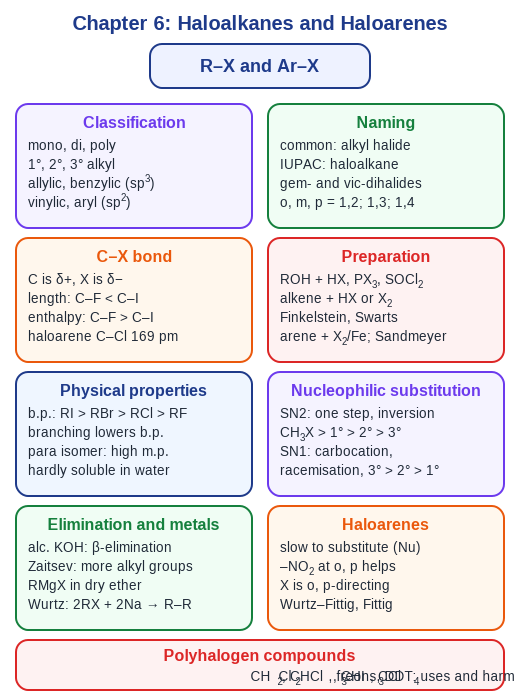
Haloalkanes (R–X) have a halogen on an sp³ carbon; haloarenes (Ar–X) have it on an sp² carbon of a benzene ring. The polar C–X bond makes haloalkanes react with nucleophiles by SN1 or SN2, lose HX to form alkenes, and form Grignard reagents. Haloarenes resist nucleophiles but undergo electrophilic substitution at ortho and para positions.
What is this chapter about?
Put a halogen in place of a hydrogen of a hydrocarbon and you get an organic halide. If the hydrocarbon part is an alkyl group the compound is a haloalkane (alkyl halide, R–X); if it is an aryl group, such as a benzene ring, it is a haloarene (aryl halide, Ar–X). The book gives some examples from medicine: the antibiotic chloramphenicol, the iodine-containing hormone thyroxine (its lack causes goitre), chloroquine for malaria and the anaesthetic halothane. Halides are also solvents and starting materials for many other compounds. This chapter, Unit 6 and the first unit of Chemistry Part II, is the first organic chemistry unit of Class 12.
How structures are written on this site. In the text we use condensed formulas: each carbon is written with its hydrogens, and a group in brackets hangs from the carbon just before it, so CH₃CH(Br)CH₃ is 2-bromopropane. A benzene ring is C₆H₅– (phenyl) or a hexagon in the drawings. In the drawings a plain line is a bond in the plane of the paper, a solid wedge comes towards you and a hashed wedge goes away from you. Red curved arrows show where an electron pair moves.
How are halides classified?
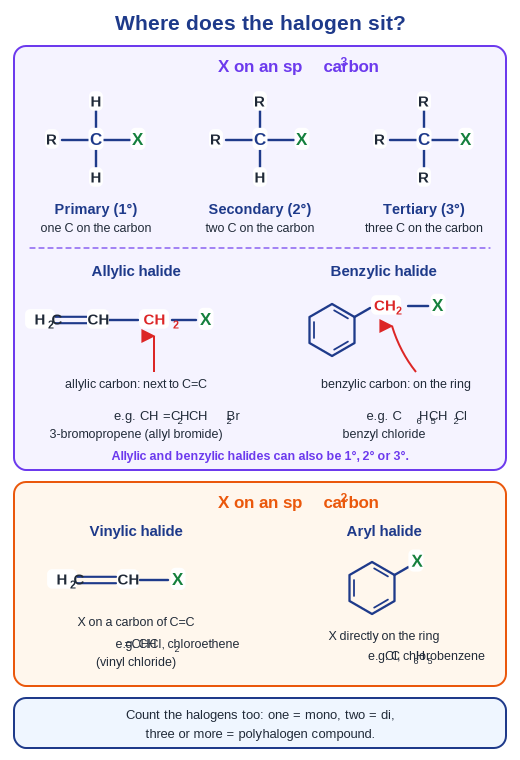
- By the number of halogen atoms: mono, di or polyhalogen compounds.
- Halogen on an sp³ carbon: alkyl halides (1°, 2° or 3°, by the number of carbons on the carbon carrying X), allylic halides (X on the carbon next to C=C) and benzylic halides (X on a carbon attached to a ring).
- Halogen on an sp² carbon: vinylic halides (X on a carbon of C=C) and aryl halides (X directly on the ring).
How are they named?
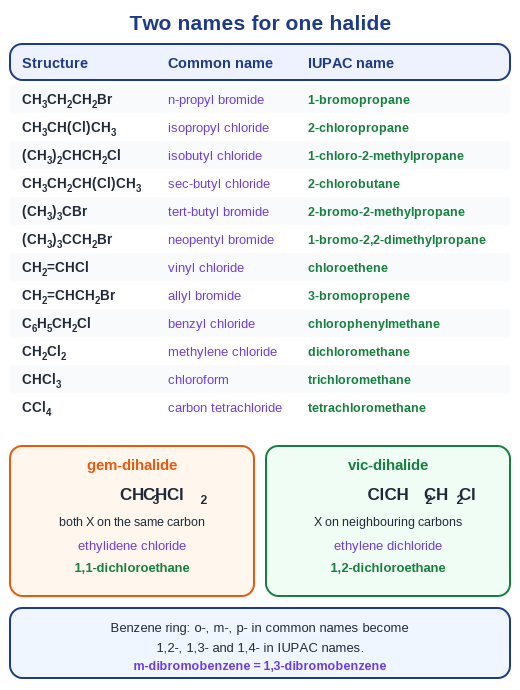
A common name names the alkyl group, then the halide: isopropyl chloride. The IUPAC name treats the halogen as a substituent on the parent hydrocarbon: 2-chloropropane. Number the longest chain so the substituents get the lowest locants; if there is a tie, the substituent that comes first in alphabetical order gets the lower number. For one halogen on benzene the two kinds of name coincide (bromobenzene). For two, common names use o-, m- and p-; IUPAC names use 1,2-, 1,3- and 1,4-.
A dihalide with both halogens on one carbon is a gem-dihalide (common name: alkylidene halide); one with them on neighbouring carbons is a vic-dihalide (alkylene dihalide). IUPAC calls both dihaloalkanes.
What is special about the C–X bond?
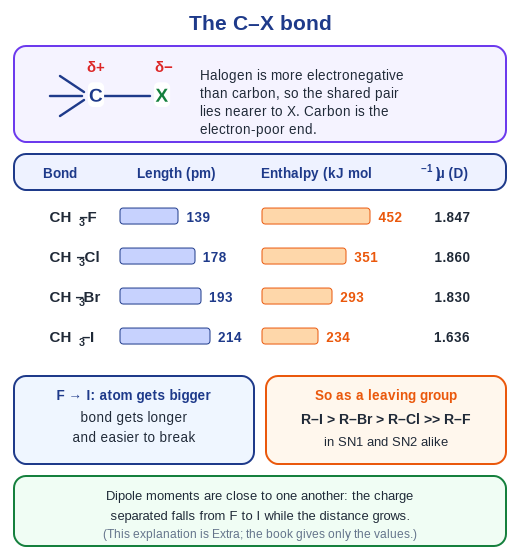
Halogens are more electronegative than carbon, so the C–X bond is polar: carbon is slightly positive (δ+) and the halogen slightly negative (δ−). Going down the group from F to I, the halogen atom gets bigger, the bond gets longer and its bond enthalpy falls.
How are haloalkanes and haloarenes prepared?
From alcohols. Strong halogen acids, phosphorus halides or SOCl₂ swap the –OH group for a halogen:
- ROH + HCl → RCl + H₂O (ZnCl₂ catalyst for 1° and 2° alcohols; a 3° alcohol only needs shaking with concentrated HCl at room temperature)
- 3ROH + PBr₃ → 3RBr + H₃PO₃; ROH + PCl₅ → RCl + POCl₃ + HCl
- ROH + SOCl₂ → RCl + SO₂ + HCl: preferred, because both by-products are gases and escape, leaving a pure halide.
With a halogen acid, 3° alcohols react fastest and 1° slowest: 3° > 2° > 1°. These methods do not work for phenols, whose C–O bond has partial double bond character.
From hydrocarbons. Free radical halogenation of alkanes gives a mixture that is hard to separate. Alkenes add HX (Markovnikov’s rule) or X₂; decolourising bromine in CCl₄ is a test for C=C.
By halogen exchange. Finkelstein: RCl + NaI → RI + NaCl in dry acetone, where NaCl precipitates and drives the reaction forward. Swarts: CH₃Br + AgF → CH₃F + AgBr.
Haloarenes. An arene reacts with Cl₂ or Br₂ in the presence of Fe or FeCl₃ (electrophilic substitution). An aromatic amine is turned into a diazonium salt and then into ArCl or ArBr with Cu₂Cl₂ or Cu₂Br₂ (Sandmeyer reaction), or into ArI with KI. Read how haloalkanes and haloarenes are prepared.
What are their physical properties?
- Pure alkyl halides are colourless; bromides and iodides colour on standing in light. CH₃Cl, CH₃Br and C₂H₅Cl are gases at room temperature.
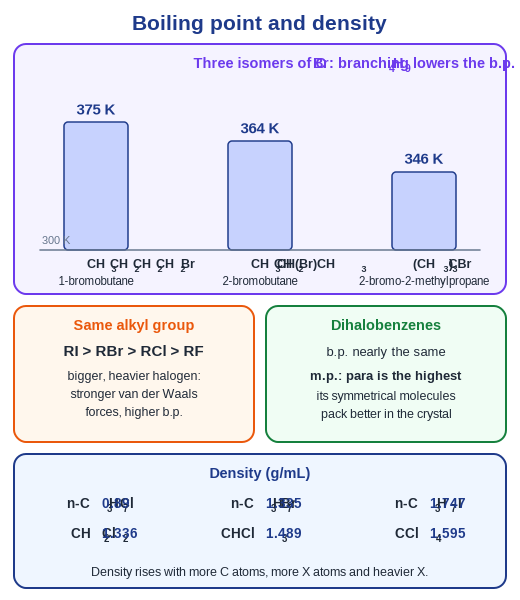
- Boiling points are higher than those of hydrocarbons of similar mass, because the molecules are polar and heavier. For the same alkyl group, RI > RBr > RCl > RF.
- Branching lowers the boiling point: 1-bromobutane 375 K, 2-bromobutane 364 K, 2-bromo-2-methylpropane 346 K.
- Isomeric dihalobenzenes have nearly the same boiling point, but the para isomer melts highest, because its symmetrical molecules fit the crystal better.
- Bromo, iodo and polychloro compounds are denser than water. Haloalkanes dissolve only slightly in water but well in organic solvents.
How do haloalkanes react with nucleophiles?
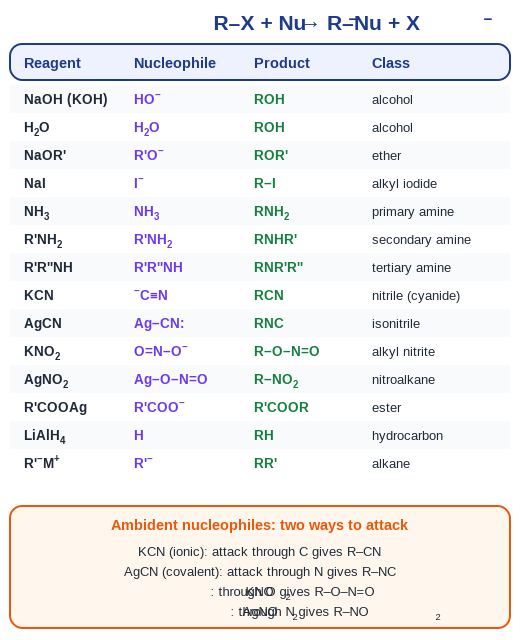
A nucleophile (Nu⁻) attacks the δ+ carbon and the halide leaves: R–X + Nu⁻ → R–Nu + X⁻. Hydroxide gives an alcohol, alkoxide an ether, ammonia an amine, cyanide a nitrile, and so on. Cyanide and nitrite are ambident: KCN gives mainly R–CN, AgCN gives R–NC; KNO₂ gives the alkyl nitrite R–O–N=O, AgNO₂ the nitroalkane R–NO₂.
There are two mechanisms.
- SN2 (substitution, nucleophilic, bimolecular): one step. The nucleophile attacks from the side opposite to the halogen while the C–X bond breaks. Rate = k[RX][Nu⁻]. Crowding slows it: CH₃X > 1° > 2° > 3°. A chiral halide gives a product with inverted configuration.
- SN1 (unimolecular): two steps. The C–X bond breaks slowly to give a carbocation, which the nucleophile then attacks quickly. Rate = k[RX]. Carbocation stability speeds it: 3° > 2° > 1°, and allylic and benzylic halides are fast. A chiral halide gives a racemic product, because the flat carbocation is attacked from both faces.
To follow the stereochemistry you need a few ideas: optical activity (rotation of plane polarised light, measured with a polarimeter), chirality (a molecule not superimposable on its mirror image, usually one with a carbon carrying four different groups), enantiomers, racemic mixtures, and retention and inversion of configuration. Read SN1 and SN2 reactions.
What are elimination and the reactions with metals?
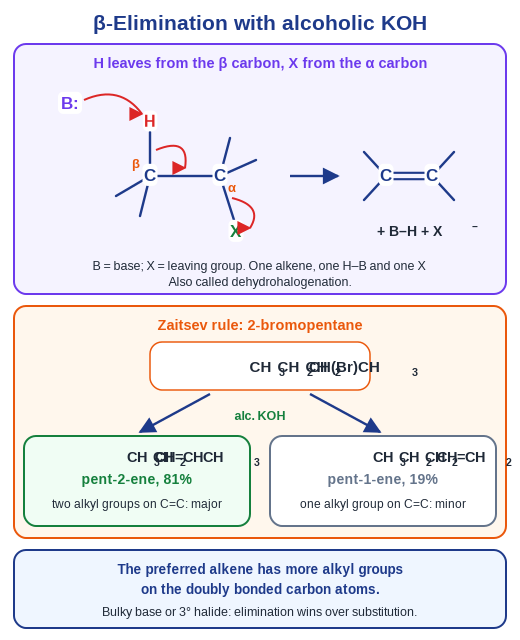
β-Elimination. Heated with alcoholic KOH, a haloalkane with a β-hydrogen loses HX and gives an alkene. When two alkenes can form, the Zaitsev rule says the one with more alkyl groups on the double bond is the main product: 2-bromopentane gives pent-2-ene (81%) and pent-1-ene (19%). A bulky base and a 3° halide favour elimination; a 1° halide favours SN2.
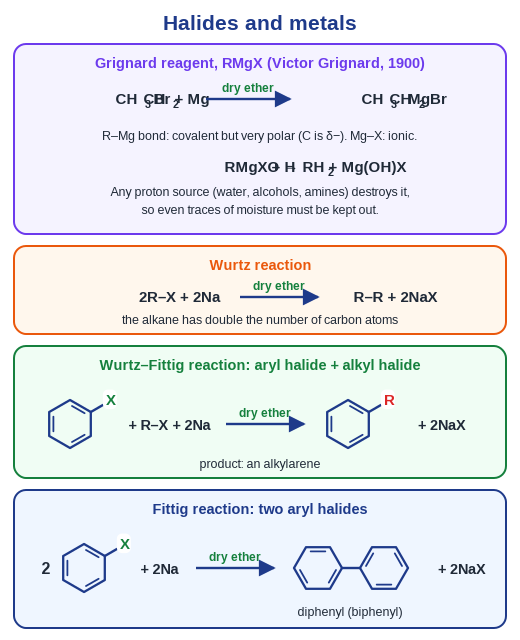
Metals. With magnesium in dry ether a halide gives a Grignard reagent, CH₃CH₂Br + Mg → CH₃CH₂MgBr. Its C–Mg bond is very polar, so it reacts with any source of protons: RMgX + H₂O → RH + Mg(OH)X. That is why it must be made under strictly dry conditions. In the Wurtz reaction, 2RX + 2Na → R–R + 2NaX in dry ether, the alkane formed has twice as many carbon atoms.
How do haloarenes react?
Haloarenes are much less reactive towards nucleophiles than haloalkanes. Resonance gives the C–Cl bond partial double bond character, the sp² carbon holds the bond pair more tightly (C–Cl is 169 pm in chlorobenzene against 177 pm in a haloalkane), the phenyl cation is not stabilised (so no SN1), and the electron-rich ring repels nucleophiles. Chlorobenzene gives phenol only with NaOH at 623 K and 300 atm. Nitro groups at the ortho and para positions make the change much easier.
Haloarenes do undergo electrophilic substitution: halogenation, nitration, sulphonation and Friedel–Crafts reactions. The halogen slightly deactivates the ring (its –I effect) but directs the new group to the ortho and para positions (resonance); the para product is the major one. With sodium in dry ether they give the Wurtz–Fittig reaction (aryl + alkyl halide) and the Fittig reaction (two aryl halides give diphenyl). Read reactions of haloarenes.
What are polyhalogen compounds used for, and why are some harmful?
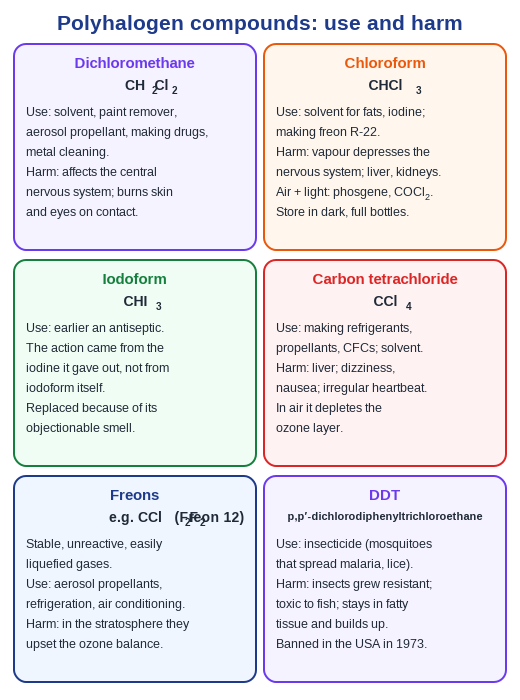
- Dichloromethane (CH₂Cl₂): solvent and paint remover; it harms the central nervous system and burns the skin and eyes on contact.
- Chloroform (CHCl₃): solvent, and used to make the refrigerant R-22. Air and light slowly oxidise it to the very poisonous gas phosgene (COCl₂), so it is kept in closed, dark bottles filled to the top.
- Iodoform (CHI₃): once an antiseptic, because of the iodine it gives out; replaced because of its smell.
- Carbon tetrachloride (CCl₄): used to make refrigerants, propellants and chlorofluorocarbons. It can damage the liver, and in the air it depletes the ozone layer.
- Freons such as Freon 12 (CCl₂F₂): very stable gases for refrigeration and aerosols that drift unchanged into the stratosphere and upset the ozone balance.
- DDT: an insecticide against malaria mosquitoes and lice. Insects became resistant, it is toxic to fish, and it builds up in fatty tissue because animals break it down slowly.
Stay safe
The chapter describes chloroform, carbon tetrachloride and other halides as harmful. Prepare or handle any halide only in the school laboratory with your teacher, never at home, and never taste or sniff a chemical.
Before we move on
Three skills carry this chapter: naming a halide from its condensed formula, choosing between SN1, SN2 and elimination for a given halide and reagent, and planning a conversion in two or three steps. Every exercise, Intext Question and worked example of the unit is answered in the NCERT solutions for Chapter 6.
Key terms
| Term | Meaning |
|---|---|
| Haloalkane and haloarene | A haloalkane (alkyl halide, R–X) has a halogen on an sp³ carbon of an alkyl group. A haloarene (aryl halide, Ar–X) has it on an sp² carbon of an aromatic ring. |
| 1°, 2° and 3° alkyl halide | The halogen sits on a carbon bonded to one, two or three other carbon atoms: CH₃CH₂Br is 1°, (CH₃)₂CHBr is 2°, (CH₃)₃CBr is 3°. |
| Allylic, benzylic and vinylic halide | Allylic: X on an sp³ carbon next to C=C. Benzylic: X on an sp³ carbon attached to a benzene ring. Vinylic: X on an sp² carbon of C=C. |
| gem- and vic-dihalide | Both halogens on the same carbon (gem, as in CH₃CHCl₂) or on neighbouring carbons (vic, as in ClCH₂CH₂Cl). |
| Nucleophile and leaving group | A nucleophile is an electron-rich species that attacks an electron-poor carbon. The group that departs with the bond pair, here the halide ion, is the leaving group. |
| Ambident nucleophile | A nucleophile that can attack through either of two atoms: cyanide through C or N, nitrite through O or N. |
| SN2 and SN1 | SN2: one step, rate depends on both reactants, inversion of configuration. SN1: two steps through a carbocation, rate depends on the halide only, racemisation. |
| Chiral and enantiomers | A chiral molecule cannot be superimposed on its mirror image. The two mirror-image forms are enantiomers; they rotate plane polarised light equally but in opposite directions. |
| Racemic mixture | An equal mixture of two enantiomers, written (±) or dl. Its optical rotation is zero. |
| β-Elimination | Loss of H from the β carbon and X from the α carbon, giving an alkene. Also called dehydrohalogenation. |
| Zaitsev rule | In dehydrohalogenation the main alkene is the one with more alkyl groups on the doubly bonded carbon atoms. |
| Grignard reagent | An alkyl or aryl magnesium halide, RMgX, made from a halide and magnesium in dry ether. It reacts with any proton source to give RH. |
Topics in this chapter
Practice
-
The IUPAC name of (CH₃)₃CBr is:
Show answer
Answer: (c) 2-bromo-2-methylpropane
-
Which reagent turns an alcohol into an alkyl chloride with only gaseous by-products?
Show answer
Answer: (c) SOCl₂
-
Which alkyl halide reacts fastest by the SN2 mechanism?
Show answer
Answer: (d) CH₃Br
-
Hydrolysis of optically active 2-bromobutane by the SN1 path gives:
Show answer
Answer: (c) (±)-butan-2-ol
-
Chlorobenzene with Cl₂ and anhydrous FeCl₃ gives mainly:
Show answer
Answer: (b) 1,4-dichlorobenzene
Questions students ask
What are the main topics of Class 12 Chemistry Chapter 6?
Classification and naming of haloalkanes and haloarenes, the nature of the C–X bond, preparation from alcohols, alkanes, alkenes, halogen exchange, arenes and amines, physical properties, nucleophilic substitution by SN1 and SN2 with stereochemistry, elimination, reactions with metals, reactions of haloarenes, and the uses and harmful effects of polyhalogen compounds.
Is Haloalkanes and Haloarenes in the 2026-27 NCERT Class 12 Chemistry book?
Yes. It is Unit 6, the first unit of Chemistry Part II, the Class 12 textbook marked Reprint 2026-27, on pages 159 to 192. The book calls it a unit; here it is Chapter 6.
Why are haloalkanes more reactive than haloarenes towards nucleophiles?
In a haloarene the C–X bond is shorter and stronger: resonance gives it partial double bond character and the carbon is sp² hybridised. The phenyl cation is not stabilised, so SN1 is ruled out, and the electron-rich ring repels an incoming nucleophile.
How should I write structures in my answers?
Condensed formulas such as CH₃CH(Br)CH₃ are fine for most answers: write each carbon with its hydrogens and put a branch or a substituent in brackets after the carbon that carries it. Draw wedge and hashed bonds only when the question is about configuration, as in SN1 and SN2.
Stuck on a question?
Take a photo and Lagnever AI explains it step by step. Try it for 7 days for ₹2.
Get it on Google Play Open in browser
For parents: after the trial, the plan renews monthly by UPI or card autopay. You can cancel anytime in the app.