
Class 6 Maths Chapter 3: Number Play Notes
This chapter in five lines
Number Play shows that numbers do much more than count. They can carry information, like children saying how many of their neighbours are taller, and they hide patterns: supercells, digit sums, palindromes that read the same both ways, and Kaprekar's routine, which takes every 4-digit number with at least two different digits to 6174. Some problems that are easy to state, such as the Collatz conjecture, are still unsolved. The chapter also covers mental maths, estimation and winning strategies for games like 21.
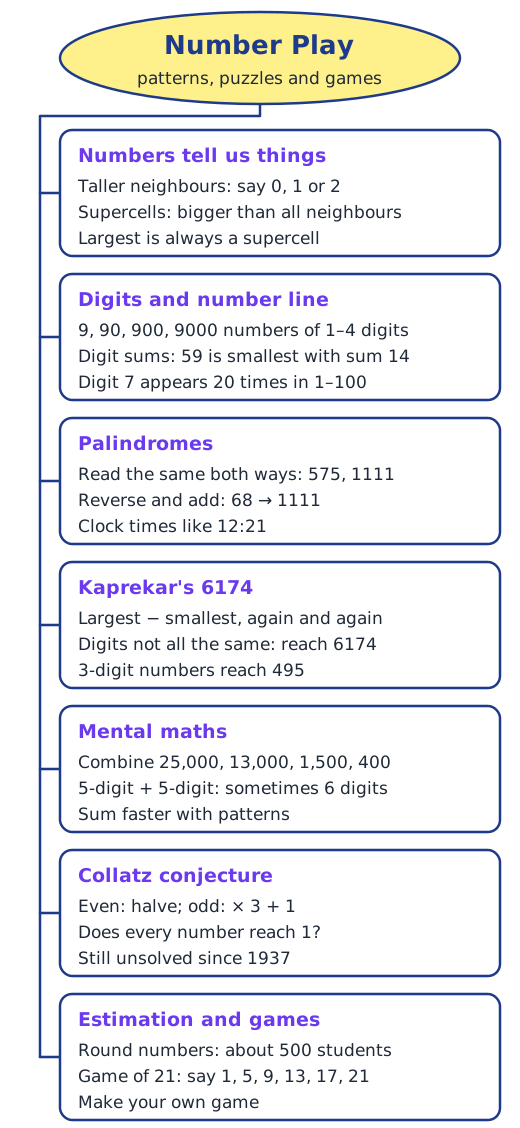
Numbers can tell us things
We use numbers for time, dates, money, marks, measurements and much more. The chapter starts with a puzzle: children of different heights stand in a line, and each says a number. The number is how many of their neighbours are taller than them. A child with two taller neighbours says 2, one taller neighbour 1, and none 0.
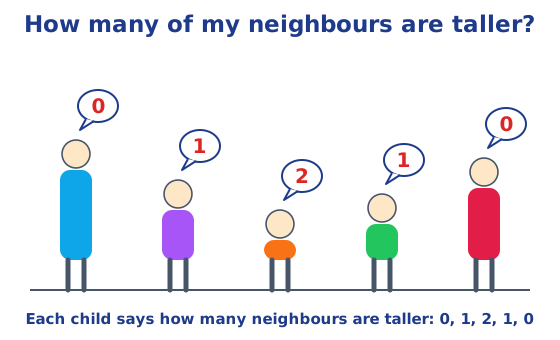
A child at either end has only one neighbour, so an end child can never say 2. The tallest child always says 0, and in a group of 5 children with different heights, at most 2 can say 2.
Supercells
A cell in a table is a supercell if its number is greater than the numbers in all its neighbouring cells. In a single row, the neighbours are the cells to the left and right; an end cell has only one neighbour.
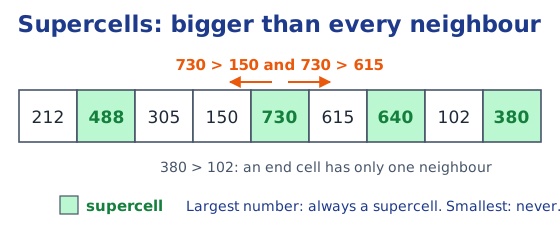
The cell with the largest number is always a supercell, and the cell with the smallest number can never be one. In a row of n cells, at most half the cells (rounded up) can be supercells: fill them alternately, big, small, big. In a grid, the neighbours are the cells to the left, right, top and bottom. Look closely at the book’s Table 1: besides the coloured cells, 5785 in the bottom-left corner is also greater than both its neighbours (4580 and 1944), so by the rule it is a supercell too.
Digits and the number line
Placing numbers such as 2180, 2754 and 9590 on a number line from 1000 to 10,000 means finding the two thousands each lies between. Counting numbers by their digits gives a neat pattern:
| Digits | How many numbers |
|---|---|
| 1 | 9 (1–9) |
| 2 | 90 (10–99) |
| 3 | 900 (100–999) |
| 4 | 9,000 (1000–9999) |
| 5 | 90,000 (10,000–99,999) |
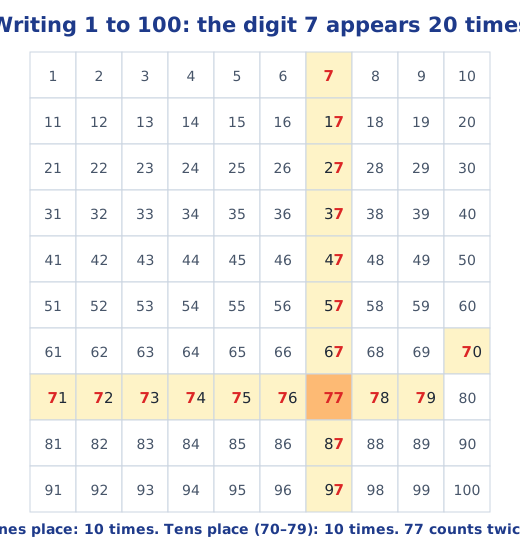
The digit sum of a number is the sum of its digits: 68, 176 and 545 all have digit sum 14. The smallest number with digit sum 14 is 59, and the largest 5-digit one is 95,000. In Digit Detectives, Dinesh writes 1 to 100: the digit 7 appears 20 times, and from 1 to 1000 it appears 300 times.
Palindromes
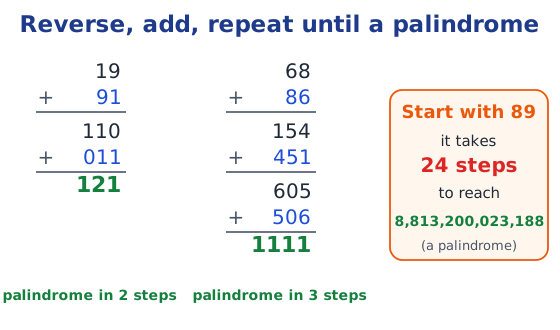
Numbers such as 66, 848, 575, 797 and 1111 read the same from left to right and from right to left. They are palindromes. Adding a 2-digit number to its reverse, and repeating, always ends in a palindrome: 68 + 86 = 154, 154 + 451 = 605, 605 + 506 = 1111. Read more in palindromic numbers.
Kaprekar’s magic number
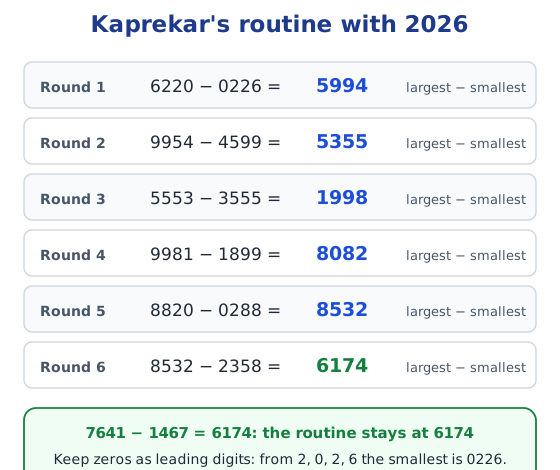
D. R. Kaprekar, a mathematics teacher in Devlali, Maharashtra, found this in 1949. Take a 4-digit number with at least two different digits. Make the largest number from its digits and the smallest, and subtract. Repeat with the answer. You always reach 6174, the Kaprekar constant, and it then repeats, since 7641 − 1467 = 6174. For 3-digit numbers, the routine reaches 495. Read more in Kaprekar’s routine and 6174.
Clock and calendar numbers
Some clock times have patterns: 4:44 (all digits the same), 10:10 (the hour repeated as minutes) and 12:21 (a palindrome). Dates can play too: Manish’s birthday, 20/12/2012, repeats the digits 2, 0, 1, 2, and Meghana’s, 11/02/2011, reads the same both ways. A year’s calendar does come back: a year that is not a leap year repeats after 6 or 11 years (2026’s calendar returns in 2037), and a leap year after 28 years.
Mental maths
To make a number from given parts, think in big, easy chunks: 38,800 = 25,000 + 13,000 + 400 + 400, and 3,400 = 1,500 + 1,500 + 400. Some sums are impossible: with 400 as the only part below 1,000, you cannot make 1,000. Reasoning about sizes helps too: a 4-digit number plus a 2-digit number is at most 9,999 + 99 = 10,098, so it can never have 6 digits, while two 5-digit numbers sometimes add up to a 6-digit number.
For patterns of repeated numbers, multiply instead of adding one by one: twelve 40s and ten 50s make 480 + 500 = 980.
An unsolved mystery: the Collatz conjecture
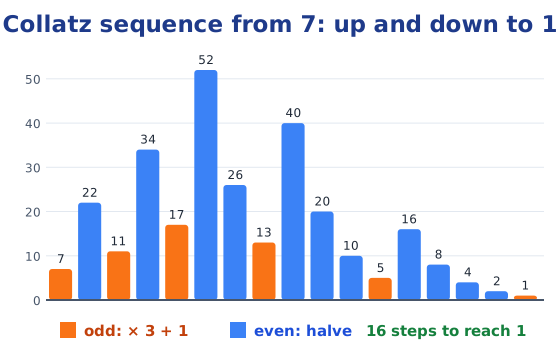
Start with any whole number. If it is even, halve it; if it is odd, multiply it by 3 and add 1. Repeat. In 1937, the German mathematician Lothar Collatz guessed that you always reach 1. It has never been proved, so it is still one of the most famous unsolved problems in mathematics. Read more in the Collatz conjecture.
Simple estimation
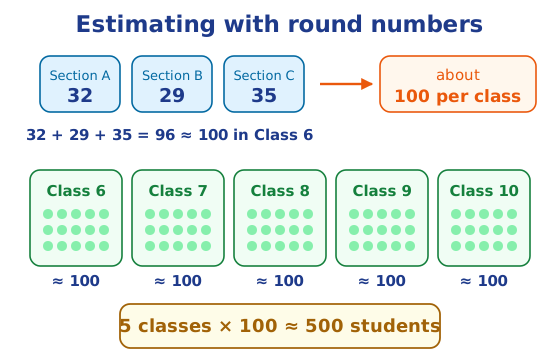
Often an exact count is not needed. Paromita’s class has three sections of 32, 29 and 35 children, about 100 in all. With five classes (6 to 10) of three sections each, she estimates about 500 students in her school. Read more in how to estimate numbers.
Games and winning strategies
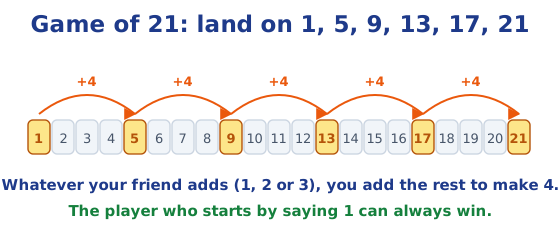
In the game of 21, two players take turns adding 1, 2 or 3, starting from the first player’s 1, 2 or 3, and whoever says 21 wins. The winning numbers are 21, 17, 13, 9, 5 and 1, each 4 apart. The first player says 1, and whatever the other adds, adds the rest to make 4. In the second game (add 1 to 10, reach 99), the key numbers are 11, 22, 33, …, 99, and the second player can always win.
Answers to every question are in the NCERT solutions for Chapter 3.
Key terms
| Term | Meaning |
|---|---|
| Supercell | A cell whose number is greater than the numbers in all its neighbouring cells: left and right in a row, and also above and below in a grid. |
| Digit sum | The sum of the digits of a number. 68, 176 and 545 all have the digit sum 14. |
| Palindrome | A number that reads the same from left to right and from right to left, such as 66, 848 and 1111; also called a palindromic number. |
| Reverse-and-add | Adding a number to its reverse again and again until a palindrome appears, as in 68 → 154 → 605 → 1111. |
| Kaprekar constant | The number 6174. Subtracting the smallest number made from the digits of a 4-digit number from the largest, again and again, always leads to it. |
| D. R. Kaprekar | A mathematics teacher in a government school in Devlali, Maharashtra, who discovered the 6174 routine in 1949. |
| Collatz conjecture | The guess, made by Lothar Collatz in 1937, that halving even numbers and turning odd numbers into 3 × n + 1 always reaches 1. Nobody has proved it yet. |
| Estimate | A sensible, rounded answer when an exact count is not needed, such as about 500 students in a school. |
| Winning strategy | A plan that lets a player always win a game if they play correctly, such as saying 1, 5, 9, 13, 17 and 21 in the game of 21. |
| Computational thinking | Thinking about and setting up step-by-step procedures to use numbers for a purpose, like Kaprekar's routine or a game strategy. |
Topics in this chapter
Practice
-
Which of these numbers is a palindrome?
Show answer
Answer: (b) 4554
-
Kaprekar's routine on a 4-digit number whose digits are not all the same always ends at:
Show answer
Answer: (c) 6174
-
In a Collatz sequence, which number comes after 7?
Show answer
Answer: (b) 22
-
How many 3-digit numbers are there?
Show answer
Answer: (b) 900
-
In a row of different numbers, which cell is always a supercell?
Show answer
Answer: (c) The cell with the largest number
Questions students ask
What are the main topics of Class 6 Maths Chapter 3?
Numbers that carry information, supercells, numbers on the number line, digits and digit sums, palindromes, Kaprekar's constant 6174, clock and calendar numbers, mental maths, number patterns, the Collatz conjecture, estimation, and winning strategies in games.
Is Number Play in the new Ganita Prakash book?
Yes. Number Play is Chapter 3 of Ganita Prakash, the Class 6 Maths textbook (Reprint 2026-27). It comes after Chapter 2, Lines and Angles.
How many questions does Chapter 3 have?
Each section has its own questions and puzzles, and the Figure it Out at the end of the chapter has 10 more. Our NCERT solutions page answers all of them, including the number-pattern sums that NCERT's answer key leaves out.
Stuck on a question?
Take a photo and Lagnever AI explains it step by step. Try it for 7 days for ₹2.
Get it on Google Play Open in browser
For parents: after the trial, the plan renews monthly by UPI or card autopay. You can cancel anytime in the app.